Why in News?
India successfully test-fired the short-range ballistic missile ‘Agni-1’ from the Integrated Test Range at Chandipur, Odisha. The launch validated all operational and technical parameters. The test was carried out under the aegis of the Strategic Forces Command.
| UPSC Relevance: GS-3 Science and Technology: Defence Technology Prelims: Agni series, MIRV, Ballistic vs Cruise Missile |
Agni-1 Ballistic Missile:
- The Agni-1 is a nuclear-capable, surface-to-surface short-range ballistic missile (SRBM).
- Indigenously developed by DRDO (Defence Research and Development Organisation) under India’s Integrated Guided Missile Development Programme.
- The missile has a range of 700km to 1200km, and is capable of carrying both conventional and nuclear warheads. It is designed for quick deployment and high mobility.
- Propelled by: Single-stage solid-fuel rocket
- Guidance: Advanced inertial navigation system with high accuracy.
- It is designed to be road-mobile via specialised transporter erector launchers and can also be launched from rail-based platforms.
The successful launch marks another milestone in India’s strategic defence preparedness and reinforces the credibility of the country’s minimum credible deterrence capability.
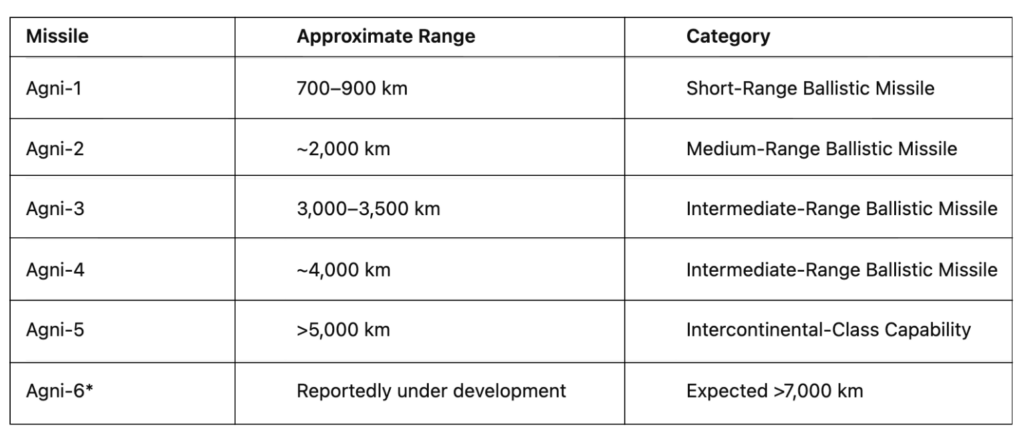
Agni Missile Series:
The Agni series comprises nuclear-capable surface-to-surface ballistic missile systems with varying strike ranges. The Agni series includes:
Agni-5 and MIRV Technology:
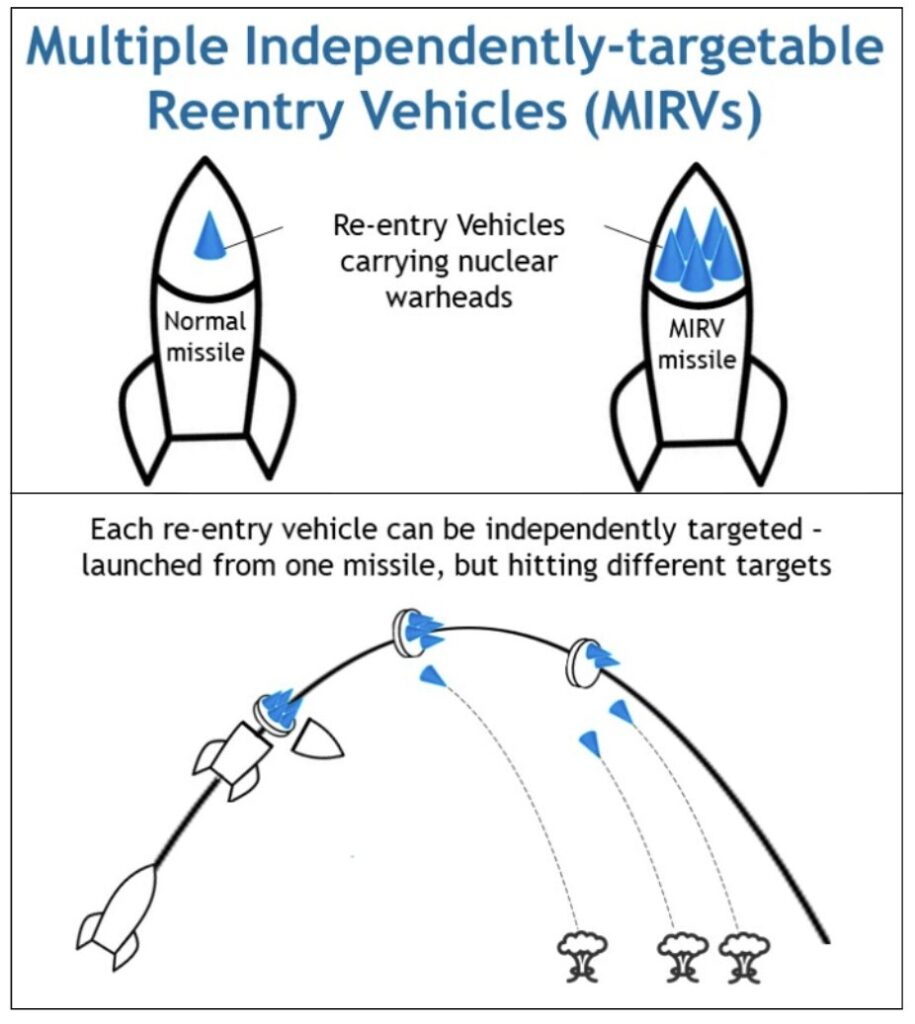
- Recently, India successfully tested an advanced Agni-5 missile equipped with MIRV (Multiple Independently Targetable Re-entry Vehicle) technology.
- MIRV enables a single missile to carry multiple warheads that can strike different targets independently. Strategic Advantages of MIRV:
- Increases deterrence capability
- Overwhelms missile defence systems
- Enables multiple target engagement using one missile
- Improves second-strike capability
- Agni-5 MIRV variant is powered by a three-stage solid-fuel engine and has a strike range exceeding 5,000 km.
Ballistic vs Cruise Missiles:
| Feature | Ballistic Missile | Cruise Missile |
| Trajectory | Arcing, parabolic path; part of the flight is often outside the Earth’s atmosphere. | Linear, non-ballistic path; stays low to the ground. |
| Propulsion | Rocket engines (solid or liquid fuel) that burn for a short initial period. | Jet engines (turbofan or ramjet) provide continuous thrust throughout the flight. |
| Speed | Very fast (Supersonic to Hypersonic, reaching speeds above Mach 5 to Mach 20 | Slower to medium (Subsonic around Mach 0.8 to Supersonic Mach 3.0 |
| Range | Variable (Short-range tactical to Intercontinental Ballistic Missiles >5000 kms) | Typically shorter to medium-range (around 300 km to 1500 km). |
| Accuracy | Lower precision; relies on gravity and initial launch angles for free-fall impact. | High precision; uses advanced onboard navigation systems (GPS, terrain contour matching) to course-correct. |
| Interception | Easier to detect early by radar, but extremely difficult to intercept due to high terminal speeds. | Harder to detect by radar due to low-altitude flying, making interception possible using advanced air defence. |
| Payload | Large; capable of carrying heavier warheads, including multiple independently targetable re-entry vehicles (MIRVs). | Smaller; designed primarily for precision conventional strikes or single nuclear warheads. |
| Examples | Agni series, Prithvi, Shaurya | BrahMos (Supersonic), Nirbhay (Subsonic) |
UPSC PYQ 2023:
Q. Consider the following statements:
1. Ballistic missiles are jet-propelled at subsonic speeds throughout their flights, while cruise missiles are rocket-powered only in the initial phase of flight.
2. Agni-V is a medium-range supersonic cruise missile, while BrahMos is a solid-fuelled intercontinental ballistic missile.
Which of the statements given above is/are correct?
(a) 1 only
(b) 2 only
(c) Both 1 and 2
(d) Neither 1 nor 2
Answer: (d)
Tell Google you want more of this.
Add Anantam IAS as a preferred sourceOne tap, and this site shows up more often in your own Top Stories, AI Overviews and AI Mode. Remove it any time.