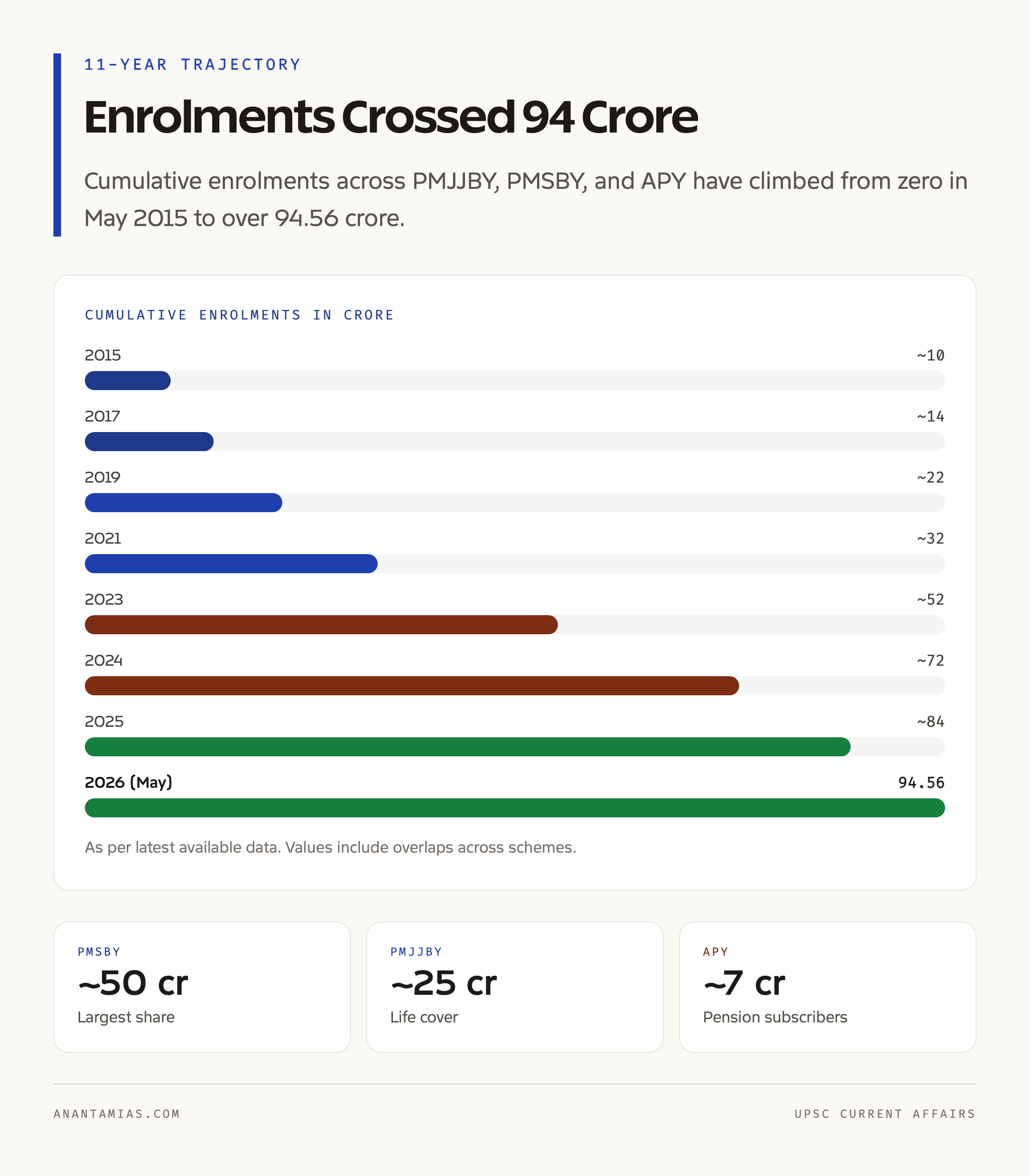
The Jan Suraksha schemes turned 11 in May 2026, and the headline number is striking. Across Pradhan Mantri Jeevan Jyoti Bima Yojana (PMJJBY), Pradhan Mantri Suraksha Bima Yojana (PMSBY), and Atal Pension Yojana (APY), the three schemes have crossed 94.56 crore cumulative enrolments since launch in May 2015. Even adjusted for overlaps and dormant accounts, that’s the largest deliberate expansion of micro-insurance and micro-pension coverage that any country has attempted in a single decade.
The schemes were launched together as part of a coordinated push to build a basic social security floor for India’s informal and low-income population. PMJJBY offers term life cover at a flat annual premium. PMSBY offers personal accident cover at an even smaller premium. APY offers a guaranteed pension at retirement age in exchange for monthly contributions. All three were designed to ride on the rails of the Jan Dhan Yojana, which had by 2015 already opened bank accounts for hundreds of millions of previously unbanked Indians.
Eleven years in, the picture is more complex than a single enrolment number suggests. Coverage has spread wide. Claims experience has been mixed. Sustainability of premiums and guarantees has been questioned. And the schemes now have to evolve into a more layered architecture that can carry India’s social security ambitions through the next demographic cycle.
Quick Facts
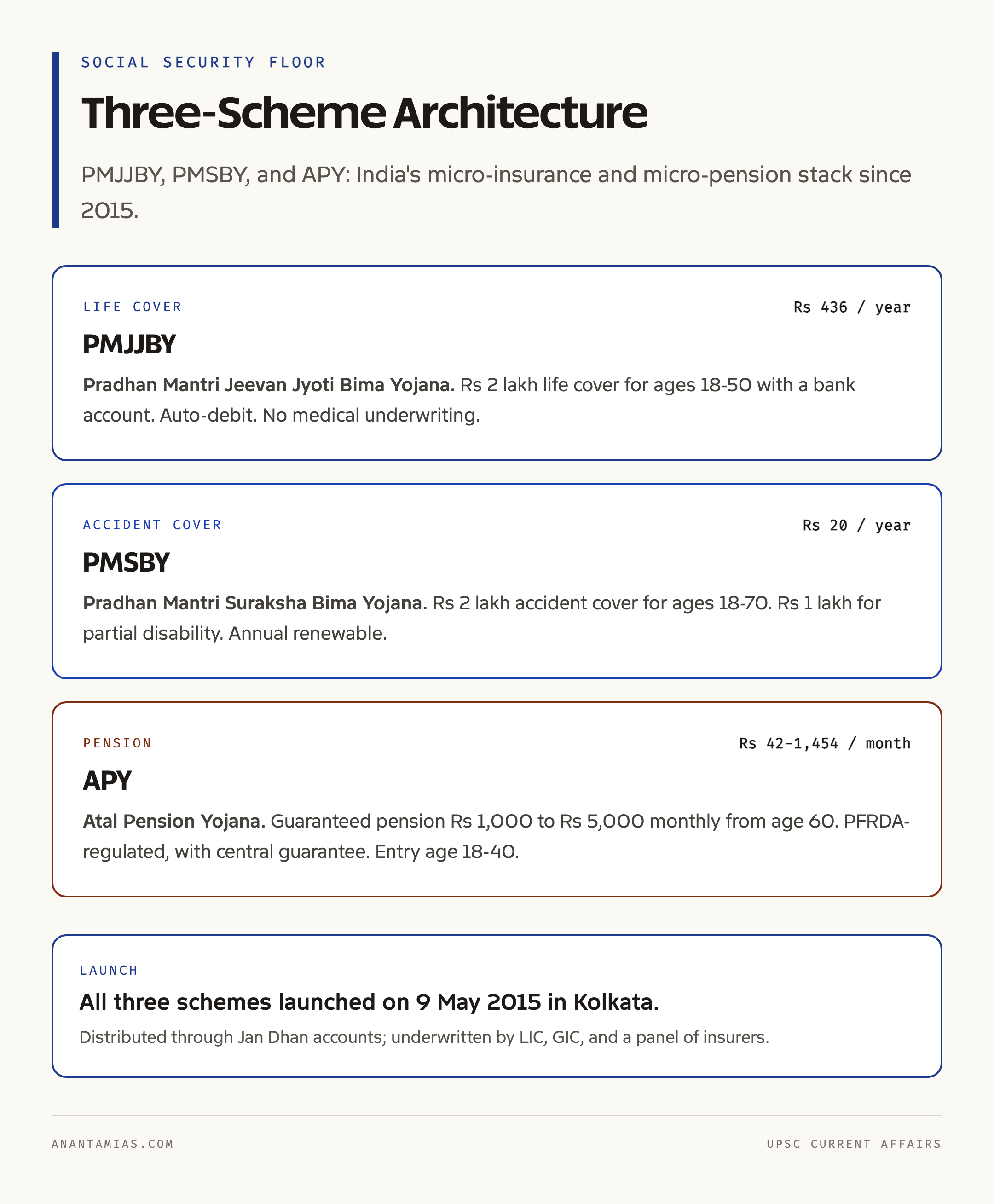
- Schemes: Pradhan Mantri Jeevan Jyoti Bima Yojana (PMJJBY), Pradhan Mantri Suraksha Bima Yojana (PMSBY), Atal Pension Yojana (APY)
- Launch date: 9 May 2015 in Kolkata
- Anniversary: 11 years as of 9 May 2026
- Total enrolments across three schemes: 94.56 crore cumulative
- Nodal ministry: Ministry of Finance, Department of Financial Services
- APY regulator: PFRDA
- PMJJBY premium: Rs 436 annual, life cover Rs 2 lakh
- PMSBY premium: Rs 20 annual, accident cover Rs 2 lakh
- APY contribution: Rs 42 to Rs 1,454 monthly depending on age and target pension
- APY benefit: Guaranteed monthly pension of Rs 1,000 to Rs 5,000 from age 60
What Just Happened
The Department of Financial Services released the 11-year review of the Jan Suraksha schemes around the anniversary on 9 May 2026. The cumulative enrolment figure of 94.56 crore covers all three schemes together. Within this, PMSBY accounts for the largest individual share at around 50 crore enrolments, given its very low premium. PMJJBY has crossed 25 crore enrolments. APY has gone past 7 crore subscribers, with steady incremental additions.
Claims payouts under PMJJBY and PMSBY have moved into multi-thousand-crore territory in recent years. Rural and women’s participation in the schemes has improved markedly. APY’s average ticket size has shifted upward as more subscribers opt for higher pension slabs. The schemes have remained operationally simple, with auto-debit from Jan Dhan and other bank accounts being the dominant enrolment channel.
Background and Historical Context
The Jan Suraksha schemes were launched on 9 May 2015 in Kolkata as part of a wider financial inclusion push. The architecture rested on three earlier foundations. The Pradhan Mantri Jan Dhan Yojana of 2014 had created the bank account base. Aadhaar provided the identity layer. The unified payments rails were beginning to take shape.
Before these schemes, micro-insurance penetration in India was very low, particularly among low-income and informal sector households. Life insurance penetration hovered around 3 percent of GDP, dominated by long-term endowment products that low-income households could not afford. Personal accident cover was even less penetrated. Old-age income security outside of the organised sector was nearly non-existent, with NPS still being seen as a middle-class instrument.
The Jan Suraksha approach borrowed three ideas. Premiums had to be tiny and flat so that the cognitive barrier to enrolment collapsed. Distribution had to ride on bank accounts that already existed. And benefits had to be simple, with no medical underwriting and minimal documentation. PMJJBY and PMSBY operate as group insurance schemes underwritten by LIC and a panel of public and private insurers. APY operates through the National Pension System architecture under PFRDA, with the central government providing a guarantee on the assured pension.
Key Provisions of the Three Schemes
Pradhan Mantri Jeevan Jyoti Bima Yojana (PMJJBY)
- Target group: Indian residents aged 18 to 50, with a savings bank or post office account.
- Premium: Rs 436 per year, auto-debited.
- Cover: Rs 2 lakh life cover, payable on death from any cause.
- Coverage period: Annual renewable, with continuous cover up to age 55 if premium continues to be paid.
- Underwriting: No medical examination; standard declaration of good health.
Pradhan Mantri Suraksha Bima Yojana (PMSBY)
- Target group: Indian residents aged 18 to 70 with a bank or post office account.
- Premium: Rs 20 per year, auto-debited.
- Cover: Rs 2 lakh on death or permanent disability due to accident, Rs 1 lakh on partial permanent disability.
- Coverage period: Annual renewable.
- Underwriting: None.
Atal Pension Yojana (APY)
- Target group: Indian residents aged 18 to 40, with a bank account, who are not income-tax payers.
- Contribution: Rs 42 to Rs 1,454 per month depending on age at entry and target pension.
- Benefit: Guaranteed monthly pension of Rs 1,000, 2,000, 3,000, 4,000, or 5,000 from age 60 onwards.
- Family pension: Spouse continues to receive the same pension after subscriber’s death.
- Return of corpus: Accumulated pension wealth returned to nominee after spouse’s death.
Why It Matters
The Jan Suraksha schemes matter for three reasons.
First, breadth of coverage. The schemes have created the largest social protection floor India has ever built. Even with overlaps and dormant accounts, the active reach is into hundreds of millions of households. That is a structural shift in the country’s financial profile.
Second, distributional impact. A non-trivial share of enrolments and claims has come from rural households, women, and low-income workers in the informal sector. For families that lose a primary earner, a Rs 2 lakh payout is meaningful in cash-flow terms.
Third, policy infrastructure. The schemes built operational infrastructure such as auto-debit enrolment, group insurance underwriting at scale, simple grievance redressal, and a digital claims tracking layer. This infrastructure is now reusable for other social protection programs.
There is a fourth subtle benefit. The schemes have normalized the idea that low-income households can and should buy insurance and pension products. That cultural shift is harder to measure but probably matters most over the long run.
Detailed Analysis
The 11-year review surfaces three important policy questions.
Premium adequacy. PMJJBY’s premium was raised from Rs 330 to Rs 436 in 2022 after years of claims pressure, but the insurance industry continues to flag claims ratios that are higher than typical group term portfolios. PMSBY’s Rs 20 premium remains heavily subsidized in actuarial terms. Both schemes depend on participation by public sector insurers willing to accept thin or negative margins as a social mandate. Long-run sustainability requires either premium recalibration, government subsidy formalization, or risk pooling reform.
APY pension adequacy. A Rs 5,000 monthly pension at age 60 covers a portion of basic needs in 2026 but will erode in real terms over the decades during which a subscriber receives it. The scheme caps benefits at Rs 5,000, which makes it more of a floor than a comprehensive retirement income. Several proposals have been floated to add a higher voluntary tier and index pension to inflation.
Coverage depth versus breadth. Cumulative enrolments are high but renewal rates are uneven. A meaningful share of PMJJBY policies lapses for non-renewal due to insufficient balance in the linked bank account at the time of premium auto-debit. PMSBY has similar but smaller drop-off. APY contributions also see lapse and revival cycles. The next phase has to focus on retention and continuity, not just enrolment.
Comparative Perspective
Globally, India’s Jan Suraksha approach is comparable to a few large micro-insurance and contributory pension programs. China’s social pension and rural health insurance schemes are larger by absolute numbers but operate through a different fiscal structure. Brazil’s Bolsa Familia provides cash transfer rather than insurance. South Africa’s social grants system is largely tax-funded.
India’s hybrid model, where contributions are nominal but real, government provides guarantees and subsidies, and the formal insurance and pension industry runs the actual product, is closer to the European Bismarckian tradition adapted for an informal-sector heavy economy. The success of the approach has caught attention internationally, and several developing countries have explored variants of the auto-debit, low-premium, group-policy model.
The scale that Jan Suraksha has achieved would have been impossible without Jan Dhan accounts and Aadhaar. The Indian stack effectively allowed a global-scale micro-insurance experiment to be run at low operational cost.
Challenges and Concerns
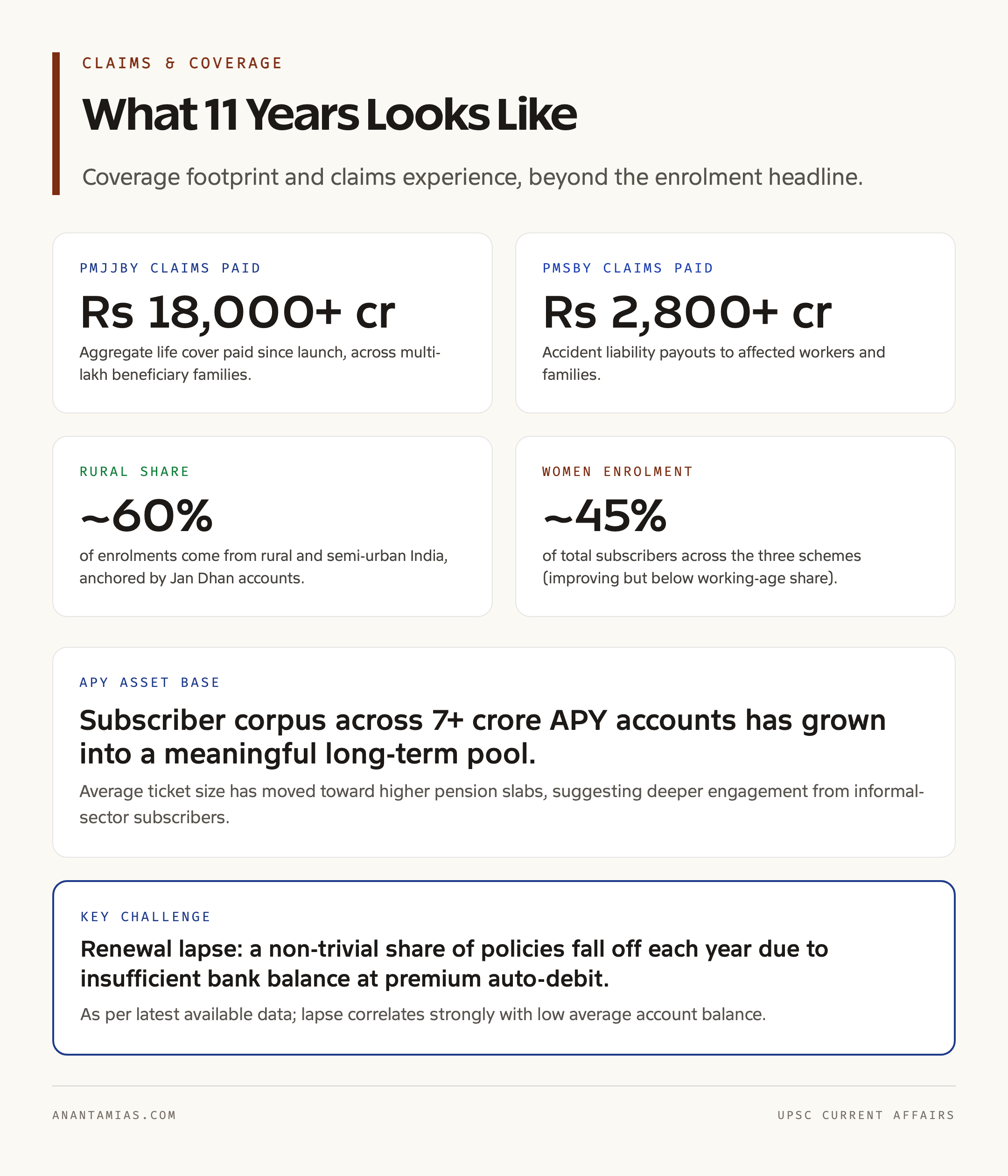
The 11-year mark is also a reasonable moment to confront persistent challenges. Lapse and renewal: A significant share of PMJJBY and PMSBY policies lapse each year. The lapse pattern correlates with low average balances in linked accounts. Claims awareness: Many eligible beneficiaries don’t know how to claim, particularly in cases of accidental death. Awareness campaigns and grievance redressal still need work. APY ceiling: The Rs 5,000 monthly pension cap looks low for a scheme expected to be a meaningful retirement instrument. Gender gap: Women’s share has improved but remains below their share of the working-age population.
There is also a structural question. As India’s organized sector expands, the boundary between Jan Suraksha and the broader insurance and pension market will blur. Schemes designed for informal-sector workers should evolve into a more layered architecture rather than remain in their original 2015 form indefinitely.
Prelims Pointers
- Launch date: 9 May 2015 in Kolkata
- Anniversary: 9 May 2026 marks 11 years
- Total enrolments across three schemes: 94.56 crore cumulative
- PMJJBY premium: Rs 436 per year, Rs 2 lakh life cover, age 18 to 50 entry
- PMSBY premium: Rs 20 per year, Rs 2 lakh accident cover, age 18 to 70 entry
- APY contribution range: Rs 42 to Rs 1,454 monthly
- APY pension slabs: Rs 1,000, Rs 2,000, Rs 3,000, Rs 4,000, Rs 5,000 per month
- Regulator (APY): PFRDA
- Linkage: Jan Dhan Yojana, Aadhaar, bank account auto-debit
Mains Questions
- GS Paper II (Social Justice): Evaluate the design, reach, and impact of the Jan Suraksha schemes (PMJJBY, PMSBY, APY) on India’s social security architecture. (15 marks, 250 words)
- GS Paper III (Economy and Financial Inclusion): “Jan Suraksha schemes rely on the Jan Dhan-Aadhaar-Mobile trinity.” Examine how the JAM architecture has enabled large-scale social protection. (15 marks, 250 words)
- GS Paper II (Welfare): Discuss the challenges of premium adequacy, renewal rates, and benefit indexation in the Jan Suraksha schemes. Suggest reforms. (10 marks, 150 words)
- GS Paper III (Pensions): Compare the Atal Pension Yojana with the National Pension System. What role should APY play in India’s broader pension architecture? (10 marks, 150 words)
Way Forward
The Jan Suraksha schemes have built scale. The next decade has to build depth. Four reforms suggest themselves. First, premium recalibration and explicit subsidy for PMJJBY and PMSBY to put long-run sustainability on a clearer footing. Second, a higher voluntary tier in APY with pension slabs above Rs 5,000 for subscribers who can afford larger contributions, with retention of the central guarantee on the base slab. Third, renewal nudges and continuity through automated balance top-up, default opt-in, and reminder systems linked to the auto-debit cycle. Fourth, claims awareness and digital tracking so that eligible beneficiaries can file and track claims through Jan Suraksha digital platforms.
The schemes also need to integrate better with the wider pension architecture, including the Unified Pension Scheme for central government employees, EPFO reforms, and the broader NPS. As India moves toward an older demographic profile, fragmented social protection will be more expensive to run than a coherent multi-tier system.
For UPSC aspirants, Jan Suraksha is a useful case study in policy design that consciously uses behavioral simplicity. Pair it with the India pension landscape for the multi-pillar context, the Bharat Maritime Insurance Pool for parallel financial sector capability-building, and the Coal Gasification Scheme 2026 for industrial policy at scale.
Frequently Asked Questions
What are the Jan Suraksha schemes?
Three financial inclusion schemes launched on 9 May 2015: Pradhan Mantri Jeevan Jyoti Bima Yojana (life insurance), Pradhan Mantri Suraksha Bima Yojana (accident insurance), and Atal Pension Yojana (pension).
How many people have enrolled in the schemes?
As of the 11-year mark in May 2026, cumulative enrolments across the three schemes have crossed 94.56 crore.
What does PMJJBY cover?
A Rs 2 lakh life cover for death from any cause, available to bank account holders aged 18 to 50, at an annual premium of Rs 436.
What does PMSBY cover?
Rs 2 lakh accidental death or permanent total disability cover, and Rs 1 lakh for partial permanent disability, available to account holders aged 18 to 70, at Rs 20 a year.
What is the Atal Pension Yojana?
A government-backed pension scheme for citizens aged 18 to 40, with monthly contributions ranging from Rs 42 to Rs 1,454 depending on age and chosen pension, providing a guaranteed pension of Rs 1,000 to Rs 5,000 from age 60.
Who regulates the Atal Pension Yojana?
The Pension Fund Regulatory and Development Authority (PFRDA) regulates APY. The central government provides a guarantee on the assured pension benefit.
How are premiums collected?
Premiums for PMJJBY and PMSBY are auto-debited from the subscriber’s bank account once a year. APY contributions are auto-debited monthly, quarterly, or half-yearly depending on subscriber preference.
How is this linked to Jan Dhan Yojana?
The Jan Dhan Yojana provided the bank account base on which Jan Suraksha could ride. Most enrolments came through Jan Dhan and similar basic savings accounts.
What happens if my account lacks the premium balance?
The policy lapses for that year. PMJJBY and PMSBY can be reinstated by topping up the account and re-enrolling, subject to conditions. Continuous lapses can affect cover continuity.
Is the Rs 5,000 pension under APY enough?
It provides a basic floor but is not designed to be a comprehensive retirement income. Subscribers with higher contribution capacity should consider layering APY with NPS or other retirement instruments.
Tell Google you want more of this.
Add Anantam IAS as a preferred sourceOne tap, and this site shows up more often in your own Top Stories, AI Overviews and AI Mode. Remove it any time.