Why in News?
On 22 October 2026, NSDC launched its maiden Zero Coupon Zero Principal issue on the NSE Social Stock Exchange, supporting skilling linked to international employment.
- NABARD subscribed to the issue supporting language and employability training for economically weaker OBC youth from Madhya Pradesh.
- NSDC International, a wholly owned NSDC subsidiary, will deliver training aimed at employment opportunities in Japan and Germany.
- Madhya Pradesh funding is separately linked to successful international placement under a bilateral Social Impact Bond framework with NSDC.
- Financing design matters because training costs arise before employment outcomes can be demonstrated.
- Public accountability requires distinguishing money mobilised, training completed and employment secured; each measures a different stage of the programme.
UPSC Relevance
Prelims Relevance
- ZCZP: Zero Coupon Zero Principal instrument.
- Social Stock Exchange: platform used for the NSDC issuance.
- NSDC: works under the aegis of the Ministry of Skill Development and Entrepreneurship.
- NABARD: institutional subscriber to this issue.
- Outcome-linked funding: payment conditional on an agreed result.
Mains Relevance
GS Paper 3
- Employment-linked skill development and blended financing.
- Distinguishing social-purpose contributions from repayable debt.
GS Paper 2
- Designing measurable outcomes and protecting vulnerable programme participants.
Essay
- Accountability in development requires measuring opportunities secured, alongside resources spent.
Background and Context
What a ZCZP Contribution Finances
The first distinction concerns the instrument itself: a social purpose does not make every financing arrangement an ordinary repayable bond.
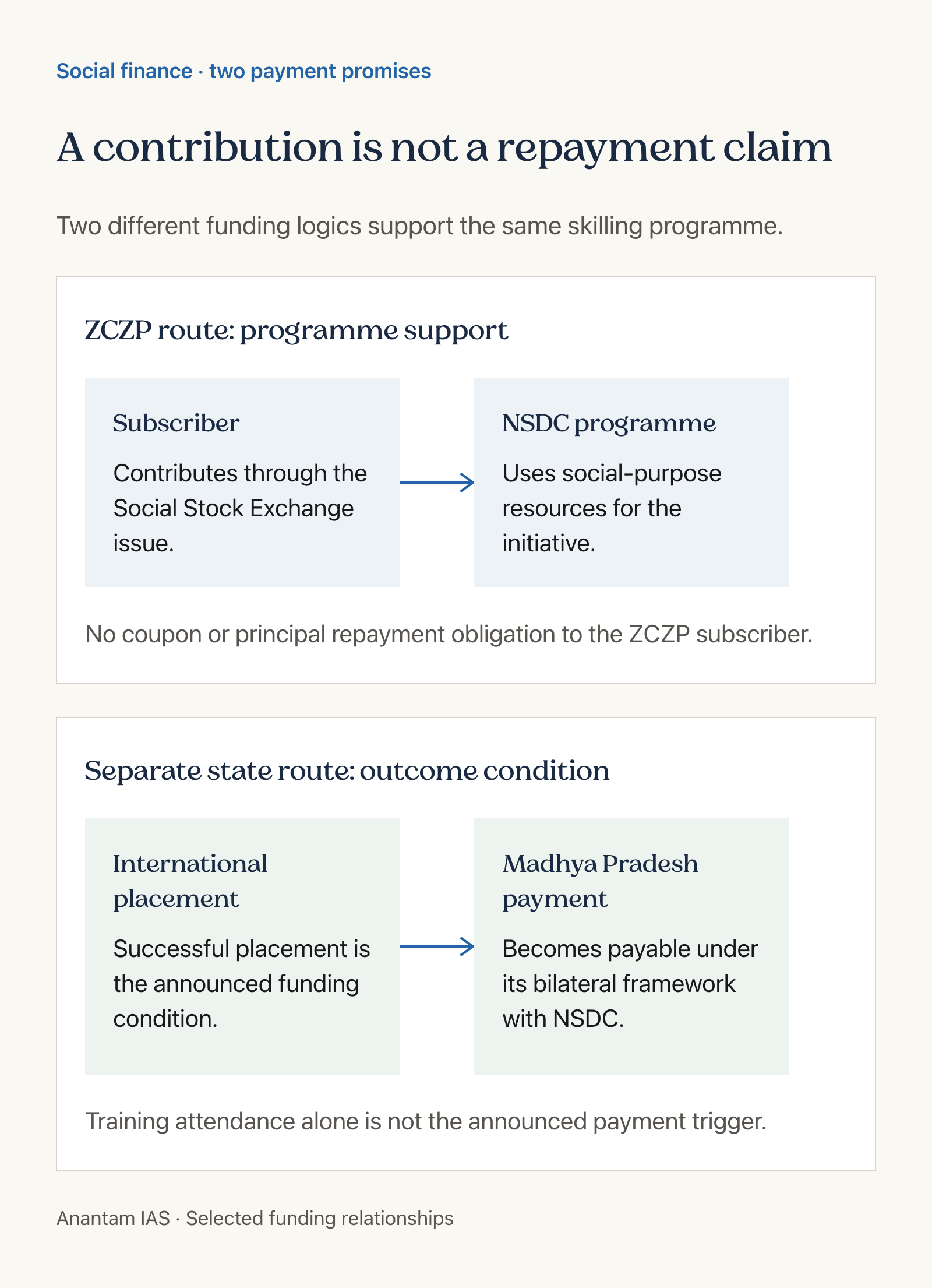
- Zero coupon means no interest payment; zero principal means no principal repayment obligation. The contributor supports the social project without receiving the conventional financial repayment promised by a debt instrument.
- Social-purpose funding still needs accountability. The absence of repayment shifts attention towards transparent deployment and reporting of social outcomes, rather than removing the need to explain where the money went.
- NABARD’s subscription supports the NSDC initiative through this non-repayable instrument. It should not be described as a loan that participating trainees or the state must automatically repay to the subscriber.
- Conventional social bonds can finance beneficial activities while retaining debt repayment obligations. The decisive comparison is the instrument’s payment promise, not whether its name includes the word social or its project benefits vulnerable groups.
- The Social Stock Exchange provides the platform for this issuance. Its involvement does not, by itself, establish that training has succeeded, overseas employment has begun, or participating households have already achieved higher incomes.
How the Separate Outcome Payment Works
The programme combines funding sources, but each source has a different role; the state’s placement condition must remain distinct from the ZCZP contribution.
- Blended financing here combines beneficiary participation, resources mobilised through the Social Stock Exchange and state funding. These streams support one programme without becoming identical financial instruments or carrying the same payment conditions.
- The state contribution becomes payable upon successful international placement, according to the announcement. Training attendance alone is not the stated trigger; the intended employment result connects this component of public expenditure to performance.
- The bilateral Social Impact Bond framework is between NSDC and Madhya Pradesh. That separate arrangement should not be used to imply that the ZCZP subscriber receives interest or recovers principal when placements occur.
- Timing creates an implementation challenge: language teaching and employability preparation precede placement. Programme managers need to coordinate resources across those stages; a later conditional payment is not interchangeable with cash available for current training.
- State support also includes candidate mobilisation, residential training infrastructure and language laboratories. Financing alone does not deliver employability: institutions must connect suitable candidates, training provision and destination-specific preparation into a functioning employment pathway.
What Counts as Success, and What Remains Unproven
The announcement describes a financing architecture and intended employment pathway; evaluating it requires evidence from implementation rather than treating expected benefits as completed results.
- Language preparation addresses a practical barrier to working abroad. The programme combines foreign-language and employability training for destination-specific readiness, with opportunities envisaged across caregiving, hospitality, construction and manufacturing rather than one uniform job category.
- Placement verification needs a clear operational definition. A useful accountability question is whether payment evidence establishes that the candidate actually entered the agreed employment, rather than merely receiving an offer or completing a course.
- Job quality matters beyond initial placement. Contract terms, worker protection and continuity of employment are relevant evaluation questions; the announcement should not be read as proof that every candidate will secure safe, lasting work.
- Beneficiary participation raises an inclusion question because the intended participants are economically weaker households. An assessment should examine whether participation costs exclude suitable candidates, while avoiding an unsupported claim that exclusion has already occurred.
- The official announcement establishes the design, not realised impact. Its expected livelihood gains require follow-up evidence; neither higher earnings nor successful overseas placements should be presented as guaranteed outcomes for every individual enrolled.
Way Forward
Make the Payment Trigger Auditable
- Define placement evidence before payments fall due, including who checks it and how disputes or failed placements are handled.
- Publish separate accounts for contributions received, programme spending and state outcome payments so the different funding streams remain traceable.
- Track participant experience alongside placement totals, including access barriers, employment continuity and grievance resolution after departure.
Conclusion
- The central distinction is between a non-repayable ZCZP contribution and a separate government payment conditional on placement; combining them does not turn the contribution into repayable debt.
- For policy analysis, judge whether the financing arrangement produces verifiable employment opportunities without excluding vulnerable candidates, while keeping announced aims separate from demonstrated improvements in workers’ livelihoods.
UPSC Practice Questions
Prelims MCQ 1
With reference to the announced NSDC financing initiative, consider the following statements:
- ZCZP instruments entail conventional principal repayment to subscribers.
- Madhya Pradesh funding is linked to successful international placement.
- The programme combines beneficiary participation, SSE resources and state funding.
How many of the above statements are correct?
(a) Only one (b) Only two (c) All three (d) None
Answer: (b) Only two
Explanation:
Statements 2 and 3 are correct. ZCZP instruments have neither conventional coupon payments nor principal repayment obligations.
Prelims MCQ 2
Which distinction best explains this financing arrangement?
(a) All funding streams become repayable loans. (b) Training attendance automatically triggers the state payment. (c) A non-repayable contribution and a separate placement-linked payment support one programme. (d) An SSE listing guarantees overseas employment.
Answer: (c) A non-repayable contribution and a separate placement-linked payment support one programme.
Explanation:
The ZCZP issuance and bilateral outcome-linked state arrangement have different payment characteristics. Neither issuance nor listing demonstrates completed employment outcomes.
UPSC Mains Questions
- Explain the distinction between non-repayable social-purpose contributions and outcome-linked government payments in skill-development financing.
- What safeguards can make placement-linked financing accountable without encouraging the exclusion of harder-to-place candidates?
Source: PIB, Ministry of Skill Development and Entrepreneurship.
Frequently Asked Questions
Does a ZCZP subscriber receive principal back?
A Zero Coupon Zero Principal instrument does not carry conventional interest or principal repayment obligations. Its social-purpose contribution must be distinguished from ordinary repayable debt, even when both finance socially beneficial activities.
When does the state funding become payable?
The announcement links Madhya Pradesh’s funding to successful international placement under a bilateral framework with NSDC. This is separate from the ZCZP contribution and is not described as payment merely for training attendance.
Has the programme already delivered its promised employment outcomes?
The announcement describes the financing initiative and intended training and employment pathway. It does not establish completed placements or guaranteed earnings for every participant; those results require evidence from subsequent implementation.
Why does beneficiary participation need scrutiny?
The programme is intended for economically weaker households. Evaluation should examine whether participation costs affect access for suitable candidates, alongside the quality of training and employment, without assuming that exclusion has already occurred.
Tell Google you want more of this.
Add Anantam IAS as a preferred sourceOne tap, and this site shows up more often in your own Top Stories, AI Overviews and AI Mode. Remove it any time.