Why in News?
On November 27, the National Biodiversity Authority reported disbursing medicinal-plant benefit-sharing contributions to states and union territories where individual benefit claimers were difficult to identify.
- The contributions came from AYUSH manufacturers commercially using medicinal plants and other plant resources procured through market and trader networks.
- Forest cover and medicinal-plant occurrence informed this allocation because the reported sourcing pattern made individual benefit claimers difficult to trace.
- The release records disbursement across states and UTs. It describes conservation activities the funds can support, while completed local outcomes require subsequent evidence.
- Access and Benefit Sharing connects commercial use of biological resources with the people and institutions supporting their conservation.
- Traceability affects the ability to connect a company’s raw material purchases with particular resource providers and knowledge holders.
UPSC Relevance
Prelims Relevance
- National Biodiversity Authority and benefit-sharing arrangements
- State Biodiversity Boards and UT Biodiversity Councils
- Biodiversity Management Committees at the local level
- People’s Biodiversity Registers and resource documentation
Mains Relevance
GS Paper 3
- Biodiversity governance through commercial benefit sharing and conservation finance.
- Supply-chain transparency and equitable treatment of resource conservers.
GS Paper 2
- Local institutions and accountability for transfers intended to support communities.
Essay
- Equity in the economic use of nature and community knowledge.
Background and Context
From Medicinal Plants to Commercial Products
The sourcing chain links biological resources with manufacturing demand, while benefit sharing creates a financial connection to conservation.
- Medicinal plants support collection, cultivation, processing and trade. Commercial demand can create livelihoods, while the continued availability of wild resources depends on harvesting practices and the condition of their habitats.
- Market intermediaries connect suppliers with manufacturers. Purchases may pass through several traders, which complicates efforts to reconstruct the source of material and identify individual benefit claimers associated with the commercial supply.
- Benefit sharing gives resource use a conservation-related financial obligation within the applicable legal framework. Its practical purpose is to connect gains from commercial utilisation with the conservation of resources and associated knowledge.
- The NBA’s explanation of ABS describes benefit claimers as resource conservers and eligible knowledge holders. Identifying them requires attention to their relationship with the resource or knowledge used.
- Commercial payment records identify a transaction, while source information establishes where the resource came from. Keeping both kinds of evidence helps administrators assess how the benefits can reach relevant people and places.

Allocating Benefits When Claimers Are Difficult to Trace
The latest disbursement used ecological information to allocate funds across states and union territories despite gaps in individual identification.
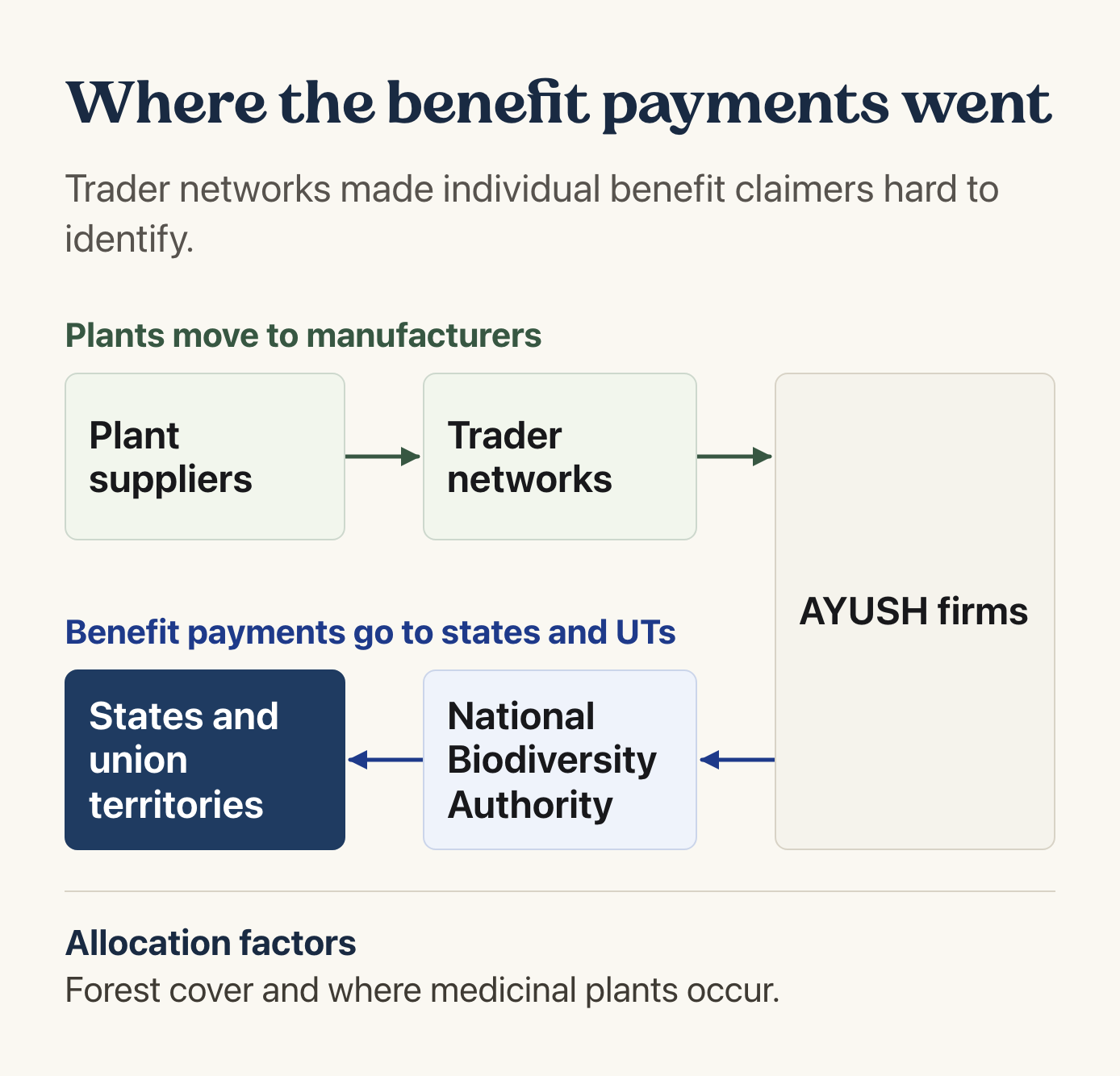
- The official disbursement release identifies trader networks as the reason individual benefit claimers were difficult to identify. This is the stated circumstance of the allocation under discussion.
- Forest cover and the occurrence of medicinal plants were considered because most resources used by the companies came from forest areas. These factors connected the allocation with the ecological distribution of relevant resources.
- The payment route runs from contributing companies through the NBA towards allocations across states and union territories. The physical movement of plant material follows its own route through suppliers and traders.
- Individual attribution connects a benefit with an identifiable claimer. An allocation informed by resource occurrence can support conservation across relevant areas, while leaving the identification of particular suppliers as a continuing administrative challenge.
- The NBA’s guidance explains that, where source areas cannot be identified, funds can support socio-economic development where the resources occur. Applying this principle requires records that explain the chosen allocation and subsequent use.
Following the Money Into Local Conservation
Disbursement creates an opportunity for conservation, whose results depend on local decisions, records and implementation.
- The release identifies Biodiversity Management Committees and resource documentation among possible uses. Local knowledge can help officials understand which biological resources occur in an area and how people depend on them.
- People’s Biodiversity Registers can document resources and associated knowledge. The distinct role of community participation is also illustrated by farmer seed systems, although this allocation concerns financial benefits from commercial utilisation.
- Sustainable harvesting, cultivation and ecosystem restoration are potential funded activities. Assessing a project requires evidence that its design fits the resource, habitat and local livelihood needs rather than treating every location identically.
- Transfer records establish where funds were sent. Evidence of functioning projects and conservation results is a further requirement, comparable to the implementation questions discussed in protected-area management effectiveness.
- Public accountability can connect allocation decisions with local spending and observable results. Records should show the recipient, authorised purpose, activity undertaken and community involvement, allowing the intended benefits to be examined.
Way Forward
Connect Source Records With Local Expenditure
- Require usable sourcing records across trader transactions so that resource origin can be examined without depending only on the manufacturer’s final purchase invoice.
- Publish allocation and expenditure records through the relevant biodiversity institutions, with explanations of how the funded work serves local resources and communities.
- Assess conservation results alongside financial transfers, including whether funded harvesting or restoration activities address the specific resource pressures identified locally.
Conclusion
- Benefit sharing connects commercial resource use with conservation and equity. The latest allocation shows how sourcing through traders can complicate the identification of individual claimers and influence where funds are directed.
- Traceable procurement and accountable spending strengthen different parts of the mechanism. Together, they help connect the biological resource, the people conserving it and the activities supported by commercial contributions.
UPSC Practice Questions
Prelims MCQ 1
With reference to the reported medicinal-plant ABS disbursement, consider the following statements
- The contributions came from AYUSH manufacturers commercially using plant resources.
- Forest cover and medicinal-plant occurrence informed the allocation.
- The release establishes that every individual collector received a direct cash payment.
How many of the above statements are correct?
(a) Only one (b) Only two (c) All three (d) None
Answer: (b) Only two
Explanation:
The release confirms the first two statements. It records geographical allocations and difficulty identifying individual benefit claimers, so the third statement is unsupported.
Prelims MCQ 2
Which evidence would best establish whether an ABS-funded local conservation activity achieved its purpose?
(a) The existence of a company purchase invoice alone (b) The number of states receiving a transfer alone (c) Verified project activity and resource outcomes alongside expenditure records (d) The announcement of a planned activity alone
Answer: (c) Verified project activity and resource outcomes alongside expenditure records
Explanation:
Expenditure and transfer records establish financial movement. Evidence of implementation and resource outcomes is needed to assess conservation results.
UPSC Mains Questions
- Explain how supply-chain traceability affects equitable benefit sharing from the commercial use of medicinal plants.
- Discuss the role of local biodiversity institutions in converting benefit-sharing receipts into accountable conservation outcomes.
Sources: PIB, Ministry of Environment, Forest and Climate Change and National Biodiversity Authority.
Frequently Asked Questions
What is Access and Benefit Sharing?
ABS connects the use of biological resources and associated knowledge with fair sharing of benefits. In this case, commercial contributions from AYUSH manufacturers were allocated through the NBA across states and union territories.
Why were individual benefit claimers difficult to identify?
The medicinal plants and other resources were purchased through markets and trader networks. These sourcing arrangements complicated the identification of individual benefit claimers associated with the supply chains.
How was this allocation determined?
The release states that forest cover and medicinal-plant occurrence informed the allocation, considering that most of the resources used by the companies came from forest areas.
Does a disbursement prove that conservation improved?
A disbursement establishes a financial transfer. Assessing conservation requires further evidence of the activities undertaken, the suitability of local projects and their results for biological resources and communities.
Tell Google you want more of this.
Add Anantam IAS as a preferred sourceOne tap, and this site shows up more often in your own Top Stories, AI Overviews and AI Mode. Remove it any time.