Why in News?
On 18 November 2026, PIB reported the release of a DIVERSIFARM-India capacity-building manual and related policy outputs to strengthen community seed banks.
- The outputs were presented at a national seminar held in New Delhi on 17–18 November.
- The manual draws on Odisha case studies and combines technical guidance with organizational approaches for establishing and sustaining community seed banks.
- The project brings together the M S Swaminathan Research Foundation and Norway’s Fridtjof Nansen Institute.
- An Odisha policy roadmap recommends a secretariat; the release does not say that the proposed institution has been established.
- Seed access links biodiversity conservation with the next sowing season: a conserved variety has greater practical value when farmers can obtain suitable planting material.
- Local management matters because rules about collection, maintenance and access determine whether a community seed bank continues functioning after initial project support.
UPSC Relevance
Prelims Relevance
- Community seed banks: locally governed institutions supporting seed conservation and access.
- On-farm conservation: maintaining crop diversity through continued cultivation and farmer management.
- Regeneration: growing stored material again to renew seed stocks.
- Seed quality: planting material must remain viable and healthy.
- Management typology: classification by institutional arrangements, rather than a ranking of seed quality.
Mains Relevance
GS Paper 3
- How farmer institutions connect agricultural biodiversity with seed security.
- Why conservation support must fund maintenance and local capacity, alongside physical storage.
Essay
- Local knowledge and scientific institutions can support the same conservation objective through different roles.
Background and Context
How Seed Banks Support On-Farm Conservation
A community seed bank connects stored planting material with farmers who maintain crop diversity through cultivation and exchange.
- Conservation through use depends on keeping varieties available to growers. A collection disconnected from cultivation cannot, by itself, sustain the farmer practices and knowledge associated with those varieties.
- Local choice includes suitability for farming conditions and household preferences. Maintaining access to different varieties can widen options, but does not establish that every traditional variety tolerates every climatic stress.
- Seed security concerns timely access to suitable, affordable, good-quality planting material. As FAO explains, production, distribution and quality assurance all influence whether that access actually reaches farmers.
- Stored seed and on-farm conservation are linked but distinct. Storage preserves material outside the growing field; subsequent cultivation and farmer management sustain the living agricultural system around it.
- Complementary institutions can connect local collections with national gene banks. The seminar recommended collaboration; it did not announce that community banks would replace national conservation facilities or their scientific functions.
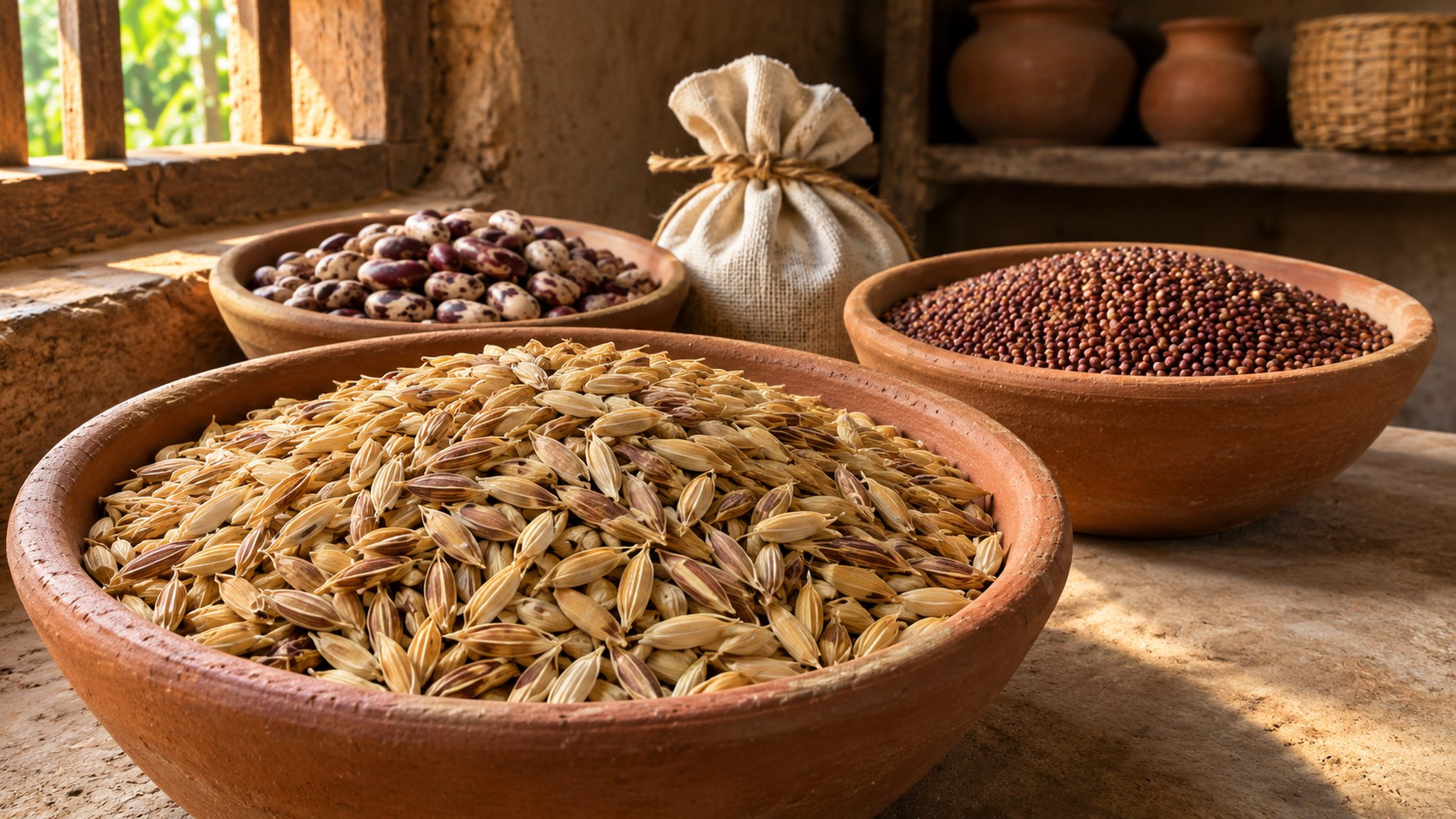
Why Management Matters As Much As Storage
Keeping a seed bank useful requires decisions about people, planting material and maintenance, rather than a building alone.
- Community participation should shape the services offered and access rules. FAO training guidance stresses consultation with farmers, including their preferences and expectations, when designing community seed-bank arrangements.
- Regeneration renews stored material through cultivation. Its timing should reflect the crop and variety; assuming one fixed replacement interval for every seed collection would ignore differences in biological and storage requirements.
- Quality management connects conservation to usable seed. FAO’s seed guidance identifies storage, sampling and testing within quality assurance; merely recording a variety’s name does not demonstrate that its seeds remain fit for planting.
- Local knowledge adds information about cultivation and use. Recording that knowledge alongside planting material helps retain the practical context that a list of crop names or a location map cannot convey.
- Institutional diversity explains why support cannot follow one template. The project identified different management structures; a community organization’s training, staffing and maintenance needs must be understood before prescribing its operating model.
What The New Outputs Establish
The manual, atlas and policy proposals serve different purposes, and their publication should not be confused with demonstrated outcomes.
- The atlas is a mapping resource, not proof of complete national coverage. The release explicitly describes a wider surveyed universe than the institutions already mapped.
- The manual offers capacity-building guidance based on Odisha case studies. Its publication supplies a resource for practitioners; adoption, continuing use and improvements in seed access still require separate evidence.
- The proposed Odisha secretariat is a recommendation in a policy roadmap. Treating it as an operating government body would collapse the distinction between an institutional proposal and an implemented administrative arrangement.
- Support for conservation should be assessed through maintained diversity and usable seed access. Counting mapped institutions alone cannot establish the condition of collections, fairness of access or continuity of local management.
- Crop improvement and conservation address connected needs. The horticultural genome-editing centre concerns developing traits; this initiative concerns farmer institutions that maintain and circulate planting material.
Way Forward
Fund Continuing Capacity
- Provide recurring training and maintenance support, with responsibilities for stock records, seed quality and collection renewal clearly assigned locally.
- Assess access and continuity alongside institution counts: which farmers obtain suitable seed, and whether collections remain usable across seasons.
- Build community–gene-bank partnerships around agreed roles while retaining farmer participation in local decisions.
- Track implementation separately from proposals, especially the Odisha roadmap and any administrative mechanism later created under it.
Conclusion
- Community seed banks connect agricultural biodiversity with practical seed access. Their value depends on usable collections, farmer participation and continuing management, rather than the presence of a storage room alone.
- The new capacity-building outputs create tools for support, not proof of universal coverage or successful implementation. Evaluate the institutions through conservation quality and the seed services they actually provide.
UPSC Practice Questions
Prelims MCQ 1
With reference to community seed banks, consider the following statements:
- They can support on-farm conservation by maintaining access to planting material.
- Publication of an atlas establishes that every seed bank in the country has been mapped.
- Regeneration requirements can differ across crops and varieties.
How many of the above statements are correct?
(a) Only one (b) Only two (c) All three (d) None
Answer: (b) Only two
Explanation:
Statements 1 and 3 are correct. Community seed banks can support cultivation-based conservation, and regeneration must reflect the material maintained. An atlas may have partial coverage; the release describes a wider surveyed universe.
Prelims MCQ 2
Which is the most appropriate measure of the continuing usefulness of a community seed bank?
(a) Whether farmers can obtain suitable viable seed and collections are maintained (b) Whether its location appears on an online map (c) Whether all varieties follow an identical regeneration schedule (d) Whether it operates without any connection to scientific institutions
Answer: (a) Whether farmers can obtain suitable viable seed and collections are maintained
Explanation:
A seed bank’s practical contribution depends on maintained planting material and access. Mapping alone does not demonstrate seed quality, while uniform regeneration schedules and institutional isolation are not necessary features.
UPSC Mains Questions
- Explain how community seed banks connect on-farm conservation with seed security. Discuss the institutional conditions required for their continuity.
- Why should the performance of community seed banks be assessed beyond the number of institutions mapped? Suggest suitable dimensions of evaluation.
Sources: PIB, Ministry of Agriculture and Farmers Welfare and FAO community seed-bank training guidance.
Frequently Asked Questions
What is a community seed bank?
A community seed bank is a locally governed arrangement for maintaining and accessing planting material. It can support crop diversity through seed conservation, farmer knowledge and continued cultivation of varieties.
How does a community seed bank support on-farm conservation?
It helps farmers access planting material for cultivation and maintains knowledge associated with varieties. The storage component supports this activity, while on-farm conservation occurs through continued cultivation and management in agricultural systems.
Has the proposed Odisha secretariat been established?
The 18 November release describes a policy roadmap recommending a secretariat. It does not confirm establishment. A recommendation should be distinguished from an officially created and functioning administrative institution.
Does the atlas cover every community seed bank in India?
No complete-coverage claim is established by the release. It describes more institutions in the surveyed universe than in the atlas, so mapped entries should not be treated as a national census.
Tell Google you want more of this.
Add Anantam IAS as a preferred sourceOne tap, and this site shows up more often in your own Top Stories, AI Overviews and AI Mode. Remove it any time.