Why in News?
The Ministry of Coal announced new coal mine closure guidelines on November 23, 2026, linking faster escrow reimbursement with evidence and verification of closure work.
- The guidelines were issued on November 20 and take effect 30 days after issuance. Their commencement falls after this announcement.
- The Coal Controller must allow withdrawal within one month of receiving a claim, with provision for test-checking claims.
- The framework widens eligible agencies for periodic claim verification and incorporates guidance for underground coal gasification.
- A dedicated closure fund helps connect revenue earned during extraction with the costs of restoring the site and supporting affected communities.
- Faster reimbursement makes credible evidence of completed work important because the operator initially certifies annual claims.
UPSC Relevance
Prelims Relevance
- Escrow account for mine closure funds.
- Coal Controller and withdrawal decisions.
- Progressive closure during mine operations.
- Annual and periodic claims with different verification requirements.
- Closure certificate after monitoring and audit.
Mains Relevance
GS Paper 3
- Financing ecological restoration across the mining lifecycle.
- Balancing faster administrative decisions with evidence and independent scrutiny.
GS Paper 2
- Designing accountable regulation through defined responsibilities and documented decisions.
Essay
- The responsibilities that remain after a resource has generated revenue.
Background and Context
Why Closure Needs Funding During Mining
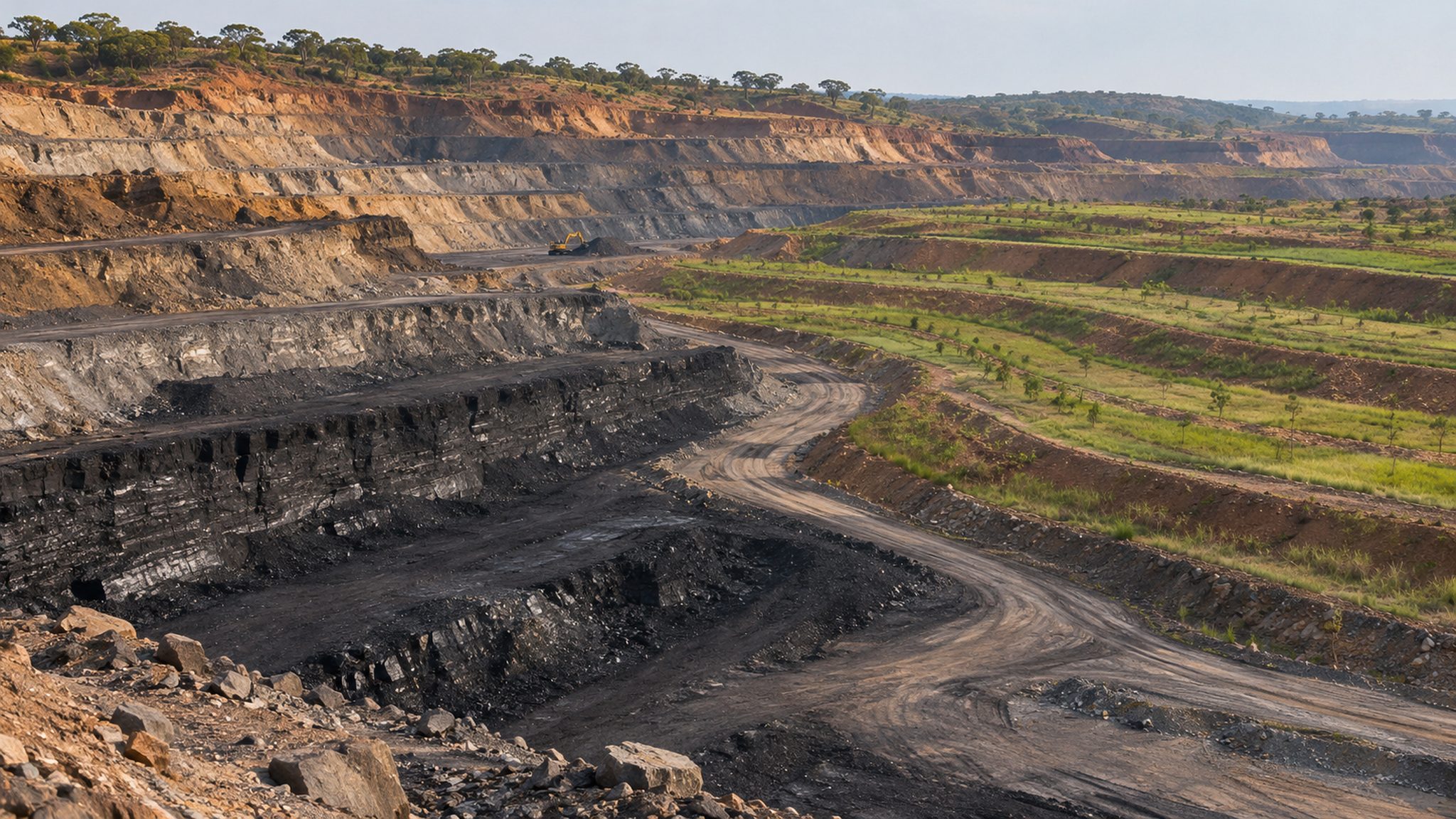
Mine closure begins while extraction continues, with money and activities planned across the life of the site.
- Mine closure covers securing and restoring a site during development, production and the period after mining ends. This lifecycle approach makes restoration a continuing obligation throughout the approved mining plan.
- The operator must open an escrow account in a scheduled commercial bank before mining begins and make annual contributions. A tripartite agreement involves the Coal Controller Organisation in the funding arrangement.
- A progressive closure plan addresses work undertaken during operations, while a final plan covers the remaining obligations. Revised final planning must account for monitoring data, updated costs and the available escrow balance.
- Restoration may include vegetation, water bodies and habitat rehabilitation. Selecting suitable future uses requires site assessment, as the earlier SUVIKALP mine-repurposing note explains through its land-use suitability framework.
- The guidelines require the operator to meet costs exceeding the escrow balance when final closure costs are higher. A dedicated account supports financing, while the underlying closure obligation continues to rest with the operator.
How Annual and Periodic Claims Differ
The reimbursement route changes with the claim year, creating different checks before the operator submits its claim.
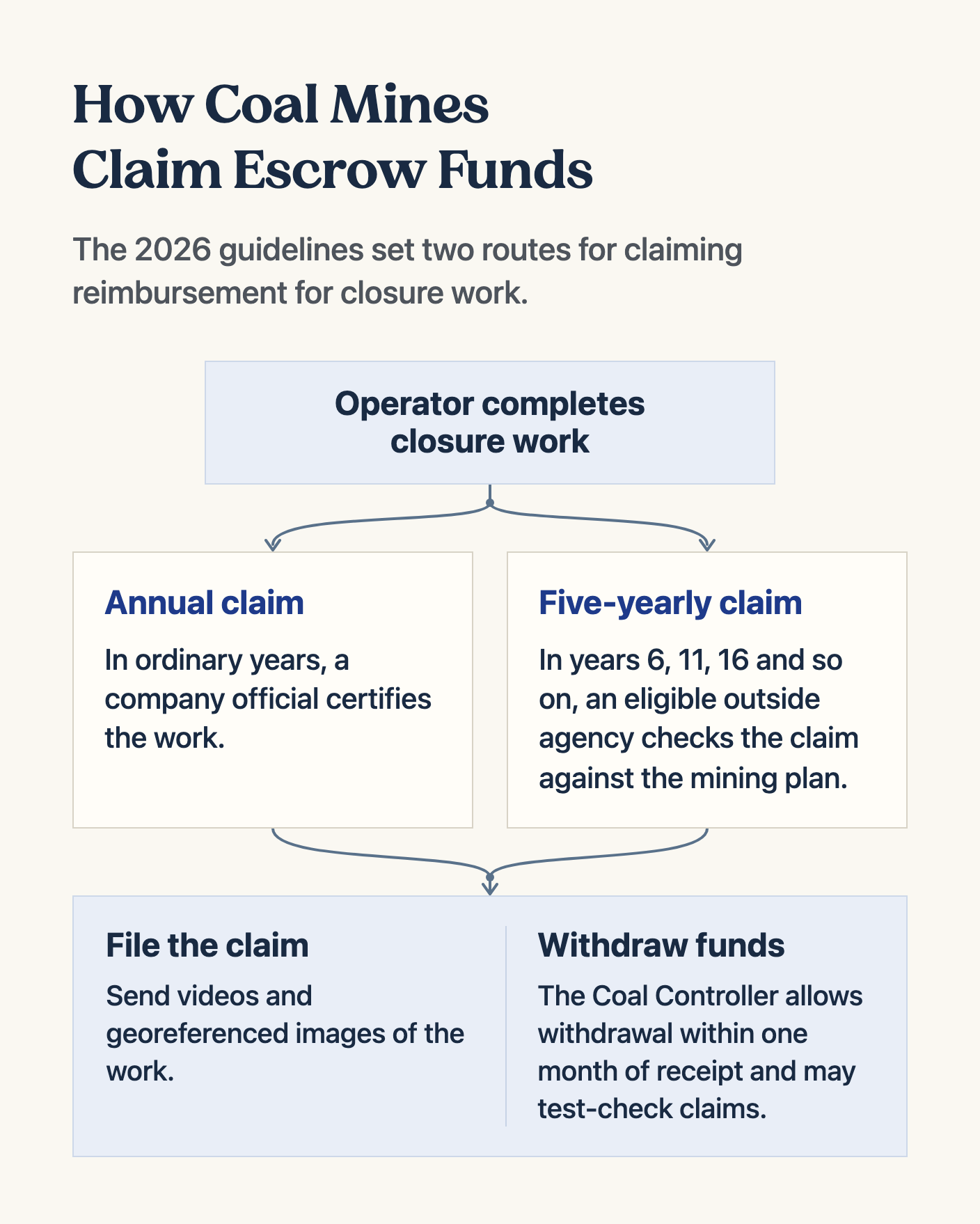
- For an annual claim, an authorized company official self-certifies completed closure work. The claim can cover up to half the previous year’s deposit, excluding interest, and must remain tied to work performed.
- In year 6, year 11, year 16 and subsequent five-year intervals, the claim uses a separate periodic route. The annual reimbursement route does not apply in those particular years.
- Before a periodic claim is submitted, an eligible outside agency verifies it against the mining plan. Eligible bodies include CMPDIL, specified public engineering institutions and NEERI, alongside other centrally authorized agencies.
- Both routes require videos and georeferenced images of completed work to accompany submission. These records connect the expenditure claim to a visible activity and its location, supporting scrutiny of the operator’s declaration.
- The Coal Controller must allow withdrawal within one month after receipt and may test-check claims. Outside verification applies before periodic submissions, while annual claims begin with the company official’s self-certification.
What Reimbursement Establishes
An escrow withdrawal addresses eligible expenditure, while final closure certification depends on completed obligations and post-closure assessment.
- The closure certificate follows post-closure monitoring, an undertaking from the operator and a third-party audit. The auditor must check completion of activities listed in the final closure plan before certification proceeds.
- The remaining escrow balance is reimbursed when the closure certificate is issued. This connects release of the final balance with a distinct completion decision after the earlier reimbursements for ongoing closure work.
- Where planned activities appear unfulfilled, the Coal Controller may issue notice of intended forfeiture. The decision requires Central Government approval, providing an enforcement route when the operator fails to carry out closure obligations.
- The new guidelines complement the existing statutory framework. Approval timelines and escrow arrangements should be read alongside applicable environmental, forest and safety requirements when assessing whether a project can proceed lawfully.
- Underground coal gasification is recognized within the planning framework. Its incorporated guidance concerns mining methods, while the earlier surface gasification note addresses above-ground industrial conversion and project selection.
Way Forward
Make Closure Evidence Auditable
- Compare georeferenced records with approved activities and expenditure claims so that location, work and payment can be reconciled.
- Use test-check findings to identify recurring weaknesses in self-certification and to improve the quality of future claim scrutiny.
- Track restoration and livelihood outcomes alongside reimbursements, including the condition of water bodies, revegetated land and assets intended for communities.
Conclusion
- The guidelines connect closure finance with completed work through annual self-certification, periodic outside verification and documented claims. Their effectiveness depends on whether those checks establish that the promised activities were carried out.
- A sound assessment follows the entire chain from annual deposits to final certification, including the operator’s continuing responsibility when available funds fall short of the cost of closure.
UPSC Practice Questions
Prelims MCQ 1
With reference to the 2026 coal mine closure guidelines, consider the following statements:
- Annual closure reimbursement claims are based on self-certification by an authorized company official.
- The periodic claim in the sixth year requires verification by an eligible outside agency before submission.
- The annual reimbursement route also applies in the sixth year alongside the periodic claim.
How many of the above statements are correct?
(a) Only one (b) Only two (c) All three (d) None
Answer: (b) Only two
Explanation:
Statements 1 and 2 are correct. The annual route does not apply in years when the separate periodic reimbursement route applies.
Prelims MCQ 2
Which event permits reimbursement of the remaining escrow balance under the final closure process?
(a) The first annual production report (b) Expiry of the mining equipment warranty (c) Issue of the mine closure certificate (d) Submission of an exploration proposal
Answer: (c) Issue of the mine closure certificate
Explanation:
The guidelines link reimbursement of the balance to issue of the mine closure certificate after the required monitoring, undertaking and third-party audit.
UPSC Mains Questions
- Explain how escrow arrangements can improve accountability for mine closure. Discuss the limitations of relying on expenditure records alone.
- Assess how differentiated verification of annual and periodic claims can balance administrative speed with environmental accountability.
Sources: PIB, Ministry of Coal and Ministry of Coal, Mining Plan and Mine Closure Guidelines 2026.
Frequently Asked Questions
When do the new coal mine closure guidelines take effect?
They were issued on November 20, 2026 and take effect 30 days after issuance. The Ministry announced them on November 23, so the announcement and commencement occur at different times.
What is a mine closure escrow account?
It is an account in a scheduled commercial bank dedicated to mine closure funds. The operator deposits annual contributions and claims reimbursement for eligible completed work under the prescribed procedures.
Who verifies periodic reimbursement claims?
Eligible agencies verify periodic claims before submission and compare them with the mining plan. They include CMPDIL, specified public engineering institutions, NEERI and other agencies authorized by the Central Government.
Does reimbursement certify that a mine is fully closed?
Final closure certification has its own requirements, including post-closure monitoring, an operator undertaking and a third-party audit of completed activities. Reimbursements during operations cover eligible closure work undertaken along the way.
Tell Google you want more of this.
Add Anantam IAS as a preferred sourceOne tap, and this site shows up more often in your own Top Stories, AI Overviews and AI Mode. Remove it any time.