Why in News?
On November 23, 2026, the Department of Science and Technology described an IASST study using MOF-based hybrid materials to degrade pyrene under irradiation and ultrasonication.
- IASST, Guwahati developed a porous framework containing copper nanowires with additional metallic components.
- The study examined palladium and aluminium systems for light absorption and pollutant degradation.
- Reported performance concerns controlled experimental conditions involving both irradiation and ultrasonication.
- Environmental materials research connects chemical structure with pollutant treatment, resource use and practical operating requirements.
- Evidence appraisal requires attention to the experimental setting and the environmental outcome actually measured.
UPSC Relevance
Prelims Relevance
- Metal-organic frameworks and porous materials
- Photocatalysis and light absorption
- Pyrene as a polycyclic aromatic hydrocarbon
- Charge transfer at material interfaces
- Laboratory degradation and field validation
Mains Relevance
GS Paper 3
- Scope and limitations of emerging environmental technologies
- Material selection, energy demand and verification before deployment
Background and Context
Why Combine a Framework With Metallic Components
A hybrid material brings several functions into close contact within one structure.
- Metal-organic frameworks are porous molecular structures with spaces through which gases and chemicals can move. Their internal architecture provides a setting in which other components can interact with surrounding substances.
- The reported IRMOF-8 framework confines copper nanowires and helps bring components close together. The research question concerns how this arrangement supports light absorption and charge transfer during the treatment process.
- Metallic nanowires are narrow, elongated structures with electrical and optical properties useful in light-driven systems. In this study, their role is part of a combined material whose components influence one another.
- Palladium was incorporated to improve broadband light absorption through plasmonic interactions. The official account associates this enhancement with the hybrid structure and its photocatalytic activity under the investigated experimental conditions.
- Aluminium was investigated as an abundant alternative to palladium. This choice addresses reliance on a noble metal, while any advantage in operating cost still requires evidence about the complete treatment system.
How Light-Assisted Pollutant Degradation Works
The study connects light capture with charge transfer and the breakdown of a target pollutant.
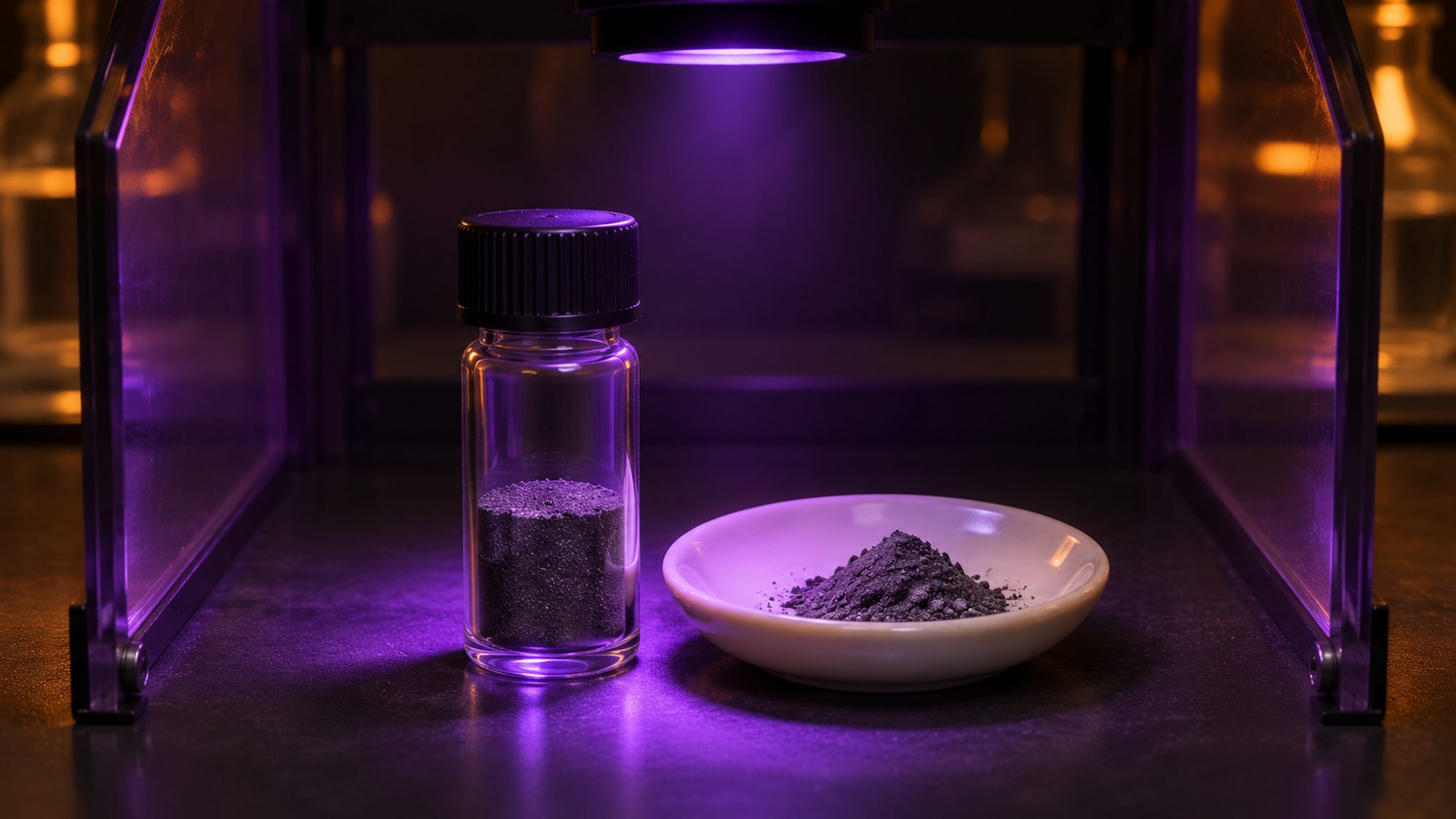
- Photocatalysis uses light to promote chemical reactions with the help of a catalytic material. The useful question is whether the material captures available light and transfers that energy into the intended chemical process.
- Plasmonic interactions help the metallic components interact strongly with light. The release describes absorption extending across visible and near-infrared wavelengths, giving the material a broader light-harvesting role within the hybrid system.
- Interfacial charge transfer means movement of charge between adjoining components. Close contact within the porous framework can support this movement, connecting the material arrangement to its reported activity against the pollutant.
- Pyrene is the persistent polycyclic aromatic hydrocarbon targeted in the experiments. Results for a named compound establish evidence about that target under the tested conditions and require further work before broader pollution claims.
- Irradiation and ultrasonication were both part of the reported investigation. A description of performance must retain those conditions because attributing the full result to sunlight alone changes what the experiment establishes.
What Must Be Established Before Field Use
A promising laboratory result begins a sequence of environmental and engineering checks.
- Removal and complete mineralisation answer different questions. A reduction in the original pollutant requires further analysis of the products formed before concluding that treatment has eliminated toxicity or produced environmentally harmless outputs.
- Real water conditions can differ from a controlled experiment. Further assessment should examine mixed contaminants, variable water composition and operating conditions before estimating how reliably the material would perform outside the laboratory.
- Material stability matters during repeated use. Evaluation should examine whether the framework and metal components remain effective, whether components enter treated water and how spent material can be recovered or managed.
- System-level assessment should include energy supplied for light and ultrasonication, material inputs and maintenance. The comparison between palladium and aluminium addresses one design choice within this wider practical evaluation.
- Independent validation benefits from accessible instruments and repeatable measurements. The broader shared research equipment model illustrates why access to testing capacity matters when assessing an emerging technology.
Way Forward
Evaluate the Whole Treatment Outcome
- Track transformation products alongside the parent pollutant and assess toxicity after treatment.
- Test repeated operation under representative water conditions, recording energy demand and material recovery.
- Compare alternatives on treatment outcomes and total operating requirements before proposing field deployment.
- Connect research with public health by keeping water safety outcomes central to the water and disease-prevention discussion.
Conclusion
- MOF hybrid research shows how porous architecture, light absorption and charge transfer can be combined to investigate pollutant degradation under controlled conditions.
- Deployment decisions need evidence on treatment products, toxicity, material stability and operating demands. An exam answer should connect the scientific mechanism to these conditions for practical environmental benefit.
UPSC Practice Questions
Prelims MCQ 1
With reference to the reported IASST study, consider the following statements.
- The hybrid material combines a metal-organic framework with metallic components.
- The reported investigation included irradiation and ultrasonication.
- The results establish complete removal of environmental toxicity in all natural water bodies.
How many of the above statements are correct?
(a) Only one (b) Only two (c) All three (d) None
Answer: (b) Only two
Explanation:
Statements 1 and 2 describe the reported material and conditions. Laboratory results do not establish universal field performance or complete elimination of toxicity.
Prelims MCQ 2
Which assessment most directly strengthens a claim that a pollutant treatment is environmentally safe?
(a) Measuring only the appearance of the untreated sample (b) Naming the most expensive component (c) Analysing transformation products and toxicity after treatment (d) Reporting only the institution conducting the experiment
Answer: (c) Analysing transformation products and toxicity after treatment
Explanation:
Transformation products and post-treatment toxicity help establish the environmental meaning of a reduction in the original pollutant.
UPSC Mains Questions
- Explain how MOF-based hybrid materials can support photocatalysis. Discuss the evidence needed to assess their environmental usefulness.
- Why should laboratory pollutant-removal results be evaluated alongside toxicity, material stability and operating requirements before field deployment?
Source: PIB, Department of Science and Technology.
Frequently Asked Questions
What is a metal-organic framework?
A metal-organic framework is a porous molecular structure. Its internal spaces can accommodate substances and other components, enabling researchers to investigate functions such as adsorption, light-assisted reactions and interactions between materials.
What did the IASST study investigate?
The study investigated hybrid materials combining a porous framework, copper nanowires and palladium or aluminium components. The official account reports pyrene removal under irradiation and ultrasonication conditions.
Why is aluminium relevant to the study?
Aluminium was investigated as an abundant alternative to palladium with useful plasmonic properties. Its potential to reduce reliance on noble metals requires evaluation alongside the performance and operating demands of the complete system.
Does pollutant removal prove that treated water is harmless?
A decline in the parent pollutant needs additional evidence about transformation products and toxicity. Assessment should also consider material stability, possible component release and the conditions under which treatment remains effective.
Tell Google you want more of this.
Add Anantam IAS as a preferred sourceOne tap, and this site shows up more often in your own Top Stories, AI Overviews and AI Mode. Remove it any time.