The idea sounds backwards on first read. A solar panel that works at night. No sun, no light, no obvious fuel. And yet Moonlight Solar Panels are real, they have a working prototype, and the physics is older than the photovoltaic effect itself. The trick is that you stop trying to absorb energy and start trying to release it.
Stanford engineers, working with off-the-shelf thermoelectric chips and a standard silicon solar cell, demonstrated a device that produces tens of milliwatts per square meter after sundown. That is roughly a thousand times less than a daytime panel. It is also roughly enough to power a small LED, a sensor node, or a low-bandwidth radio. For grid replacement, it is irrelevant. For agriculture telemetry in a Vidarbha village without a battery bank, it is genuinely useful.
The why-in-news angle for India is sharper than the global headlines suggest. Our renewable buildout is overwhelmingly daytime solar. The duck curve, the storage gap, and the diesel-set fallback for night load are all real costs we pay for that lopsided mix. Anything that tilts the balance, even by a sliver, deserves a closer look.
Quick Facts at a Glance
- What it is: A device that generates electricity at night using radiative cooling and the Seebeck effect.
- Output: About 50 mW per square meter, scaling with sky clarity and ambient temperature.
- Lead research: Shanhui Fan’s group at Stanford, with later prototypes from UCLA and UNSW Sydney.
- Mechanism: Thermoelectric generator sandwiched between the warm ground side and a cold sky-facing emitter.
- Status: Lab and field prototypes; no commercial product as of April 2026.
- Key application target: Off-grid sensors, IoT, rural lighting, low-power telecom.
What Just Happened: Why Moonlight Solar Panels Are in the News
A fresh round of peer-reviewed work, picked up by Indian science press in late April 2026, pushed Moonlight Solar Panels back into mainstream coverage. The new prototype reported a stable ~50 mW per square meter output across a 12-hour night window in clear-sky conditions, with degraded but still measurable output under thin cloud cover.
What changed is not the physics. The physics has been understood since the 19th century. What changed is the integration. Earlier demonstrations needed bulky heat sinks, exotic emitters, and lab-grade vacuum gaps. The current generation uses commodity thermoelectric chips, a polymer film tuned to emit in the 8-13 micron atmospheric window, and a passive aluminum spreader. That brings the bill of materials into a range where pilot deployments stop being absurd.
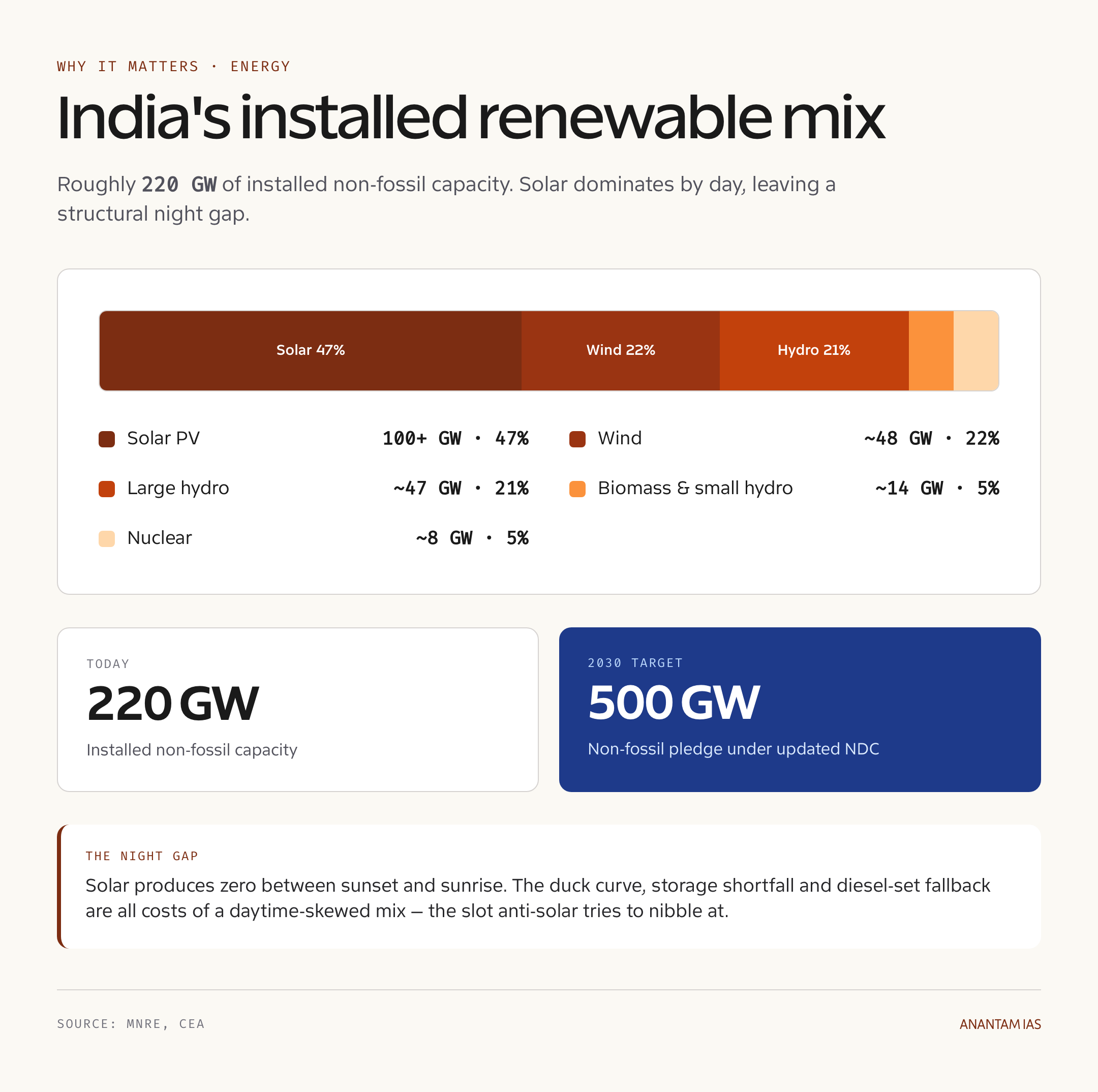
For India, the news lands at an awkward moment. The country has crossed 220 GW of installed renewable capacity, with solar leading at over 100 GW. Storage is the bottleneck. Battery prices are softening but pumped hydro is slow to build. Anything that produces electrons in the dark hours, even at low density, gets attention from policymakers who have been burned by storage timelines.
Background and Historical Context
How a Moonlight Solar Panel Generates Electricity at Night
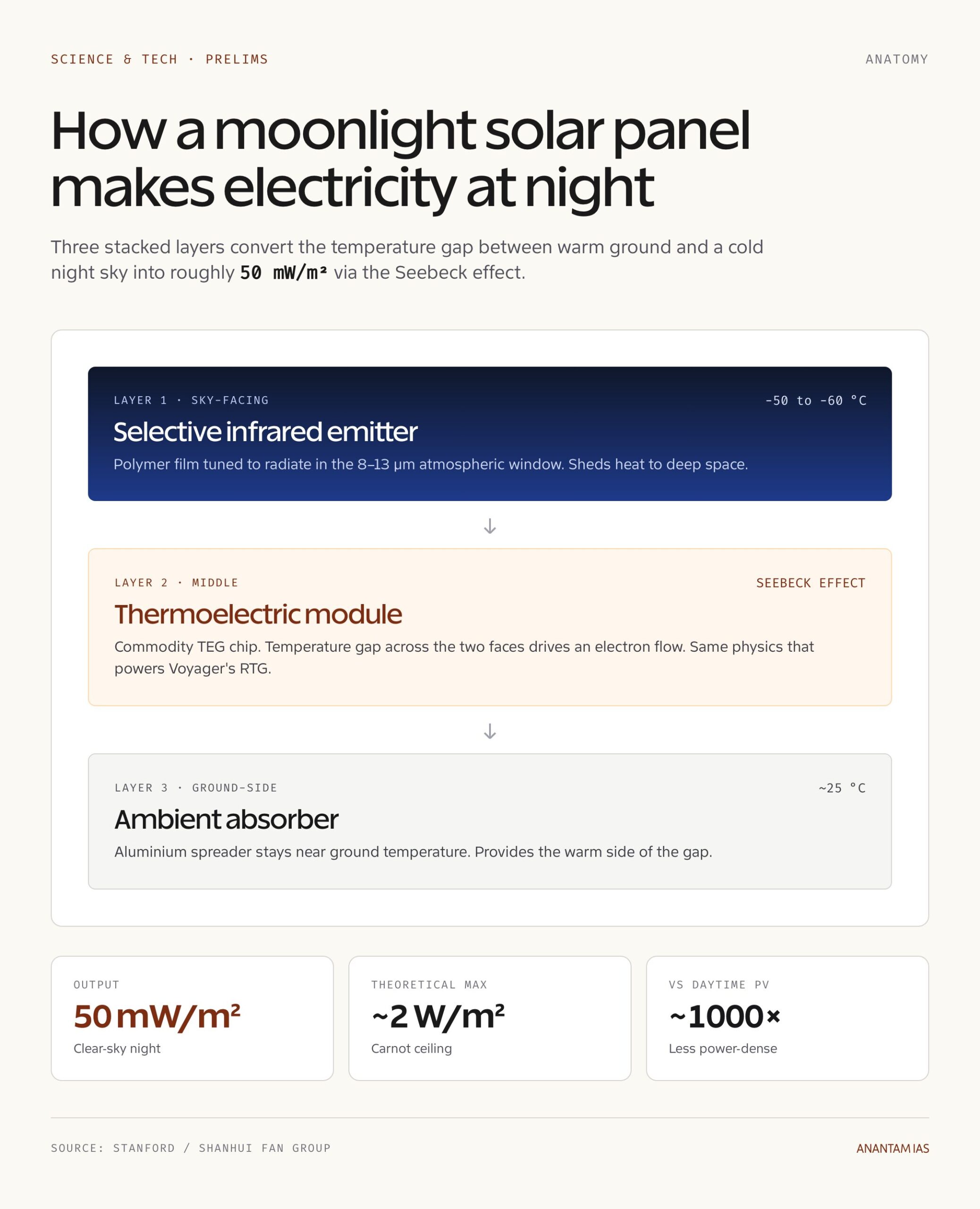
The night sky is cold. Not metaphorically, literally. The effective temperature of clear sky in the 8-13 micron infrared window sits around -50 to -60 degrees Celsius. The ground, even at 2 a.m. in Jaisalmer, is warmer than that. Whenever you have a temperature gap between two surfaces, you have the raw material for a thermoelectric generator.
The Moonlight Solar Panel, more accurately called an anti-solar panel or a radiative-cooling generator, uses three layers stacked together:
- A sky-facing emitter engineered to radiate strongly in the atmospheric window. This is usually a thin polymer or a multilayer dielectric stack tuned to those wavelengths.
- A thermoelectric module in the middle. When one side is colder than the other, electrons flow. This is the Seebeck effect, the same principle that powers radioisotope generators on Voyager.
- A ground-facing absorber that stays close to ambient air temperature, providing the warm side of the gap.
By day, you can flip the same architecture and use it as a hybrid panel: photovoltaics on top harvest sunlight while the radiative-cooling layer underneath shaves a few degrees off the cell temperature, which boosts PV efficiency. So the device is not strictly a night-only product. It is more like a 24-hour panel where the night shift produces a much smaller paycheck.
Output is fundamentally limited. The Carnot efficiency between a 25-degree ground and a -50-degree sky caps the conversion at single-digit percent. Real-world thermoelectrics are below that ceiling. The Stanford team’s paper estimated a theoretical maximum near 2 W per square meter under ideal desert-sky conditions, which is still less than 2% of midday solar irradiance.
Why It Matters for India’s Renewable Mix
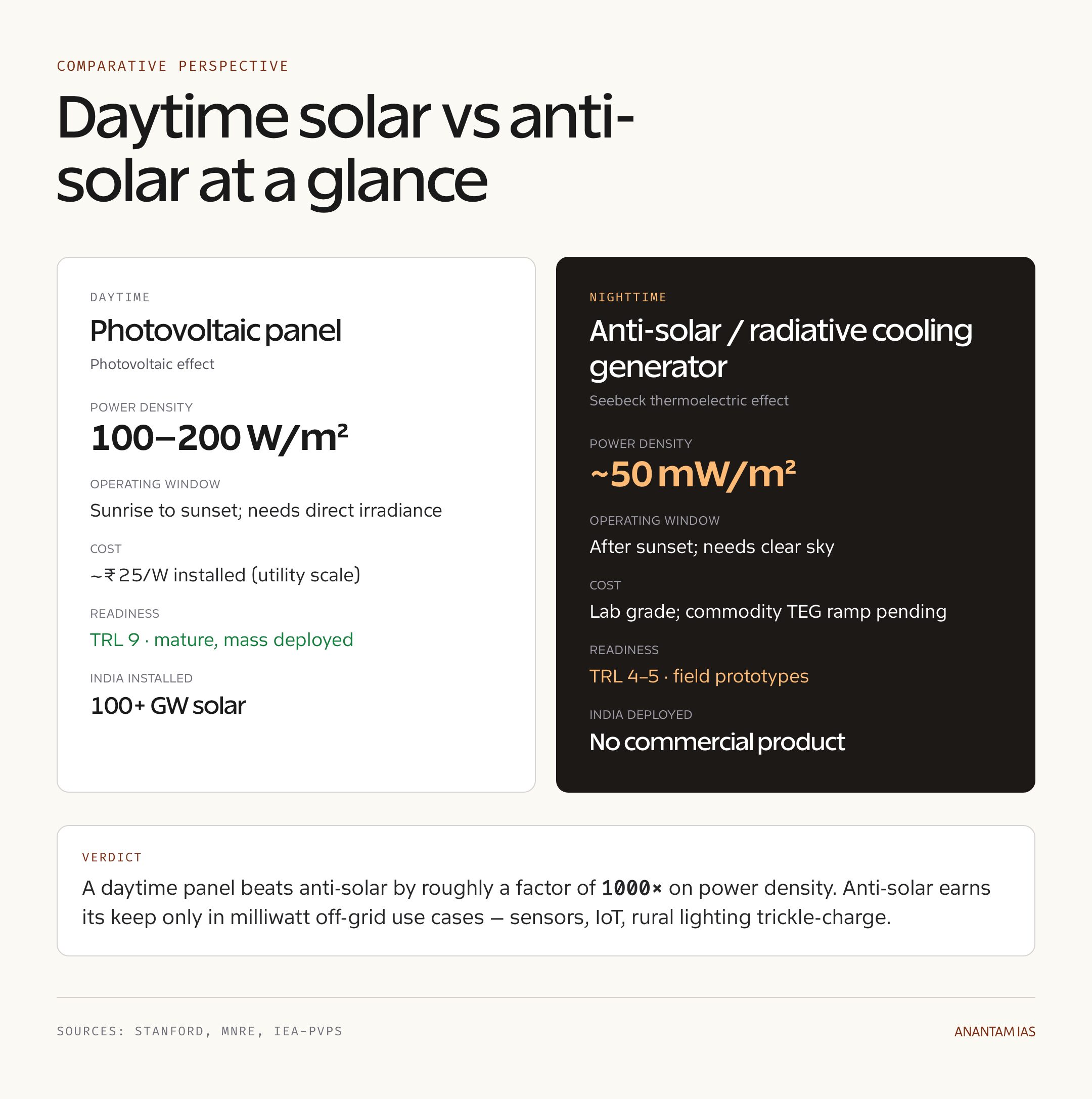
India’s renewable strategy has a structural night problem. As per latest available data, solar contributes roughly 47% of installed renewable capacity but produces zero between sunset and sunrise. Wind helps, hydro helps, nuclear runs flat baseload. But the gap between evening peak demand and daytime solar surplus is widening as electrification deepens.
Utility-scale storage is the obvious answer. It is also expensive, supply-chain-dependent, and slow to deploy. Pumped hydro requires geography and clearances we do not always have. Battery storage tenders have been competitive but the rupee cost per kilowatt-hour over the asset’s lifetime is still higher than gas peaking in many states.
Moonlight Solar Panels do not displace any of this at grid scale. They produce milliwatts where the grid needs gigawatts. Where they earn their keep is in the long tail of distributed loads we currently solve with diesel, kerosene, or nothing at all. Read the related explainer on India’s energy poverty and the case becomes obvious. Forty million Indians still lack reliable electricity. They do not need 500 watts at 2 a.m. They need a phone charge, a light, and a sensor for the irrigation pump.
Detailed Analysis: Where Moonlight Solar Panels Fit
The honest framing is that anti-solar is a niche complement, not a replacement. Three deployment categories make sense.
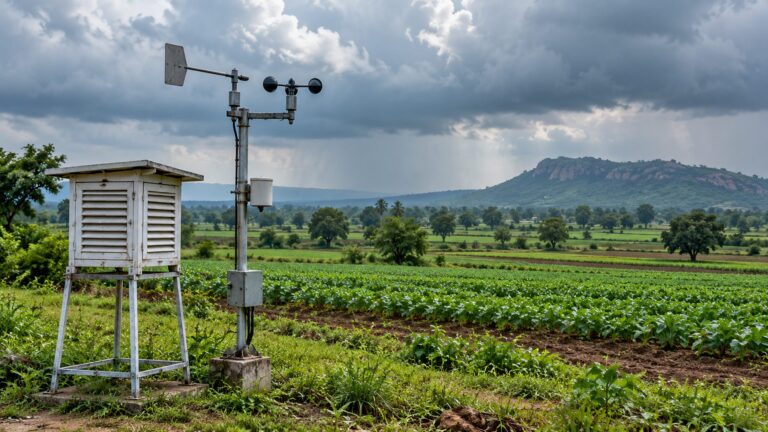
Off-grid sensor networks. Soil moisture probes, weather stations, livestock collars, and pipeline monitors all run on milliwatts. A small thermoelectric generator with a supercapacitor buffer can keep these alive without battery swaps. Battery-free IoT is a hot research area for exactly this reason.
Rural lighting trickle-charge. Solar lanterns die when the panel cannot reach the sun for three cloudy days. A passive nighttime trickle adds resilience without adding to the user’s bill. The economics depend entirely on bringing per-unit cost below 100 rupees per square meter.
Hybrid PV efficiency boost. This is the underrated story. If the radiative-cooling layer drops PV cell temperature by 5 to 10 Celsius, you gain 2-4% efficiency during the day. That is structurally larger than the night-time output. For utility-scale plants, the cooling effect alone could justify the integration before the night generation is counted.
What it cannot do is power a household. A 100-watt LED bulb running 4 hours a night needs 400 Wh of energy. Even at the theoretical 2 W per square meter ceiling, you would need 50 square meters of anti-solar panel for one bulb. A regular daytime panel plus a 1 kWh battery does the same job in less than 1 square meter for less money.
Comparative Perspective: Anti-Solar Versus Other Night Power Options
Compared to small-scale wind, anti-solar is silent, has no moving parts, and works in dead-calm conditions. It loses on power density by an order of magnitude.
Compared to thermal storage like molten salt, anti-solar is decentralized and modular. Thermal storage scales better but only works at utility scale and needs concentrating solar plants to feed it.
Compared to lithium-ion battery storage, anti-solar is cheaper per square meter but provides far less usable energy. Batteries store solar electrons. Anti-solar generates fresh, if anemic, ones. They are not really substitutes.
Compared to nuclear baseload, the comparison is silly. Read the primer on India’s nuclear energy push for what serious night power looks like. Anti-solar is a complement to the grid, not a competitor.
Challenges and Critiques
The technology is real but the gap between lab demo and useful product is wide. Five problems stand out.
Cloud cover kills output. The atmospheric window only opens under a clear sky. Monsoon India is overcast for months. In Cherrapunji or coastal Kerala, output collapses during the very months when solar is also weakest.
Power density is fundamentally low. No engineering breakthrough will push a Carnot-limited device past a few watts per square meter. This caps the addressable market.
Cost has not been driven down. Lab prototypes use small-batch thermoelectric chips at hundreds of rupees per cell. Mass production needs a credible supply chain that does not yet exist in India.
Hybrid integration adds complexity. Stacking radiative cooling, PV, and thermoelectrics into a single panel raises failure modes, weatherproofing concerns, and warranty headaches.
Hype risks crowding out steady investment. Every few years a flashy “solar at night” headline makes the rounds. Policymakers who confuse the milliwatt regime with the megawatt regime can divert funds from boring, working technologies like distribution upgrades and battery storage.
Moonlight Solar Panels and the Indian R&D Pipeline
The IISc Bangalore thermoelectrics group, the IIT Bombay nano-photonics lab, and CSIR-NPL Delhi all have research programs adjacent to this space. The Department of Science and Technology has historically funded radiative-cooling work for passive building cooling, which uses the same emitter physics. Translating that into an outdoor panel is a smaller leap than it looks.
A reasonable next step would be a five-crore pilot program funded jointly by MNRE and DST, deploying 1,000 anti-solar units across off-grid villages, agricultural sensor networks, and forest monitoring stations. Real-world data over two monsoons would clarify whether the Indian climate is the dealbreaker that critics suspect.
UPSC Prelims Pointers
- Moonlight Solar Panels work via radiative cooling and the Seebeck (thermoelectric) effect.
- The relevant infrared emission band is the atmospheric window at 8-13 micrometers.
- Lead research came from Shanhui Fan’s Stanford group; output is around 50 mW per square meter.
- Anti-solar panels are about 1,000 times less power-dense than daytime PV.
- They can also act as passive coolers to boost daytime PV efficiency by 2-4%.
- India’s installed renewable capacity has crossed 220 GW, with solar over 100 GW as per latest available data.
- The Ministry of New and Renewable Energy (MNRE) is the nodal ministry; MNRE was formed in 2006, evolving from the earlier Department of Non-Conventional Energy Sources (1982).
Mains Practice Questions
- “Moonlight Solar Panels demonstrate scientific elegance but limited grid relevance for India.” Critically examine the statement in the context of India’s renewable mix. (GS Paper III, 250 words)
- Discuss the role of distributed and off-grid renewable technologies in addressing energy poverty in India. How can anti-solar panels complement existing solutions? (GS Paper III, 150 words)
- The transition to renewable energy is constrained as much by storage and night-load gaps as by generation. Evaluate. (GS Paper III, 250 words)
- Examine the ethical and policy implications of investing public R&D funds in early-stage technologies whose practical payoff remains uncertain. (GS Paper IV / III, 150 words)
Way Forward
The right framing for Moonlight Solar Panels is sober optimism. The physics is sound, the prototypes are working, the bill of materials is dropping. None of that turns the device into a grid solution. What it can become, with disciplined investment and honest expectations, is the missing piece for a particular class of off-grid loads where batteries are too expensive, diesel is too dirty, and silence is a feature.
India should fund a small, focused pilot. Pair it with the existing thermoelectrics research at IISc and IIT Bombay. Set realistic milestones: cost per square meter, deployment uptime through a monsoon, total energy yield over a year. If the numbers come in, scale. If they do not, learn and move on. Either way, the conversation about renewable energy gets more nuanced, which is overdue. The night problem will not be solved by one technology. It will be solved by stitching together batteries, pumped hydro, demand management, nuclear baseload, and yes, the occasional unconventional sliver of milliwatts harvested from a cold sky.
Frequently Asked Questions
Q1. Are Moonlight Solar Panels really a thing or just a science headline?
They are real working prototypes. Multiple peer-reviewed papers from Stanford, UCLA, and UNSW Sydney have demonstrated nighttime electricity generation. No commercial product is on shelves yet.
Q2. How much electricity can a Moonlight Solar Panel produce?
Current prototypes deliver about 50 mW per square meter under clear-sky conditions. The theoretical ceiling is around 2 W per square meter, which is still about 50 times less than a midday solar panel.
Q3. Do Moonlight Solar Panels work on cloudy nights?
Output drops sharply under cloud cover because the atmospheric window for radiative cooling is blocked. In monsoon-heavy regions, performance during cloudy months is essentially zero.
Q4. Can Moonlight Solar Panels replace batteries in a home solar system?
No. Power density is too low. They could reduce battery requirements at the margin for very low-power applications like sensors or single-LED lights, but not for household loads.
Q5. Is India working on anti-solar panel research?
Yes, indirectly. IISc Bangalore, IIT Bombay, and CSIR-NPL have active research programs in thermoelectrics and radiative cooling. There is no flagship MNRE pilot yet but the building blocks are in place.
Q6. What is the difference between a normal solar panel and a Moonlight Solar Panel?
A normal panel converts sunlight to electricity via the photovoltaic effect. A Moonlight Solar Panel converts the temperature gap between the warm ground and the cold sky into electricity via the thermoelectric effect.
Q7. Could Moonlight Solar Panels help meet India’s 500 GW non-fossil target by 2030?
Not directly. The target will be met by utility-scale solar, wind, hydro, and nuclear. Anti-solar is too small in power density to move the needle at grid scale.
Q8. What are the main challenges for commercializing Moonlight Solar Panels in India?
Low power density, sensitivity to cloud cover, high per-unit cost, and the absence of a domestic thermoelectric supply chain. Pilot deployments would help clarify which of these are dealbreakers and which are solvable.
Tell Google you want more of this.
Add Anantam IAS as a preferred sourceOne tap, and this site shows up more often in your own Top Stories, AI Overviews and AI Mode. Remove it any time.