Why in News?
On November 11, the World Meteorological Organization and the UN Office for Disaster Risk Reduction reported that 136 countries had some capacity to issue multi-hazard early warnings.
- The 2026 report puts country coverage at 70%. Its headline count rose by 17 countries from March 2025.
- Small island developing States had the lowest reported coverage among the groups examined.
- Least Developed Countries had the lowest overall comprehensiveness scores despite making the greatest progress from their initial scores.
- A government can report a national capability while remote settlements still lack a reliable way to receive and understand a warning.
- The report associates more comprehensive systems with lower disaster losses. Preparedness decisions also need evidence from individual communities.
UPSC Relevance
Prelims Relevance
- WMO and UNDRR jointly produced the global status report.
- Country coverage uses countries as the unit of comparison.
- Comprehensiveness describes the extent of early warning capabilities.
- Anticipatory action uses advance information to act before the expected impact.
Mains Relevance
GS Paper 3
- Assess how a district can connect hazard information to timely protective action.
- Choose evidence of warning receipt, comprehension and response among exposed groups.
Essay
- Public infrastructure earns trust when the people facing danger can use it in time.
Background and Context
What Does Country Coverage Measure?
Start with the unit being counted. Each country enters the headline figure when it reports some multi-hazard early warning capability.
- A country count gives the same weight to a small island state and a populous continental country. Converting that count into a share of the world population would require separate population data.
- The measure identifies where a national capability exists. A country with alerts in several major cities can still face delivery gaps in dispersed settlements, including places where telecommunications fail during a storm.
- A multi-hazard system deals with more than one kind of threat. For a district facing coastal flooding and high winds, the warning should identify which hazard threatens which location.
- The comprehensiveness score asks how far a system has developed. The report can record a country as covered while its authorities are still improving forecasting, dissemination or arrangements for acting on alerts.
- Read the two country-group findings separately. The island states finding concerns reported coverage. The least developed countries finding concerns the depth of capability and the change from their starting point.
How Does a Forecast Reach a Household?
Consider a coastal village expecting a storm surge. The forecaster, district official and household each need different information before the water arrives.
- The forecaster estimates the hazard. Local authorities combine that information with exposure, such as the location of homes on low ground, to identify the settlements that may need to move.
- A technical forecast becomes an actionable warning when people can identify their locality, the expected timing and the protective action. A general announcement of rough weather leaves residents to guess whether to evacuate.
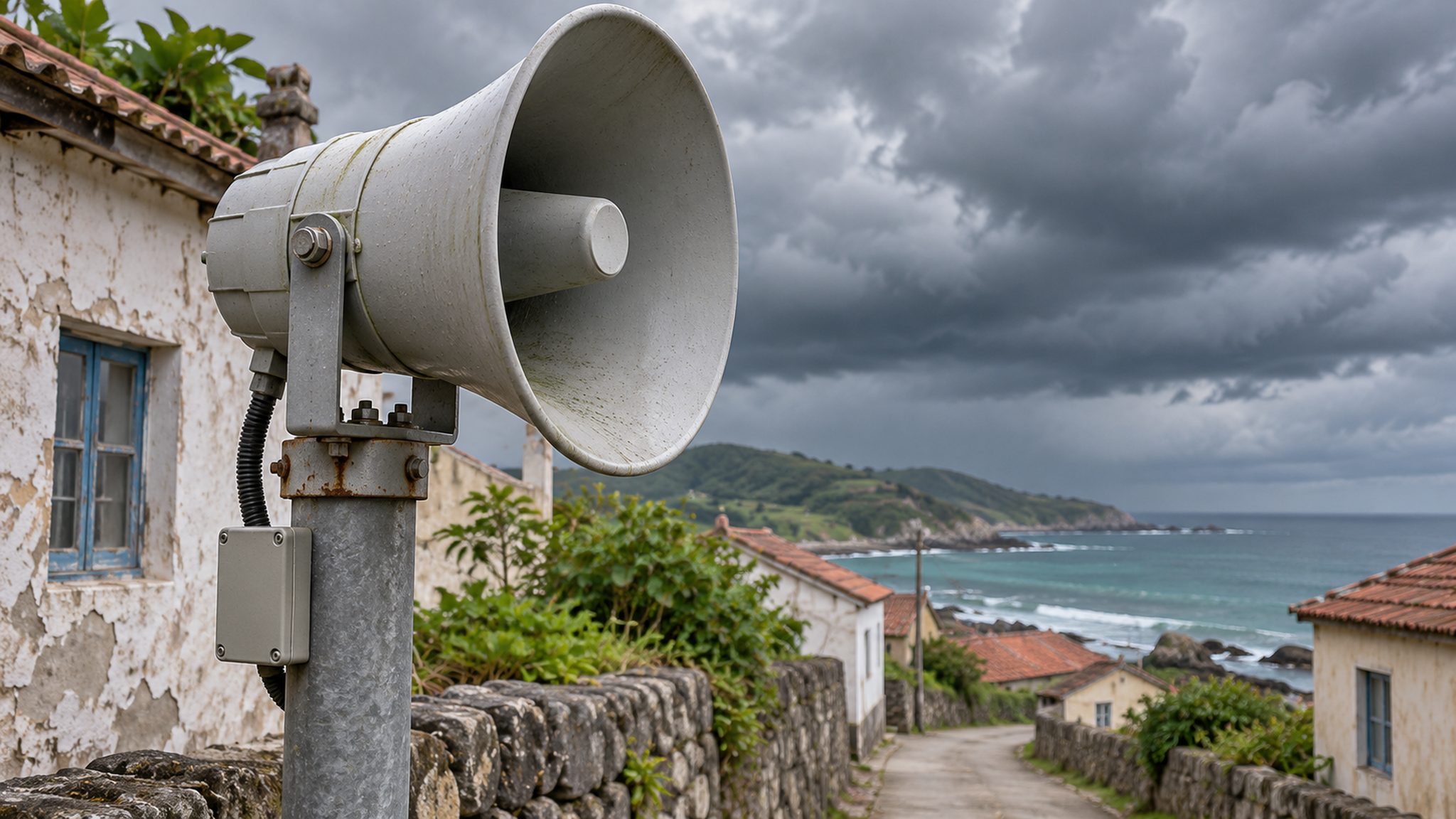
- A pole-mounted loudspeaker can carry an instruction to residents outdoors. The district should check whether households beyond earshot, people with hearing impairments and residents away from home receive an accessible message.
- Lead time has practical value only if the trip to safety fits within it. A family caring for someone with limited mobility may need help with transport well before the hazard peaks.
What Evidence Shows That a Warning Worked?
A district can trace a recent alert from the issuing office to the people who faced the hazard. Each check answers a different question.
- A dispatch record establishes when an authority sent the message and which areas it targeted. Delivery failures or interrupted power can still leave individual settlements outside the communication chain.
- Interviews after a drill can establish receipt and understanding. Ask residents what danger they expected, when they first heard the warning and what action they believed the message advised.
- Compare those answers with observed action. If residents understood the evacuation advice but could not reach a shelter, better transport or a nearer safe site addresses the obstacle more directly than another announcement.
- The international report finds an association between stronger systems and lower disaster impacts. Local exposure, housing and the severity of the event also influence losses when comparing outcomes across countries.
Way Forward
Test the Last Mile in a District Drill
- Select settlements with different communication conditions and record which residents receive an alert first and last.
- Ask participants to repeat the protective instruction in their own words and identify a safe destination.
- Use the results to assign responsibility for specific gaps, such as a missing accessible message, a broken relay or transport for residents who need assistance.
Conclusion
- Use the global coverage figure to describe the spread of national capability. Use comprehensiveness to assess the development of the systems countries report.
- For a district case study, follow one local warning through receipt, understanding and action. The first point where residents lose time identifies a practical place to intervene.
UPSC Practice Questions
Prelims MCQ 1
With reference to the 2026 global early warning report, consider the following statements.
- The headline coverage percentage measures the share of the world population that received a warning.
- Small island developing States had the lowest reported coverage.
- Least Developed Countries had the lowest overall comprehensiveness scores.
How many of the above statements are correct?
(a) Only one (b) Only two (c) All three (d) None
Answer: (b) Only two
Explanation:
Statements two and three describe different measures. The headline coverage figure counts countries reporting some capability.
Prelims MCQ 2
Which evidence best shows that a warning led to timely protective action?
(a) A ministry issued an advisory (b) A district purchased a loudspeaker (c) A forecast correctly identified a hazard (d) Residents received the warning and reached a safe place before impact
Answer: (d) Residents received the warning and reached a safe place before impact
Explanation:
Timely movement to safety links an alert with a protective response. The other observations document individual inputs or stages.
UPSC Mains Questions
- Explain how reported national early warning capability can coexist with substantial local protection gaps.
- Design a district-level review that distinguishes a failure of warning dissemination from a failure of preparedness.
Source: World Meteorological Organization and United Nations Office for Disaster Risk Reduction.
Frequently Asked Questions
What does the 70% coverage figure mean?
It describes the share of countries reporting some multi-hazard early warning system capability. To estimate the share of people reached, analysts would need separate local or population-level evidence.
How did the findings differ for island states and least developed countries?
Small island developing States had the lowest reported coverage. Least Developed Countries had the lowest overall comprehensiveness scores, although they had improved most from their initial position.
What is last-mile warning delivery?
It is the step that brings a usable warning to people facing a particular hazard. A local review should establish when people received the message and whether they understood its instruction.
How can a district assess preparedness after an alert?
Officials can compare reported receipt with the action people took. Residents who understood the alert may still have faced transport difficulties or lacked access to a suitable shelter.
Tell Google you want more of this.
Add Anantam IAS as a preferred sourceOne tap, and this site shows up more often in your own Top Stories, AI Overviews and AI Mode. Remove it any time.