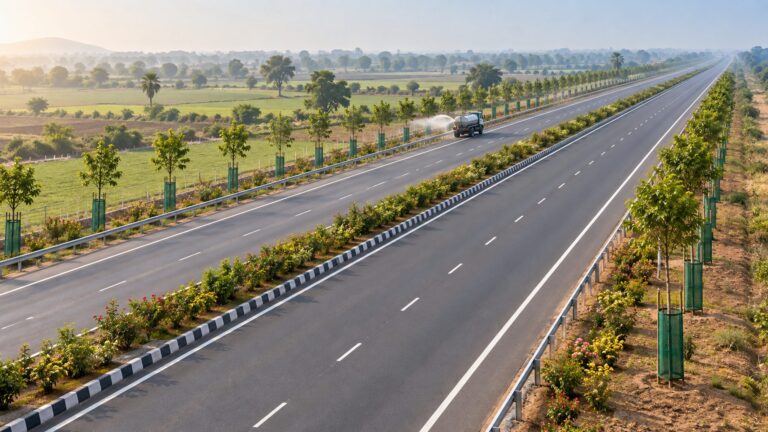
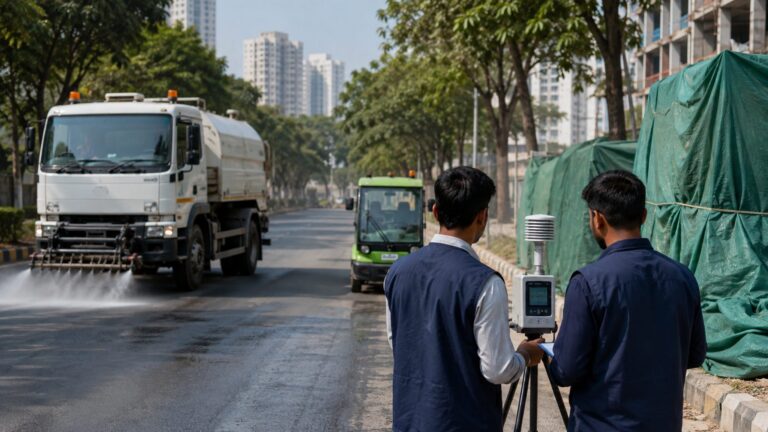
The National Mission for Clean Ganga reviewed smart STP monitoring, digital dashboards and effluent-surveillance tools in January 2026. The update pointed to a shift from building sewage infrastructure to monitoring whether it actually performs.
For UPSC, this is the exact distinction that matters. River cleaning fails when projects are counted as assets but pollution load is not continuously tracked, enforced and corrected.
This article uses the smart STP dashboard update to explain Namami Gange, sewage treatment, river pollution governance and the implementation gap in environmental policy.
Quick Facts
- The update came through the 17th Empowered Task Force review under Namami Gange.
- Smart STP monitoring and digital dashboards were highlighted.
- STP stands for Sewage Treatment Plant.
- NMCG is the National Mission for Clean Ganga.
- River pollution is driven by sewage, industrial effluents, solid waste and ecological-flow stress.
- Official source: PIB Jal Shakti release dated 5 January 2026.
- Official source: PIB, Ministry of Jal Shakti.
What Just Happened
The National Mission for Clean Ganga reviewed digital monitoring systems for sewage treatment plants and river-cleaning progress.
The policy direction is important because India has often built treatment capacity without ensuring utilisation, power supply, maintenance and compliance.
For aspirants, this is a practical case where environmental governance depends on data, local bodies, contracts and enforcement rather than only central funding.
Background and Historical Context
Namami Gange was launched as an integrated mission to reduce pollution, conserve biodiversity and improve riverfront and public participation components in the Ganga basin.
Earlier river-cleaning efforts struggled because sewage generation outpaced treatment capacity and local urban bodies lacked funds and technical capacity.
Hybrid annuity models, one-city-one-operator contracts and real-time monitoring are attempts to improve long-term operation and maintenance.
Key Features of River Governance
The core policy architecture can be read through these features.
- Smart monitoring: dashboards track STP performance and effluent quality.
- Accountability: real-time data can expose non-performing treatment plants.
- Urban link: municipal sewage remains the biggest pollution source.
- Basin approach: Ganga governance must cover tributaries and urban clusters.
- Institutional coordination: NMCG, states, ULBs and regulators all matter.
- Outcome focus: river health depends on treated discharge, not sanctioned capacity.
Why It Matters
This is a high-yield UPSC topic because it joins current news with durable syllabus themes.
- It connects a January 2026 event with durable UPSC syllabus themes.
- It gives usable facts for Prelims and analytical hooks for Mains.
- It helps students move from news recall to policy reasoning.
- It can be linked with static concepts in polity, economy, governance, science, environment or society.
Detailed Analysis: River Governance Lens
The dashboard is only as good as the sensor and the response. Data must trigger enforcement, maintenance and financing decisions.
STPs fail because O&M fails. Many plants underperform due to power costs, weak sewer connections, poor maintenance and lack of skilled staff.
River cleaning is urban governance. Unless cities manage sewage and solid waste, river missions will remain downstream clean-up efforts.
Comparative Perspective
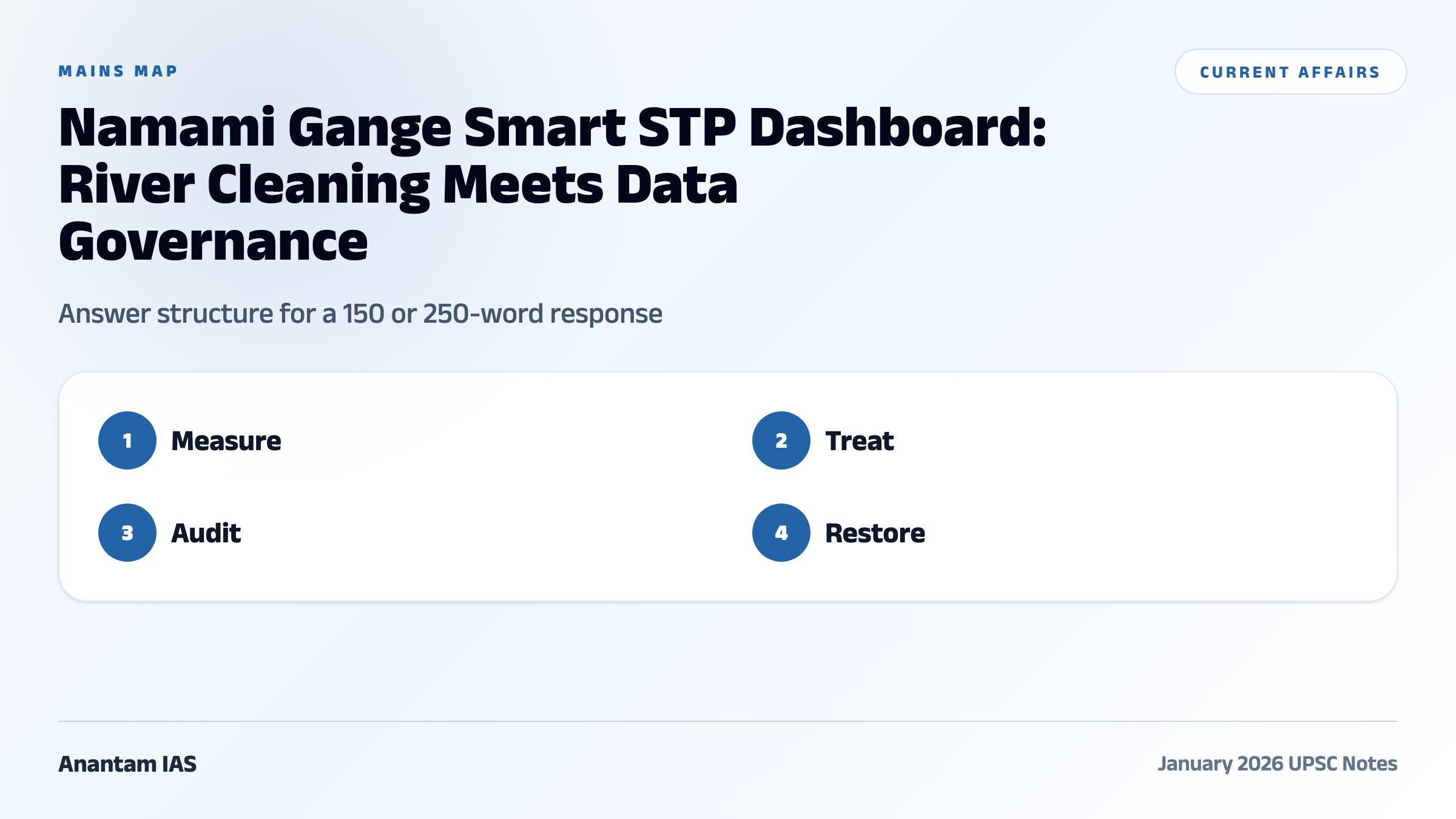
A comparison helps prevent the answer from becoming a one-dimensional news summary.
- Ganga Action Plan: early focus on infrastructure but weak implementation.
- Namami Gange: integrated mission with stronger central financing and monitoring.
- Hybrid annuity model: links payment to long-term plant operation.
- Smart dashboards: add performance visibility to the mission.
Challenges
The policy or institutional promise runs into recurring constraints.
- Sewer networks often do not connect all households to STPs.
- Small towns lack technical and financial capacity.
- Industrial effluent enforcement can be uneven.
- River ecology also needs environmental flows, not only pollution control.
- Data manipulation or sensor failure can weaken real-time systems.
Prelims Pointers
- NMCG implements Namami Gange.
- STP stands for Sewage Treatment Plant.
- CPCB and State Pollution Control Boards regulate pollution standards.
- Biochemical Oxygen Demand is a common water-quality indicator.
- Environmental flow refers to water needed to sustain river ecosystems.
- Hybrid annuity model combines construction and long-term operation payments.
Mains Questions
- River cleaning in India is as much an urban-governance challenge as an environmental challenge. Discuss. (GS Paper III, 250 words)
- How can real-time monitoring improve pollution-control outcomes? (GS Paper III, 150 words)
- Evaluate Namami Gange’s shift from infrastructure creation to performance monitoring. (GS Paper III, 250 words)
- Why do sewage-treatment plants underperform in Indian cities? Suggest reforms. (GS Paper II/III, 250 words)
Way Forward
Smart dashboards should be backed by public data disclosure, independent audits and penalty-linked O&M contracts.
Urban local bodies need predictable funds and technical capacity to run sewage systems after construction.
The exam answer should avoid a simplistic claim that STP capacity equals river cleanliness. Utilisation and compliance are the real test.
The examiner is unlikely to reward a bare fact dump here. The better answer connects the January 2026 event to institutional design, implementation capacity and India’s long-term development priorities.
Frequently Asked Questions
What is an STP?
A Sewage Treatment Plant treats wastewater before discharge into rivers or other water bodies.
What is NMCG?
The National Mission for Clean Ganga is the implementation agency for Namami Gange.
Why are dashboards useful?
They can track plant performance, effluent quality and gaps in near real time.
What is the main pollution source in rivers?
Untreated municipal sewage is one of the biggest sources.
What is BOD?
Biochemical Oxygen Demand is a measure of organic pollution in water.
What is the UPSC angle?
Environment, urban governance, data systems, federal coordination and implementation capacity.
Tell Google you want more of this.
Add Anantam IAS as a preferred sourceOne tap, and this site shows up more often in your own Top Stories, AI Overviews and AI Mode. Remove it any time.