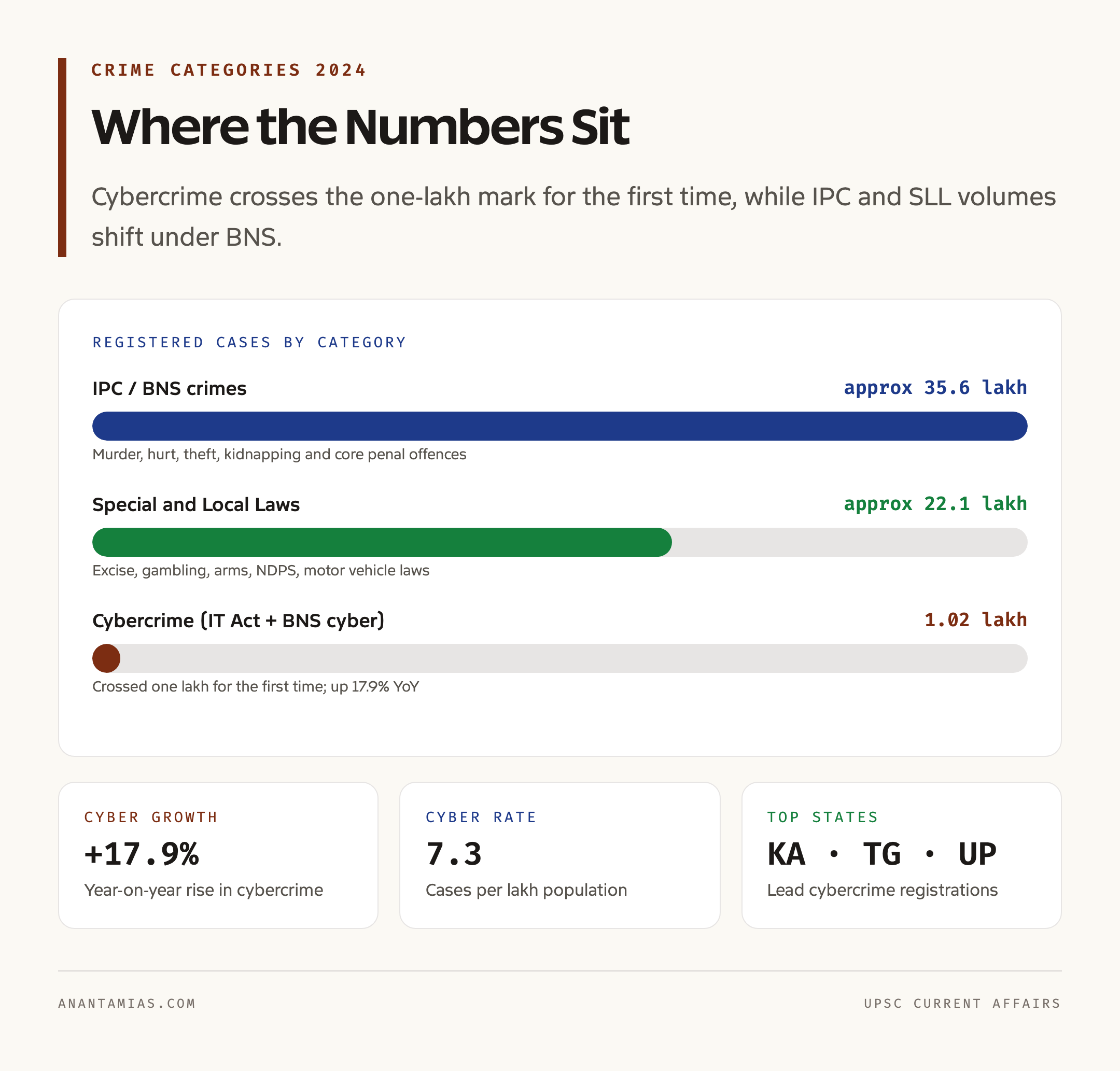
For the first time in independent India, a single year recorded more than one lakh cybercrime cases. The National Crime Records Bureau’s Crime in India 2024 report, released on 7 May 2026, logged 1,01,928 cybercrime registrations, a 17.9 percent jump over 2023. The headline contrast is stark: overall cognisable crime fell roughly 6 percent to 58.85 lakh cases, even as digital offences crossed a psychological threshold.
The NCRB crime statistics 2024 release also marks the first full-year dataset captured under the Bharatiya Nyaya Sanhita, 2023, which replaced the colonial-era Indian Penal Code. That transition partly explains the drop in conventional categories, since reclassification, training gaps, and new charge sheets compressed reporting in the first year. Strip out that effect and the underlying picture is more mixed than the headline suggests.
This article reads the NCRB crime statistics 2024 with a UPSC lens: what changed, what stayed the same, what the cybercrime explosion tells us about state capacity, and how policymakers should respond before next year’s report arrives.
Quick Facts
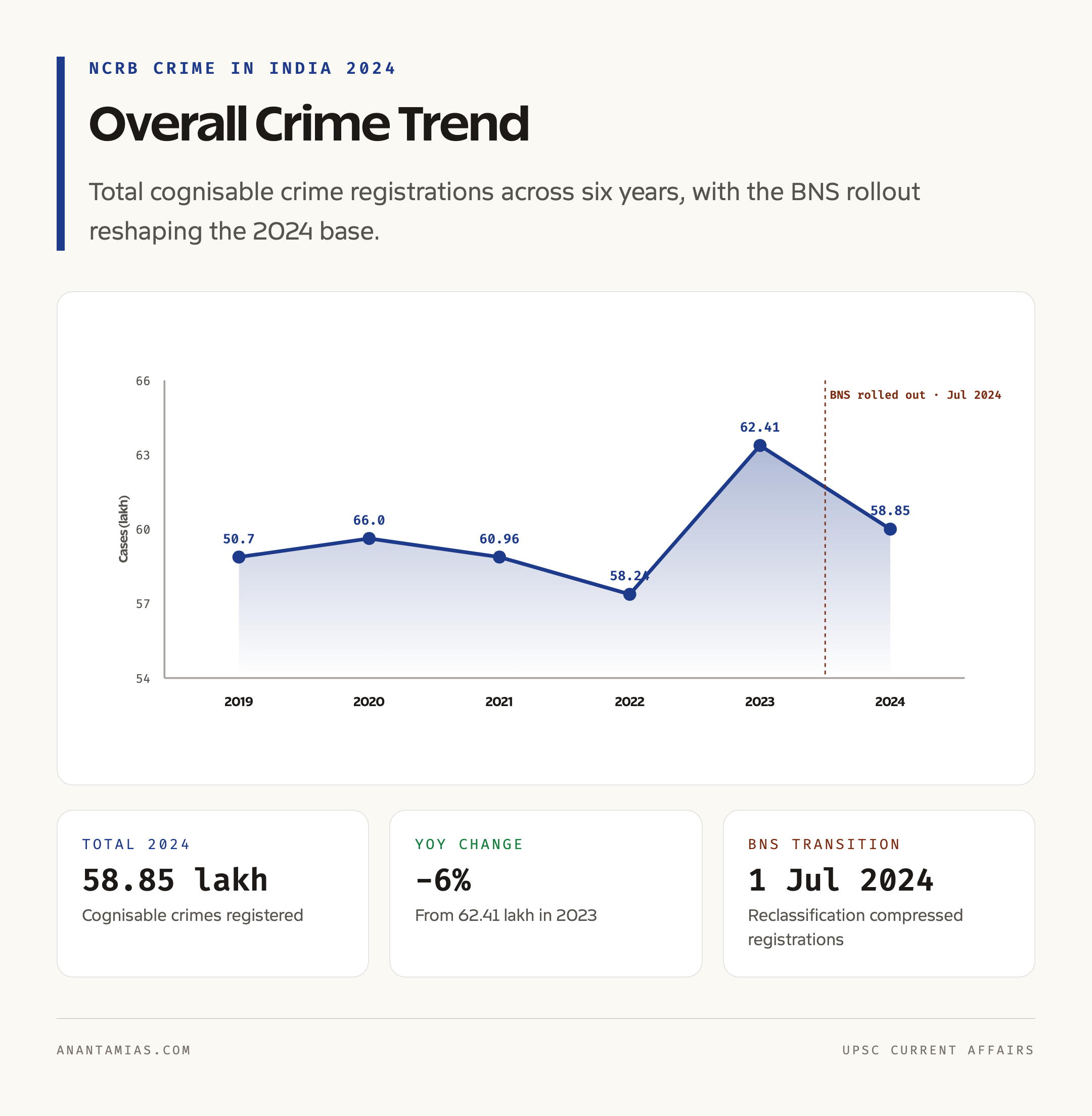
- Total cognisable crimes: 58.85 lakh in 2024, down from 62.41 lakh in 2023.
- Cybercrime cases: 1,01,928, up 17.9 percent year on year.
- Cybercrime rate: rose from 6.2 to 7.3 per lakh population.
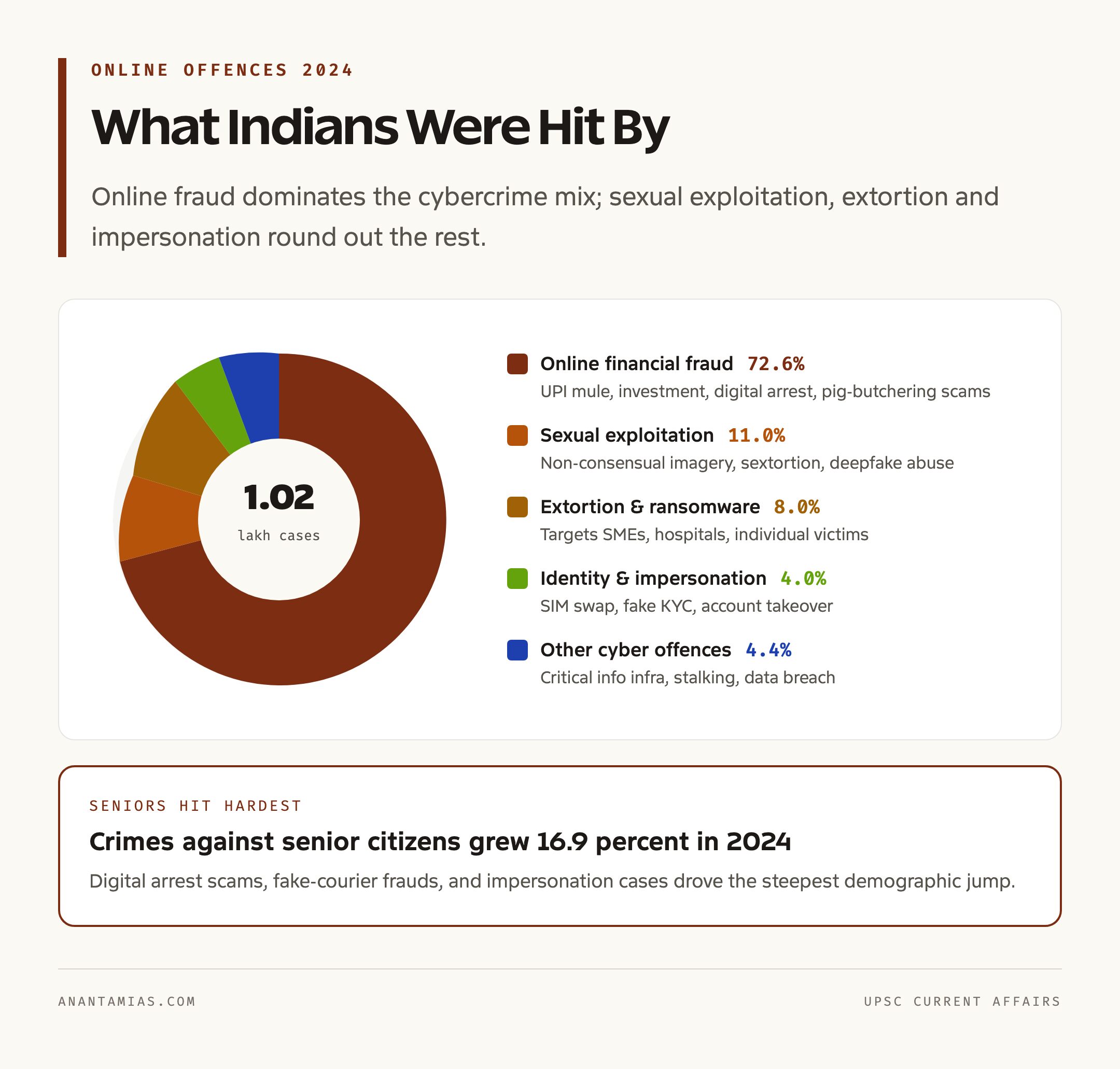
- Online fraud share: 72.6 percent of all cybercrime cases.
- Crimes against women: down 1.5 percent; against children up 5.9 percent; against senior citizens up 16.9 percent.
- Drug overdose deaths: 978 in 2024, up 50 percent from 650 in 2023.
- Juveniles in conflict with law: up 11.2 percent.
What Just Happened
The Ministry of Home Affairs released the NCRB crime statistics 2024 on 7 May 2026, after a longer-than-usual delay attributed to the BNS transition and a parallel migration to the Crime and Criminal Tracking Network and Systems 2.0. The headline drop in cognisable crime made political news, but the technical annexures revealed a more uneven story.
Punjab posted a 73 percent rise in cybercrime registrations, the steepest among large states. Karnataka, Telangana, and Uttar Pradesh continued to top absolute cybercrime numbers, partly because of higher reporting and better citizen-facing helplines such as 1930 and the National Cyber Crime Reporting Portal. The report also flagged a sharp jump in offences against senior citizens, much of it digital impersonation, fake-courier scams, and remote-takeover frauds.
Economic offences grew 4.6 percent. Cases under the Special and Local Laws bucket, which includes excise, gambling, and arms acts, declined modestly. Crimes against children rose 5.9 percent, driven by POCSO registrations and digital exploitation cases now routed through the cyber wing.
Background and Historical Context
As our deep dive on the NCRB report notes, the bureau was established in 1986 under the Ministry of Home Affairs, with a mandate to function as the central repository of crime data. Its flagship Crime in India series began in 1953 and has tracked the evolution of policing, prosecutions, and offence patterns through every decade of post-independence India. From 2014, NCRB added separate volumes on accidental deaths, suicides, and prison statistics.
The bureau’s data architecture has shifted three times in three decades. The original paper-based aggregation gave way to the Crime and Criminal Tracking Network and Systems in 2013, which connects police stations across states. CCTNS 2.0, currently being rolled out, integrates with the Inter-operable Criminal Justice System, linking courts, forensic labs, prisons, and prosecutors. The 2024 dataset is the first to ride this richer pipe, even as state-level integration remains uneven.
The cybercrime category was added formally in 2016 and has grown faster than any other heading. From under 13,000 registrations that year, it has crossed one lakh in 2024, an order-of-magnitude jump in eight years. The NCRB crime statistics 2024 therefore mark a structural moment: digital offences are now mainstream police work, not a specialised sliver.
Key Findings of the NCRB Crime Statistics 2024
The headline 6 percent drop in cognisable crime owes much to the Bharatiya Nyaya Sanhita transition. New section numbers, revised classification rules, and field-level training gaps temporarily depressed conventional registrations. The Drishti analysis and ClearIAS breakdowns both note that comparable categories such as murder and grievous hurt declined less than the aggregate, suggesting the headline is partly a measurement artefact.
Cybercrime is where the report breaks new ground. Of 1,01,928 registered cases, 72.6 percent involved online financial fraud, 11 percent involved sexual exploitation including non-consensual intimate imagery, and the rest spanned extortion, ransomware, stalking, identity theft, and offences against critical information infrastructure. Karnataka and Telangana together accounted for nearly a third of national cybercrime registrations, driven by Bengaluru and Hyderabad metro caseload.
Crimes against women fell 1.5 percent in absolute numbers, with a notable dip in domestic violence registrations after BNS rollout. Civil society groups have urged caution, pointing out that procedural complexity in the new code may have suppressed early-stage filings. Crimes against children rose 5.9 percent, while elderly victimisation grew 16.9 percent, the steepest demographic spike in the report.
Why It Matters
The NCRB crime statistics 2024 carry weight far beyond the social-justice classroom. Crime data feeds budgetary allocations for police modernisation, sets the agenda for Centrally Sponsored Schemes on cybersecurity, shapes insurance pricing, and influences India’s international standing on rule-of-law indices. A wrong reading at year one of the BNS could lock in poor policy choices for the rest of the decade.
For internal security, the cyber surge is the single most important takeaway. Online fraud now ranks alongside narcotics and organised crime as a top revenue stream for transnational criminal networks. Indian police forces collectively lost an estimated Rs 22,000 crore worth of citizen money to cyber fraud across 2023 and 2024, according to numbers cited in parliamentary replies. Recovery rates hover in single digits.
For UPSC GS Paper III, the report ties internal security to economic governance, financial inclusion, digital infrastructure, and federal coordination. It also raises hard questions about police capacity: most state cyber wings still operate with under 100 dedicated officers, and forensic backlog in digital evidence runs into months.
Detailed Analysis: Cybercrime Anatomy
Reading these patterns alongside our broader briefs on cyber security, deepfakes, and the wider universe of organized crime and terrorism linkages helps situate the numbers. Online fraud dominates the cybercrime category and breaks down into recognisable archetypes. Investment scams using fake stock-tip groups, deepfake videos, and spoofed broker apps cost retail investors heavily, especially in tier-2 towns. UPI-based mule-account fraud, where a victim is tricked into transferring money to a chain of accounts that funnel funds offshore, accounts for a large slice of the lakh-plus cases.
Romance and pig-butchering scams have grown sharply, often run out of Southeast Asian compound facilities staffed with trafficked Indian workers. The Ministry of External Affairs has had to repatriate hundreds of Indians from Cambodia, Laos, and Myanmar who were lured into operating these scam farms. Digital arrest scams, in which a fake police officer or CBI agent video-calls a victim and demands transfers under threat of arrest, particularly target senior citizens.
The NCRB crime statistics 2024 also confirm the rise of OTP and SIM-swap fraud, sextortion using AI-generated imagery, ransomware against small and medium enterprises, and impersonation scams using cloned voice over WhatsApp. Each of these requires different investigative skill sets, different platform cooperation, and different forensic tools.
Comparative Perspective
Globally, India’s cybercrime growth tracks but does not lead. The United States Federal Trade Commission logged USD 12.5 billion in consumer fraud losses in 2024, with investment scams as the largest category. The United Kingdom’s Action Fraud agency reported over 5,00,000 fraud cases. South Korea, Singapore, and Japan have moved aggressively toward platform-liability rules that force banks and telecom operators to reimburse victims of authorised push-payment fraud.
India’s reimbursement framework, anchored in the RBI’s 2017 directions on customer protection, still depends on the victim reporting within tight windows. The 1930 helpline and the citizen reporting portal have improved early response, but the legal architecture for shared liability across banks, payment aggregators, and telcos lags peers.
Challenges
Three structural challenges leap out of the NCRB crime statistics 2024. First, capacity. Cyber forensic labs across most states remain under-equipped, with case backlogs running 6-18 months. Specialised cybercrime police stations exist in only a fraction of districts. Second, jurisdiction. Cybercrime is borderless by design; victims, perpetrators, and infrastructure typically sit in different states or countries, complicating investigation under the BNS and the Information Technology Act.
Third, prosecution. Conviction rates in cybercrime cases lag conventional crime, partly because digital evidence handling standards vary, partly because witnesses are reluctant to testify against transnational networks. The Bharatiya Sakshya Adhiniyam, 2023 modernised electronic evidence rules, but courts and police are still building familiarity with chain-of-custody norms for cloud-based records.
A fourth, less discussed challenge is data quality itself. The transition to BNS, CCTNS 2.0, and parallel reporting under State Crime Records Bureaus introduces noise. Comparing 2024 with prior years requires care, and the report flags this in its methodology section.
Prelims Pointers
- NCRB was set up in 1986 under the Ministry of Home Affairs based on the Tandon Committee and Tata Committee recommendations.
- The Crime in India series has been published annually since 1953.
- The Bharatiya Nyaya Sanhita, 2023 came into force on 1 July 2024, replacing the Indian Penal Code.
- Cybercrime helpline number is 1930; reporting portal is cybercrime.gov.in.
- Indian Cyber Crime Coordination Centre (I4C) operates under MHA.
- NCRB also publishes Accidental Deaths and Suicides in India (ADSI) and Prison Statistics India annually.
Mains Questions
- The NCRB crime statistics 2024 show a sharp rise in cybercrime even as conventional crime declined. Examine the structural drivers behind this divergence and suggest a roadmap for strengthening cyber policing in India. (GS Paper III, Internal Security)
- Discuss the institutional architecture for cybercrime investigation in India. How can coordination between I4C, state cyber wings, and the private sector be improved? (GS Paper III, Internal Security)
- Critically evaluate the impact of the Bharatiya Nyaya Sanhita, 2023 on crime registration and prosecution. (GS Paper II, Polity and Governance)
- Crimes against senior citizens grew 16.9 percent in 2024. Analyse the social, economic, and policy implications and suggest a protection framework. (GS Paper I, Society)
Way Forward
The NCRB crime statistics 2024 should trigger a five-track response. One, scale up cyber forensic capacity through a Centre-state mission that adds equipped labs to every district headquarter within three years. Two, mandate platform liability and faster reimbursement timelines for authorised push-payment fraud, with bank, aggregator, and telco co-liability. Three, ring-fence cyber-trained officers within state cadres so that postings cannot be churned for vigilance or law-and-order duty.
Four, deepen international cooperation. Most fraud infrastructure sits in Southeast Asia and Eastern Europe; mutual legal assistance treaties, joint operations, and platform-level takedown protocols need urgent upgrades. Five, invest in public awareness with the same intensity that financial inclusion received. Citizen literacy on OTPs, deepfakes, and impersonation will reduce victim flow faster than any prosecution.
Frequently Asked Questions
What is the NCRB and what does it publish?
The National Crime Records Bureau was set up in 1986 under the Ministry of Home Affairs. It publishes annual flagship reports including Crime in India, Accidental Deaths and Suicides in India, and Prison Statistics India.
Why did overall crime fall in 2024?
The 6 percent decline reflects a mix of genuine drops in some conventional offences and a transition effect from the rollout of the Bharatiya Nyaya Sanhita, 2023. The new code changed section numbers, classification rules, and charge-sheet workflows, compressing first-year registrations.
How big is the cybercrime jump?
Cybercrime registrations crossed 1 lakh for the first time, reaching 1,01,928 cases, a 17.9 percent year-on-year rise. The cybercrime rate per lakh population went from 6.2 to 7.3.
What types of cybercrime dominate?
Online financial fraud accounts for about 72.6 percent of cybercrime cases, followed by sexual exploitation and extortion. Investment scams, mule-account UPI fraud, digital arrest scams, and pig-butchering rackets are the most common modus operandi.
Which states report the most cybercrime?
Karnataka, Telangana, Maharashtra, and Uttar Pradesh lead in absolute numbers. Punjab posted the steepest year-on-year growth at 73 percent. State-level differences also reflect reporting infrastructure and helpline maturity.
What is the I4C?
The Indian Cyber Crime Coordination Centre, operational under MHA, runs the cybercrime reporting portal, the 1930 helpline, the Joint Cyber Coordination Teams, and the Cyber Volunteers programme.
How are crimes against senior citizens trending?
They rose 16.9 percent in 2024, the steepest demographic spike. Digital impersonation, fake-courier scams, and digital arrest frauds are major drivers.
Did crimes against women really fall?
Registered crimes against women dipped 1.5 percent. Civil society groups have urged caution, pointing out that procedural complexity in BNS may have suppressed early-stage filings in the transition year.
What can citizens do if they are victims of cybercrime?
Call the 1930 helpline immediately, file a complaint on cybercrime.gov.in, freeze affected bank accounts, and follow up with the local cybercrime police station. Speed of reporting is critical because the Golden Hour rule applies for fund recovery.
How does India compare internationally on cyber fraud?
India’s growth in registered cases is high but its per-capita loss rate is still below the United States and the United Kingdom. The reimbursement architecture, however, lags peers because shared liability across banks, aggregators, and telcos is not yet codified.
Tell Google you want more of this.
Add Anantam IAS as a preferred sourceOne tap, and this site shows up more often in your own Top Stories, AI Overviews and AI Mode. Remove it any time.