Why in News?
On 14 September 2026, NHAI announced plans to upgrade the 1033 National Highway Helpline, with IHMCL inviting industry interest in developing and operating the proposed platform.
- The existing 1033 helpline provides round-the-clock assistance for emergencies, breakdowns and other National Highway problems.
- The proposed platform combines location capture, AI-assisted multilingual handling and smart dispatch with improved coordination.
- Human operators will remain important, particularly where emergencies require judgement and decision-making.
- IHMCL has invited an Expression of Interest; the announcement does not establish that the proposed platform is already deployed.
- An answered call is only the first step: useful assistance also requires a usable location, an understood problem and a suitable response.
- The relevant governance question is how technology and operational teams work together, rather than whether a helpline uses AI.
UPSC Relevance
Prelims Relevance
- 1033: the National Highway Helpline.
- IHMCL: Indian Highways Management Company Limited, promoted by NHAI.
- EOI: Expression of Interest, the announced industry-engagement stage.
- Smart dispatch: matching a reported need with suitable assistance.
Mains Relevance
GS Paper 2
- Accountability and accessibility in technology-assisted public services.
- Coordination across agencies delivering emergency assistance.
GS Paper 3
- AI-assisted response systems and road safety.
Essay
- A public service succeeds when information leads to timely, appropriate action.
Background and Context
The helpline exists; the upgrade is proposed
Separate the current public service from the capabilities being proposed for its next platform.
- 1033 already assists National Highway users with medical emergencies, vehicle breakdowns, toll-plaza and FASTag issues. It is a round-the-clock service, rather than a new number awaiting launch.
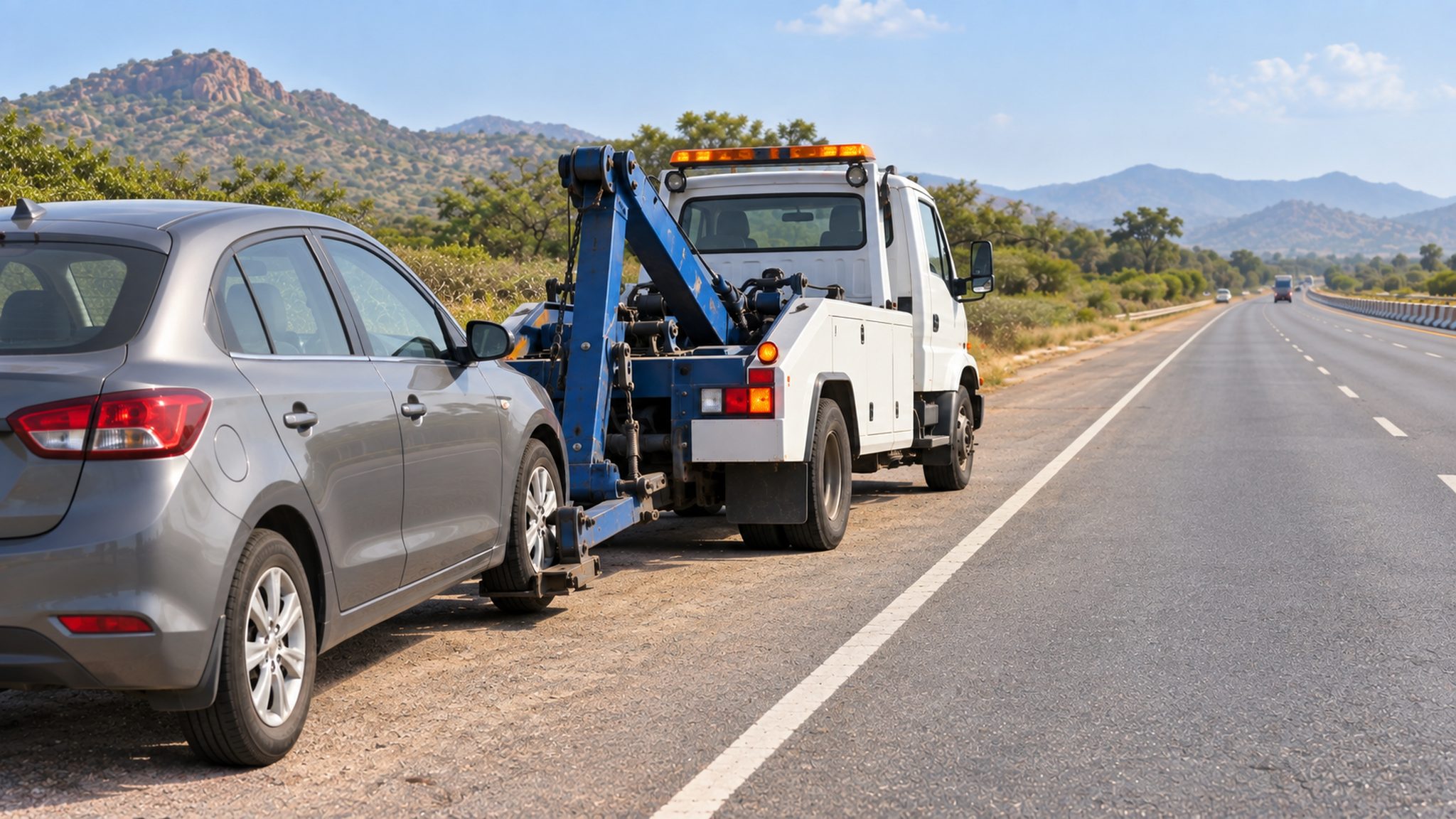
- Ambulances, cranes and patrol vehicles are among the assistance categories described in the release. The proposal concerns improving how calls and response resources are connected, not inventing roadside assistance from scratch.
- The existing service already supports multiple languages. What is proposed is AI-assisted language handling within an upgraded platform; multilingual access should not be described as an entirely new capability.
- IHMCL, a company promoted by NHAI, invited an EOI for design, development, deployment, operation and maintenance. Industry suggestions will inform the requirements, so the announcement is not a completed implementation report.
- The broader road-safety challenge includes prevention and enforcement. This proposal addresses the distinct assistance function: helping a traveller obtain appropriate support after a problem has been reported.
How a call becomes a suitable response
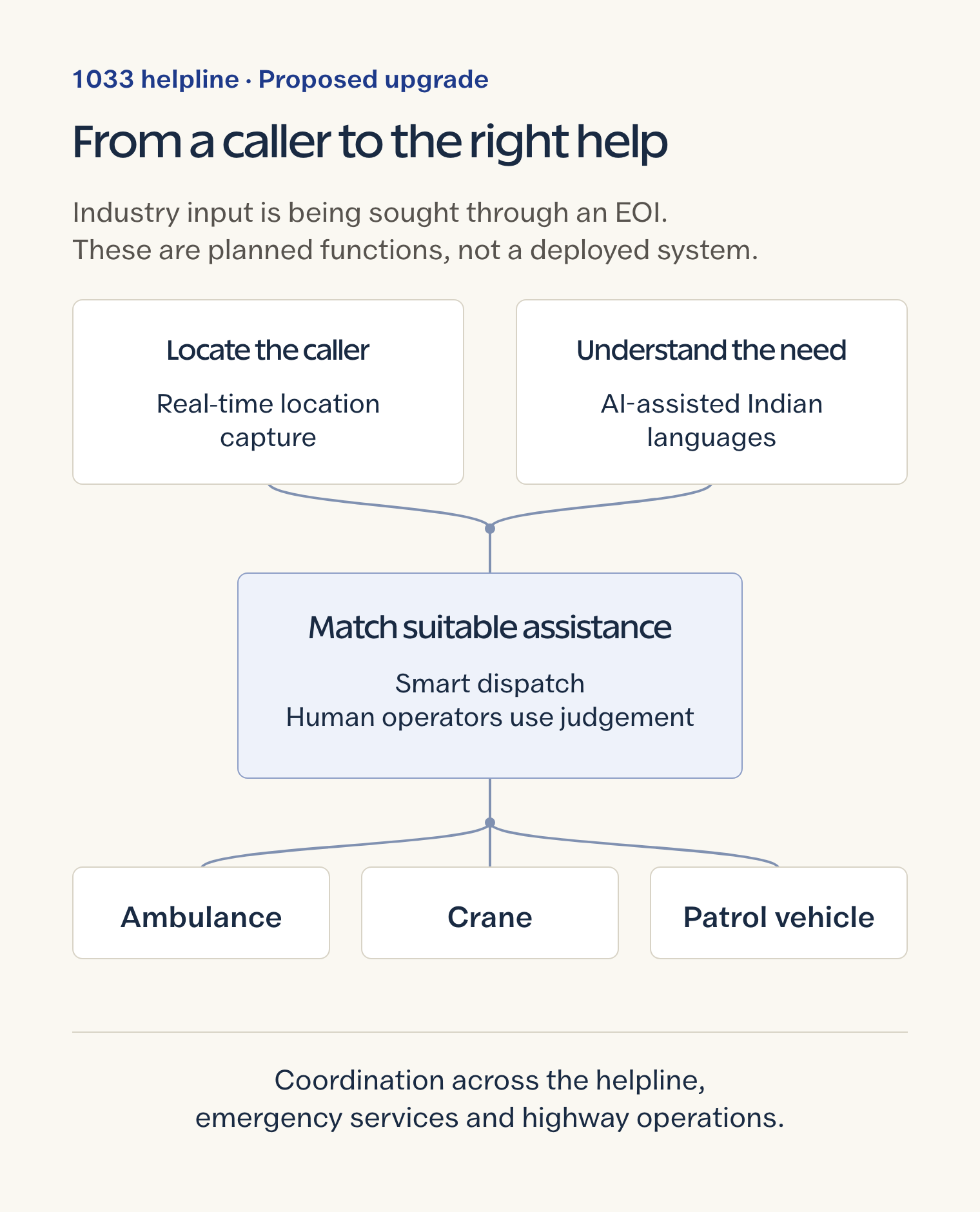
The proposed features address different links between receiving a call and sending help; none substitutes for all the others.
- Locate the caller: real-time location capture is intended to help teams reach the incident. Knowing the reported problem without a usable location can still leave responders unable to find the person needing help.
- Understand the need: AI-assisted Indian-language handling is intended to help interpret calls. A location alone does not reveal whether the caller needs medical assistance, vehicle recovery or a different highway service.
- Select suitable assistance: smart dispatch is intended to identify the appropriate ambulance, crane or patrol vehicle. Correctly receiving a call is different from matching the response to what the incident requires.
- Coordinate the response: the proposal links helpline staff, emergency services and highway operations teams more closely. Dispatching a resource and keeping the relevant teams coordinated are related but separate operational tasks.
- Issue advisories: proactive alerts would inform highway users about incidents and important developments. This is a wider information function alongside assistance to the individual caller, not proof that an emergency has been resolved.
Why human judgement remains necessary
The announced model combines technical assistance with people making decisions, particularly during emergencies.
- Human operators retain an important role under the proposal. The release explicitly highlights judgement and decision-making; it does not describe fully autonomous emergency handling or the removal of call-centre staff.
- An unclear account may need follow-up questions before a response can be matched. This illustrates why language-processing support should assist understanding rather than be treated as sufficient evidence of what happened.
- Context can change: a reported breakdown might also involve an injured person. This is an illustrative scenario, not a newly announced protocol; it shows why response categories should not replace situational judgement.
- Automation quality should be judged by whether operators can use, question and correct its outputs. Such oversight is a design consideration, not a claim that a particular safeguard has already been implemented.
- Coordination failures can persist even when software functions correctly. The last-mile health-response gap offers a related governance lesson: information needs an available service and a team able to act.
Read the procurement stage accurately
An invitation to industry identifies a development process; it does not establish operational performance.
- The EOI seeks combined expertise in digital platforms, continuous call-centre operations and emergency-response services. The task extends beyond purchasing an AI tool because the service depends on operational arrangements.
- Industry feedback is intended to help finalize requirements. Avoid presenting an imagined rollout timetable, staffing standard, data-sharing rule or mandatory technical architecture as though NHAI has already specified it.
- Faster assistance is the stated objective, not a guaranteed response time. The release supplies no measured before-and-after improvement, so assessment must await implementation evidence rather than infer success from the proposed features.
Way Forward
Test the service that users receive
- Test location and language handling against difficult real-world conditions, with human review when the information is unclear.
- Assess correct dispatch and coordination as well as call handling; report bottlenecks separately so improvements address the right stage.
- Set clear operational accountability before rollout, including how teams correct errors and follow up unresolved requests.
Conclusion
- Next Generation 1033 is a proposal to connect better information with suitable roadside assistance, while retaining human judgement.
- In a governance answer, distinguish announced capability, operational deployment and demonstrated performance. An EOI establishes the first step in that sequence, not the final outcome.
UPSC Practice Questions
Prelims MCQ 1
With reference to the proposed Next Generation 1033 platform, consider the following statements:
- The existing 1033 helpline already provides round-the-clock assistance.
- The proposed platform eliminates the role of human operators.
- IHMCL has invited an Expression of Interest for the platform.
How many of the above statements are correct?
(a) Only one (b) Only two (c) All three (d) None
Answer: (b) Only two
Explanation:
Statements 1 and 3 are correct. Human operators remain important, especially where emergencies require judgement and decisions.
Prelims MCQ 2
In the proposed highway helpline upgrade, smart dispatch primarily refers to:
(a) Automatically imposing traffic penalties. (b) Guaranteeing a fixed response time nationwide. (c) Identifying and sending suitable assistance for the reported need. (d) Replacing emergency services with caller advisories.
Answer: (c) Identifying and sending suitable assistance for the reported need.
Explanation:
The release describes identifying the most suitable ambulance, crane or patrol vehicle. It does not promise a fixed response time or replace emergency services.
UPSC Mains Questions
- Explain how location capture, multilingual handling and suitable dispatch address different stages of highway emergency assistance. (150 words)
- Discuss why human judgement and institutional coordination remain necessary in AI-assisted public-service delivery, using the proposed 1033 upgrade. (150 words)
Source: PIB, Ministry of Road Transport and Highways.
Frequently Asked Questions
What is the 1033 helpline?
1033 is the existing round-the-clock National Highway Helpline. It assists travellers with medical emergencies, vehicle breakdowns, toll-plaza and FASTag issues, and other highway-related problems, including coordination of relevant roadside assistance.
Is the Next Generation platform already operational?
The announcement describes a planned upgrade and an Expression of Interest invited by IHMCL. It does not establish that the proposed platform, or all its advanced features, has already been deployed.
What does smart dispatch mean?
Smart dispatch means identifying and sending suitable assistance for the reported need, such as an ambulance, crane or patrol vehicle. It addresses resource matching rather than merely answering or translating a call.
Will AI replace human operators?
No. The release says human operators will continue to play an important role, especially where emergencies require human judgement and decision-making. AI-assisted handling is part of a combined technology-and-human approach.
Does NHAI guarantee a response time?
The release aims for faster, more coordinated assistance but specifies no guaranteed response time. A proposed capability should not be confused with demonstrated performance or a promise about every incident.
Tell Google you want more of this.
Add Anantam IAS as a preferred sourceOne tap, and this site shows up more often in your own Top Stories, AI Overviews and AI Mode. Remove it any time.