Why in News?
The Indian Express reported that six children had died and around 100 had fallen ill over the preceding month in four remote, Baiga-dominated villages of Balaghat district in Madhya Pradesh.
- The affected children, aged between one and 13 years, were from Adori, Kundeksa, Bondari and Korka villages in the Baihar area.
- Reported symptoms included high fever, rashes or red spots, stomach pain and ulcers, but this symptom combination is not enough to identify a pathogen or disease.
- The district health department said it learnt about the deaths only after three children had already died, revealing a serious delay in event detection and escalation.
- Health workers faced forested and hilly terrain, difficulty locating cases, and families who were reluctant to disclose illness or allow hospital admission. Officials later used police assistance to complete referrals.
- Samples were sent to an ICMR bacterial-infection research institute in Kolkata and the ICMR-National Institute of Virology in Pune, while a Jabalpur Medical College team investigated the outbreak.
- An outbreak is not only a biomedical event. Its outcome depends on how quickly unusual illness is noticed, reported, verified, sampled, treated and referred.
- Remote tribal habitations face a compound disadvantage: distance to facilities, seasonal access, weak transport, staff shortages, language differences, livelihood schedules and memories of disrespectful care can reinforce one another.
- Coercion may secure an urgent transfer, but repeated reliance on police can deepen mistrust. A resilient system must build community consent and confidence before an emergency.
UPSC Relevance
Prelims Relevance
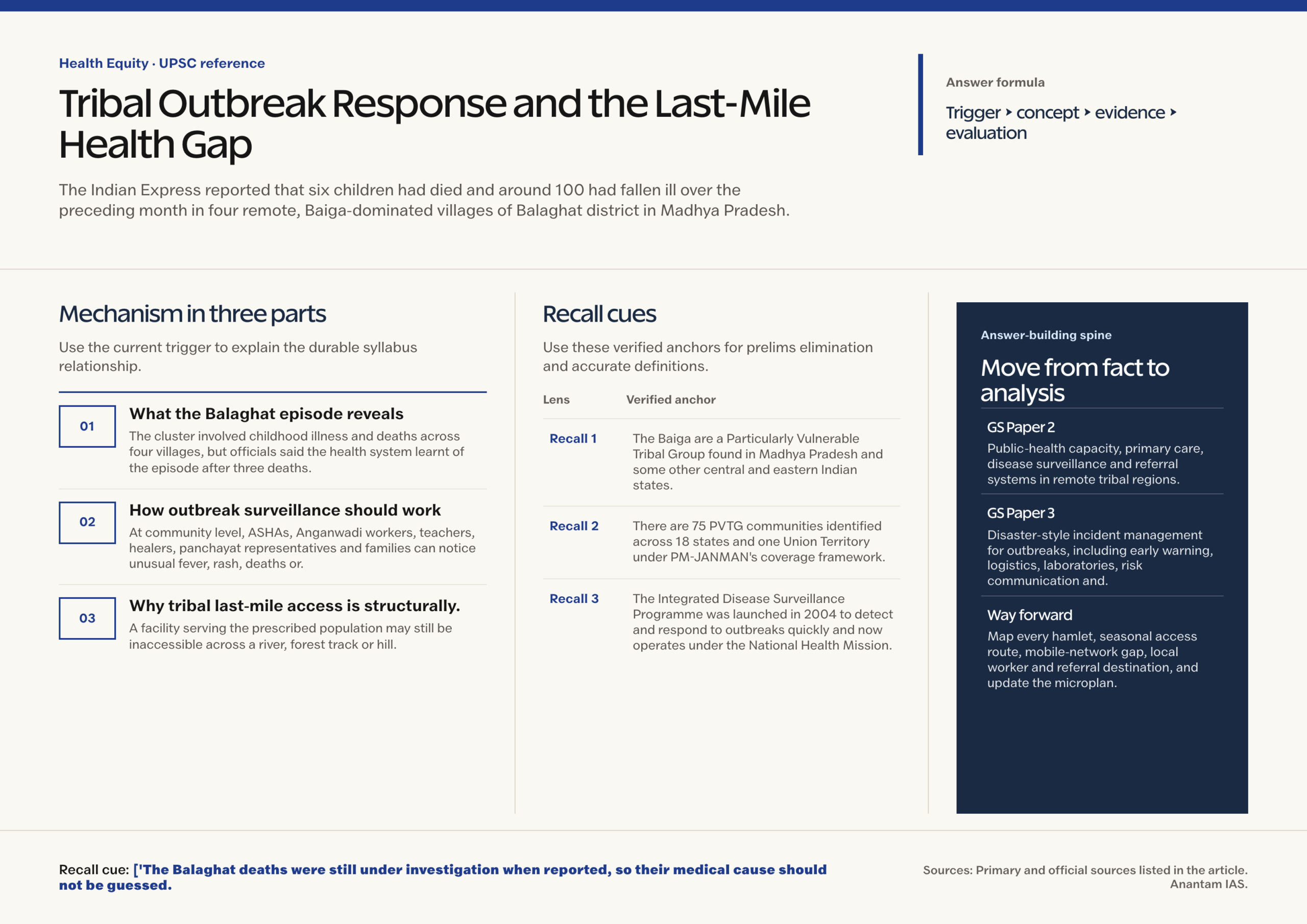
- The Baiga are a Particularly Vulnerable Tribal Group found in Madhya Pradesh and some other central and eastern Indian states.
- There are 75 PVTG communities identified across 18 states and one Union Territory under PM-JANMAN’s coverage framework.
- The Integrated Disease Surveillance Programme was launched in 2004 to detect and respond to outbreaks quickly and now operates under the National Health Mission.
- IDSP has surveillance units at the Central, State and district levels, with Rapid Response Teams investigating rising illness trends and suspected outbreaks.
- The Integrated Health Information Platform supports surveillance reporting; its community-based surveillance route allows reporting of outbreak-prone diseases and unusual health events.
- Mobile Medical Units under NHM are meant to take healthcare to remote, difficult, underserved and unreached populations; they are not primarily patient-transfer vehicles.
Mains Relevance
GS Paper 2
- Public-health capacity, primary care, disease surveillance and referral systems in remote tribal regions.
- Health equity, cultural competence and the State’s responsibility to make essential services physically and socially accessible.
GS Paper 3
- Disaster-style incident management for outbreaks, including early warning, logistics, laboratories, risk communication and data quality.
- Use of digital surveillance and geospatial microplanning without substituting dashboards for frontline detection and human trust.
Essay
- The distance between a citizen and the State is measured not only in kilometres, but also in language, trust and time to care.
Background and Context
What the Balaghat episode reveals
The sequence of events points to a system failure before it points to a specific disease.
- The cluster involved childhood illness and deaths across four villages, but officials said the health system learnt of the episode after three deaths. This is an event-detection gap: severe events occurred before a formal alert.
- Officials had to search hilly and forested settlements for affected children. A district may have facilities on paper while scattered hamlets remain outside routine visits, mobile connectivity and reliable transport routes.
- Families were reportedly reluctant to disclose cases or accept admission. That response cannot be reduced to ignorance. It may reflect fear of unfamiliar institutions, indirect costs, language barriers, livelihood disruption, past treatment experiences and different understandings.
- Faith healing was reported during the episode. The public-health task is not to ridicule belief, but to prevent delay by working with trusted community members and clearly explaining danger signs, treatment and the right to accompany.
- The age range and distribution across several settlements make a complete case search essential. Investigators must include children treated at home, those who recovered, recent deaths and clinically similar illness in neighbouring habitations, because hospital records.
How outbreak surveillance should work
Surveillance is a cycle from signal to action, not a weekly reporting form.
- At community level, ASHAs, Anganwadi workers, teachers, healers, panchayat representatives and families can notice unusual fever, rash, deaths or absenteeism. A simple channel must carry that event-based signal to the health system immediately.
- The district surveillance unit should verify the alert, develop a working case definition, make a line list, search actively for additional cases, map cases by place and onset date, and deploy a Rapid Response Team when.
- Clinical care cannot wait for final laboratory results. Teams use syndrome-based precautions, stabilisation and referral while collecting correctly labelled specimens and documenting onset, vaccination, exposure and treatment history.
- Laboratory findings must be interpreted with epidemiology. A positive result may not explain every case, while a negative result may reflect timing, sample quality or the wrong test panel.
- Daily analysis should guide action: new cases, severe cases, deaths, admissions, recoveries, affected hamlets, referral delays and supply gaps. Surveillance is successful only when it changes field decisions.
Why tribal last-mile access is structurally different
Standard population norms can miss communities separated by terrain, forests and travel time.
- A facility serving the prescribed population may still be inaccessible across a river, forest track or hill. Time to care, seasonal access and the location of each habitation are better operational measures than population totals.
- Households may lose wages, forest-produce collection time or food security when a caregiver accompanies a child to a distant hospital. Free treatment does not remove transport, accommodation, communication and opportunity costs.
- Language and communication affect consent, adherence and safety. Instructions on samples, isolation, discharge and medicines must be delivered in a language and form the family understands.
- Vacancies, rapid staff turnover and weak accommodation reduce continuity. When every visit involves a new team, the system struggles to establish the relationships needed for early disclosure.
- Tribal health also depends on water, nutrition, roads, telecom and education. An outbreak response needs administrative convergence because the determinants of exposure and delayed care lie beyond the health department.
Trust is public-health infrastructure
A technically correct referral can fail if the family does not trust the messenger, destination or process.
- Local ASHAs and other community workers can translate both language and institutional intent. Their role should begin during routine care, not after an outbreak has already become fatal.
- Health teams should explain why admission is advised, where the child will go, who may accompany the child, what care is free, and how the family will receive updates. Procedural clarity reduces fear.
- Community leaders, women’s groups and trusted traditional practitioners can help communicate danger signs and encourage timely referral. Engagement should not endorse harmful delay; it should create a bridge to evidence-based care.
- Police assistance may be necessary where a child’s life faces immediate danger, but it should remain an exceptional, legally accountable step. Routine dependence on force can convert a health encounter into a conflict with the State.
- After the emergency, teams should return with results, explain what was found, acknowledge uncertainty and address grievances. Without feedback, communities supply data but receive no trustworthy account in return.
Way Forward
Create habitation-level early warning
- Map every hamlet, seasonal access route, mobile-network gap, local worker and referral destination, and update the microplan before monsoon and other high-risk periods.
- Train ASHAs, Anganwadi workers, teachers and selected community volunteers to report clusters and deaths through a low-bandwidth channel with a clear escalation deadline.
- Audit zero-reporting: silence from an inaccessible village should trigger contact, not be assumed to mean zero illness.
Conclusion
- The Balaghat deaths were still under investigation when reported, so their medical cause should not be guessed.
- The answer is a habitation-level system of surveillance, trusted local communication, regular outreach and closed-loop referral .
UPSC Practice Questions
Prelims MCQ 1
With reference to tribal health and disease surveillance in India, consider the following statements:
- The Baiga are included among the Particularly Vulnerable Tribal Groups.
- The Integrated Disease Surveillance Programme operates under the National Health Mission.
- Mobile Medical Units under NHM are designed primarily as ambulances for inter-facility patient transfer.
How many of the above statements are correct?
(a) Only one (b) Only two (c) All three (d) None
Answer: (b) Only two
Explanation:
Statements 1 and 2 are correct. Baiga are a PVTG, and IDSP continues under NHM. MMUs take primary healthcare to remote and underserved populations; NHM guidance does not define them primarily as patient-transfer vehicles.
Prelims MCQ 2
In an outbreak investigation, which one of the following best describes a line list?
(a) A list of all medicines stocked at a district hospital (b) A case-wise table recording key clinical, demographic, place and time information (c) A statutory list of diseases that can be diagnosed without laboratory tests (d) A roster of only the members of a Rapid Response Team
Answer: (b) A case-wise table recording key clinical, demographic, place and time information
Explanation:
A line list organises information for each suspected or confirmed case, commonly including identity code, age, residence, symptom onset, clinical status, exposure, sample and outcome. It helps investigators describe the outbreak and identify patterns.
UPSC Mains Questions
- A disease outbreak in a remote tribal habitation is as much a test of trust and access as of laboratory capacity. Discuss.
- Examine how habitation-level surveillance, Mobile Medical Units and closed-loop referral can reduce avoidable deaths in Particularly Vulnerable Tribal Group areas.
Sources: The Indian Express and National Health Mission, Mobile Medical Unit Guidelines.
Frequently Asked Questions
What caused the illness in the Balaghat villages?
The cause had not been confirmed when the report was published. Children had fever and several other symptoms, and samples were sent to specialised ICMR laboratories. Those facts support an outbreak investigation, not a definitive diagnosis. Naming a disease before.
Who are the Baiga?
The Baiga are an Adivasi community included in the official list of Particularly Vulnerable Tribal Groups. They live across parts of central and eastern India, including Madhya Pradesh. PVTG status signals the need for focused development support, but communities should.
What is the role of IDSP during an outbreak?
The Integrated Disease Surveillance Programme collects and analyses disease and event information to identify rising trends quickly. District and State surveillance units verify alerts, and Rapid Response Teams investigate suspected outbreaks, support case finding and sampling, recommend control measures and.
Why might families resist hospital referral?
Reasons can include distance, transport and wage costs, language barriers, fear of unfamiliar institutions, lack of caregiver support, previous disrespectful encounters and different beliefs about illness. A safe response explains the need for referral, reduces practical costs, permits communication and.
Can Mobile Medical Units solve the tribal health-access gap?
MMUs can bring regular primary care, medicines, diagnostics, immunisation and surveillance closer to remote habitations. They cannot replace ambulances, laboratories, staffed fixed facilities or referral hospitals. Their strongest role is as one predictable layer in a network with community workers.
Tell Google you want more of this.
Add Anantam IAS as a preferred sourceOne tap, and this site shows up more often in your own Top Stories, AI Overviews and AI Mode. Remove it any time.