A weathered granite overhang in the Nilgiris just gave up a secret it had been keeping for several thousand years. In late April 2026, a survey team operating near Kotagiri in Tamil Nadu documented what they’re calling a significant new Nilgiris Rock Painting site, with red ochre figures of human dancers, animal forms, and abstract symbols spread across an interior wall of a low rock shelter. The discovery doesn’t sit in isolation. It connects to a long, patchy archaeological record of South Indian rock art and to the living cultural memory of the Irula and Kurumba communities whose ancestors have walked these slopes for generations.
What makes the find interesting isn’t just the imagery. It’s the location. The Nilgiris hasn’t been treated as a major rock art zone in standard textbooks, which lean heavily on Bhimbetka in Madhya Pradesh and Edakkal in Kerala. A confirmed shelter near Kotagiri, with motifs that echo ritual practices documented among indigenous tribes, forces a rethink. South Indian prehistoric art is denser and more distributed than the canon suggests, and the Western Ghats are very much part of that map.
For UPSC aspirants, this is one of those rare current affairs items that reaches across Art and Culture, Ancient History, Tribal Affairs, and Heritage Conservation in a single story. It’s worth slowing down on.
Quick Facts at a Glance
- Site location: A rock shelter in the forests near Kotagiri, Nilgiris district, Tamil Nadu
- Discovery date: Reported publicly in late April 2026
- Medium: Red ochre (hematite-based pigment) on natural rock surface
- Imagery: Human figures in dance postures, animal silhouettes, concentric circles, and dot clusters
- Probable cultural context: Late prehistoric to early historic, with ritual symbolism connected to Irula and Kurumba tribal traditions
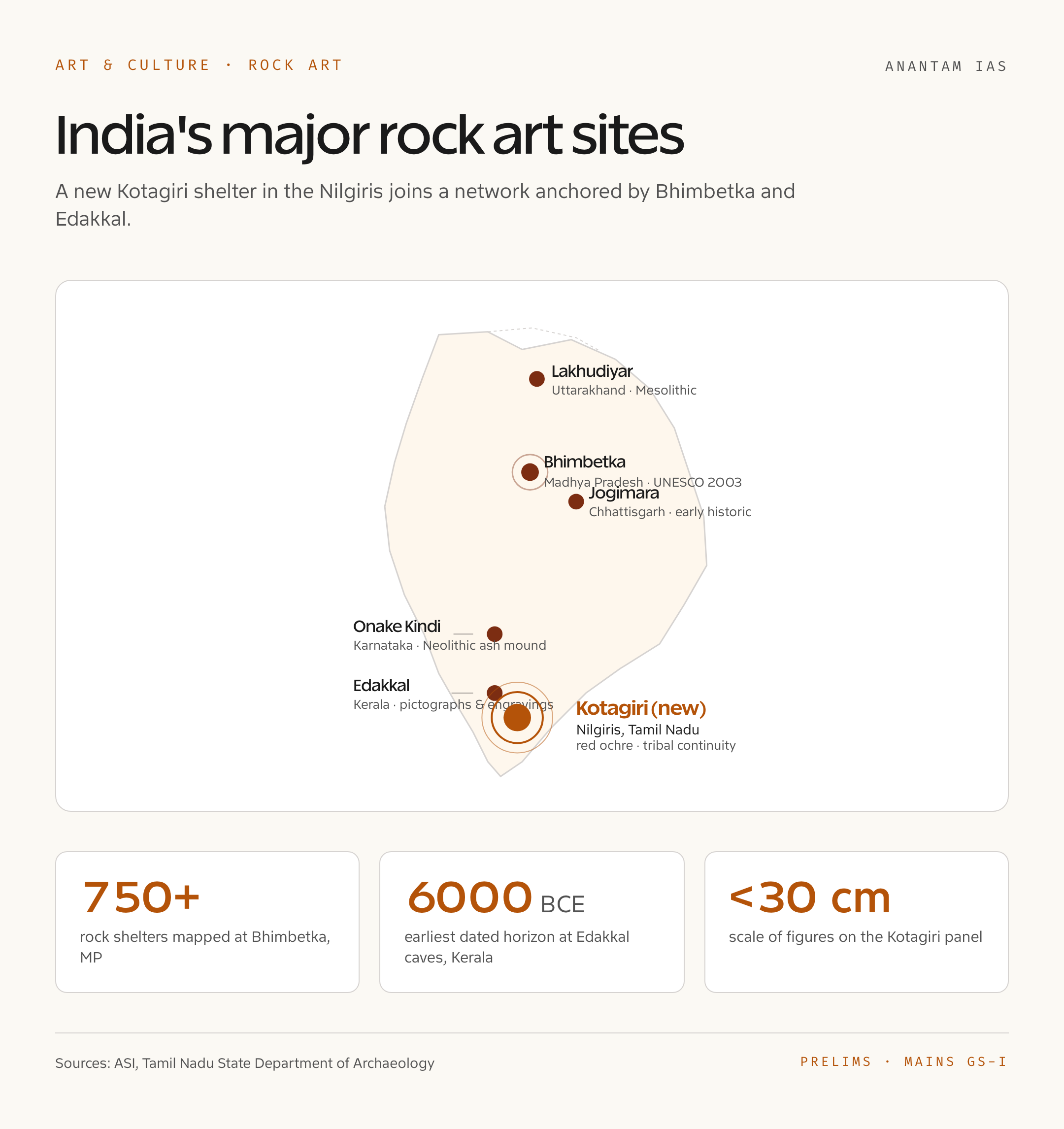
- Comparable sites: Bhimbetka (UNESCO listed), Edakkal caves in Wayanad, Lakhudiyar in Uttarakhand, Onake Kindi in Karnataka
- Protection status: Currently unprotected. Documentation ongoing by state archaeology and ASI
Why in News: A Forest Survey That Found More Than Trees
The team that flagged the Nilgiris Rock Painting shelter wasn’t on a treasure hunt. They were doing a routine biodiversity and heritage survey in the Kotagiri belt, the kind of work that often turns up small habitations, megalithic burials, and stone tool scatters as a side effect of walking grids through dense forest. What they found this time was a clean, painted panel that hadn’t been recorded in any prior gazetteer.
The shelter sits on a slope above a seasonal stream, the kind of micro-environment prehistoric people repeatedly chose: water access, defensible position, dry interior, line of sight across the valley. The figures on the wall are small, mostly under 30 centimeters, and arranged in clusters rather than as a single composition. Several show dancers with raised arms, a motif found across Indian rock art from Bhimbetka in the north to the Sanganakallu complex in Karnataka. Some panels include hunting scenes with what look like stylized deer and bovids.
The Tamil Nadu State Department of Archaeology has begun formal documentation. The Archaeological Survey of India is expected to coordinate with state authorities on a possible protection notification, though that process can take years.
Background and Historical Context
Indian rock art is one of the longest continuous artistic traditions on the subcontinent. The earliest layers at Bhimbetka, the canonical reference site, are conservatively dated to the Mesolithic, with some scholars arguing for Upper Palaeolithic phases as well. The tradition didn’t die with prehistory. It carries through the Neolithic, Chalcolithic, Iron Age megalithic period, and into the early historic, with style and content shifting as the artists’ worlds shifted.
South India has its own dense map. The Edakkal caves in Wayanad, with their pictographs and engravings dated broadly to between 6000 BCE and 1000 BCE, are the best-known reference. Karnataka’s Onake Kindi, Hire Benakal, and Sanganakallu sites preserve red ochre paintings linked to Neolithic ash mound communities. Andhra Pradesh has rock shelters in Kurnool, Cuddapah, and Anantapur districts. Tamil Nadu has been the relatively quiet partner in this map, with reported sites at Settavarai, Mallapadi, and a handful of Nilgiris locations, but nothing on the documentation scale of Bhimbetka or Edakkal.
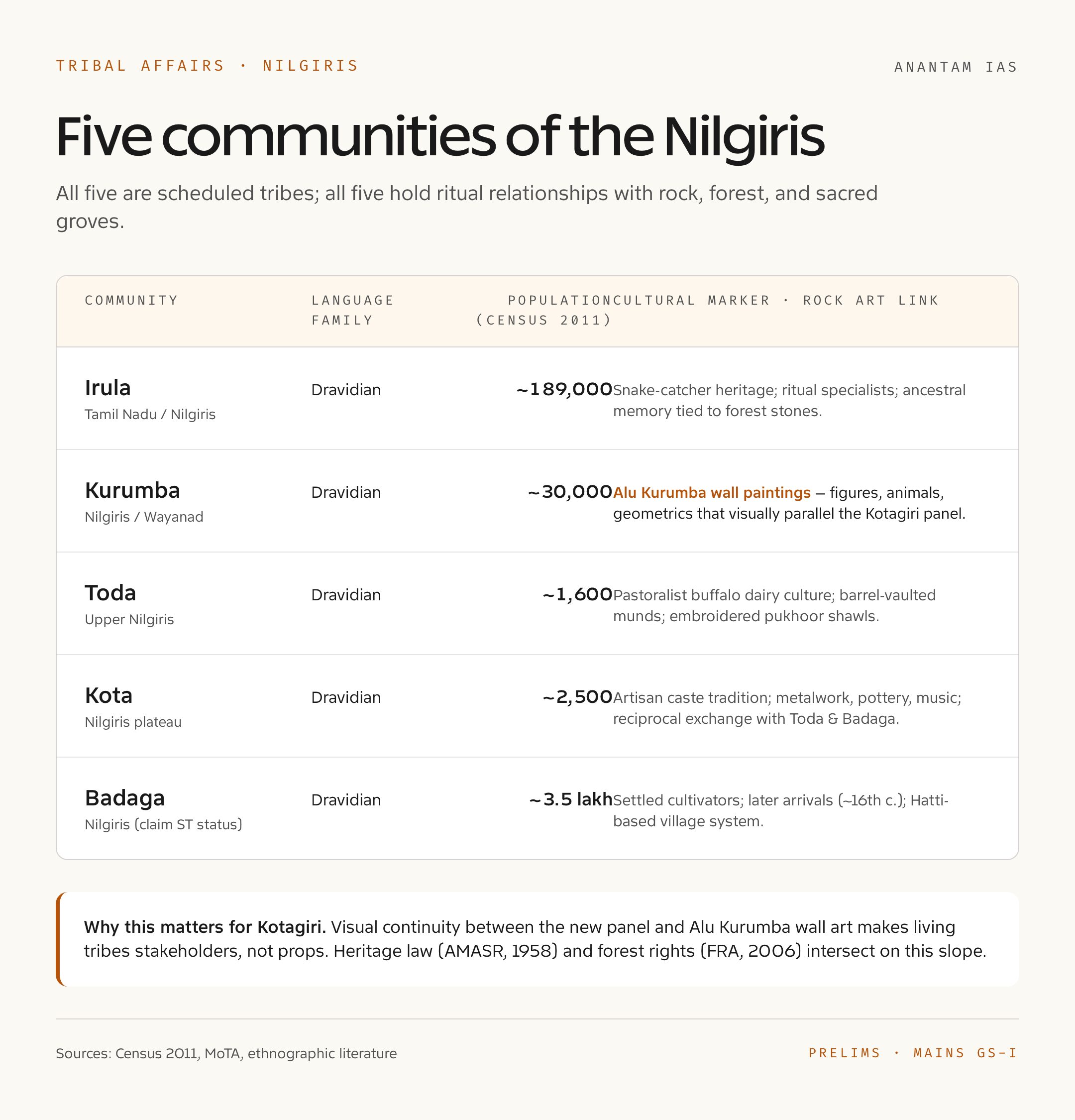
The Nilgiris specifically have always been culturally distinctive. The plateau and surrounding forests sustained the Toda, Kota, Badaga, Irula, and Kurumba communities long before colonial cartographers drew lines across these slopes. Each community has its own oral tradition, ritual calendar, and relationship with sacred groves and stones. Some Kurumba and Irula traditions still reference paintings on rock as ancestral marks, places where rituals are performed, or where the dead are remembered. That continuity matters when interpreting what a new shelter actually means.
If you’re tracking the broader heritage thread, our piece on the Sengol gives a useful frame for how India is currently negotiating between living tradition and museum-grade documentation.
How It Works: Reading a Rock Painting
A rock painting isn’t just an image. It’s a chemical, geological, and cultural composite, and reading it well takes a layered approach.
Pigment chemistry. The red ochre dominant at the Nilgiris site is hematite, an iron oxide. Prehistoric artists ground hematite into a powder, mixed it with binders, plant sap, animal fat, blood, or simply water, and applied it with fingers, twigs, or chewed-fiber brushes. Over time the pigment penetrates microscopic pores in the rock surface, which is why these images survive monsoons and centuries of wind.
Substrate. The Nilgiris shelter is granite-gneiss, a hard rock that resists weathering but can spall in flakes when temperature swings stress the surface. Conservation of these panels means controlling not just human contact but micro-climate.
Imagery vocabulary. Indian rock art has a recurring vocabulary: hunting scenes with bows and spears, dancing figures, animal processions, abstract geometrics like concentric circles, dot grids, and ladder forms. Reading the Nilgiris panel means cross-referencing this vocabulary against South Indian regional traditions and against ethnographic records of Irula and Kurumba ritual.
Dating methods. Direct radiocarbon dating of pigment is possible only when organic binders are present, and even then samples are tiny. Uranium-thorium dating of calcium carbonate crusts that form over paintings can give minimum ages. Stylistic comparison with dated panels elsewhere is the most common method, but it’s the least precise. The Nilgiris team will likely combine all three, plus pigment chemistry analysis, to bracket an age range.
Why It Matters: Five Threads Worth Pulling

One, it expands South India’s rock art map. Every well-documented site is a node in a network. A confirmed Kotagiri shelter strengthens the case for systematic survey across the Nilgiris and the broader Western Ghats.
Two, it links prehistoric art to living tribes. When motifs at the new site echo ritual elements still practiced by Irula and Kurumba communities, the painting stops being only a museum object. It becomes part of a continuing cultural world. That changes how it should be conserved and who gets to speak for it.
Three, it stress-tests the Forest Rights Act and heritage conservation overlap. The shelter sits in forest land. Tribal communities have customary use rights. Heritage protection under the AMASR Act sometimes runs into community access issues. This site will sit at that intersection.
Four, it adds material to the demographic and migration debates. South Indian prehistory is being rewritten by ancient DNA studies showing complex mixtures of Iranian agriculturalists, Andamanese-related hunter-gatherer ancestry, and later Indo-Aryan flows. Rock art is the visible cultural counterpart to those genetic stories.
Five, it has tourism and livelihood potential. Done right, with community partnership, a documented site can support local guides, homestays, and craft markets. Done wrong, it gets vandalized within a season.
Detailed Analysis
The Irula and Kurumba Connection
The Irula and the Kurumba are scheduled tribes of the Nilgiris and adjoining forests. Both speak Dravidian languages, both have historically practiced shifting cultivation, foraging, and small-scale animal husbandry, and both maintain ritual specialists who interface with ancestral and forest spirits. Kurumba traditions in particular have long been associated with painting and ritual decoration. The Alu Kurumba subgroup has a documented tradition of wall paintings in domestic and ritual spaces, with motifs that include human figures, animals, and geometric abstractions strikingly similar to the new Nilgiris panel.
This doesn’t mean the Kotagiri paintings were made by Kurumba ancestors in any direct genealogical sense. Rock art traditions are old and layered. But the visual continuity is real, and it’s the kind of evidence that should drive any interpretation framework. Tribal communities are stakeholders, not props.
Comparison With Bhimbetka and Edakkal
Bhimbetka is the heavyweight reference. Over 750 rock shelters in the Vindhyan sandstone, with paintings spanning Mesolithic hunters to early historic battle scenes. UNESCO World Heritage status since 2003. The Nilgiris site is nowhere near that scale. It’s a single shelter, possibly a few panels.
Edakkal in Wayanad is a closer fit. Two natural caves, pictographs and engravings, motifs ranging from human figures and animals to symbols some scholars argue are proto-Brahmi or earlier graphic systems. Edakkal is dated broadly to the Neolithic and later. The Kotagiri shelter, geographically and ecologically similar, may belong to a similar broad horizon.
Conservation Challenges
Rock art is fragile in ways that don’t show. Tourists touching paintings strip pigment in seconds. Wood smoke from picnic fires darkens panels. Graffiti is permanent. Microbial colonization, lichen growth, and water seepage from above the shelter can erase a panel within a few decades if unmanaged.
The Nilgiris shelter is currently in a forest with limited access, which is its best protection. Once a site becomes “discovered” in the public sense, the threat profile changes overnight. ASI and state archaeology will need to balance documentation, protection, and tribal community access carefully.
If the science angle interests you, our explainer on graphene offers a good companion read on how material science enables non-invasive analysis of fragile artifacts.
Comparative Perspective: Indian Rock Art Sites
| Site | State | Period | Highlights |
|---|---|---|---|
| Bhimbetka | Madhya Pradesh | Mesolithic to historic | UNESCO site, 750+ shelters |
| Edakkal | Kerala | Neolithic onward | Pictographs and engravings |
| Lakhudiyar | Uttarakhand | Mesolithic | Human and animal figures |
| Jogimara | Chhattisgarh | Early historic | Coloured paintings, inscriptions |
| Hire Benakal | Karnataka | Neolithic | Megalithic context |
| Onake Kindi | Karnataka | Neolithic | Ash mound culture link |
| Kotagiri (new) | Tamil Nadu | TBD | Tribal continuity context |
Globally, the Kotagiri find sits in conversation with sites like Lascaux in France, Altamira in Spain, the Cueva de las Manos in Argentina, and Bradshaw paintings in Australia. India’s contribution to the global rock art canon is underweighted relative to the actual density of sites, partly because publication has been uneven and partly because South Indian sites have received less international attention than European caves.
Challenges and Critiques
The discovery is real, but the work that follows is the harder part. A few honest caveats are worth flagging.
Dating uncertainty. Without chemical analysis and direct dating, “ancient” is a wide bracket. The Kotagiri panel could be a few thousand years old or a few centuries. Until dating is published, claims should stay conservative.
Authenticity verification. Forgery in rock art is rare but not unknown. The first job of any documentation team is to confirm that paintings aren’t recent additions made to look old.
Community consent. Documenting and publicizing a site that has ritual significance for living communities raises consent questions. Did the documentation team consult Irula and Kurumba elders? Were any access protocols negotiated? These questions are not optional.
Protection vs access. Once a site is notified under AMASR, public access typically tightens. That’s good for conservation, often bad for tribal customary use. The legal framework hasn’t fully solved this tension anywhere in India.
Resource constraints. State archaeology departments are chronically under-staffed and under-funded. ASI has limited bandwidth. Newly discovered sites often wait years for proper conservation plans.
UPSC Prelims Pointers
- Bhimbetka rock shelters are in the Raisen district of Madhya Pradesh and were inscribed as UNESCO World Heritage in 2003
- Edakkal caves are located in Wayanad, Kerala, and contain pictographs and engravings
- Red ochre pigment in rock art is primarily hematite, an iron oxide
- The Irula and Kurumba are scheduled tribes of the Nilgiris and Western Ghats
- The AMASR Act, 1958 governs the protection of monuments and archaeological sites of national importance in India
- The Forest Rights Act, 2006 recognizes the rights of forest-dwelling Scheduled Tribes and other traditional forest dwellers
- The Nilgiris Biosphere Reserve was the first biosphere reserve in India, notified in 1986
- Onake Kindi in Karnataka is associated with Neolithic ash mound culture
Mains Practice Questions
- GS Paper I: Discuss the significance of recently discovered rock art sites like the Nilgiris Rock Painting shelter in reconstructing the cultural history of South India. How do such sites bridge prehistoric art and living tribal traditions? (250 words)
- GS Paper I: “Indian rock art is one of the world’s longest continuous artistic traditions, yet it remains under-documented and under-protected.” Examine in light of the AMASR Act and current conservation practices. (250 words)
- GS Paper II: Conservation of heritage sites in tribal areas often creates tension between the AMASR Act and the Forest Rights Act. Discuss with reference to recent rock art discoveries. (150 words)
- GS Paper I: Compare the cultural significance of Bhimbetka and Edakkal with newly discovered rock shelters in the Nilgiris. What does the geographic distribution of rock art tell us about prehistoric movement and settlement patterns in the subcontinent? (250 words)
Way Forward
The Nilgiris Rock Painting find deserves what most newly discovered sites don’t get: a slow, careful, community-anchored response. That means joint documentation by ASI and the Tamil Nadu State Department of Archaeology, with formal consultation of Irula and Kurumba representatives. It means scientific dating before public claims about age. It means a conservation management plan before the site is publicized to tourists. And it means using the moment to fund a broader Western Ghats rock art survey, which is overdue by at least two decades.
If India treats this discovery as an asset class, a tourism node, or a press cycle, the panel will degrade within a generation. If it treats the find as a piece of living cultural heritage that connects prehistoric makers to present-day communities, it could become a model for how the country handles the dozens of similar sites that almost certainly remain undocumented in the Western and Eastern Ghats.
The granite has kept its secret for a long time. The next chapter is on us.
Frequently Asked Questions
What is the Nilgiris Rock Painting site?
It is a recently documented prehistoric rock shelter near Kotagiri in Tamil Nadu, containing red ochre paintings of human figures, animals, and geometric symbols on a granite surface.
Who discovered the Nilgiris rock paintings?
A heritage and biodiversity survey team operating in the Kotagiri belt documented the site in late April 2026. Formal verification and dating are being coordinated by the Tamil Nadu State Department of Archaeology and the Archaeological Survey of India.
How old are the Nilgiris rock paintings?
A precise date hasn’t been established yet. Stylistic comparison suggests a late prehistoric to early historic range, but radiocarbon and uranium-thorium analysis are needed for confirmation.
What pigment was used in the paintings?
The dominant pigment is red ochre, a hematite-based iron oxide, mixed with organic binders and applied to the granite shelter wall.
How are the paintings connected to the Irula and Kurumba tribes?
Some motifs at the site visually parallel ritual decorations and wall painting traditions documented among the Kurumba and Irula communities of the Nilgiris, suggesting cultural continuity rather than direct authorship.
How does this site compare with Bhimbetka and Edakkal?
Bhimbetka in Madhya Pradesh and Edakkal in Kerala are larger and better-known. The Kotagiri shelter is a smaller find but significant because it strengthens the South Indian rock art map and ties prehistoric imagery to living tribal traditions.
What law protects rock art sites in India?
The Ancient Monuments and Archaeological Sites and Remains Act, 1958 (AMASR Act) governs protection. State antiquities laws also apply, and the Forest Rights Act, 2006 affects access where sites lie in forest land.
Why is this discovery important for UPSC?
It cuts across Art and Culture, Ancient History, Tribal Affairs, and Heritage Conservation, making it useful for both Prelims factual questions and Mains analytical answers in GS Paper I and Paper II.
Tell Google you want more of this.
Add Anantam IAS as a preferred sourceOne tap, and this site shows up more often in your own Top Stories, AI Overviews and AI Mode. Remove it any time.