Why in News?
Reports suggest that the government’s ₹37,500 crore incentive scheme for surface coal and lignite gasification had received no applications ahead of its September 7, 2026 deadline, raising questions about project viability.
However, the Coal Ministry clarified that the final number could be determined only after the online window closed.
| UPSC Relevance: GS-3: Environment and Biodiversity; GS-3: Economy: Energy & Infrastructure Prelims: Coal Gasification Scheme (key facts), Coal Gasification, Syngas |
What is Coal Gasification?
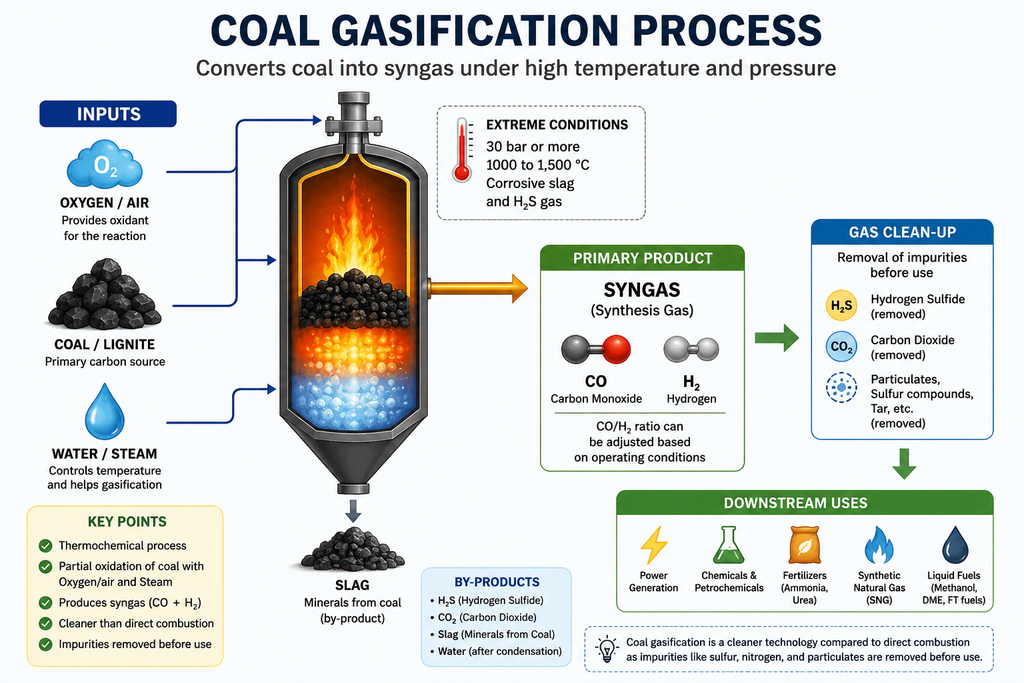
Coal gasification is a thermochemical process in which coal reacts with controlled quantities of oxygen or air and steam at high temperature and pressure. Instead of being burnt directly, coal is converted into synthesis gas or syngas, consisting mainly of:
- hydrogen
- carbon monoxide
- carbon dioxide; and
- smaller quantities of methane and impurities.
Syngas can be converted into methanol, ammonia, urea, synthetic natural gas, hydrogen, dimethyl ether and liquid fuels.
The scheme concerns surface gasification, where mined coal is processed in an above-ground plant. In underground coal gasification, the coal seam is converted into gas in situ.
About the Scheme:
- Approved in May 2026, the scheme seeks to gasify approximately 75 million tonnes of coal and lignite, contributing to the National Coal Gasification Mission’s target of 100 million tonnes by 2030.
- Its major provisions include:
- financial assistance of up to 20% of plant and machinery costs
- maximum assistance of ₹5,000 crore per project
- disbursement in four milestone-linked instalments
- selection through competitive bidding; and
- coal linkages for up to 30 years.
The scheme builds upon the National Coal Gasification Mission (2021), and the ₹8500 crore programme approved in 2024 (under which eight projects involving assistance of ₹6,233 crore are reportedly under implementation).
Why is Coal Gasification being Promoted?
- Import substitution: Syngas can reduce dependence on imported LNG, methanol, ammonia and fertiliser feedstocks.
- Energy security: It converts India’s abundant coal reserves into value-added fuels and chemicals.
- Industrial development: It can support fertilisers, petrochemicals, steel and synthetic-fuel industries.
- Management of local pollutants: Sulphur, particulates and other impurities can be removed from syngas before its final use.
- Easier carbon capture: Gasification produces relatively concentrated carbon dioxide streams, making pre-combustion carbon capture technically easier than in conventional coal combustion.
Why is Industry Hesitant?
- High capital requirement: Integrated gasification and downstream chemical plants require large upfront investment and long construction periods. A 20% capital incentive may not adequately cover technological and market risks.
- High-ash Indian coal: India’s low-grade, high-ash coal reduces efficiency, raises ash-handling costs and may require coal washing or specially designed indigenous gasifiers. The National Coal Gasification Mission itself recognises this as a major constraint.
- Limited domestic experience: India lacks an extensive record of operating large commercial coal-to-chemical plants. Dependence on foreign technology licensors increases costs and execution risks.
- Uncertain product demand: Lenders require assured purchasers and predictable prices for methanol, synthetic gas, hydrogen and fertiliser products. Capital support cannot substitute for long-term offtake arrangements.
- Water and land requirements: Gasification plants need substantial land, water, electricity, oxygen-production facilities and downstream pipelines, often in coal-bearing regions already facing ecological and social pressures.
- Carbon intensity: Gasification is cleaner than direct combustion regarding some local pollutants, but it is not inherently low-carbon. Without effective carbon capture, utilisation and storage, coal-derived hydrogen and chemicals may have high life-cycle greenhouse-gas emissions.
- Transition risk: Falling renewable-energy costs, green hydrogen and tighter carbon standards may make long-lived coal-based projects commercially uncompetitive or create stranded assets.
Way Forward:
- The government should support pilot plants designed specifically for high-ash Indian coal and link incentives to gasification efficiency, product output and emissions performance.
- Long-term coal-pricing and product-offtake arrangements could improve bankability.
- New projects must incorporate CCUS readiness, life-cycle emission assessment, water recycling, ash utilisation and community safeguards.
- Plants should preferably be located near coal mines, downstream consumers and suitable carbon-storage or utilisation facilities.
- Every project should undergo a transparent comparison with alternatives such as natural gas, biomass and green hydrogen.
- Public incentives must not create permanent dependence on commercially unviable or carbon-intensive technologies.
The reported lack of early applications reveals that coal gasification cannot be scaled through capital subsidies alone. Its future depends on solving the combined problems of technology, assured demand, environmental sustainability and financial viability.
Coal gasification may assist import substitution during the energy transition, but it cannot automatically be labelled “clean energy” without deep carbon capture and strict environmental safeguards.
Tell Google you want more of this.
Add Anantam IAS as a preferred sourceOne tap, and this site shows up more often in your own Top Stories, AI Overviews and AI Mode. Remove it any time.