Context: The Union Budget for 2025-26 marked a significant shift in India’s nuclear energy plan by announcing an ambitious target of 100 GW of nuclear power generating capacity by 2047, up from the present 8.18 GW. However, the path is not going to be free from hurdles.
Significance of Nuclear Power
- A major pillar for achieving twin goals:-
- emerging as a developed country (Viksit Bharat) by 2047 as there is a well-established correlation between economic growth and energy consumption. In 2022, India’s per capita electricity consumption stood at 1,208 kWh, compared to 4,600 kWh for China, and over 12,500 kWh for the U.S.
- achieving “net zero emissions” by 2070.
- Nuclear Energy Mission announced a special allocation of *20,000 crore to develop “at least five indigenously designed and operational Small Modular Reactors (SMR) by 2033.”
- To fulfill the growing energy demand- India’s electricity generation capacity, currently at 480 GW (divided almost equally between fossil fuels and renewables), will have to grow five-fold, accounting for growth in population and urbanisation.
- Achieve Aatmanirbharta in Energy Security by reducing reliance on imported fossil fuels and developing the capacity to utilize indigenously available reserves of nuclear fuels like Thorium.
Unreliability of Renewables – solar, wind, and small hydro projects provide only intermittent power. That is why out of 2030 terrawatt-hours (TWh) – the total electricity generated in 2024 – renewable energy, with half the generation capacity, accounted for only 240 TWh. Coal fired thermal plants accounted for 75% of energy generation.
Renewed global interest in nuclear power – This is reflected in the Dubai 2023 COP28‘Declaration to Triple Nuclear Energy’, acknowledging nuclear power as a critical input in reducing reliance on fossil fuels, enhancing energy security, and a move towards a low carbon future.
In June, the International Atomic Energy Agency (IAEA) and the World Bank agreed to work together to support nuclear energy in developing countries.
India’s nuclear journey
An early start : setting up Asia’s first nuclear research reactor, Apsara, in 1956, and beginning work on Asia’s first nuclear power reactors at Tarapore in 1963. As early as 1954, Dr. Homi Bhabha, the architect of India’s nuclear programme, presented a target of generating 8 GW of nuclear power by 1980.
Exclusion of India from Global Nuclear Order : Following India’s war with China in 1962; its entry into the nuclear club in 1964; the decision to stay out of the nuclear Non-Proliferation Treaty (NPT) in 1968; and the Peaceful Nuclear Explosion (PNE) test in 1974, India was excluded from the emerging nuclear order. International cooperation ceased and export controls slowed down the nuclear power programme. This led to the nuclear power target being pushed to 10 GW by 2000
Acceptance as a responsible Nuclear Power : After the nuclear tests in 1998, followed by intense negotiations with the U.S. and other strategic partners, India finally gained acceptance as a responsible nuclear power. It also got a special waiver from the Nuclear Suppliers Group (NSG). India was thus ready to resume exchanges with other nuclear powers to import both nuclear fuel and more advanced reactors to expand its nuclear energy programme.
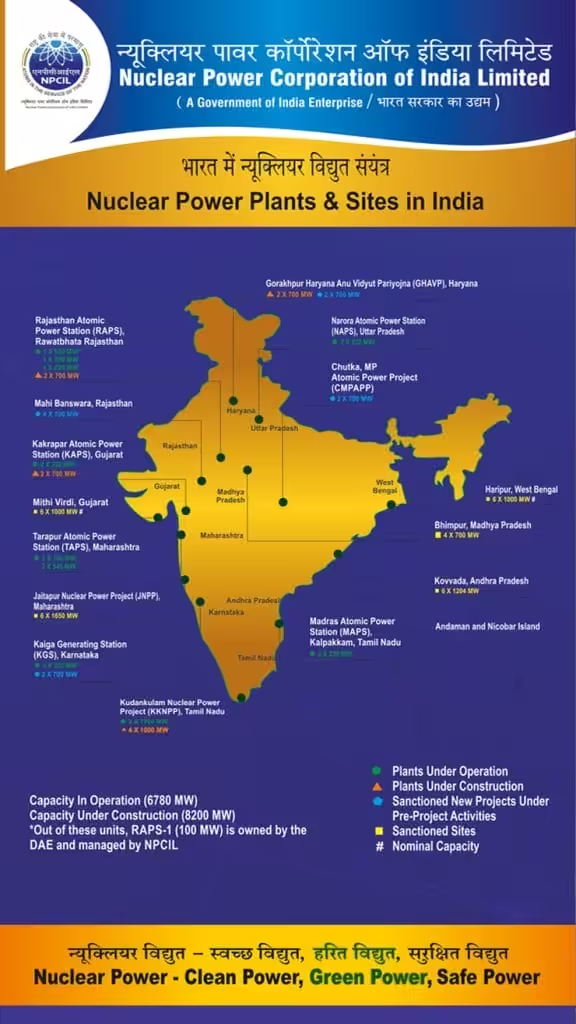
Issues with CLNDA : The CLNDA puts liability on both the operator as well as the supplier creating new difficulties that have prevented external participation from countries like France and USA. Russia is the only country that is partnering with us at Kudankulum with six VVER-1000 power reactors because the government-to-government agreement, signed in 1988, predated the CLNDA.
Key Challenges Limiting Nuclear Power Growth in India:
Human Resource Development: Ensuring a sufficient supply of skilled manpower for operating and managing advanced nuclear technologies and safety protocols is a crucial bottleneck.
High Capital Costs and Long Gestation Periods with limited private participation Nuclear power plants are extremely capital-intensive, requiring massive investments with construction and commissioning taking many years to complete, often leading to cost overruns and deterring private investment.
Limited Uranium Supply and Import Dependence: India has insufficient domestic uranium reserves, necessitating reliance on imported uranium, which introduces vulnerabilities related to global market conditions and geopolitical risks.
Nuclear Waste Management: The safe and permanent disposal of radioactive waste remains a significant challenge, as spent nuclear fuel is highly radioactive for thousands of years.
Public Opposition and Safety Concerns: Public perception, particularly regarding radiation exposure and environmental impact, has led to significant opposition to nuclear projects, often delaying or halting their development.
Regulatory Hurdles and Liability Issues: Complex regulatory frameworks, including the Civil Liability for Nuclear Damage Act of 2010, have created concerns for foreign suppliers regarding liability for accidents, hindering access to advanced international technologies and financing.
Technological Bottlenecks: While India aims for a three-stage nuclear program utilizing thorium, the advancement of technologies required for the later stages, particularly thorium utilization, faces technical and expertise challenges.
Scaling Nuclear Power in India
In May 2025 the country’s Minister for Power set out the steps needed to scale the country’s nuclear energy capacity:
Building skilled manpower capacity by strengthening nuclear education and training infrastructure.
Amending the Atomic Energy Act, 1962 and Civil Liability for Nuclear Damage Act, 2010 to enable broader participation by private and state sectors
Strengthening public perception and enhancing awareness about nuclear energy’s safety and benefits
Facilitating faster land acquisition through brownfield expansions and repurposing retired thermal sites.
Streamlining regulatory approval processes to reduce project timelines.
Introducing tax concessions, green power classification, and long-term financing to ensure competitive nuclear tariffs.
While nuclear energy is a low-carbon energy source, it is not classified as “renewable”, like solar or wind. Revising this classification would make nuclear power projects eligible for tax incentives and specially designed ‘green financing’ instruments.
Diversifying technology choices through competitive bidding and promoting indigenous manufacturing under Make in India.
Securing diversified uranium fuel sources and expanding the vendor base for specialized nuclear equipment
Some other measures suggested by the author
The sector also needs to be opened up to foreign direct investments, perhaps up to 49%, to ensure Indian ownership and control.
One is to standardise the 220 MW PHWR design and apply it to Bharat Small Modular Reactors, which would significantly reduce costs and commissioning time.
The second track is to scale up the Nuclear Power Corporation of India Limited (NPCIL) plans for the 700 MW PHWR by facilitating land acquisition, streamlining licensing, and strengthening indigenous supply chains.
The third track is to accelerate negotiations with partners in France and U.S. that have been moving at a glacial pace for the last 15 years.
Discussion with potential stakeholders that include major players like Tatas, Adani, Ambani, Vedanta etc. on ownership, management and responsibility of private partners.
A set of comprehensive amendments will also be needed for the 2010 CLNDA especially with regards to its liability clause which affects not just the ‘operator’ but also the ‘supplier’ of nuclear power.
Atomic Energy Regulatory Board (AERB) that is ‘autonomous’ but not a legal entity and is subordinate to the Department of Atomic Energy. In 2011, a draft Bill was circulated to establish AERB as an independent regulator, but the Bill lapsed. With the entry of the private sector, the need for an independent regulator becomes paramount.
Tell Google you want more of this.
Add Anantam IAS as a preferred sourceOne tap, and this site shows up more often in your own Top Stories, AI Overviews and AI Mode. Remove it any time.