Parakram Diwas 2026 marked Netaji Subhas Chandra Bose’s 129th birth anniversary with national commemorations at Sri Vijaya Puram in the Andaman and Nicobar Islands. The location mattered as much as the event.
For UPSC, this is not only a culture-calendar item. It opens a modern-history question about the Indian National Army, wartime nationalism, symbolic geography and how the state remembers freedom-struggle narratives outside the mainstream Congress framework.
This article reads Parakram Diwas 2026 through the Andaman lens: Netaji, the INA, colonial imprisonment, island memory and the politics of commemoration.
Quick Facts
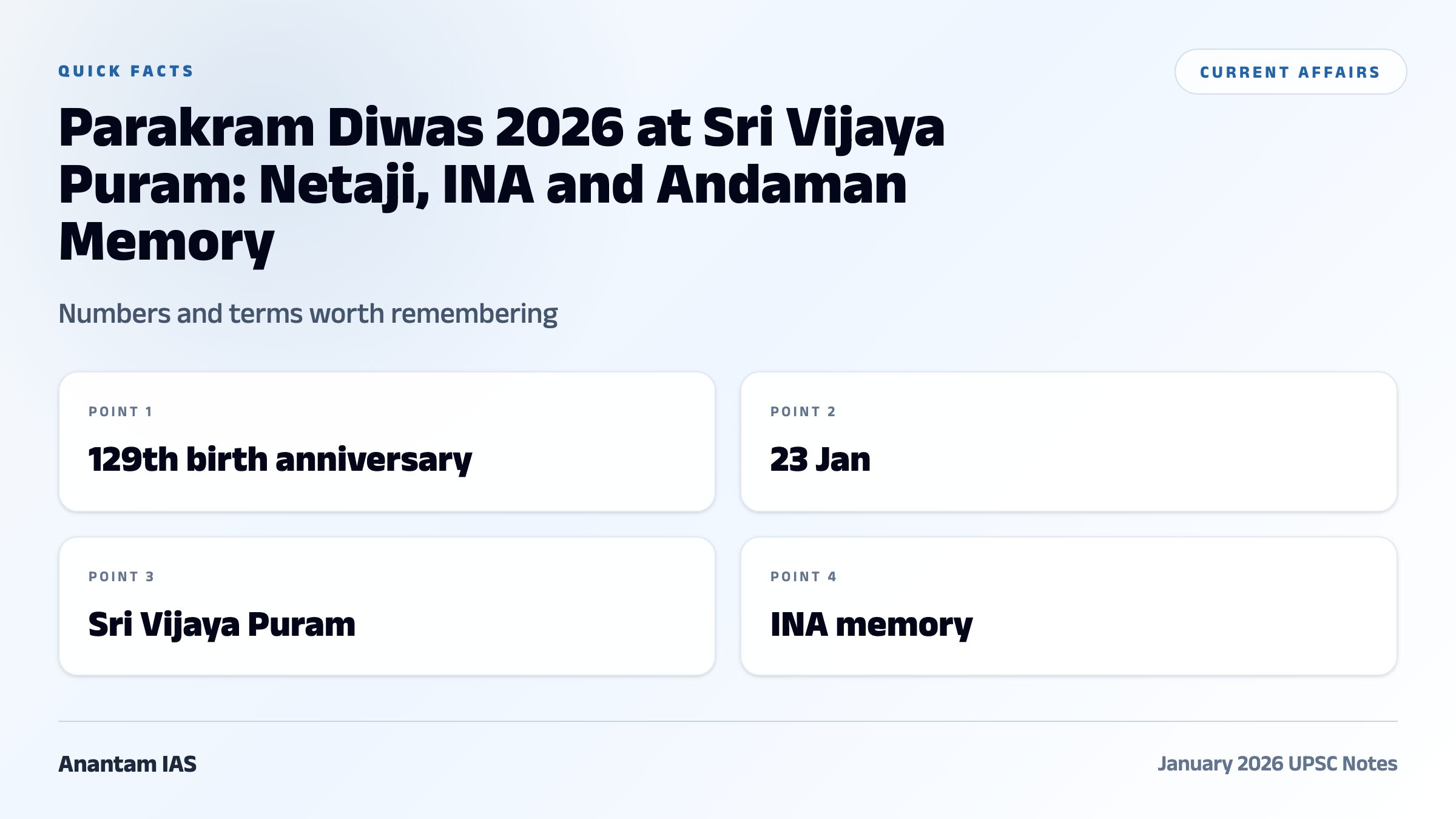
- Parakram Diwas is observed on 23 January, Netaji Subhas Chandra Bose’s birth anniversary.
- The 2026 commemoration marked his 129th birth anniversary.
- The national event was held at Sri Vijaya Puram in the Andaman and Nicobar Islands.
- The event ran from 23 to 25 January 2026 across multiple iconic locations.
- A veteran of the INA, Madhavan Pillai, was felicitated at the event.
- Netaji Subhas Chandra Bose Island, formerly Ross Island, was part of the symbolic geography.
- Official source: PIB, Ministry of Culture.
What Just Happened
The Ministry of Culture organised Parakram Diwas commemorations in Sri Vijaya Puram, foregrounding Netaji’s connection with the Andaman and Nicobar Islands. The program included exhibitions, cultural events and tributes at historically significant locations.
The event location was deliberate. The Andaman Islands carry memories of the Cellular Jail, political imprisonment, anti-colonial sacrifice and the brief wartime symbolism of Azad Hind authority.
For aspirants, the news hook should be used to revise Netaji’s ideological journey, the INA’s military and political role, the impact of INA trials and the contribution of non-mainland spaces to India’s freedom struggle.
Background and Historical Context
Subhas Chandra Bose was elected Congress president in 1938 and 1939 but later broke with the Congress high command over strategy, pace of struggle and wartime politics. He formed the Forward Bloc before leaving India during World War II.
The Indian National Army, initially associated with Mohan Singh and later reorganised under Bose, sought to fight British rule with Japanese support. Bose’s Provisional Government of Azad Hind gave the INA a political frame beyond a military formation.
The Andaman and Nicobar Islands became symbolically important when Bose visited Port Blair in December 1943 and associated the islands with the names Shaheed and Swaraj. That memory continues to shape official commemorations.
Key Features of the 2026 Commemoration
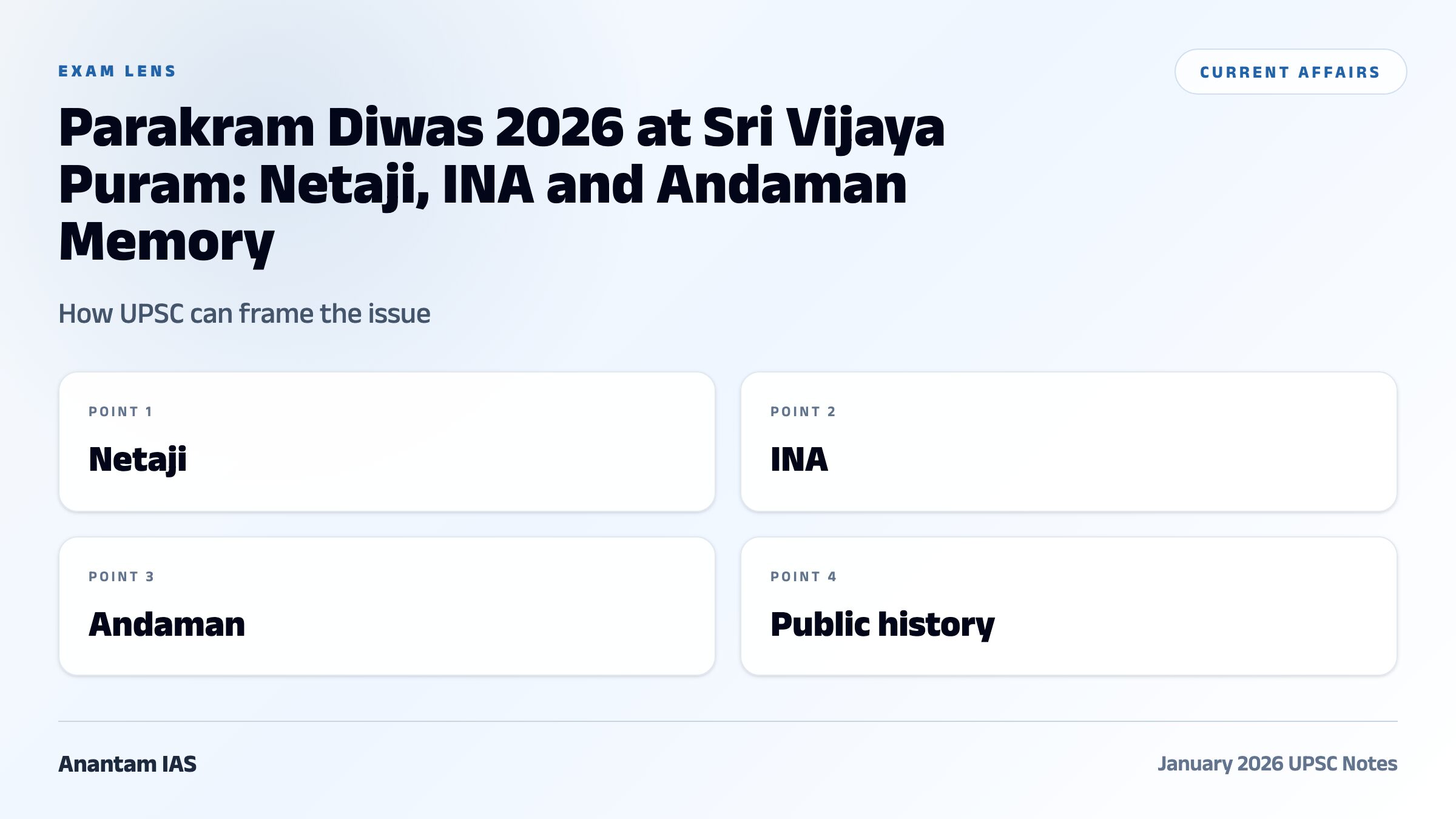
The core policy architecture can be read through these features.
- Birth anniversary: 23 January was observed as Parakram Diwas.
- Island location: Sri Vijaya Puram placed the Andaman story at the centre.
- INA memory: the event linked Netaji with soldiers, veterans and wartime nationalism.
- Public history: exhibitions and cultural programs translated archival history for citizens.
- Symbolic geography: Netaji Subhas Chandra Bose Island and Cellular Jail remain central memory sites.
- Modern-history relevance: the event gives a news hook for revising INA and Bose for UPSC.
Why It Matters
This is a high-yield UPSC topic because it joins current news with durable syllabus themes.
- It gives GS-I Modern History material on Netaji, INA and freedom-struggle diversity.
- It connects commemoration with nation-building and public memory.
- It helps avoid reducing Netaji to one-line factual notes.
- It offers Essay material on memory, sacrifice and the many streams of nationalism.
Detailed Analysis: History and Culture Lens
Netaji remains a difficult figure to simplify. He was a radical nationalist, a mass leader, an organiser and a wartime strategist. Good UPSC answers recognise both his courage and the moral complexity of wartime alliances.
The INA’s direct military impact was limited, but its political impact was large. The Red Fort trials, public sympathy and unrest among armed forces contributed to the psychological erosion of British authority.
The Andaman setting widens the freedom-struggle map. Indian nationalism was not only built in Delhi, Bombay, Calcutta or Lahore. Penal colonies, islands, borderlands and diaspora networks also shaped resistance.
Comparative Perspective
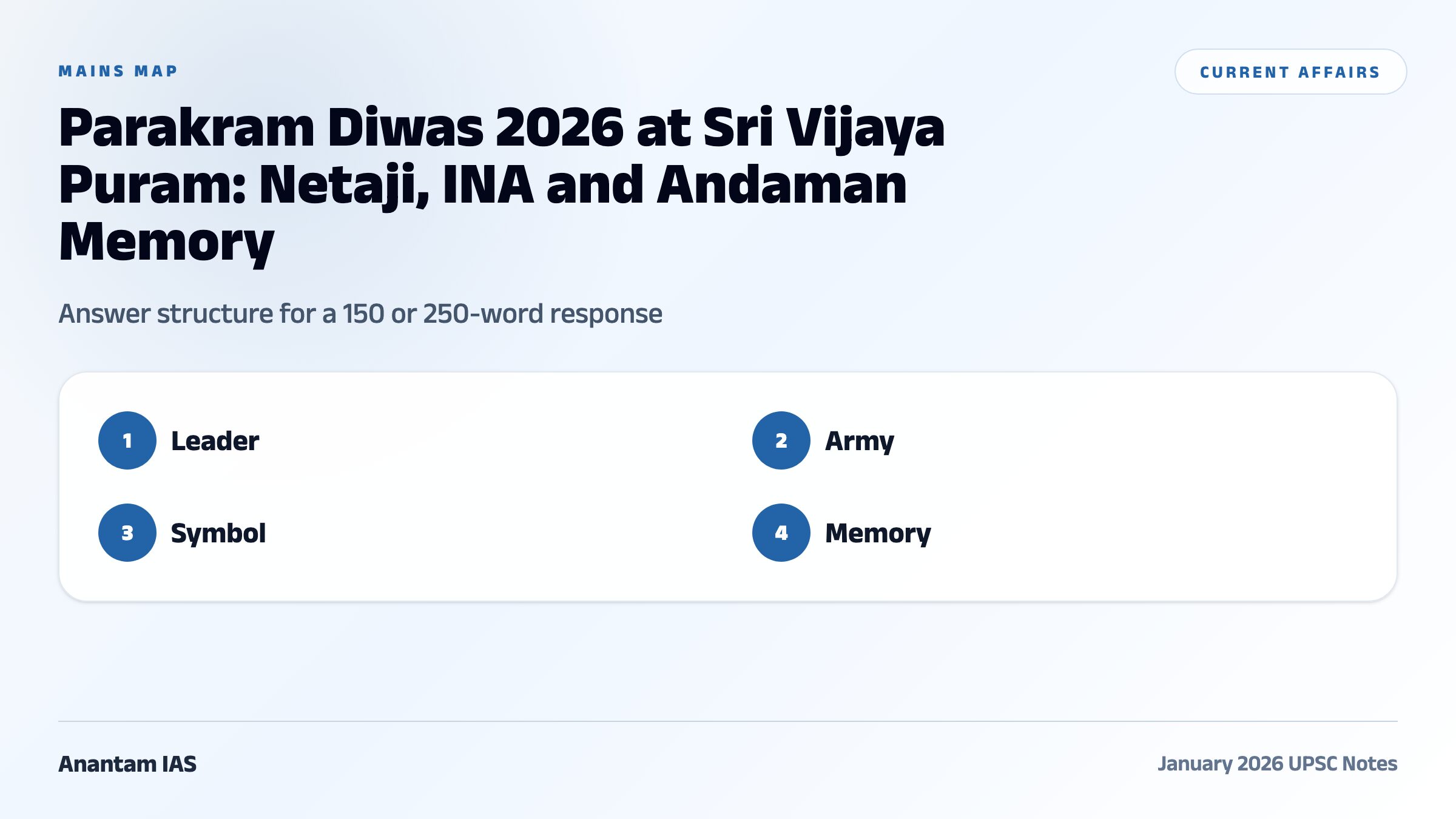
A comparison helps prevent the answer from becoming a one-dimensional news summary.
- Gandhian nationalism: mass mobilisation, non-violence and moral politics.
- Revolutionary nationalism: armed struggle, secret societies and sacrifice.
- INA approach: military struggle combined with expatriate mobilisation and provisional government symbolism.
- Constitutional politics: negotiations, elections, legislatures and institution-building.
Challenges
The policy or institutional promise runs into recurring constraints.
- Commemoration can become symbolic without improving public understanding of historical complexity.
- Netaji’s wartime alliances require careful treatment, not hagiography or dismissal.
- Public history often underrepresents women, soldiers and diaspora contributors in the INA story.
- Regional and island histories need better integration into school and exam narratives.
- Memorialisation must preserve archives, sites and oral histories before they disappear.
Prelims Pointers
- Parakram Diwas is observed on 23 January.
- Netaji Subhas Chandra Bose was born in Cuttack in 1897.
- He was Congress president at Haripura in 1938 and Tripuri in 1939.
- Forward Bloc was founded by Bose in 1939.
- The Provisional Government of Azad Hind was formed in 1943.
- Cellular Jail in the Andaman Islands was a major colonial penal institution.
Mains Questions
- Assess the contribution of Subhas Chandra Bose and the INA to the final phase of India’s freedom struggle. (GS Paper I, 250 words)
- Public commemorations shape historical memory as much as textbooks do. Discuss with reference to Parakram Diwas. (GS Paper I, 150 words)
- The INA’s importance was more political than military. Critically examine. (GS Paper I, 250 words)
- Why should island and diaspora histories be integrated into the narrative of Indian nationalism? (GS Paper I, 250 words)
Way Forward
Parakram Diwas should be used to build better public history: digitised INA records, oral histories, museum pedagogy and translations of archival material into Indian languages.
UPSC aspirants should avoid a binary treatment of Netaji. The stronger answer explains his ideological differences with Congress leadership, his mass appeal, the INA’s symbolic power and the ethical complexity of wartime choices.
The Andaman focus is welcome because it moves the freedom-struggle narrative beyond mainland capitals and reminds students that geography can be an archive.
The examiner is unlikely to reward a bare fact dump here. The better answer connects the January 2026 event to institutional design, implementation capacity and India’s long-term development priorities.
Frequently Asked Questions
What is Parakram Diwas?
Parakram Diwas is observed on 23 January to mark the birth anniversary of Netaji Subhas Chandra Bose.
Why was Sri Vijaya Puram important in 2026?
The 2026 national commemoration was held there to foreground Netaji’s connection with the Andaman and Nicobar Islands.
What was the INA?
The Indian National Army was a military force of Indian soldiers and expatriates that sought to fight British rule during World War II.
Why is Netaji important for UPSC?
He connects Modern History with debates on nationalism, armed struggle, leadership, diaspora mobilisation and public memory.
What was the Provisional Government of Azad Hind?
It was a government-in-exile proclaimed under Bose’s leadership in 1943 to give political form to the INA struggle.
How should students write about Bose?
With balance: recognise courage, organisation and mass appeal, while also noting the complexity of wartime alliances.
Tell Google you want more of this.
Add Anantam IAS as a preferred sourceOne tap, and this site shows up more often in your own Top Stories, AI Overviews and AI Mode. Remove it any time.