Why in news:
Chief Minister Yogi Adityanath declaring during a recent session in the state Assembly the Piprahwa relics -repatriated to India recently, nearly 127 years after they were taken out of the country-would be brought back to Uttar Pradesh.
UPSC Relevance:
Ancient History, Art and Culture, Prelims
PYQ:
With reference to ancient India, consider the following statements:
1. The concept of Stupa is Buddhist in origin.
2. Stupa was generally a repository of relics.
3. Stupa was a votive and commemorative structure in Buddhist tradition.
How many of the statements given above are correct?
(a) Only one
(b) Only two
(c) All three
(d) None
Background of the Piprahwa Relics:
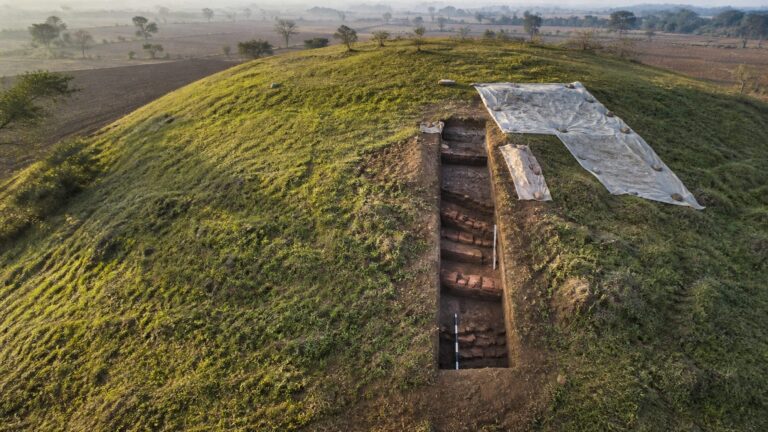
- The relics were discovered over 125 years ago at Piprahwa
- Found by British colonial estate manager William Claxton Peppé in 1898 during excavation of a stupa linked to Lord Buddha and the ancient Shakya kingdom.
- Relics include bone fragments, soapstone and crystal caskets, a sandstone coffer, gold ornaments, and gemstones believed to be remains of Gautama Buddha.
- Taken away under the Indian Treasure Trove Act, 1878; some were kept by Peppé and they were to be auctioned in Hong Kong in May 2024 before Indian intervention.
- Indian Ministry of Culture issued a legal notice demanding immediate cessation of the auction and repatriation of the relics to India.
- The Ministry stated the relics are an “inalienable religious and cultural heritage of India and the global Buddhist community.”
Location & Historical Significance of Piprahwa Stupa:
- Piprahwa village, in Siddharthnagar district (UP), is near the India-Nepal border.
- Lies just south of Lumbini, the birthplace of Lord Buddha.
- The site is linked to the Shakya kingdom (ancient Kapilvastu, Buddha’s childhood home).
- Protected site under the Archaeological Survey of India (ASI).
- Phases of Construction:The stupa was built in three phases
- Initially by the Sakyas soon after Buddha’s death as a simple mud structure.
- The second phase, with fired bricks and concentric circles of clay mortar, dates to the Mauryan period under Emperor Ashoka (~3rd century BCE).
- The third phase included raising the height, squaring the base, and construction of monastic buildings during the Kushan era (~1st-3rd century CE).

| Important Event | Description |
| Buddha’s Death (Parinirvana) | Buddha passed away around 483 BCE in Kushinagar. His body was cremated as per his instructions. |
| Distribution of Relics | Buddha’s ashes were divided into eight portions by a Brahmin named Drona to avoid conflict among claimants. |
| Eight Clans/Groups Receiving Relics | King Ajātasattu of Magadha, Licchavis of Vesāli, Sakyas of Kapilavastu, Bulis of Allakappa, Koliyas of Rāmagāma, Vethadipaka-Dronagramakas, Mallas of Pāvā, and Mallas of Kusinārā. |
| Additional Relics Distribution | Vessel used for cremation was given to Drona, and remaining ashes to Moriyas of Pipphalivana. |
| Building of Stupas | The relic portions were placed in reliquaries and enshrined in hemispherical monuments called stupas. |
| King Ashoka’s Role | Over a century later, Emperor Ashoka redistributed relics in approximately 84,000 stupas across India. |
| Ramagrama Stupa | Only stupa whose relics remain intact today; it was not disturbed by Ashoka’s redistribution. |
Eight original stupas of Buddha:
- Stupa at Kapilavastu (Piprahwa) – Relics of Buddha discovered here; connected to his home region (Sakya tribe).
- Stupa at Rajagriha – One of the oldest stupas built after Buddha’s death, located in the ancient Magadha kingdom.
- Stupa at Vaishali – Built by the Lichhavi republic, houses Buddha’s relics.
- Stupa at Kushinagar – Marks the place of Buddha’s parinirvana (final nirvana after death).
- Stupa at Ramagrama – The only original stupa untouched by Ashoka, located in Nepal, containing undisturbed relics.
- Stupa at Allakappa – Built by the Bullies tribe.
- Stupa at Pava – In the city where Buddha died.
- Stupa at Vethapida – Constructed for relics given to a Brahmana of Vethadipa.
■ The Uttar Pradesh Government is working on transforming Piprahwa into a global Buddhist heritage and tourism hub, restoring Buddha’s relics to their original site, and developing modern facilities to attract pilgrims and international visitors.
■ Tourist footfall has been rising steadily in Kapilvastu :
- 2022: 26,805 visitors.
- 2023: 70,006 visitors (double from 2022).
- Jan–Mar 2025: 23,507 visitors already.
- Projected ~1 lakh tourists by 2025-end.
Tell Google you want more of this.
Add Anantam IAS as a preferred sourceOne tap, and this site shows up more often in your own Top Stories, AI Overviews and AI Mode. Remove it any time.