Why in News?
PIB said Union Home and Cooperation Minister Amit Shah launched the PM Family Care Tracker pilot project in Gandhinagar, Gujarat, and administered polio drops to children.
The pilot seeks to connect birth-death data with a unique child ID so welfare benefits can reach eligible children automatically and on time through an integrated monitoring system.
- The launch was held in Gandhinagar with the Gujarat Chief Minister and the Union Home Secretary present.
- PIB said children were given polio drops and nutrition kits at the event.
- The tracker is framed as a response to three delivery gaps: beneficiary identification, government outreach and timely scheme delivery.
- The system will link a child-level database with birth and death records and create a number or ID for each child.
- The release connects the tracker with DBT-based transparent welfare delivery and monitoring of health-related initiatives.
The development matters in the context of:
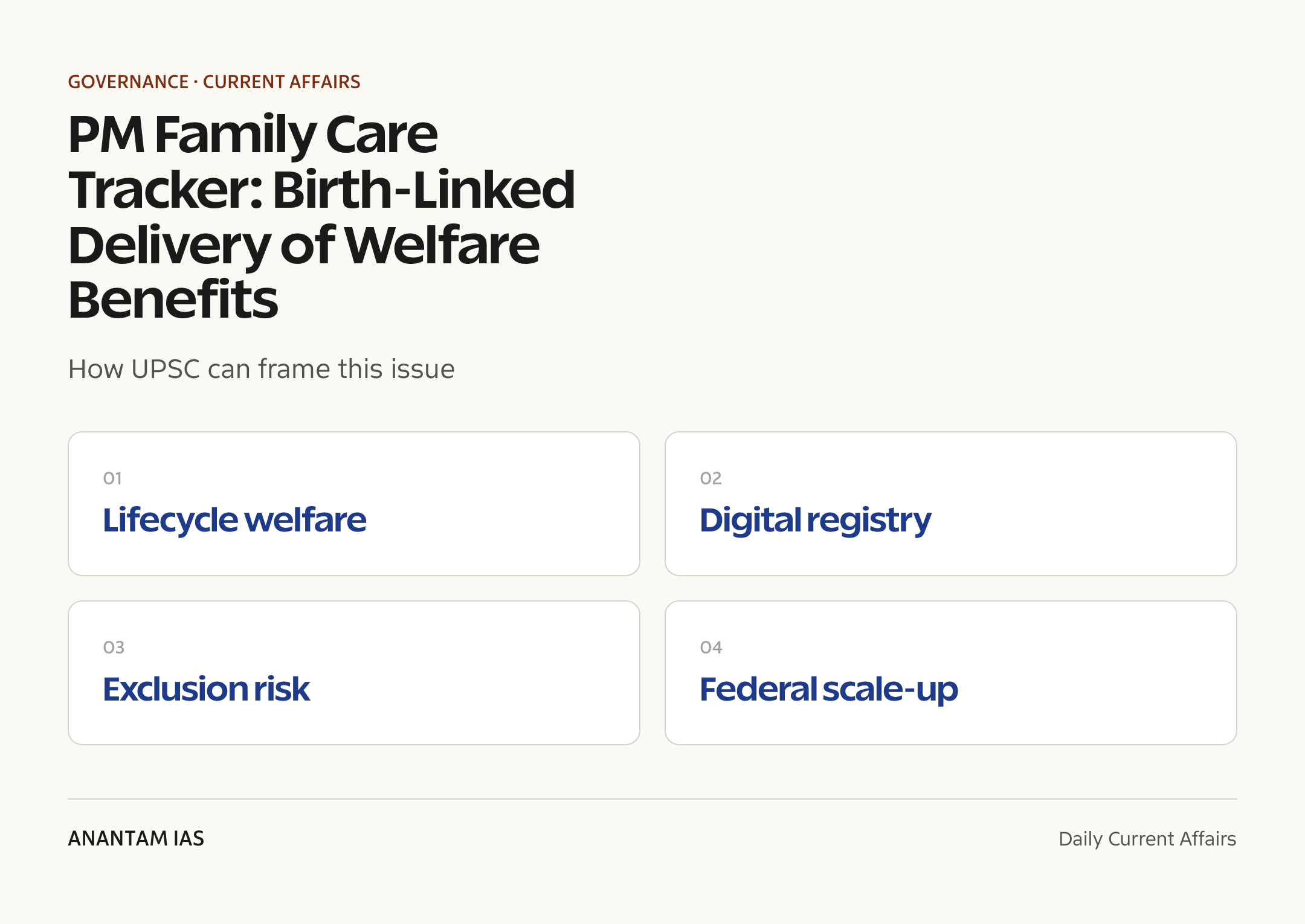
- This matters in the context of lifecycle welfare, where the state shifts from application-based delivery to birth-linked eligibility tracking.
- It is a case study in digital public infrastructure, because registry quality, interoperability and consent shape the delivery outcome.
- It also raises classic GS2 concerns: exclusion errors, data protection, federal coordination and grievance redress.
UPSC Relevance
Prelims Relevance
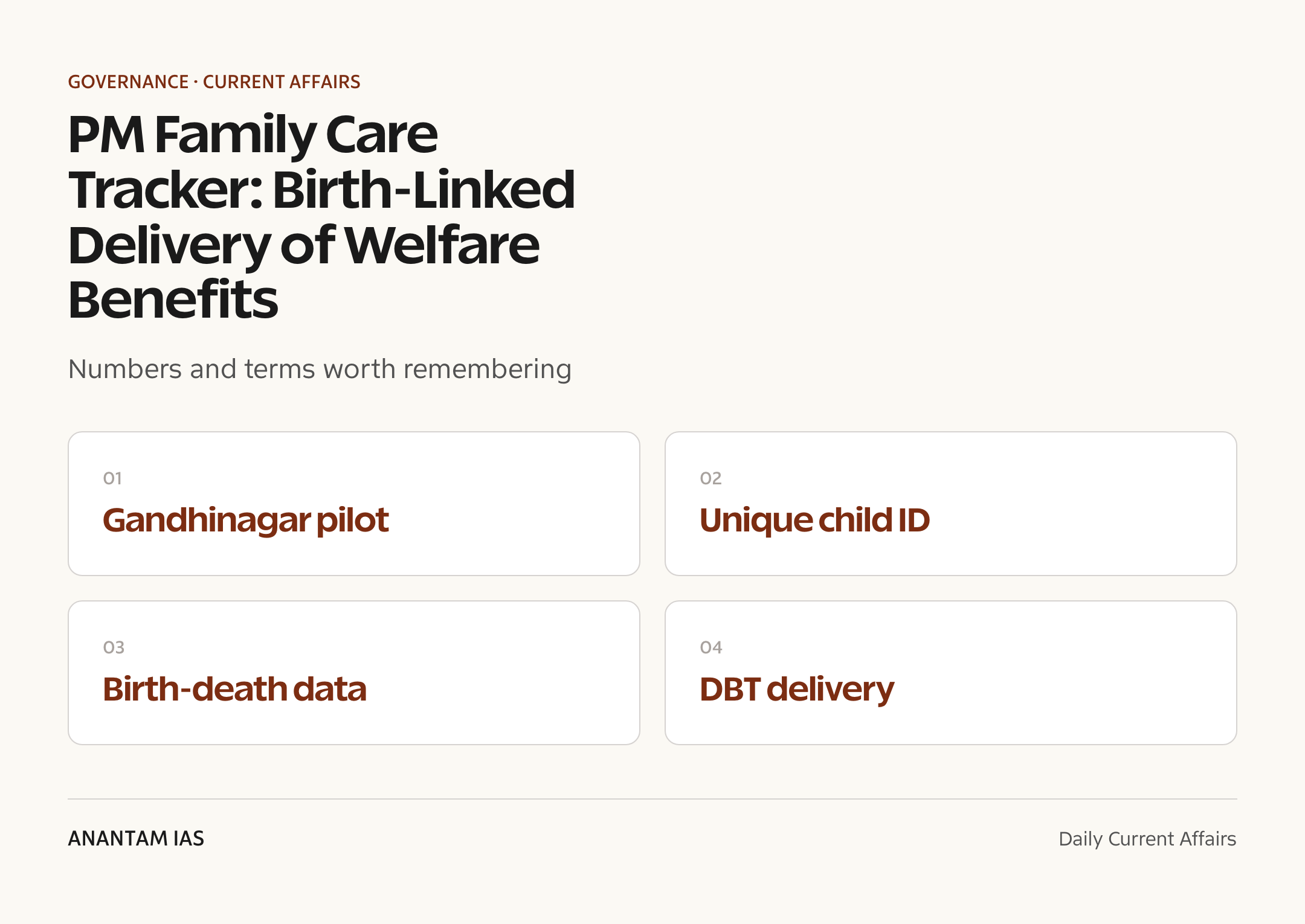
- PM Family Care Tracker: a pilot launched in Gandhinagar to track child-linked welfare delivery.
- Birth-death data: the basic civil-registration layer used to identify eligible children and lifecycle events.
- Unique child ID: the proposed identifier for linking children with welfare entitlements; the release does not call it Aadhaar.
- Direct Benefit Transfer: the transfer architecture used for transparent and targeted welfare payments.
- Integrated monitoring system: the delivery layer meant to track whether benefits reach the needy.
- Polio immunization: relevant to child health, vaccination outreach and last-mile public health delivery.
- Nutrition kits: linked with child nutrition, maternal-child health and convergence of welfare schemes.
- Gandhinagar: the pilot location in Gujarat.
Mains Relevance
GS Paper 2
- Governance reform through beneficiary databases, DBT and last-mile delivery.
- Welfare design for children, especially health, nutrition and early-life interventions.
- Accountability concerns around privacy, exclusion and grievance redress in digital welfare.
GS Paper 2
- Centre-State coordination because birth-death registration, health services and welfare delivery involve multiple levels of government.
- Social justice angle: reaching children and families who often miss benefits because of weak documentation or outreach.
GS Paper 3
- Use of digital public infrastructure for public-service delivery, audit trails and real-time monitoring.
- Cybersecurity and data-governance risks when sensitive child data is linked across databases.
Essay
- Digital state capacity: when technology improves welfare delivery and when it can deepen exclusion.
- The first years of life as the foundation of human capital.
- Trust, transparency and privacy in welfare governance.
Background and Context
What The Tracker Tries To Solve
The pilot is built around a simple governance question: how can a child receive benefits without the family repeatedly proving eligibility?
- Beneficiary identification is the first problem: welfare schemes often fail when the state does not know who is eligible, where they live or which life event has triggered entitlement.
- Government outreach is the second problem: families may not know which scheme applies, which document is needed or which office to approach.
- Timely delivery is the third problem: child-health and nutrition benefits lose value when they reach late, especially in infancy and early childhood.
- The tracker tries to shift delivery from a reactive application model to a proactive lifecycle model where the state acts when a birth or other record appears.
- For UPSC, the core concept is not the software name alone; it is the move toward event-triggered welfare delivery.
- A child-linked tracker can also reduce fragmentation, because one household may interact separately with civil registration, immunization, anganwadi services, nutrition support and cash-transfer systems.
- The administrative promise is single-view follow-up: officials can see whether a child has been identified, whether a benefit is due and whether delivery is pending.
Birth-Death Data As A Welfare Layer
Civil registration becomes more powerful when it is treated as a service-delivery trigger, not only as a record-keeping function.
- Birth registration can help identify a newborn, the household and the first set of health, nutrition and social-protection entitlements.
- Death registration can help update records, prevent duplicate delivery and identify families that may need social support after the loss of a caregiver.
- India’s civil registration framework is linked with the Registration of Births and Deaths Act, 1969, making the quality of local registration crucial for any child-linked tracker.
- Weak registration can create exclusion errors: children without timely birth registration may remain outside automated delivery loops.
- Clean registries also need deduplication, error correction and an easy process for families to update names, addresses and guardian details.
- The biggest governance gain comes when civil registration is combined with field verification, because frontline workers can confirm whether the child and family actually received services.
- For Prelims, remember the distinction: registration data identifies a life event, while welfare systems decide eligibility and delivery.
DBT 2.0 And Last-Mile Delivery
The release frames the tracker within the wider DBT logic of targeted, transparent and monitorable welfare.
- Direct Benefit Transfer reduces leakages by moving benefits or subsidies closer to identified beneficiaries through verified channels.
- The tracker adds a child-lifecycle lens: birth, immunization, nutrition and health interventions can be tracked against a child’s record.
- This is an extension of the governance logic behind direct benefit transfers: fewer middle layers, clearer beneficiary lists and better audit trails.
- But DBT works best when identity, banking access, mobile connectivity and local support systems are reliable.
- If a family lacks documents, faces migration, or has errors in records, an automated system can miss exactly the child it is meant to protect.
- The next-generation challenge is assisted delivery: using data to find the beneficiary, but using human support to complete documentation, resolve mismatch and close the service gap.
- A good answer should balance the gains from leakage reduction with the risk that efficiency metrics can hide families who never entered the database.
Child Health And Nutrition Convergence
The launch connected the tracker with polio drops and nutrition kits, making it relevant to child health governance.
- Polio drops point to immunization outreach, micro-planning and local health-worker networks.
- Nutrition kits connect the tracker with early-childhood nutrition, maternal-child health and the fight against wasting, stunting and anemia.
- For a child, welfare is not one scheme; it is a bundle of health, nutrition, sanitation, childcare and household-support interventions.
- The tracker can be studied with child malnutrition and stunting, because early identification matters more than delayed compensation.
- It also links with early childhood care and education, where the first six years shape learning, nutrition and cognitive development.
- The delivery challenge is convergence: health departments, civil registrars, anganwadi systems and local governments must read from compatible data.
- The public-health angle is continuity of care: a child should not disappear from follow-up after one vaccine dose, one nutrition kit or one household visit.
- The social-justice angle is early correction: a timely intervention in infancy can prevent deeper deprivation later in schooling, health and learning outcomes.
How To Use It In Mains Answers
This topic is best used as an example of digital governance that needs both technology and rights-based safeguards.
- Under governance, use it to show how databases, DBT and local delivery systems can reduce leakages and delays.
- Under social justice, use it to discuss children as a vulnerable group whose entitlements must be delivered without making poor families navigate complex paperwork.
- Under health, connect it with immunization, nutrition, early childhood development and preventive care.
- Under ethics, frame the dilemma as efficiency versus dignity: faster delivery is valuable, but not at the cost of consent, privacy or easy correction.
- Under federalism, note that central platforms need state and local implementation capacity, because the last mile is handled by field institutions.
- A balanced conclusion should say that digital welfare is a tool, not a substitute for frontline staff, social audits and accessible grievance systems.
Digital Governance Risks
A child-linked welfare tracker can improve delivery, but it also concentrates sensitive data and decision power.
- Privacy risk is high because child data, family data, health status and welfare eligibility can become part of the same service-delivery system.
- Purpose limitation matters: data collected for welfare delivery should not be freely reused for unrelated surveillance or profiling.
- Consent and guardian rights become important because children cannot meaningfully consent to long-term data trails.
- Algorithmic exclusion can occur if the system flags a family as ineligible because of stale or mismatched records.
- Grievance redress must be offline-friendly: a parent should be able to correct records at a local office, health center or anganwadi, not only through an app.
- Cybersecurity is part of welfare capacity because a breach of child-level data can cause lasting harm.
- Children’s data needs a higher standard of care because a record created at birth can follow the person for decades.
- Public dashboards should publish aggregate performance, not personally identifiable child or household information.
Federal And Administrative Scaling
A pilot can prove the concept, but scaling it needs legal clarity, common standards and local administrative capacity.
- The pilot is in Gandhinagar; UPSC answers should avoid treating it as a nationwide operational scheme unless officially expanded.
- State and local bodies handle much of the practical work: birth registration, health outreach, anganwadi services and local welfare lists.
- A national or wider state rollout would need interoperability standards, role-based access and clear accountability for data correction.
- Field workers need usable tools and training; otherwise a digital tracker can become one more reporting burden.
- The best test of the model is not the dashboard but whether high-risk children receive services earlier, with fewer missed cases.
- A phased rollout should publish lessons from the pilot: data quality, error rates, benefit delays, grievance load and staff workload.
- Scale should follow evidence. If the pilot reduces missed children and service delays without increasing exclusion, it becomes a stronger model for lifecycle welfare.
Way Forward
Build Rights-Based Data Governance
- Adopt data minimization: collect only what is needed for child welfare delivery and monitoring.
- Define purpose limitation, retention rules and audit trails before scaling beyond the pilot.
- Create child-sensitive safeguards for access, correction, deletion where legally possible and guardian grievance redress.
Protect Against Exclusion
- Keep offline enrollment and correction channels available through local health centers, anganwadis and civil-registration offices.
- Use social workers and ASHA/anganwadi networks to identify children who are missing from the database.
- Measure success by reduced missed benefits, not by the number of profiles created.
Make Convergence Practical
- Link only the necessary datasets across health, nutrition and civil registration with clear departmental responsibility.
- Train frontline staff to use the tracker for service follow-up, not only for upward reporting.
- Run periodic public audits on delivery timelines, grievance resolution and correction rates.
Conclusion
The PM Family Care Tracker pilot is important because it treats a child’s birth record as the beginning of a welfare pathway. If implemented well, it can reduce missed benefits in health, nutrition and social protection.
The caution is equally clear. A welfare tracker for children must be built around trust, privacy, human support and local correction mechanisms. Digital delivery is useful only when the weakest household can still claim its rights.
UPSC Practice Questions
Prelims MCQ 1
With reference to the PM Family Care Tracker pilot, consider the following statements:
- It was launched in Gandhinagar, Gujarat.
- It seeks to link birth-death data with a unique child ID.
- PIB described it as a system for replacing all child-health schemes with one cash transfer.
How many of the above statements are correct?
(a) Only one (b) Only two (c) All three (d) None
Answer: (b) Only two
Explanation:
Statements 1 and 2 are correct. PIB said the tracker was launched in Gandhinagar and will link birth-death data with a unique child ID. It did not say that all child-health schemes will be replaced by one cash transfer.
Prelims MCQ 2
Which of the following is the best governance rationale for linking birth registration with welfare delivery?
(a) It removes the need for data protection safeguards (b) It allows benefits to be triggered by lifecycle events (c) It makes local governments irrelevant in service delivery (d) It automatically proves household income without verification
Answer: (b) It allows benefits to be triggered by lifecycle events
Explanation:
Birth registration can act as an early trigger for child-linked health, nutrition and welfare entitlements. It does not remove privacy duties, local implementation or verification needs.
UPSC Mains Questions
- The PM Family Care Tracker pilot shows how birth-linked databases can support lifecycle welfare. Discuss its potential for improving child health and nutrition delivery, and examine the risks of exclusion, privacy loss and weak grievance redress.
- Digital governance can make welfare delivery more proactive, but it can also make errors harder for citizens to correct. Analyze this statement with reference to DBT, civil registration and child-welfare delivery.
- For child-focused welfare, convergence across health, nutrition, civil registration and local government is more important than creating one more dashboard. Comment.
Source: PIB, Ministry of Home Affairs.
Frequently Asked Questions
What is PM Family Care Tracker?
PM Family Care Tracker is a pilot launched in Gandhinagar to connect child-linked welfare delivery with birth-death data and a unique child ID. PIB frames it as an integrated monitoring system for identifying beneficiaries, improving outreach and delivering scheme benefits on time.
Where was the pilot launched?
The pilot was launched in Gandhinagar, Gujarat. PIB said Union Home and Cooperation Minister Amit Shah launched it and administered polio drops to children during the event, where nutrition kits were also distributed.
Why is birth-death data important?
Birth-death data helps the state identify lifecycle events. A registered birth can trigger child health, nutrition and welfare follow-up, while updated records can reduce duplication and missed delivery. The model depends on accurate, timely and inclusive civil registration.
How is it linked to DBT?
The release connects the tracker with DBT-style transparent welfare delivery. The idea is to identify eligible beneficiaries more accurately, reduce delays and monitor whether benefits reach the intended child or family through the delivery chain.
What are the main risks?
The main risks are exclusion of children with missing or incorrect records, privacy loss from linking sensitive child and family data, weak cybersecurity and poor grievance redress. Automated welfare systems still need human support and offline correction channels.
Why is it relevant for UPSC?
It fits GS2 themes such as governance, welfare schemes, social justice, health delivery, DBT and federal implementation. It also raises GS3 questions on digital public infrastructure, data security and the use of technology in public-service delivery.
Tell Google you want more of this.
Add Anantam IAS as a preferred sourceOne tap, and this site shows up more often in your own Top Stories, AI Overviews and AI Mode. Remove it any time.