Why in News?
On 28 October 2026, the Union Cabinet approved Pradhan Mantri Viksit Gram Swaraj Yojana (PM VGSY), a Centrally Sponsored Scheme intended to strengthen participatory village planning, Panchayat capabilities and accountability.
- PM VGSY will support holistic Gram Panchayat Development Plans by connecting village priorities, departmental interventions and available resources.
- Implementation will run through States and Union Territories, whose Annual Action Plans require appraisal and approval by the designated Central Empowered Committee.
- Existing departmental arrangements for delivering individual schemes will continue; approval of the new coordinating framework does not establish completed village outcomes.
- A village may receive support through several programmes, but coordination determines whether their activities address the same local service gap.
- Planning capacity, reliable accounts and public scrutiny help local institutions turn available funds into services residents can use.
UPSC Relevance
Prelims Relevance
- GPDP: Gram Panchayat Development Plan.
- PM VGSY: a Centrally Sponsored Scheme approved by the Union Cabinet.
- Gram Sabha: a forum for informed community deliberation envisaged in this scheme.
- Own Source Revenue: locally mobilised revenue, distinct from external grants.
- Coverage: all States and Union Territories, including traditional rural local bodies in non-Part IX areas.
Mains Relevance
GS Paper 2
- Participatory planning and institutional capacity in rural local governance.
- Coordination across departments while retaining responsibility for individual programmes.
Essay
- Democratic participation needs institutions capable of acting on public priorities.
Background and Context
How Village Priorities Become a Development Plan
A useful village plan identifies needs, connects them to available interventions and makes responsibility visible before activities are taken up.
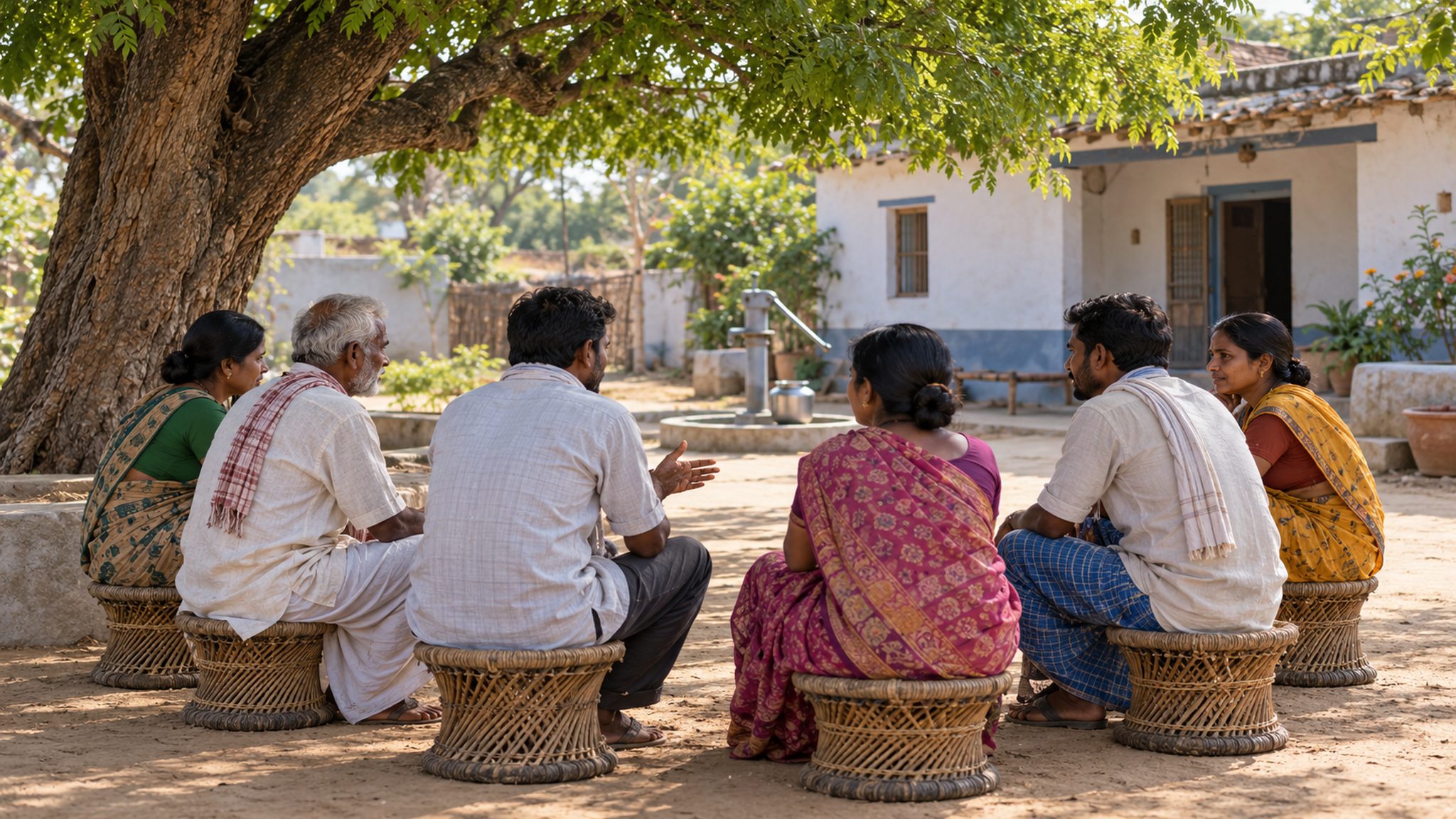
- Participatory planning begins with residents discussing local needs through Gram Sabhas and other Panchayat forums. The scheme envisages informed discussion of government initiatives so that village priorities can shape development choices and subsequent follow-up.
- A Gram Panchayat Development Plan brings priorities, relevant departmental interventions and available resources together. Its practical value lies in exposing gaps and overlaps across separate programmes before officials treat a collection of activities as coordinated development.
- Evidence-based planning requires information about community assets, benefits, beneficiaries and resources. A common view can reveal unmet needs, but its usefulness depends on complete, current records and the ability to interpret them locally.
- Convergence connects the planning processes of Central departments and State governments with Panchayat priorities. It does not mean that each department transfers its entire programme, staff or financial authority to the Gram Panchayat.
- For example, a village service gap may involve different departmental responsibilities. Joint planning should clarify the relevant intervention and available resources; this is an explanatory planning example, not a new funding entitlement under PM VGSY.
Who Plans, Approves and Delivers
The scheme combines local coordination with State implementation and central appraisal; these roles should remain distinct when reading its approval.
- States and Union Territories will submit Annual Action Plans describing activities, priorities and requirements under the scheme. The designated Central Empowered Committee will appraise and approve those plans according to applicable procedures and norms.
- Existing departmental delivery continues for individual schemes. A Panchayat can coordinate needs and monitor gaps without becoming the sole implementing authority for every programme operating in its territory or controlling all associated funds.
- Capacity building covers digital systems, resource information, planning and communication with citizens. Training matters when representatives and functionaries can apply information to actual choices, rather than merely complete a course or enter data.
- The approval permits need-based contractual support at State, district and block levels, while stating that no permanent posts will be created. Technical assistance supports institutions; it does not substitute for their assigned responsibilities.
- Traditional rural local bodies in non-Part IX areas are included where Panchayats do not exist. This coverage recognises institutional differences; the announcement does not abolish those differences or impose identical local government structures everywhere.
Resources, Audit and the Limits of Approval
Better planning needs a traceable connection between resources, decisions and results, followed by public examination of how money was used.
- Own Source Revenue and external grants are different resource streams. The scheme supports local revenue mobilisation and better use of available funds; it does not itself announce a new unlimited Panchayat power to levy taxes.
- Accounting and auditing help trace expenditure to authorised purposes, while public disclosure allows residents to examine decisions. Preparing an audit plan is an administrative step; completing the audit and addressing findings remain separate tasks.
- The related rural water finance discussion explains why funding conditions matter. Coordinating resources through a village plan does not automatically remove restrictions attached to a particular grant or departmental programme.
- Unlike the municipal devolution debate, this announcement concerns rural planning capability and coordination. Improved information systems cannot, by themselves, settle broader questions about legal powers or the distribution of administrative authority.
- Cabinet approval establishes the scheme decision, not evidence of better services already delivered. Assessment should examine whether priorities reach plans, resources match those plans, responsibilities are clear and public scrutiny leads to corrective action.
Way Forward
Make Each Plan Traceable to Follow-Up
- Record the service gap, relevant department and available resource against each priority so residents can follow the decision.
- Support functionaries in checking data quality before planning, and keep a practical route for residents to flag omissions.
- Publish understandable accounts and track audit follow-up, rather than treating an uploaded plan or completed training session as the final result.
Conclusion
- PM VGSY centres the Gram Panchayat in participatory planning and coordination while retaining departmental delivery. The important governance question is whether local priorities can be translated into feasible, resourced activities with clear responsibility.
- Accountability requires more than a common platform: residents need understandable information, institutions need capacity and audit findings need follow-up. Use the scheme to connect participation, administrative coordination and scrutiny in a decentralisation answer.
UPSC Practice Questions
Prelims MCQ 1
With reference to the approved PM VGSY design, consider the following statements:
- Existing departmental arrangements for delivering individual schemes will continue.
- The scheme creates permanent posts at the Gram Panchayat level.
- Traditional rural local bodies in non-Part IX areas are included in its coverage.
How many of the above statements are correct?
(a) Only one (b) Only two (c) All three (d) None
Answer: (b) Only two
Explanation:
Statements 1 and 3 are correct. The Cabinet release expressly retains departmental delivery and includes traditional local bodies in non-Part IX areas. It states that no permanent posts will be created.
Prelims MCQ 2
Which interpretation best reflects the role of convergence in a Gram Panchayat Development Plan?
(a) Combining every departmental fund into an unrestricted Panchayat account (b) Replacing all departmental implementing agencies with the Gram Sabha (c) Linking village priorities, departmental interventions and available resources (d) Treating preparation of a plan as proof that every service gap is resolved
Answer: (c) Linking village priorities, departmental interventions and available resources
Explanation:
Convergence coordinates planning and identifies gaps across interventions. The approval does not merge every fund, abolish departmental delivery or establish completed outcomes.
UPSC Mains Questions
- How can participatory village planning improve coordination across government programmes? Discuss the institutional conditions needed for PM VGSY to achieve this objective.
- Explain why digital planning, accounting and audit systems require local administrative capacity and public scrutiny to strengthen Panchayat accountability.
Source: PIB, Cabinet.
Frequently Asked Questions
What is PM VGSY?
Pradhan Mantri Viksit Gram Swaraj Yojana is a Centrally Sponsored Scheme approved to strengthen village planning, Panchayat capabilities, resource management and accountability through State and Union Territory implementation.
Does PM VGSY replace individual departmental schemes?
No. The Cabinet release states that existing departmental arrangements for delivering individual schemes will continue. The new framework brings their planning processes and available resources together around village priorities.
Why does the scheme emphasise Own Source Revenue?
Locally mobilised revenue can support financial self-reliance alongside grants and other funds. The scheme supports mobilisation and resource management, but the approval does not announce an unrestricted new taxing power.
Does an approved village plan prove that services have improved?
No. A plan records intended priorities and activities. Delivery, resource use, audit findings and corrective action require separate examination before claiming that residents have received better services.
Tell Google you want more of this.
Add Anantam IAS as a preferred sourceOne tap, and this site shows up more often in your own Top Stories, AI Overviews and AI Mode. Remove it any time.