Why in News?
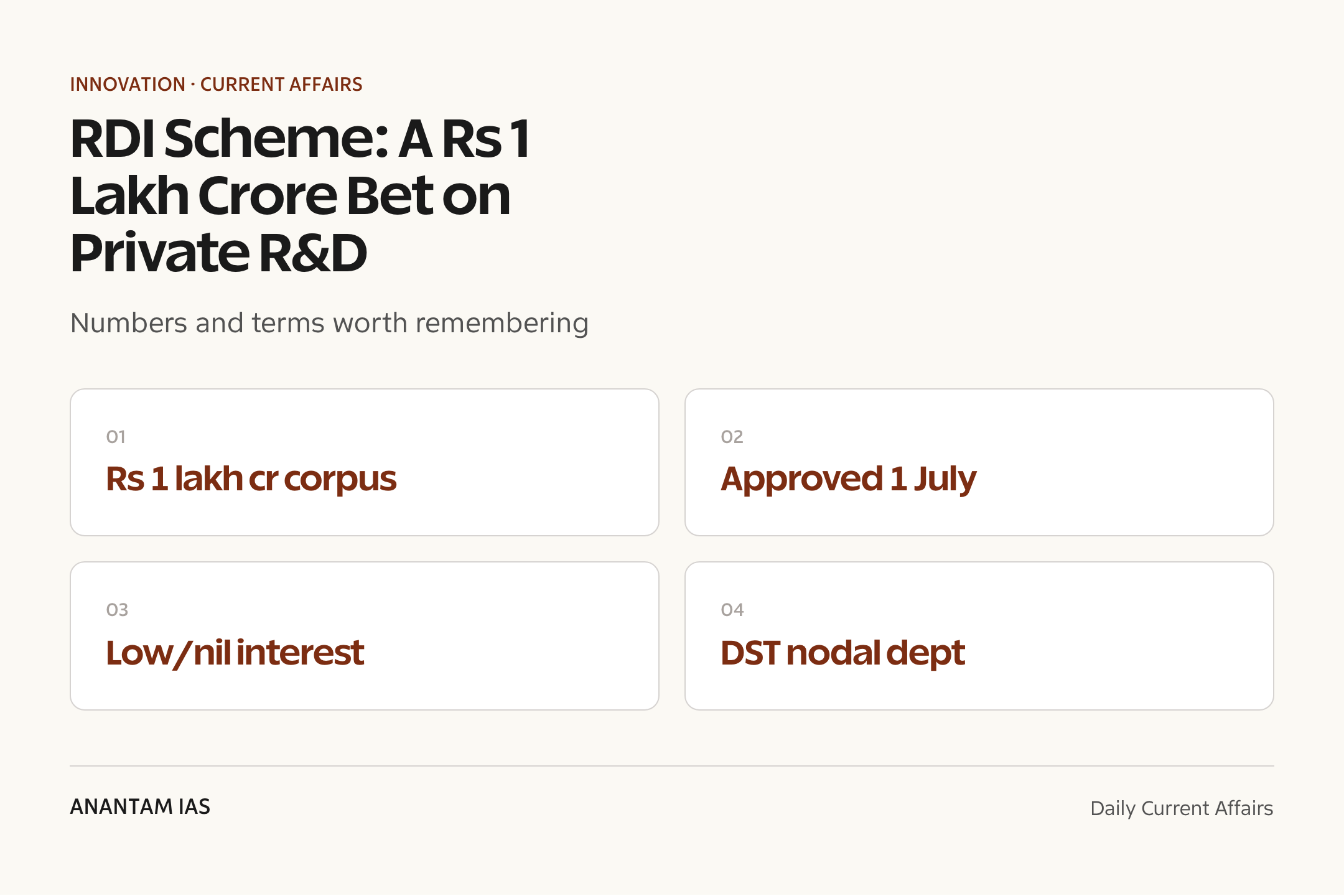
On 1 July 2025 the Union Cabinet, chaired by the Prime Minister, approved the Research, Development and Innovation (RDI) Scheme with a corpus of Rs 1 lakh crore, PIB confirmed. The scheme is built to channel long-term, affordable capital into private-sector R&D in strategic and sunrise sectors.
The headline design is a two-tiered funding mechanism: a Special Purpose Fund (SPF) housed in the Anusandhan National Research Foundation (ANRF) acts as custodian, then routes money to second-level fund managers who lend to projects at low or nil interest with long tenors.
- Corpus of Rs 1 lakh crore; long-tenor financing or refinancing at low or nil interest rates.
- Strategic direction from the Governing Board of ANRF, chaired by the Prime Minister.
- Department of Science and Technology (DST) is the nodal department for implementation.
- A Deep-Tech Fund of Funds (FoF) is to be set up under the scheme.
- Targets sunrise and strategic sectors — economic security, strategic purpose and self-reliance.
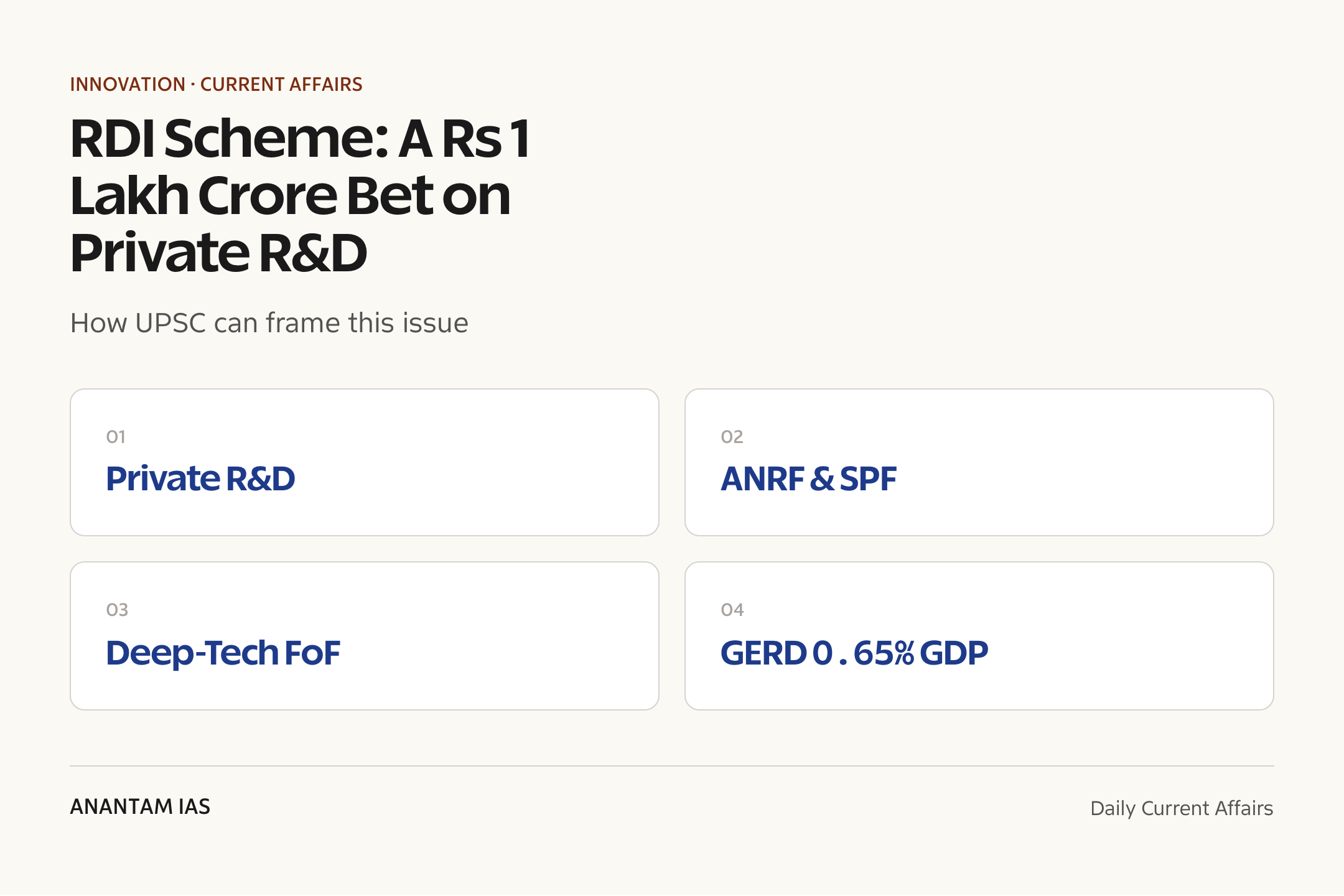
- Aimed at lifting India’s chronically low gross R&D spending, around 0.65% of GDP per standard estimates.
The development matters in the context of:
- Matters because India’s private sector funds a far smaller share of national R&D than in the US, China or South Korea, leaving deep-tech under-capitalised.
- Sits alongside the ANRF architecture (created by the ANRF Act, 2023) as the financing arm for an innovation-led Viksit Bharat 2047.

UPSC Relevance
Prelims Relevance
- RDI Scheme — Rs 1 lakh crore corpus; approved by Union Cabinet on 1 July 2025.
- Anusandhan National Research Foundation (ANRF) — set up under the ANRF Act, 2023.
- Governing Board of ANRF is chaired by the Prime Minister.
- Special Purpose Fund (SPF) — custodian of funds, established within ANRF.
- Empowered Group of Secretaries (EGoS) — led by the Cabinet Secretary.
- Department of Science and Technology (DST) — nodal department for the RDI Scheme.
- Technology Readiness Levels (TRL) — scheme finances projects at higher TRLs.
- Deep-Tech Fund of Funds — to be facilitated under the scheme.
- Financing is mainly long-term concessional loans; equity allowed, especially for startups.
- India’s gross R&D expenditure is roughly 0.65% of GDP.
Mains Relevance
GS Paper 3
- Indigenisation of technology and developing new technology — designing public finance to crowd in private R&D.
- Achievements of Indians in science and technology; the role of institutions like ANRF in the innovation ecosystem.
GS Paper 2
- Government policies and interventions for development in the science and technology sector and issues in their design and implementation.
Essay
- Can a state-funded corpus turn India into a private-sector innovation power?
- Self-reliance and the economics of deep technology.
Background and Context
What the scheme funds
The RDI Scheme supplies patient, cheap capital that commercial lenders will not.
- Provides long-term financing or refinancing with long tenors at low or nil interest rates.
- Offers growth and risk capital to sunrise and strategic sectors to spur innovation and adoption of technology.
- Finances transformative projects at higher Technology Readiness Levels (TRL) — closer to deployment, not just lab stage.
- Supports acquisition of critical or strategically important technologies.
- Designed to overcome the funding constraints private players face for high-risk, long-gestation research.
The two-tiered money pipe
Funds flow through two layers rather than directly from the government to firms.
- First level: a Special Purpose Fund (SPF) inside ANRF acts as custodian of the entire corpus.
- Second level: the SPF allocates money to a variety of second-level fund managers.
- These managers extend long-term loans at low or nil interest to R&D projects.
- Equity financing is permitted, especially for startups.
- The SPF may also contribute to the Deep-Tech Fund of Funds or other RDI-focused funds.
Who runs it — the governance stack
Authority is split across a strategy board, an executive council and a secretaries’ group.
- Governing Board of ANRF, chaired by the Prime Minister, sets overarching strategic direction.
- Executive Council (EC) of ANRF approves scheme guidelines and recommends second-level fund managers and the scope of sunrise-sector projects.
- Empowered Group of Secretaries (EGoS), led by the Cabinet Secretary, approves changes, sectors and project types and reviews performance.
- Department of Science and Technology (DST) is the nodal implementing department.
ANRF — the parent body
RDI is the financing engine bolted onto India’s apex research-funding agency.
- The Anusandhan National Research Foundation was created under the ANRF Act, 2023, subsuming the erstwhile Science and Engineering Research Board (SERB).
- ANRF is meant to seed, grow and promote research across universities, colleges and research institutions.
- It is mandated to draw a large slice of its funding from non-government sources — industry and philanthropy.
- The RDI Scheme gives ANRF a dedicated, market-facing channel to back the private sector.
The problem it targets
India spends little on R&D, and the private share of that little is unusually thin.
- India’s gross expenditure on R&D (GERD) hovers near 0.65% of GDP, well below major economies.
- Globally the private sector drives most R&D spend; in India the government still dominates.
- High-risk deep-tech — long timelines, uncertain returns — struggles to attract commercial debt or equity.
- Concessional, long-tenor public capital is meant to crowd in private money rather than replace it.
Sunrise and strategic sectors
The scheme prioritises frontier domains tied to economic and strategic security.
- Aimed at sunrise and strategic sectors relevant for economic security, strategic purpose and self-reliance.
- Likely focus areas flagged in policy discourse include artificial intelligence, quantum technologies, biotechnology and clean energy.
- Final sectors and project types are to be cleared by the EGoS on the recommendation of the ANRF Executive Council.
- Frames innovation as a pillar of Viksit Bharat 2047 and Atmanirbhar Bharat.
Why the design is notable
The scheme reads more like a development-finance vehicle than a grant programme.
- Money mostly flows as loans and equity, not grants — the corpus is meant to revolve, not deplete.
- Fund-manager intermediation pushes commercial discipline and project selection out of the bureaucracy.
- Anchoring it in ANRF links cheap capital to a wider research-funding mandate.
- Scale — Rs 1 lakh crore — signals intent to move the national R&D-to-GDP ratio meaningfully.
Way Forward
Get the fund managers right
- Pick second-level fund managers with genuine deep-tech underwriting capacity, not just balance-sheet size.
- Build clear, time-bound guidelines from the ANRF Executive Council so disbursal does not stall.
Crowd in, don't crowd out
- Use concessional capital to de-risk private investment, with co-investment and milestone-linked tranches.
- Track whether private R&D spend actually rises against the 0.65% of GDP baseline.
Build the pipeline
- Strengthen university-industry linkages and IP commercialisation so high-TRL projects exist to fund.
- Pair finance with talent — researchers, technicians and a supportive procurement market.
Conclusion
The RDI Scheme reframes India’s innovation gap as a financing problem and answers it with patient, cheap capital routed through ANRF and professional fund managers rather than one-off grants. Its Rs 1 lakh crore scale and loan-first design mark a clear shift from funding research to financing its commercialisation.
Execution will decide everything. The test is whether concessional public money genuinely crowds in private R&D in AI, quantum, biotech and clean energy — and whether the national R&D-to-GDP ratio finally starts climbing toward levels its competitors take for granted.
UPSC Practice Questions
Prelims MCQ 1
With reference to the Research, Development and Innovation (RDI) Scheme approved in 2025, consider the following statements:
- The scheme has a corpus of Rs 1 lakh crore.
- Its Special Purpose Fund is housed within the Anusandhan National Research Foundation.
- The Reserve Bank of India is the nodal body for its implementation.
How many of the above statements are correct?
(a) Only one (b) Only two (c) All three (d) None
Answer: (b) Only two
Explanation:
Statements 1 and 2 are correct. The corpus is Rs 1 lakh crore and the Special Purpose Fund sits within ANRF. Statement 3 is wrong — the Department of Science and Technology (DST), not the RBI, is the nodal department.
Prelims MCQ 2
The Governing Board that provides overarching strategic direction to the RDI Scheme is chaired by which of the following?
(a) The Cabinet Secretary (b) The Prime Minister (c) The Principal Scientific Adviser (d) The Minister of Science and Technology
Answer: (b) The Prime Minister
Explanation:
The Governing Board of ANRF, chaired by the Prime Minister, gives strategic direction. The Empowered Group of Secretaries is led by the Cabinet Secretary.
UPSC Mains Questions
- India’s gross expenditure on R&D remains around 0.65% of GDP, with a low private-sector share. Examine how the design of the RDI Scheme seeks to correct this, and the risks in routing public capital through fund managers.
- “Financing, not grants, is the right lever for India’s deep-tech ambitions.” Critically discuss in light of the RDI Scheme and the Anusandhan National Research Foundation.
Sources: PIB, Cabinet and Prime Minister's Office (PMINDIA).
Frequently Asked Questions
What is the RDI Scheme?
The Research, Development and Innovation (RDI) Scheme is a Rs 1 lakh crore initiative the Union Cabinet approved on 1 July 2025. It provides long-tenor financing or refinancing at low or nil interest rates to push private-sector R&D in strategic and sunrise sectors, with the Department of Science and Technology as the nodal department.
How big is the RDI Scheme corpus?
The scheme carries a corpus of Rs 1 lakh crore. Money is deployed mainly as long-term concessional loans, with equity allowed for startups, so the fund is designed to revolve rather than be spent down like a grant programme.
What is ANRF and how does it relate to the scheme?
The Anusandhan National Research Foundation, created under the ANRF Act, 2023, is India’s apex research-funding body. Its Governing Board, chaired by the Prime Minister, guides the RDI Scheme, and the scheme’s Special Purpose Fund is housed within ANRF, which routes money to second-level fund managers.
How does the two-tiered funding mechanism work?
At the first level, a Special Purpose Fund inside ANRF holds the corpus. At the second level, it allocates funds to professional fund managers who lend to R&D projects at low or nil interest, and may take equity in startups or contribute to the Deep-Tech Fund of Funds.
Which sectors does the RDI Scheme target?
It targets sunrise and strategic sectors linked to economic security and self-reliance. Policy discussion points to frontier domains such as artificial intelligence, quantum technologies, biotechnology and clean energy, with final sectors cleared by the Empowered Group of Secretaries.
Why does India need the RDI Scheme?
India’s gross R&D spending is only around 0.65% of GDP, far below leading economies, and the private share is unusually low. Cheap, patient public capital is meant to crowd in private investment in high-risk deep-tech rather than replace it.
Tell Google you want more of this.
Add Anantam IAS as a preferred sourceOne tap, and this site shows up more often in your own Top Stories, AI Overviews and AI Mode. Remove it any time.