Why in News?
Recently, a Division Bench of the Gujarat High Court stayed a single judge’s ruling that had struck down restrictions on the preparation, storage and sale of non-vegetarian food near Somnath Temple. The restrictions cover a 500-metre radius and designated pilgrimage roads.
The order is an interim measure and does not constitute a final judicial determination on the constitutional validity of the notification.
| UPSC Relevance: GS-1 History & Culture: Medieval India, Temple Architecture Prelims: Somnath Temple, Jyotirlingas, Chaulukya architecture |
About Somnath Temple:
- Location: Prabhas Patan, near Veraval, in Gir Somnath district, Gujarat, along the Arabian Sea coast.
- Religious significance: Dedicated to Lord Shiva, it is traditionally regarded as the first among the twelve Jyotirlingas.
- Sacred geography: Prabhas is associated with the Triveni Sangam of Hiran, Kapila and Saraswati (a local river).
Historical Significance:
- Medieval history: The temple was famously raided and despoiled by Mahmud of Ghazni in 1026 CE during the reign of the Chaulukya ruler Bhima I.
- Colonial appropriation: In 1842, Governor-General Lord Ellenborough ordered gates from Mahmud’s tomb at Ghazni to be brought to India, claiming they belonged to Somnath. The claim proved unfounded: the gates were made of deodar rather than sandalwood and were deposited at Agra Fort.
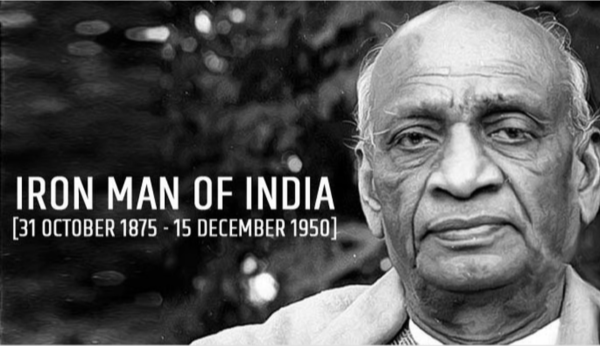
- Post-independence reconstruction: Sardar Vallabhbhai Patel championed reconstruction after visiting the site in 1947.
- Consecration: President Dr Rajendra Prasad performed the Pran-Pratishtha on 11 May 1951. Construction continued in subsequent stages.
Architectural Features:
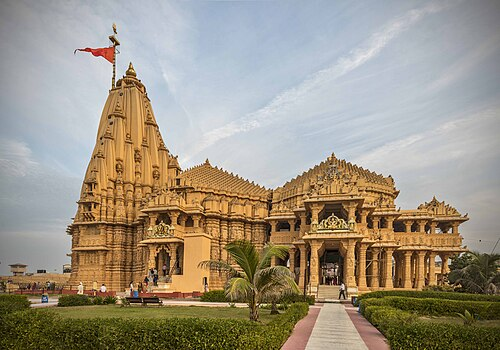
The present temple complex is built in the Chaulukya / Solanki tradition, a sub-school of Northern Indian Nagara architecture associated with Western India’s medieval Maru-Gurjara style.
Structurally, it is designed in the majestic Kailas Mahameru Prasad form, representing a multi-storeyed, mountain-like celestial abode.
- Shikhara: A monumental, elaborately carved main tower (Shikhara) rises directly above the primary sanctum, reaching a height of approximately 155 feet, topped with a massive Amalaka and a golden Kalasha.
- Garbhagriha: The innermost, secure sanctum sanctorum houses the principal deity, the Jyotirlinga, arranged to receive natural light and accommodate essential ritual spaces.
- Sabha Mandapa: A grand, pillared assembly hall designed with complex octagonal arrangements and multi-tiered ceilings to accommodate large congregations of devotees.
- Nritya Mandapa: An interconnected, designated hall historically and structurally associated with sacred dance, ceremonial performances, and cultural functions.
- Ornamentation: The structural surfaces feature dense, elaborate stone carvings depicting iconographic deities, musicians, celestial dancers (apsaras), and narrative friezes that embody the hereditary expertise of the Sompura temple-building tradition.
The architectural layout and execution blueprints of the modern post-independence structure were meticulously prepared by the master traditional architect Prabhashankar Oghadbhai Sompura.
Arguments For and Against Restrictions: Constitutional Perspective
| Dimensions | Arguments Supporting Restrictions | Arguments Against Restrictions |
| Religious Freedom | Articles 25-26: Protect religious practices and the autonomy of religious denominations to preserve the sanctity of religious institutions. | Article 25: Freedom of conscience extends to all individuals; religious sentiments cannot automatically override the rights of others. |
| Food Choice & Personal Autonomy | Article 25: Respecting the religious beliefs and dietary sensitivities of pilgrims may be considered in regulating activities around sacred spaces. | Article 21: Personal autonomy and privacy encompass individual food choices; the State should not impose dietary preferences on citizens. |
| Freedom of Trade & Livelihood | Article 19(6): Permits reasonable restrictions on trade in the interest of the general public, including legitimate regulation of commercial activities around pilgrimage sites. | Articles 19(1)(g) and 21: A blanket ban may infringe the occupational freedom and livelihood of meat vendors and associated workers. |
| Secularism & Pluralism | Articles 25-26: State accommodation of religious practices can be consistent with India’s model of secularism. | Preamble and Articles 14, 15 and 25: State neutrality requires equal respect for diverse religious beliefs, dietary practices and individual freedoms. |
| Proportionality & Reasonableness | Article 19(6): Reasonable restrictions can be imposed to balance individual freedoms with legitimate collective interests. | Articles 14, 19 and 21: A blanket prohibition may fail the tests of necessity and proportionality if less restrictive alternatives are available. |
Practice Prelims MCQ:
Q. Consider the following statements regarding the Somnath Temple:
1. The modern architectural plan of the Somnath Temple follows the Chaulukya or Solanki style and was prepared by Prabhashankar Sompura.
2. The Triveni Sangam at Prabhas Patan marks the confluence of the rivers Hiran, Kapila, and the inland-glacier-derived Vedic Saraswati.
Which of the statements given above is/are correct?
(a) 1 only
(b) 2 only
(c) Both 1 and 2
(d) Neither 1 nor 2
Answer: (a)
UPSC PYQ 2022
Q. The Prime Minister recently inaugurated the new Circuit House near Somnath Temple, Veraval. Which of the following statements are correct regarding Somnath Temple?
1. Somnath Temple is one of the Jyotirlinga shrines.
2. A description of Somnath Temple was given by Al-Biruni.
3. Pran Pratishtha of Somnath Temple (installation of the present-day temple) was done by President S. Radhakrishnan.
Select the correct answer using the code given below:
(a) 1 and 2 only
(b) 2 and 3 only
(c) 1 and 3 only
(d) 1,2 and 3
Answer: (a)
Tell Google you want more of this.
Add Anantam IAS as a preferred sourceOne tap, and this site shows up more often in your own Top Stories, AI Overviews and AI Mode. Remove it any time.