
Why in News?
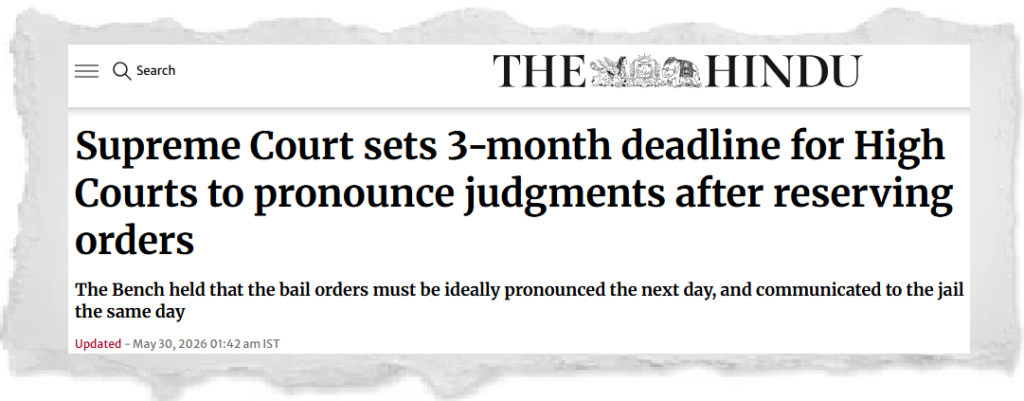
The Supreme Court of India, on May 29, 2026, directed that High Courts should pronounce judgments within three months of reserving a case for orders. The Court also laid down timelines for bail orders, communication to prisons, and publication of judgments, aiming to address delays that often undermine access to justice and judicial efficiency.
UPSC Relevance
Prelims: Article 21, Article 141, Article 142, High Courts, Judicial Reforms, Bail Jurisprudence.
Mains:
GS-II: Judiciary, Constitutional Bodies, Judicial Reforms, Access to Justice, Governance and Accountability.
Background
Indian courts have traditionally followed the principle that judgments should be delivered within a reasonable time after arguments conclude. However, there is no constitutional or statutory provision prescribing a fixed timeline for pronouncing judgments.
Over the years, several instances have emerged where judgments remained reserved for months or even years. Such delays have raised concerns regarding:
- Access to justice.
- Rights of litigants.
- Prolonged incarceration of undertrials.
- Judicial accountability and transparency.
Against this backdrop, the Supreme Court issued binding guidelines to ensure timely disposal of cases and strengthen public confidence in the justice delivery system.
What Did the Supreme Court Direct?
The Bench headed by Chief Justice Surya Kant prescribed several procedural safeguards.
Three-Month Limit for Reserved Judgments
The Court held that High Courts should ordinarily pronounce judgments within three months from the date a case is reserved for orders.
This seeks to prevent situations where litigants remain uncertain about the outcome of their cases for prolonged periods.
Special Timelines for Bail Cases
Recognising that liberty is at stake in bail matters, the Court directed that:
- Bail orders should ideally be pronounced the next day after hearing.
- Orders should be communicated to jail authorities on the same day.
- Release of undertrials should ordinarily occur on the same day or, at the latest, the following day after grant of bail.
The objective is to ensure that procedural delays do not continue the incarceration of individuals who have already secured judicial relief.
Transparency Measures
The Court further directed that:
- High Court websites must display the date on which a judgment was reserved.
- The operative portion of judgments should be pronounced in open court.
- Detailed reasons should preferably be uploaded within one week.
These measures aim to improve transparency and public accountability in judicial functioning.
Consequences of Non-Compliance
If the prescribed guidelines are not followed, the matter may be reassigned to another Bench through the administrative authority of the Chief Justice concerned.
The Supreme Court also directed that copies of its judgment be circulated to all High Courts.
Constitutional Basis of the Decision
Article 21: Right to Life and Personal Liberty
The Supreme Court has repeatedly interpreted Article 21 broadly to include the right to speedy justice.
Hussainara Khatoon and subsequent judgments established that unreasonable delays in judicial proceedings violate fundamental rights.
A judgment that remains reserved indefinitely can effectively deny meaningful justice, particularly in criminal cases where personal liberty is involved.
Article 141
Under Article 141, the law declared by the Supreme Court is binding on all courts within India.
Therefore, these directions are expected to serve as authoritative guidelines for judicial administration across the country.
Judicial Accountability and Constitutional Governance
The ruling reflects the principle that judicial independence must be accompanied by institutional accountability. While judges enjoy decisional independence, timely delivery of judgments remains essential for maintaining public trust.
Why Timely Judgments Matter
Justice Delayed Can Become Justice Denied
A litigant may win a case eventually, but excessive delays can diminish the practical value of that victory. In civil disputes, delayed judgments may affect property rights, business decisions, and contractual relationships.
In criminal matters, prolonged uncertainty can severely affect both victims and accused persons.
Impact on Undertrials
India continues to have a large undertrial population in prisons.
Delays in pronouncing bail orders often mean that individuals remain incarcerated despite having successfully argued their case before the court. The Supreme Court’s directions seek to bridge this gap between judicial decision-making and actual implementation.
Improving Judicial Efficiency
Time-bound pronouncement of judgments can:
- Reduce case backlogs.
- Improve court management.
- Increase predictability in judicial proceedings.
- Strengthen public confidence in the legal system.
Previous Judicial Concerns Regarding Delayed Judgments
Anil Rai v. State of Bihar (2001)
The Supreme Court expressed concern over prolonged delays in pronouncing judgments and suggested that decisions should ordinarily be delivered within a reasonable period after conclusion of arguments.
Balaji Baliram Mupade v. State of Maharashtra (2020)
The Court observed that delayed judgments weaken litigants’ confidence in the judicial process and affect the quality of justice.
The 2026 ruling builds upon these earlier concerns by introducing a clearer and more structured framework.
Way Forward
Strengthening Judicial Capacity
Filling judicial vacancies, increasing research support, and enhancing court infrastructure can help judges meet timelines without compromising quality.
Technology-Driven Monitoring
Digital dashboards tracking reserved judgments can improve transparency and allow timely administrative intervention where delays occur.
Institutional Best Practices
High Courts may develop internal mechanisms to periodically review reserved judgments and ensure compliance with prescribed timelines.
Focus on Bail Administration
Effective coordination between courts, prison authorities, and police departments is essential to ensure that bail orders translate into immediate release.
Conclusion
The Supreme Court’s decision represents a significant step toward reinforcing the constitutional promise of timely justice. By imposing a three-month timeline for reserved judgments and prioritising speedy implementation of bail orders, the Court has sought to strengthen judicial accountability while protecting individual liberty. The success of these reforms, however, will ultimately depend on institutional capacity, administrative efficiency, and consistent implementation across the judicial system.
Practice Questions
Prelims Question 1 (Inference-Based)
Consider the following statements:
I. Timely pronouncement of judgments is closely linked to the constitutional principle of access to justice.
II. Delays in delivering reserved judgments may affect the effectiveness of judicial remedies even when the final decision is legally sound.
III. The Supreme Court’s directions regarding timelines for judgments seek to improve both judicial accountability and public confidence in courts.
Which of the following relationships among the above statements is/are correct?
- Statement II explains why the principle mentioned in Statement I is important.
- Statement III can be seen as a policy response to concerns highlighted in Statements I and II.
- Statement I contradicts Statement III because judicial accountability compromises judicial independence.
(a) 1 only
(b) 1 and 2
(c) 2 and 3
(d) 1, 2 and 3
Answer: (b)
Explanation: Statement II logically explains the significance of Statement I, while Statement III addresses the concerns arising from delayed justice. Statement I and III are complementary, not contradictory.
Prelims Question 2
Assertion (A): The Supreme Court directed that bail orders should ideally be pronounced the next day and communicated immediately to prison authorities.
Reason (R): Article 21 encompasses protection of personal liberty, and procedural delays after grant of bail can continue deprivation of liberty.
(a) Both A and R are true and R is the correct explanation of A.
(b) Both A and R are true but R is not the correct explanation of A.
(c) A is true but R is false.
(d) A is false but R is true.
Answer: (a)
Explanation: The directions are rooted in the constitutional protection of personal liberty under Article 21 and seek to prevent unnecessary detention after bail has been granted.
Mains Questions
- The effectiveness of judicial remedies depends not only on the quality of judgments but also on their timely delivery. Examine in the context of the Supreme Court’s recent directions to High Courts regarding reserved judgments. (250 words)
- Discuss the constitutional significance of the right to speedy justice under Article 21. How can judicial reforms improve both efficiency and accountability in India’s justice delivery system? (250 words)
Tell Google you want more of this.
Add Anantam IAS as a preferred sourceOne tap, and this site shows up more often in your own Top Stories, AI Overviews and AI Mode. Remove it any time.