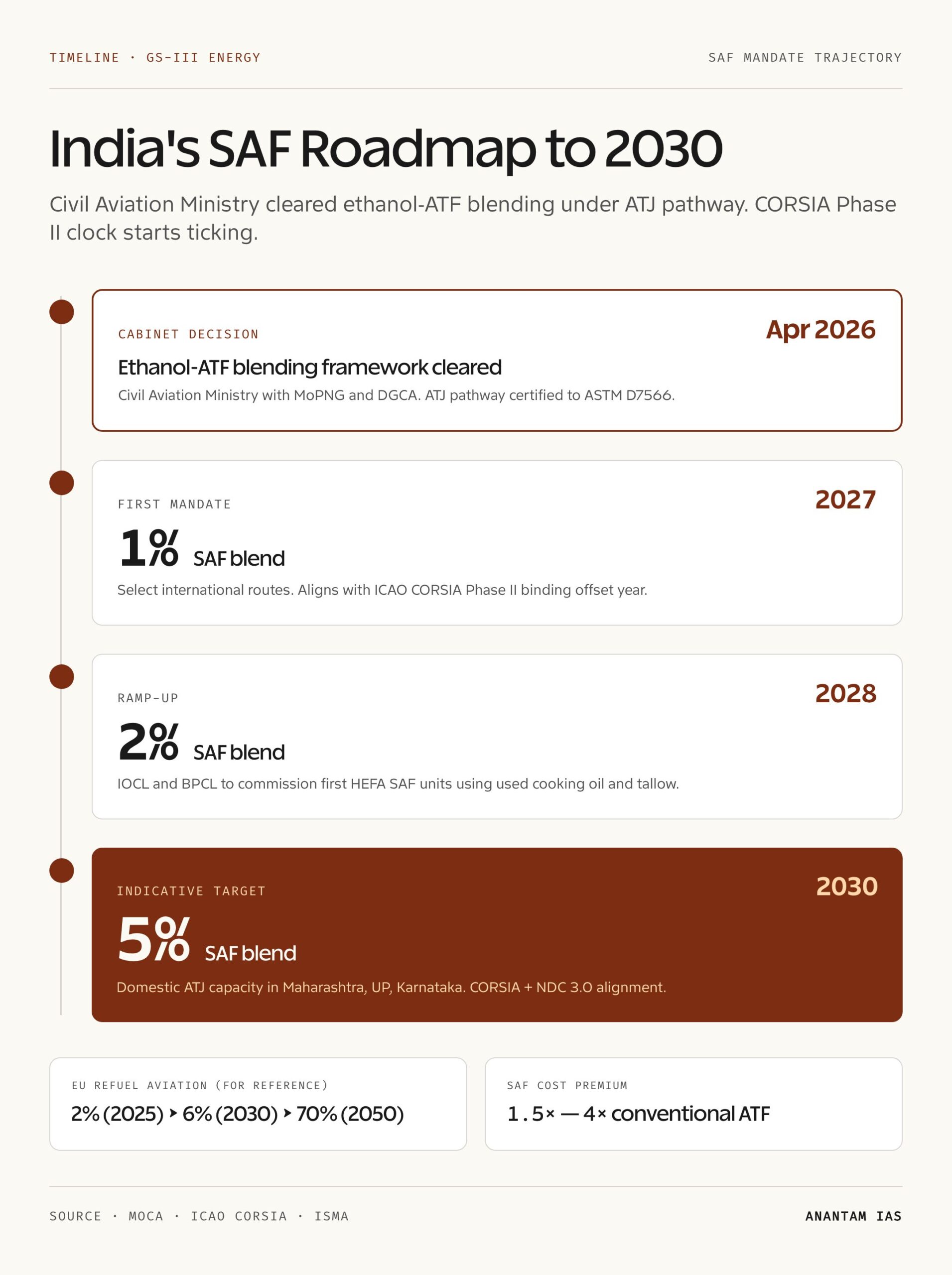
On April 24, 2026, the Government of India cleared a regulatory framework that allows ethanol blending in aviation turbine fuel (ATF), kicking off India’s formal entry into the Sustainable Aviation Fuel transition. The decision puts India on a path toward a 1% Sustainable Aviation Fuel mandate by 2027 and aligns the country’s flagship carrier exports with the International Civil Aviation Organization’s CORSIA scheme that begins binding offsets in 2027.
For context, civil aviation contributes roughly 2.5% of global CO2 emissions and a much larger share of non-CO2 climate forcing through contrails and high-altitude NOx. India’s aviation sector is one of the world’s fastest-growing, with passenger traffic doubling between 2014 and 2024. Without intervention, that growth locks in more emissions for 25 years, the typical aircraft service life. Sustainable Aviation Fuel is the only meaningful near-term lever, since electric and hydrogen aircraft remain at least a decade away from commercial scale.
The April 2026 clearance turns an industry conversation into a policy timeline. For UPSC, it sits squarely at the GS-III crossover of energy, environment, and infrastructure.
Quick Facts at a Glance
- Decision date: April 24, 2026
- Issuing authority: Ministry of Civil Aviation, with concurrence from MoPNG and DGCA
- First mandate: 1% SAF blend by 2027 on select international routes
- Trajectory: 2% by 2028, 5% by 2030 (indicative)
- Lead industry body: Indian Sugar Mills Association (ISMA), coordinating ethanol-to-jet pathway
- International framework: ICAO CORSIA (Carbon Offsetting and Reduction Scheme for International Aviation)
- CORSIA binding phase: 2027 onwards
- Approved SAF pathways globally: HEFA, ATJ, FT-SPK, plus newer e-fuel pathways
- Indian SAF feedstocks under consideration: bagasse, used cooking oil, ethanol, agri-residues
- Indicative SAF cost premium over conventional ATF: 1.5x to 4x
What Just Happened
The April 24, 2026 decision does three things in one move.
First, it amends ATF specifications to formally allow up to 1% ethanol blending through the alcohol-to-jet (ATJ) pathway, certified to ASTM D7566 standards. Second, it creates a Civil Aviation Sustainability Cell within the Ministry to oversee SAF production, certification, and lifecycle accounting. Third, it ties India’s domestic SAF roadmap to ICAO’s CORSIA emissions-baseline year, which is critical because Indian carriers will face offset obligations on international routes from 2027.
The decision also asks public-sector oil marketing companies, mainly IOCL and BPCL, to commission at least one HEFA-route SAF unit by 2028, using used cooking oil and tallow as feedstock. ISMA has been pushing the alcohol-to-jet pathway because India’s bamboo-based and grain-based ethanol capacity is already running ahead of E20 demand, creating a structural surplus that SAF could absorb.
Background and Historical Context
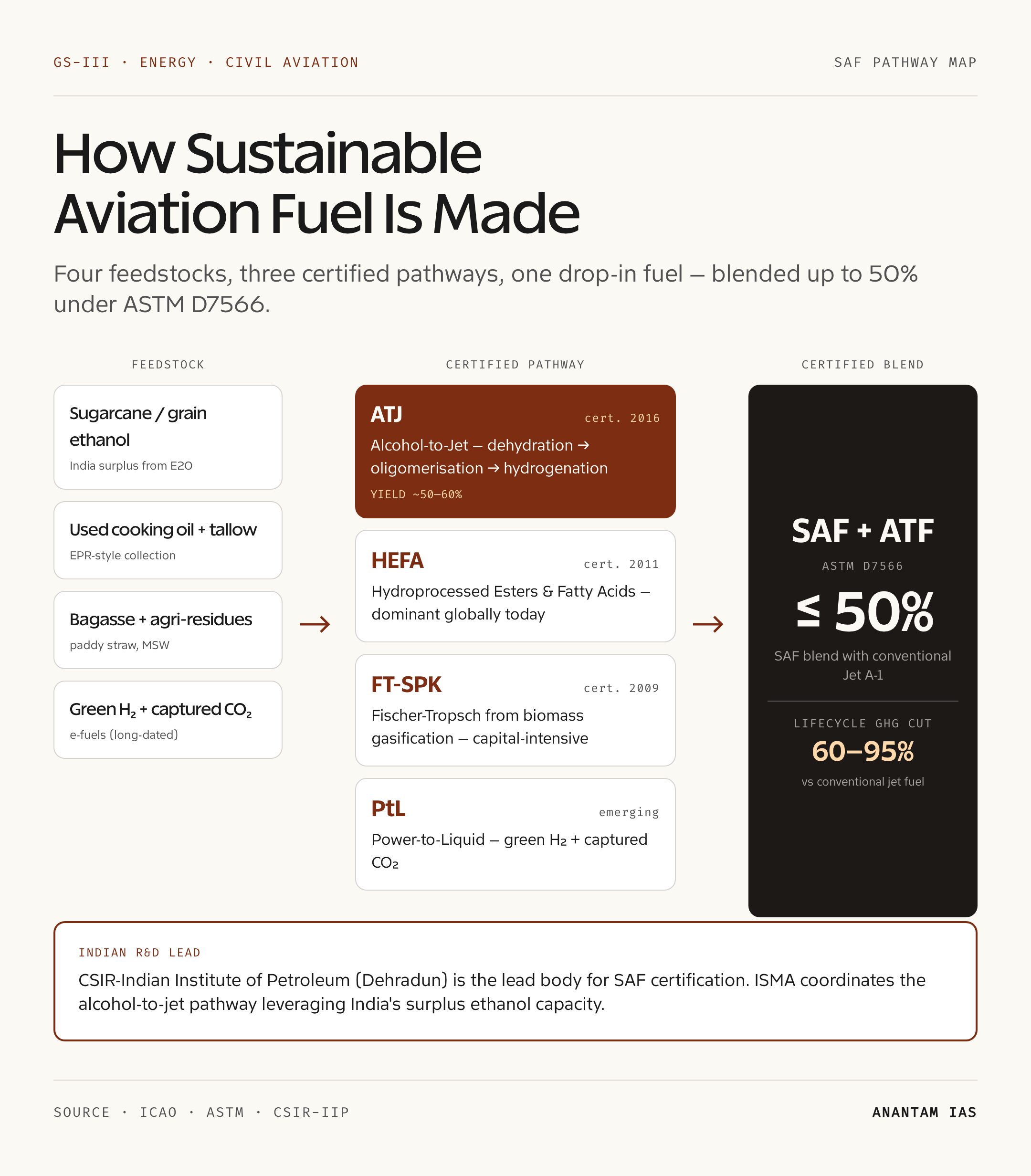
Sustainable Aviation Fuel as a category dates to the late 2000s, when ASTM International first certified Fischer-Tropsch synthetic kerosene from gasification (FT-SPK) for blending up to 50% with conventional jet. The Hydroprocessed Esters and Fatty Acids pathway (HEFA), which uses used cooking oil, tallow, and oilseeds, followed in 2011. Alcohol-to-jet (ATJ), which converts ethanol or isobutanol into jet-range hydrocarbons, was certified in 2016. These pathways together cover almost all currently available SAF.
India’s SAF history begins with a 2018 IndiGo-Lufthansa pilot blend on a Delhi flight, followed by SpiceJet’s 2018 Dehradun-Delhi flight using bio-jet from CSIR-IIP, Dehradun, with jatropha-derived HEFA fuel. Those were demonstration runs, not commercial supply. Through 2021-2024, the Ministry of Petroleum and Natural Gas explored SAF under the National Biofuel Policy framework, but no firm mandate emerged.
The international pressure shifted with ICAO’s CORSIA. CORSIA was adopted in 2016 with a pilot phase from 2021, voluntary phase till 2026, and mandatory phase from 2027 onwards for routes between participating states. Once mandatory, airlines flying international routes must offset CO2 above the baseline (revised to 85% of 2019 levels) using approved emission units or eligible SAF. India joined CORSIA in 2019. Indian carriers face their first binding compliance year in 2027.
The European Union added pressure with ReFuelEU Aviation regulation, which mandates 2% SAF on flights departing EU airports from 2025, rising to 70% by 2050. Indian carriers operating EU routes already face this constraint. The April 24, 2026 decision is partly a response to these aligned external pressures and partly a domestic industrial play, since India has a large surplus of ethanol from sugarcane and grain that needs new offtake markets.
Key Provisions and Features
The new SAF framework rests on five operative pieces.
- Blend mandate trajectory. 1% SAF blend on select international routes by 2027, 2% by 2028, 5% by 2030, all ramped from international flight ATF first.
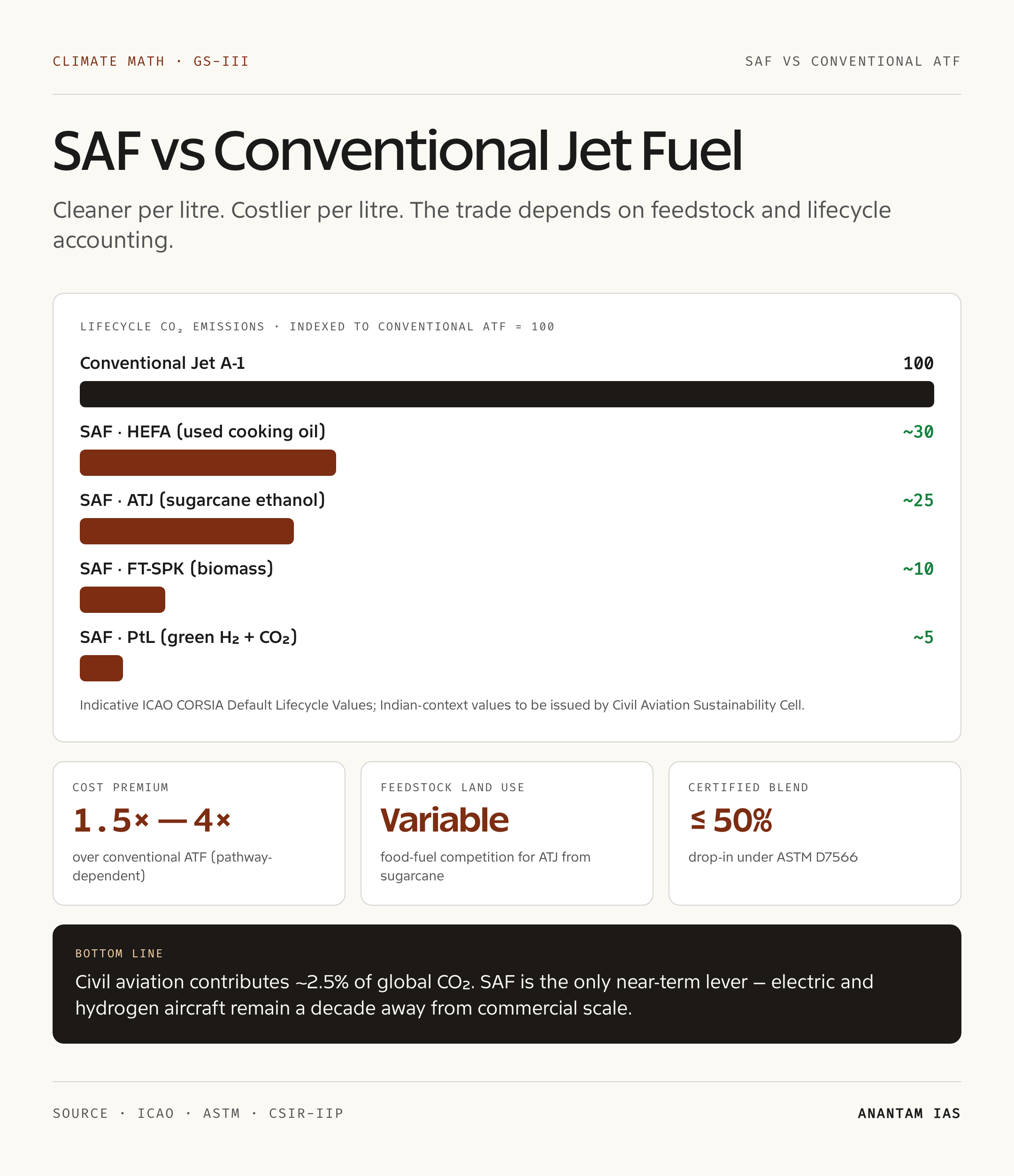
- Pathway certification. Only ASTM D7566-certified pathways accepted, currently HEFA, ATJ, FT-SPK, and emerging e-fuel routes. Domestic SAF must also satisfy CORSIA Sustainability Criteria, which means lifecycle GHG reduction of at least 10% compared to conventional jet, along with traceable feedstock.
- Lifecycle accounting. SAF emissions calculated using the CORSIA Default Lifecycle Values methodology, with India-specific values to be issued by the Civil Aviation Sustainability Cell in coordination with CSIR-IIP.
- Public-sector capacity. IOCL and BPCL to set up at least one HEFA SAF unit each by 2028. ISMA-coordinated ATJ capacity build-out using surplus ethanol.
- Cost-pass-through. SAF blend premium to be reflected in airline ticket pricing through a transparent levy line, similar to how fuel surcharges work today.
The framework also opens the door to “book-and-claim” accounting for SAF, where airlines can claim SAF credits even if the physical fuel is delivered to a different airport. This matches global practice and is essential for early-stage SAF supply, because production hubs and consumption hubs rarely coincide.
Why It Matters: Climate, Cost, and Energy Strategy
Sustainable Aviation Fuel matters for India for three reasons that pull in slightly different directions.
The climate logic is straightforward. SAF can cut lifecycle emissions by 60% to 95% versus conventional ATF depending on feedstock and pathway. With Indian aviation projected to triple by 2040, even a 5% SAF mandate avoids tens of millions of tonnes of CO2 annually by mid-century. That makes SAF a cornerstone of India’s NDC 3.0 climate goals for 2031-2035 and aviation-specific commitments under ICAO and global climate forums.
The industrial logic is sharper. India’s ethanol production has already overshot E20 petrol blending demand. SAF gives sugarcane and grain ethanol producers a premium-priced offtake that keeps capacity utilised. Used cooking oil collection, currently informal, can be formalised through an EPR-style mandate that feeds HEFA refineries. The bagasse-and-biomass route also creates rural livelihoods near sugar mills.
The energy security logic is harder. SAF reduces ATF imports if and only if domestic SAF production scales. In the near term, India will likely import some HEFA SAF from Singapore or the EU to meet 2027 obligations, which means SAF is a net forex outflow until domestic capacity catches up.
Detailed Analysis
The Three Practical Pathways for India
Alcohol-to-Jet (ATJ). Converts ethanol (typically) to jet-range hydrocarbons via dehydration, oligomerisation, and hydrogenation. Best fit for India because of surplus sugarcane and grain ethanol. Capital cost is moderate. Yields are around 50-60% mass conversion from ethanol to SAF.
HEFA. Uses used cooking oil, animal fats, palm fatty acid distillate, or oilseed crops. Most globally produced SAF today is HEFA. Indian potential is limited by feedstock supply. Used cooking oil collection is fragmented; oilseed competition with food is politically sensitive.
FT-SPK. Gasifies biomass (rice straw, bagasse, MSW) and uses Fischer-Tropsch synthesis to make jet hydrocarbons. Capital intensive. Useful long-term route for India’s paddy stubble problem, but unlikely to scale before 2030.
E-fuels (Power-to-Liquid) are a fourth pathway using green hydrogen and captured CO2. Long-dated for India.
The CORSIA Compliance Equation
CORSIA Phase 1 (2024-2026) is voluntary. Phase 2 (2027-2035) is binding for participating states. The baseline is 85% of 2019 emissions. Indian carriers exceeding this on international routes between CORSIA-participating states must offset using approved emission units (largely Article 6.4 PACMs from the Paris Agreement framework) or eligible SAF.
The cheaper path is SAF, if domestic supply exists. The fallback is buying offsets, which means a forex outflow with no industrial benefit. Even a partial SAF supply at 1% mandate dramatically reduces offset demand.
The Cost Reality
SAF costs 1.5x to 4x conventional ATF depending on pathway and feedstock. ATJ is at the cheaper end. HEFA is mid-range. FT-SPK and e-fuels are at the expensive end. The cost premium translates into ticket price impact of roughly 0.5% to 2% at 1% blend, scaling proportionally. That is bearable in business and full-service segments and tougher in budget aviation.
The Feedstock Question
If India scales SAF aggressively, the feedstock question becomes binding. Sugarcane ethanol displaces food or fodder. Used cooking oil supply is finite. Biomass collection is logistically expensive. The realistic scenario is a portfolio of feedstocks rather than betting on one.
Comparative Perspective
The European Union’s ReFuelEU Aviation requires 2% SAF in 2025, 6% in 2030, 20% in 2035, and 70% in 2050, with sub-mandates for synthetic e-fuels. The United States uses tax credits (Inflation Reduction Act SAF credit) rather than blend mandates. Singapore, a fuelling hub, mandated 1% SAF from 2026 with a levy mechanism that finances domestic production. The UAE has set non-binding targets aligned with its hosting of COP28.
India’s 1% by 2027 target is modest by EU standards but realistic given current production capacity. Whether the trajectory to 5% by 2030 holds depends on how fast ATJ capacity is commissioned in Maharashtra, UP, and Karnataka.
Challenges and Critiques
Sustainable Aviation Fuel faces five live problems in the Indian context.
One, certification capacity. ASTM D7566 testing requires specialised labs. CSIR-IIP has the capability but not the throughput for commercial-scale certification of multiple Indian feedstocks.
Two, cost pass-through risk. If SAF cost gets passed entirely to passengers, low-cost carriers may push back. If absorbed by carriers, it dents margins.
Three, food-fuel competition. ATJ from sugarcane ethanol and HEFA from oilseeds raise the same concerns as biofuels from food crops have raised globally.
Four, lifecycle accounting honesty. SAF lifecycle GHG values depend on assumed land-use change, fertiliser inputs, and process energy. Indian-context values must be transparent and conservative to maintain credibility.
Five, infrastructure mismatch. SAF is currently certified up to 50% blends. India’s blend trajectory stays well below that, so airport fuel handling needs no major retrofit. But long-term scale-up requires investment in segregated pipelines and storage at hub airports.
UPSC Prelims Pointers
- SAF certified under ASTM D7566 standards.
- CORSIA: Carbon Offsetting and Reduction Scheme for International Aviation, ICAO mechanism.
- CORSIA Phase 2 binding from 2027.
- Approved SAF pathways: HEFA, ATJ (Alcohol-to-Jet), FT-SPK, plus emerging e-fuel routes.
- India’s first SAF mandate: 1% blend by 2027 on international routes (April 24, 2026 decision).
- Lead R&D institution: CSIR-Indian Institute of Petroleum (CSIR-IIP), Dehradun.
- ISMA: Indian Sugar Mills Association, key industry body for ATJ pathway.
- 50% maximum blend currently certified for SAF in jet engines.
- SAF lifecycle GHG cut: typically 60-95% vs conventional ATF.
- ReFuelEU Aviation: EU’s SAF blend mandate, 2% from 2025.
Mains Practice Questions
- “Sustainable Aviation Fuel is the only meaningful near-term lever for civil aviation decarbonisation.” Discuss in the context of India’s recent regulatory framework and ICAO CORSIA obligations. (GS-III, 250 words)
- Examine the food-versus-fuel debate in the context of large-scale Sustainable Aviation Fuel production from sugarcane ethanol in India. (GS-III, 150 words)
- Compare the alcohol-to-jet, HEFA, and Fischer-Tropsch pathways for SAF production. Which is most suited to India’s feedstock endowment? (GS-III, 250 words)
- Discuss the role of multilateral aviation regulation, particularly ICAO CORSIA, in shaping India’s domestic biofuel policy. (GS-II, 150 words)
Way Forward
A credible Sustainable Aviation Fuel rollout for India needs three sequential moves.
First, lock in Indian-context lifecycle GHG values for ATJ and HEFA pathways within 12 months, so both producers and airlines have a stable accounting basis.
Second, fund at least three commercial-scale SAF refineries (one ATJ, one HEFA, one FT-SPK pilot) through a viability gap funding window similar to how renewable energy was bootstrapped in the early 2010s.
Third, integrate SAF demand with India’s broader bioethanol roadmap and the bamboo-based ethanol capacity so feedstock policy serves both road and air transport.
The April 2026 decision is a credible start. The harder work, building domestic SAF supply, transparent lifecycle accounting, and a fair cost pass-through to passengers, lies ahead. Get those three right and Sustainable Aviation Fuel becomes a genuine pillar of India’s net-zero aviation. Get them wrong and SAF becomes an expensive offset purchase in dollars.
Frequently Asked Questions
What is Sustainable Aviation Fuel?
Sustainable Aviation Fuel is jet-range hydrocarbon fuel produced from non-petroleum feedstocks like used cooking oil, agricultural residues, ethanol, or captured CO2 with green hydrogen. It is certified under ASTM D7566 to be a drop-in replacement for conventional jet fuel up to 50% blends.
What did the Government of India clear on April 24, 2026?
The Ministry of Civil Aviation, with concurrence from MoPNG and DGCA, cleared a framework allowing ethanol blending in aviation turbine fuel through the alcohol-to-jet (ATJ) pathway, with a 1% SAF mandate on select international routes from 2027.
What is ICAO CORSIA?
The Carbon Offsetting and Reduction Scheme for International Aviation. It is an ICAO mechanism that requires participating states’ airlines to offset CO2 above a baseline on international routes. It enters its mandatory phase in 2027.
Why is SAF more expensive than conventional jet fuel?
SAF feedstocks (ethanol, used cooking oil, biomass) and processing pathways are more expensive than petroleum refining. Current SAF costs are 1.5x to 4x conventional ATF depending on pathway, scaling down as production scales.
Which Indian institutions lead SAF research?
CSIR-Indian Institute of Petroleum (CSIR-IIP) in Dehradun is the lead R&D body for SAF, including bio-jet fuel certification and process development. CSIR-NCL in Pune and IISc Bangalore also contribute.
How does Sustainable Aviation Fuel reduce emissions?
Lifecycle GHG emissions of SAF are typically 60% to 95% lower than conventional jet fuel because the carbon in SAF feedstock was recently absorbed from the atmosphere (in plants) or captured from industrial processes, creating a near-closed carbon loop.
What is the ATJ pathway?
Alcohol-to-Jet. It converts ethanol (or isobutanol) into jet-range hydrocarbons through dehydration, oligomerisation, and hydrogenation. ASTM-certified since 2016. Most relevant pathway for India given its surplus ethanol capacity.
How does SAF fit India’s broader climate goals?
SAF is a pillar of aviation decarbonisation under India’s NDC 3.0 framework and CORSIA obligations. It complements electric vehicle adoption, green hydrogen, and renewable power as part of India’s net-zero pathway to 2070.
Tell Google you want more of this.
Add Anantam IAS as a preferred sourceOne tap, and this site shows up more often in your own Top Stories, AI Overviews and AI Mode. Remove it any time.