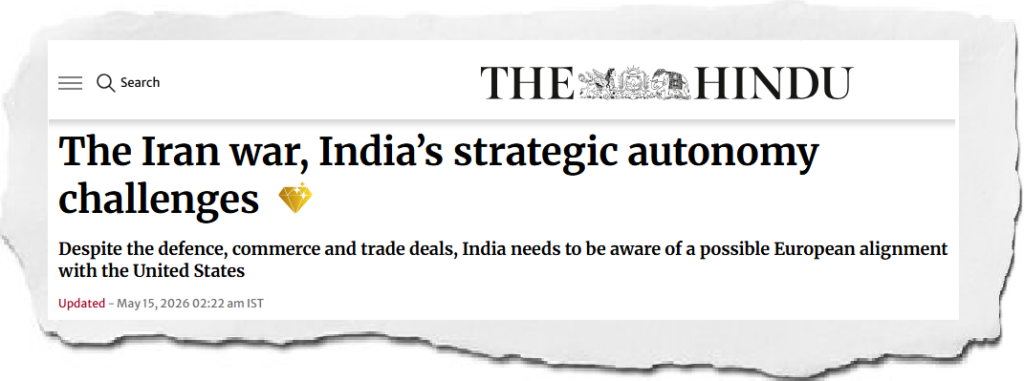
The Iran Conflict and India’s Strategic Autonomy Challenge
Why in News?
The recent escalation involving Israeli-American military strikes on Iran and subsequent counterstrikes has generated major geopolitical uncertainty in West Asia. The conflict has revived concerns regarding: Energy security, Global trade disruptions, Strategic alignments, Great power rivalry
For India, the crisis is particularly significant because Iran has historically been central to: India’s energy imports, Connectivity ambitions, Access to Central Asia, Strategic balancing in Eurasia
The developments come at a time when India is simultaneously:
- Deepening ties with the United States and Europe
- Expanding strategic partnerships in the Indo-Pacific
- Seeking to preserve its long-standing doctrine of strategic autonomy
The situation therefore raises fundamental questions regarding the future of India’s foreign policy independence in an increasingly polarised world order.
UPSC Relevance
Prelims Relevance
- Strategic autonomy, Chabahar Port, BRICS, India-EU Free Trade Agreement, NATO, West Asian geopolitics
Mains Relevance
GS Paper 2
- India and its neighbourhood, Bilateral and multilateral relations, India’s foreign policy, International groupings and agreements
GS Paper 3
- Energy security, Globalisation and economic diplomacy
Essay
- Strategic autonomy in a multipolar world
- India and changing global power structures
- Global South and geopolitical realignment
Background and Context
Strategic Autonomy in Indian Foreign Policy
Strategic autonomy refers to:
A country’s ability to pursue independent foreign and security policies based on national interest without excessive dependence on any major power bloc.
India’s approach evolved from:
- Non-Alignment during the Cold War
to - Multi-alignment in the contemporary era
Unlike rigid alliance systems, India traditionally maintained relations with multiple competing powers simultaneously.
Examples include India’s relations with:
- United States, Russia, Iran, Israel, European Union, Gulf countries, China
This flexibility has historically provided India:
- Diplomatic manoeuvrability
- Economic diversification
- Security balancing options
Evolution of India-Iran Relations
Iran has long been strategically important for India.
Energy Security
Iran was historically among India’s major crude oil suppliers because:
- Iranian oil was competitively priced
- Transportation costs were lower
- Payment flexibility existed
Before sanctions intensified, Iran supplied a substantial share of India’s crude imports.
Connectivity and Eurasian Access
Iran is central to India’s connectivity strategy through:
- Chabahar Port
- International North-South Transport Corridor (INSTC)
Chabahar Port provides India strategic access to:
- Afghanistan
- Central Asia
- Eurasia
without dependence on Pakistan.
Geopolitical Significance
Iran’s location gives it strategic importance because it sits near:
- Strait of Hormuz, Persian Gulf, West Asian energy routes
Instability in Iran directly affects:
- Global oil prices
- Shipping routes
- Energy markets
The Emerging Geopolitical Crisis
Escalation in West Asia
The recent strikes on Iran mark a major escalation in West Asian geopolitics.
The conflict has implications for:
- Global energy markets
- Maritime trade
- Regional security architecture
- Great power competition
The crisis has revived fears of:
- Wider regional war
- Disruption in the Strait of Hormuz
- Oil supply shocks
Strategic Impact on India
India imports a significant portion of its energy requirements.
Any disruption in West Asia can lead to:
- Higher crude oil prices
- Inflationary pressures
- Current account deficits
- Exchange rate instability
The crisis also complicates India’s balancing strategy between:
- United States
- Iran
- Israel
- Gulf Arab countries
The Challenge to Strategic Autonomy
Shift from Liberal Economic Order to Strategic Alignment
The article highlights an important transformation in global politics.
Historically, the post-Second World War economic order was relatively open:
- Countries could maintain diverse economic ties even amidst geopolitical rivalry.
For example:
- India traded heavily with both the U.S. and China simultaneously.
- Economic engagement was less rigidly linked to military alignment.
However, recent developments suggest:
- Economic relations are increasingly being securitised.
- Trade and investment are now linked to geopolitical alignment.
U.S. Economic and Strategic Pressure
The article argues that the United States increasingly expects partners to align with its:
- Strategic interests
- Sanctions regime
- Geoeconomic priorities
Examples include pressure regarding:
- Russian oil imports
- Iran sanctions
- De-dollarisation within BRICS
- Technology and supply chain alignment
This constrains India’s policy flexibility.
Russia-Ukraine War and India’s Foreign Policy
The Russia-Ukraine conflict already tested India’s strategic autonomy.
India adopted a carefully balanced approach:
- Avoided condemning Russia directly
- Continued oil imports
- Maintained relations with Western powers
India successfully managed:
- Energy interests
- Diplomatic balancing
- Strategic partnerships
However, the Iran crisis is viewed as more difficult because:
- It directly affects India’s immediate energy and maritime interests.
- West Asia is more critical to India’s economic stability.
India’s Relations with Europe
India-EU Free Trade Agreement
European Union and India recently accelerated negotiations on a Free Trade Agreement (FTA).
The agreement was viewed as:
- A geoeconomic diversification strategy
- A hedge against U.S. unpredictability
- A sign of strengthening multipolarity
However, the article questions whether Europe can genuinely support India’s strategic autonomy independently of the United States.
Rafale Fighter Jet Deal
India’s expanded Rafale acquisition from France was also interpreted as:
- Diversification of defence partnerships
- Reduction of overdependence on Russia
- Greater technological cooperation
Dassault Rafale is considered one of the world’s advanced fighter aircraft platforms.
However, concerns remain regarding:
- Technology transfer limitations
- Dependence on foreign upgrades
- Control over source codes and algorithms
These concerns relate directly to:
- Defence indigenisation
- Strategic dependence
- Make in India objectives
Technology Dependence and Defence Autonomy
Modern warfare increasingly depends on:
- Software systems
- Artificial intelligence
- Algorithms
- Network-centric capabilities
Thus, control over:
- Source codes
- Upgrades
- Maintenance ecosystems
can create long-term strategic dependence.
This illustrates a broader dilemma:
Military modernisation through imports may enhance capability while simultaneously reducing autonomy.
Multipolarity versus Unipolarity
India’s Vision of Multipolarity
India consistently advocates:
- Multipolar global order
- Reform of global governance institutions
- Strategic pluralism
India supports institutions such as:
- BRICS
- SCO
- G20
- Quad
simultaneously.
This reflects India’s preference for:
- Flexible coalitions
- Issue-based partnerships
- Non-bloc politics
Persistence of U.S. Dominance
The article argues that despite discussions of multipolarity:
- U.S. strategic dominance remains significant.
- Europe often aligns with Washington during major crises.
This limits the practical space available for independent middle powers.
Global South and Geoeconomic Competition
The article also highlights concerns regarding:
- Western-centric supply chains
- Strategic economic blocs
- Geoeconomic fragmentation
The Global South increasingly faces pressure to:
- Align with competing power centres
- Accept strategic conditionalities
rather than operating autonomously.
India’s Energy Security Concerns
Dependence on Imported Energy
India imports more than 80% of its crude oil requirements.
West Asia remains a critical supplier.
Any regional instability affects:
- Fuel prices
- Inflation
- Fiscal stability
- Industrial competitiveness
Strait of Hormuz
Strait of Hormuz is one of the world’s most important oil transit chokepoints.
A major share of global petroleum trade passes through it.
Conflict involving Iran could:
- Disrupt shipping
- Increase insurance costs
- Raise freight charges
This would directly impact India’s economy.
Chabahar Port and Connectivity Risks
India invested in Chabahar to:
- Bypass Pakistan
- Expand Central Asian access
- Enhance regional connectivity
U.S. sanctions and geopolitical instability have repeatedly complicated the project.
Reduced strategic space regarding Iran may weaken:
- India’s Eurasian outreach
- Connectivity ambitions
Challenges Before India
Shrinking Strategic Space
Increasing geopolitical polarisation limits India’s ability to maintain balanced ties with competing powers.
Economic Vulnerability
Energy price volatility can:
- Increase inflation
- Widen trade deficits
- Slow economic growth
Defence Dependence
Reliance on imported defence technology creates:
- Long-term dependency
- Operational vulnerabilities
- Upgrade constraints
Weakness of Alternative Power Centres
Europe’s strategic autonomy from the United States remains limited during major geopolitical crises.
Pressure on Multi-Alignment Strategy
India’s simultaneous engagement with:
- U.S.
- Russia
- Iran
- Europe
is becoming increasingly difficult under bloc-style geopolitics.
Way Forward
Strengthen Energy Diversification
India should continue diversifying:
- Crude import sources
- Renewable energy investments
- Strategic petroleum reserves
Reducing excessive dependence on any single region is essential.
Accelerate Defence Indigenisation
Initiatives such as:
- Atmanirbhar Bharat
- Make in India in Defence
must focus on:
- Indigenous R&D
- Engine technology
- Electronics
- AI-enabled defence systems
Technological sovereignty is central to strategic autonomy.
Deepen Multi-Alignment Diplomacy
India should continue engaging multiple power centres while avoiding rigid bloc politics.
Flexible issue-based coalitions remain beneficial.
Strengthen Regional Connectivity
Projects such as:
- Chabahar Port
- INSTC
should remain strategic priorities for Eurasian access.
Enhance Maritime Security
Given instability in the Indian Ocean and West Asia, India should strengthen:
- Naval capacity
- Maritime domain awareness
- Energy shipping protection
Promote Global South Cooperation
India can play a larger role in articulating:
- Strategic autonomy
- Equitable global governance
- South-South cooperation
through forums such as:
- BRICS
- G20
- Voice of Global South Summit
Build Economic Resilience
Reducing external vulnerability requires:
- Supply chain diversification
- Domestic manufacturing
- Technological self-reliance
Economic resilience strengthens diplomatic autonomy.
Conclusion
The ongoing Iran conflict represents a major geopolitical stress test for India’s foreign policy doctrine of strategic autonomy. The crisis demonstrates that the contemporary international system is increasingly characterised by:
- Geopolitical fragmentation
- Economic securitisation
- Strategic conditionalities
India’s long-standing strategy of balancing relations across competing power centres is becoming more difficult as major powers increasingly demand alignment rather than partnership.
At the same time, the situation underscores the enduring importance of:
- Energy security
- Defence indigenisation
- Economic resilience
- Diplomatic flexibility
For India, preserving strategic autonomy in the coming decades will require not only skilful diplomacy but also deeper domestic capabilities that reduce dependence on external power structures.
UPSC Practice Questions
Consider the following statements regarding India’s strategic autonomy:
- Strategic autonomy refers to complete diplomatic isolation from major powers.
- India historically maintained relations simultaneously with competing global powers.
- Energy security is an important component of strategic autonomy.
Which of the statements given above are correct?
(a) 1 and 2 only
(b) 2 and 3 only
(c) 1 and 3 only
(d) 1, 2 and 3
Correct Answer: (b) 2 and 3 only
Explanation:
Statement 1 is incorrect because strategic autonomy means independent decision-making, not isolation.
Statement 2 is correct because India has historically maintained diversified partnerships.
Statement 3 is correct because dependence on external energy sources directly affects strategic flexibility.
With reference to Chabahar Port, consider the following statements:
- It is located in Iran.
- It provides India access to Afghanistan and Central Asia bypassing Pakistan.
- It is part of India’s Indo-Pacific maritime strategy alone.
Which of the statements given above are correct?
(a) 1 and 2 only
(b) 2 and 3 only
(c) 1 and 3 only
(d) 1, 2 and 3
Correct Answer: (a) 1 and 2 only
Explanation:
Statement 1 is correct because Chabahar Port is located in Iran.
Statement 2 is correct because it offers connectivity access bypassing Pakistan.
Statement 3 is incorrect because Chabahar is more closely linked to Eurasian connectivity and the International North-South Transport Corridor (INSTC).
Mains Question:
- Discuss the implications of West Asian geopolitical instability for India’s energy security and foreign policy.
- “The contemporary international system is increasingly transforming economic interdependence into strategic dependence.” Examine in the context of India’s strategic autonomy.
Tell Google you want more of this.
Add Anantam IAS as a preferred sourceOne tap, and this site shows up more often in your own Top Stories, AI Overviews and AI Mode. Remove it any time.