Why in News?
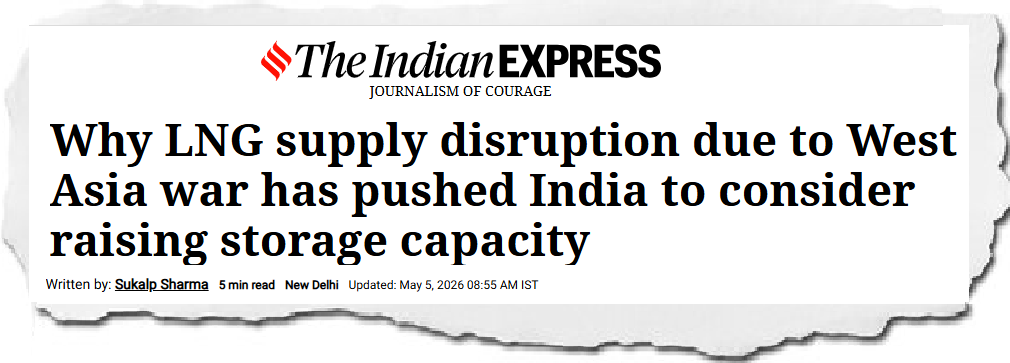
The disruption of liquefied natural gas (LNG) supplies due to the closure of the Strait of Hormuz amid the ongoing West Asia conflict has highlighted India’s vulnerability to external energy shocks. With LNG cargo movements from the Persian Gulf severely affected for over two months, policymakers and energy companies are reconsidering India’s limited LNG storage capacity.
Petronet LNG, India’s largest LNG importer, has indicated that both industry and government stakeholders are now actively considering expansion of LNG storage infrastructure, including additional cryogenic tanks and improved gas pipeline connectivity.
UPSC Relevance
GS-II: International Relations, India-West Asia Relations
GS-III: Energy Security, Infrastructure, Economy, Environmental Sustainability, Climate and Development
Understanding LNG
Liquefied Natural Gas (LNG) is natural gas cooled to around –162°C, converting it into liquid form for easier storage and transportation.
The LNG supply chain involves:
- Liquefaction of natural gas.
- Transportation through specialised cryogenic LNG carriers.
- Storage in insulated cryogenic tanks at regasification terminals.
- Reconversion into gaseous form for pipeline distribution.
LNG is increasingly important for countries seeking cleaner transition fuels compared to coal and oil.
India’s Dependence on LNG Imports
India imports nearly half of its natural gas requirements in the form of LNG.
The major suppliers include:
- Qatar
- United Arab Emirates
- Australia
- United States
A significant portion of these imports passes through the Strait of Hormuz, one of the world’s most critical maritime chokepoints.
Strategic Importance of the Strait of Hormuz
The Strait of Hormuz connects the Persian Gulf to the Arabian Sea and is vital for global energy trade.
Its importance includes:
- Carries nearly one-fifth of global oil and LNG trade.
- Main route for Gulf energy exports.
- Essential for Asian energy-importing economies including India, China, Japan, and South Korea.
Any disruption in the Strait directly affects global energy prices and supply chains.
Impact of the West Asia Conflict on India
The closure and disruption of vessel movement through the Strait of Hormuz led to:
LNG Supply Interruptions
India reportedly did not receive LNG cargoes from the Persian Gulf for over two months.
Industrial Supply Constraints
The government prioritised gas allocation to:
- Household cooking fuel,
- City gas distribution,
- Transportation sectors.
Industrial users faced rationing of natural gas supplies.
Price Volatility
Reduced LNG availability led to higher spot market prices and increased import costs.
Energy Security Concerns
The crisis exposed India’s limited capacity to absorb prolonged external disruptions.
Why LNG Storage Capacity Matters
Strategic Buffer Against Supply Shocks
Higher LNG storage capacity allows countries to maintain emergency reserves during geopolitical crises.
Unlike crude oil, India has very limited strategic LNG reserves.
Cushion Against Price Volatility
Stored LNG can reduce dependence on volatile spot markets during emergencies.
Supply Stability
Larger stockpiles ensure uninterrupted supply to critical sectors such as:
- Fertilisers,
- Power generation,
- City gas distribution,
- Transportation.
Operational Flexibility
Additional storage enables terminals to continue functioning efficiently even during temporary shipping disruptions.
Existing LNG Infrastructure in India
India currently has:
- Around 23 LNG storage tanks,
- Multiple regasification terminals,
- Expanding pipeline infrastructure.
Major LNG terminals include:
| Terminal | Operator |
| Dahej | Petronet LNG |
| Kochi | Petronet LNG |
| Hazira | Shell |
| Dabhol | Ratnagiri Gas |
| Ennore | Indian Oil |
| Mundra | GSPC |
Why Existing Capacity is Inadequate
Current LNG tanks are primarily designed for operational continuity rather than emergency stockpiling.
According to industry estimates:
- One LNG tank roughly stores one shipload of LNG.
- India consumes about 1.25 tank-equivalents daily.
Thus, existing infrastructure provides only limited short-term resilience.
Petronet LNG’s Expansion Plans
Petronet LNG plans to significantly expand storage capacity.
Proposed Additions
Dahej Terminal
- Existing: 8 tanks
- Proposed addition: 4 more tanks
Kochi Terminal
- Existing: 2 tanks
- Proposed addition: 1 more tank
Gopalpur Terminal
- Under development
- Planned addition: 2 tanks
The company estimates overall LNG storage capacity may increase by nearly 70%.
Importance of Gas Pipeline Connectivity
Storage alone is insufficient without strong evacuation infrastructure.
Some Indian LNG terminals suffer from:
- Weak pipeline connectivity,
- Low utilisation rates,
- Limited market access.
Improved gas grid integration is essential for:
- Efficient fuel transportation,
- Better terminal utilisation,
- Expansion of gas-based economy.
LNG and India’s Energy Transition
Natural gas is viewed as a “transition fuel” in India’s move toward cleaner energy.
It emits less carbon dioxide compared to coal and oil.
India aims to raise the share of natural gas in its energy mix from around 6% to 15%.
Gas is important for:
- Cleaner industrial fuel,
- Urban cooking energy,
- Transport fuel (CNG),
- Fertiliser production,
- Backup power generation.
Challenges in Expanding LNG Storage
High Capital Costs
Cryogenic LNG tanks require specialised engineering and insulation technologies.
Long Construction Timelines
A single LNG tank may take three or more years to complete.
Land Constraints
Large storage terminals require coastal land availability.
Safety Concerns
LNG handling involves stringent safety and environmental regulations.
Import Dependence
Storage buffers reduce short-term risks but do not eliminate dependence on imported energy.
Strategic Lessons from the Hormuz Crisis
The crisis demonstrates that:
- Even low-probability geopolitical events can severely disrupt energy supply chains.
- Energy security must include diversification, redundancy, and strategic reserves.
- India needs integrated planning across storage, transport, procurement, and diplomacy.
Wider Implications for India’s Energy Security
The LNG disruption has revived broader debates on:
Diversification of Supply Sources
Reducing excessive dependence on Gulf suppliers.
Strategic Energy Reserves
Developing reserves not only for crude oil but also for gas.
Domestic Gas Production
Boosting exploration and production under initiatives such as:
- Open Acreage Licensing Policy (OALP),
- Hydrocarbon Exploration and Licensing Policy (HELP).
Renewable Energy Expansion
Reducing fossil fuel vulnerability through renewables and green hydrogen.
Way Forward
Creation of Strategic LNG Reserves
India should establish dedicated emergency LNG reserves similar to strategic petroleum reserves.
Expansion of Storage Infrastructure
More cryogenic tanks must be built at major terminals with long-term planning.
Strengthening Pipeline Connectivity
The national gas grid should be expanded to improve evacuation and distribution.
Diversification of Import Sources
India should secure long-term LNG contracts from multiple geographies including:
- Africa,
- Australia,
- United States,
- Russia.
Promotion of Domestic Production
Domestic natural gas exploration and extraction should be accelerated.
Integrated Energy Security Framework
India needs a coordinated national energy security strategy linking:
- Storage,
- Infrastructure,
- Diplomacy,
- Market reforms,
- Renewable transition.
Development of Green Hydrogen
In the long run, green hydrogen and renewable energy can reduce exposure to imported fossil fuel disruptions.
Conclusion
The LNG supply disruption caused by the West Asia conflict and the closure of the Strait of Hormuz has exposed a major vulnerability in India’s energy architecture. While India has developed substantial LNG import capacity, its storage buffers remain inadequate for prolonged geopolitical disruptions.
The crisis has underscored that energy security today is not merely about securing imports, but also about building resilience through storage, diversification, infrastructure expansion, and strategic planning. Expanding LNG storage capacity, strengthening pipeline connectivity, and accelerating the transition toward cleaner domestic energy sources will be critical for ensuring India’s long-term energy stability.
Prelims Practice Questions
1. With reference to Liquefied Natural Gas (LNG), consider the following statements:
- LNG is natural gas cooled to extremely low temperatures.
- LNG occupies less volume than gaseous natural gas.
- LNG can be stored in ordinary steel tanks at room temperature.
Which of the statements given above are correct?
(a) 1 and 2 only
(b) 2 and 3 only
(c) 1 and 3 only
(d) 1, 2 and 3
Answer: (a)
2. The Strait of Hormuz is strategically important because:
(a) It connects the Mediterranean Sea with the Atlantic Ocean
(b) It connects the Persian Gulf with the Arabian Sea
(c) It connects the Red Sea with the Gulf of Aden
(d) It connects the Black Sea with the Mediterranean Sea
Answer: (b)
3. Consider the following statements:
- India imports a substantial portion of its LNG from Qatar.
- LNG regasification terminals convert LNG back into gaseous form.
- India currently maintains large strategic LNG reserves comparable to its strategic crude oil reserves.
Which of the statements given above are correct?
(a) 1 and 2 only
(b) 2 and 3 only
(c) 1 and 3 only
(d) 1, 2 and 3
Answer: (a)
Mains Practice Questions
- Examine the challenges and opportunities in expanding India’s natural gas infrastructure and storage capacity.
- Discuss the strategic importance of LNG in India’s energy transition and energy security framework.
- The Strait of Hormuz remains a critical vulnerability for India’s energy imports. Examine the geopolitical and economic implications of disruptions in the region.
- Energy security in the 21st century requires resilience, diversification, and strategic reserves. Analyse in the context of India’s LNG sector.
Tell Google you want more of this.
Add Anantam IAS as a preferred sourceOne tap, and this site shows up more often in your own Top Stories, AI Overviews and AI Mode. Remove it any time.