Opens in a new tab
Join Anantam IAS Channel on Telegram

Daily Digest · Sunday

16 November 2025 Current Affairs for UPSC

4 current affairs published on Sunday, 16 November 2025

16 November 2025 Current Affairs for UPSC — every Why-in-News article AnantamIAS published on Sunday, 16 November 2025, broken down with Why in News?, the exact GS paper it feeds, sub-topic mapping, MCQ-ready facts and a UPSC-style practice question. 4 articles in total, covering Polity, Economy, Environment, S&T, IR, Geography, History, Society and Internal Security — the same Why-in-News + GS-paper-mapping + practice-question format the Compass uses across every daily digest on the site.

Daily current affairs for UPSC is where new material enters your prep stream. Read this 16 November 2025 digest end-to-end in 25–35 minutes, attempt the practice question at the foot of each article (it's MCQ for some, 10/15-marker for others), then bookmark the entries that fall inside your active revision window. Everything stays cross-linked: tap any subject pill to jump to that subject's hub, or use the table of contents above to skip straight to a specific story.

Use this page three ways. Read sequentially for a one-sitting scan of everything that mattered on 16 November 2025. Download the 16 November 2025 PDF below for offline study or print revision. Or use the November 2025 Current Affairs compilation to see this day in the month's full context. For the previous day's reading, see 15 November 2025 Current Affairs; the next day's is 17 November 2025 Current Affairs.

Why we publish daily current affairs separately from the monthly compilation: daily is learning, monthly is revision. Use the daily page to add fresh material to your notes the day it breaks; come back to the November 2025 compilation 60 days before Prelims when the noise has settled and only the lasting takeaway is worth re-reading.

White Collar Terrorism 

Open article →Download PDF

Why in News?

On 10 November 2025, a car exploded near the Red Fort in Delhi, India, killing at least 13 people and injuring more than twenty others. Among the suspects are several Kashmiri doctors, including Umar Nabi, a junior doctor who is suspected of being the driver of the car that exploded, raising concerns about White Collar Terror Modules.

UPSC Relevance

GS3, Internal Security.

PYQ

2023 – Winning of ‘Hearts and Minds’ in terrorism affected areas is an essential step in restoring the trust of the population. Discuss the measures adopted by the Government in this respect as part of the conflict resolution in Jammu and Kashmir

2025 – Terrorism is a global scourge. How has it manifested in India? Elaborate with contemporary examples. What are the counter measures adopted by the State? Explain.

What is ‘White-Collar’ Terrorism?

  • White-collar terrorism refers to:
    • The radicalization and recruitment of highly educated professionals (like doctors, engineers, university professors, and IT experts) into terrorist or extremist networks.
  • The Faridabad module, reportedly a nine-to-ten-member sleeper cell, included five to six doctors.
  • This suggests a new modus operandi by terror groups to radicalize people with regular, respectable, white-collar jobs who are less likely to be on agency watchlists, unlike unemployed youngsters.
  • Challenge to intelligence agencies : Investigative agencies (NIA, IB, etc.) have done commendable work in busting many terror cells, including the one in Faridabad. However, the job of the agencies has now increased manifold due to this new form of terror.
  • Agencies must now focus their efforts, using all available resources and technology, on identifying and tracking educated, middle-aged people being radicalized.
  • The overall fight against terror is continuous, as threats are always “lurking in the shadows.”

What has led to White-Collar Radicalization ?

  • Evolved Radical Ideology: Terror groups have refined their narratives to target intellect rather than desperation. They offer a powerful sense of purpose, identity, and moral righteousness that appeals to educated individuals seeking meaning or a higher cause.
  • Perceived Moral/Social Humiliation: In some cases, individuals may feel a sense of social or religious marginalization/humiliation despite being in professional setting due to their identity, which the extremist ideology exploits by framing violence as a “moral war” or a justified response.
  • Intelligence and Methodical Approach: The same analytical skills used in their profession can be leveraged to deconstruct and adopt radical narratives, making them more methodical, disciplined, and dangerous operatives.
  • Exploitation of Digital Echo Chambers: Online platforms and encrypted communication apps create ideological echo chambers where extremist views are constantly validated and reinforced, facilitating clandestine recruitment and indoctrination.
  • Operational Utility: Terror groups specifically target these individuals because their technical expertise (e.g., in chemistry for explosives, medicine for logistics) and their social invisibility make their operations more resilient and difficult for intelligence agencies to track.

Countermeasures

Countering white-collar terrorism requires an integrated, multi-pronged approach that goes beyond traditional policing, focusing on intelligence and community engagement:

  • Advanced Digital Monitoring: Utilize Artificial Intelligence (AI) and big data analytics for enhanced cyber surveillance to track and predict online radicalization patterns on encrypted apps and dark web forums.
  • Targeted Financial Investigations: Tighten laws and enforcement mechanisms (in line with FATF standards) to block terror financing, specifically tracing funds that move through professional, academic, or charitable networks disguised as legitimate transactions.
  • Enhanced Human Intelligence (HUMINT): Agencies need to develop human intelligence within professional and academic circles to identify subtle behavioral changes indicating radicalization among high-status individuals.
  • Community-Based Awareness: Establish early warning systems involving family, educational institutions, and community leaders to recognize and report initial signs of extremist mobilization.
  • Integrative Deradicalization Programs: Implement robust psychological counseling and rehabilitation programs that challenge extremist ideology and offer alternative, positive avenues for purpose and identity.
  • Professional Oversight: Ensure strict adherence to ethical codes within professional groups (medical, engineering, academic) to hold individuals accountable for their involvement in illegal activities.
  • Reviewing Institutional Security: Implement stringent vetting processes for staff and students, particularly at academic and research institutions, to prevent them from becoming staging grounds or logistical hubs for terror activities.

Eighth Report of the 2nd ARC on Terrorism 

What is Terrorism ?

  • Despite terrorism being recognised as a global phenomenon, there is no internationally accepted definition of terrorism. According to some observers, this ambivalence in definition is primarily due to two reasons:
    • Firstly, a ‘terrorist’ in one country may be viewed as a ‘freedom fighter’ in another; 
    • Secondly,it is known that some States resort to or encourage various kinds of criminal acts,indirectly  to subvert or to otherwise destabilize another lawfully established government or get important political or governmental personalities of another State assassinated. Hence, there is an obvious lack of political will.
  • Since states have failed to reach a consensus, academicians have given a definition of terrorism.
    • UN’s Academic Consensus Definition (Alex P. Schmid): Terrorism is an anxiety-inspiring method of repeated violent action, employed by (semi-)clandestine actors (individual, group, or state) for political, criminal, or idiosyncratic reasons. The immediate victims are chosen randomly or selectively to serve as message generators for the main target audience, aiming for intimidation, coercion, or propaganda.
  • Definition in Indian Law – Terrorism as an offence does not figure in the Indian Penal Code of 1860 as amended from time to time. The Unlawful Activities (Prevention) Act, 1967 was amended to include the definition of a ‘terrorist act’.
    • (UAPA, 1967/2004): An act committed with the intent to threaten the unity, integrity, security, or sovereignty of India or to strike terror in the people, by using hazardous substances (explosives, chemicals, etc.) to cause or likely to cause death, injuries, property damage, or disruption of essential services, or to compel the government to act or abstain from acting.

Forms of Terrorism

  • Ethno-Nationalist Terrorism: Violence by a subnational ethnic group with the goal of creating a separate State or elevating their status over others (e.g., Tamil Nationalist groups in Sri Lanka).
  • Religious Terrorism: Activities motivated largely by religious imperatives, where violence is considered a divine duty or a sacramental act ( e.g. jihad). This type is generally more destructive in nature.
  • Ideology Oriented Terrorism: 
    • Left-wing Terrorism: Driven by leftist ideologies, believing that existing social relations are exploitative and requiring revolutionary change through violent means (e.g., Maoist groups in India and Nepal).
    • Right-wing Terrorism: Groups seeking to maintain the status-quo or return to a past situation, sometimes assuming an ethnic or racist character (e.g., Ku Klux Klan).
  • State-sponsored Terrorism (Warfare by Proxy): Terrorism used as a deliberate instrument of foreign policy to achieve clearly defined foreign policy objectives, and is considered the most effective means from the perpetrator’s perspective.
  • Narco-terrorism: The combination of drug trafficking and terrorist violence, motivated mainly by economic reasons to raise huge funds for terrorist activities.

Causes of Terrorism

  • Ideological/Value Conflicts: Any ideology can be used to support the use of violence and terrorism. The underlying causes must be confronted at the level of ideologies and values.
  • Political Exploitation of Religion: Violence often follows when politics intrudes into and takes over religion for the purpose of mobilisation often resorting to bigotry and hatred towards other religions.
  • Socio-Economic Factors: Vulnerable sections of society fall prey to terrorist propaganda promising wealth and equity, suggesting socio-economic marginalization.
  • Perceived Grievance: Extremism is often based on a perceived sense of grievance which may not have any substantive base in reality, that can be inflamed to motivate people to fight.
  • Lack of Responsive Governance: The failure of administration and service delivery to be responsive to the legitimate and long-standing grievances of people allows terrorist groups to exploit these issues.

Measures to Tackle Terrorism

  • Comprehensive Strategy: A multi-pronged approach is needed that amalgamates political, social, economic, administrative, police, and other measures.
  • Administrative and Legal Reform:
    • The government must move beyond reacting to events and adopt a long term vision or planning.
    • The country’s legal and administrative framework needs to be upgraded, strengthened, and reformed. The intelligence network and policing capacity at both Union and State levels must be significantly improved.
  • Addressing Grievances:
    • Prioritize socio-economic development to prevent vulnerable populations from joining terrorist groups.
    • Administration and service delivery must be responsive to the legitimate and long-standing grievances of the people.
  • Political Consensus: Political parties must arrive at a national consensus on the broad contours of a planned strategy and rise above sectarian and petty electoral compulsions
  • Law Enforcement:
    • Law enforcement agencies need to be supported with an appropriate legal framework, adequate training infrastructure, equipment, and intelligence. 
    • Strong measures are required to deal with criminal elements, but with strict respect for human rights.
  • Countering Extremism: The nation needs to address extremist ideologies and elements to achieve any long-term headway in combating them.
  • Eighth Report of the 2nd ARC
    • The spectre of international terrorism is a phenomenon evolving out of the churning that has accompanied the globalization process. We must fight terrorism wherever it exists, because terrorism anywhere threatens democracy everywhere.
    • Whatever the outward manifestation at any one time, anywhere in the world; – this is a global fight about values, about modernization, both within religions and outside. 
    • It is about whether our value system can be shown to be sufficiently robust, fair, principled and appealing so that it beats those of the extremists. Extremism’s whole strategy is based on a perceived sense of grievance that can be inflated to motivate people to fight against each other. Our response has to be a set of values strong enough to unite rather than divide people.


Vrindavani Vastra

Open article →Download PDF

Why in News

Assam Chief Minister Himanta Biswa Sarma left for London (November 15, 2025) to initiate the process of bringing back the historic Vrindavani Vastra, currently housed in the British Museum.

Return of Vrindavani Vastra

  • An agreement is expected to be signed for the return (loan) of the textile to Assam by 2027.
  • This is one of India’s most significant art repatriation efforts, involving a revered artefact linked to Srimanta Sankaradeva, the 15th–16th century saint-reformer.
  • The textile is not being permanently returned. British Museum agreed to lend the Vrindavani Vastra to India for 18 months.
  • The loan is conditional on Assam constructing a climate-controlled, museum-standard facility.

What is Vrindavani Vastra? 

  • Vrindavani Vastra = “Cloth of Vrindavan”
  • A sacred, richly woven silk textile depicting scenes from Lord Krishna’s life, especially his Vrindavan episodes.
  • Created in Assam under the guidance of Vaishnavite saint Srimanta Sankaradeva, a key figure in the Bhakti Movement and founder of Neo-Vaishnavism (Ekasarana Dharma) in Assam.
  • Made using the Assamese mulberry silk (Muga/Eri).
  • Contains intricate woven motifs, not painted (unique Assamese weaving tradition).
  • Depicts: Krishna’s childhood acts, Rasleela, Vrindavan landscapes, Cowherds and animals
  • Represents:
    • Assamese weaving excellence
    • Bhakti art tradition
    • Sankaradeva’s cultural revolution (Sattriya culture, Bhakti movement revival)

Who Was Srimanta Sankaradeva? 

  • 15th–16th century Saint, Composer, poet, dramatist, scholar, painter, and reformer from Assam.
  • Founded Ekasarana Dharma (Neo-Vaishnavism).
  • Established Satras and Namghars (community prayer halls).
  • Created Ankiya Naat, Borgeet, and influenced Sattriya Dance (now a classical dance of India).
  • Guided artisans to create devotional art — including the Vrindavani Vastra.

How Did the Vrindavani Vastra Reach the British Museum?

  • Originally created in Assam in the 16th century.
  • Later pieces believed to have travelled to Tibet in the 17th–18th century (via monks, traders, or collectors).
  • British explorers collected these pieces in the 19th century from Tibet.
  • Eventually acquired and preserved by:
    • British Museum, London
    • Musee Guimet, Paris (other fragments)

Practice Question

1. With reference to the Vrindavani Vastra, consider the following statements:

  1. It is a woven silk textile depicting episodes from the life of Lord Krishna.
  2. It was created under the guidance of a prominent 15th–16th century Shaivite Bhakti saint from Assam.
  3. All surviving pieces of the Vrindavani Vastra are currently preserved in India.
  4. It represents the Neo-Vaishnavite cultural tradition known for Satras and community prayer halls.

Which of the statements given above are correct?

(a) 1 and 2 only
(b) 1  and 4 only
(c) 2 and 3 only
(d) 1, 3 and 4 only

 Correct Answer: (b)

2. Consider the following pairs regarding Indian cultural artefacts and their associated traditions:

Artefact / TraditionAssociated Region
1. Patola WeavingGujarat
2. Vrindavani VastraAssam
3. Kalamkari PaintingAndhra Pradesh
4. Mayurbhanj ChhauWest Bengal

How many of the above pairs are correctly matched?

(a) Only one
(b) Only two
(c) Only three
(d) All four

Correct Answer: (c) Only three

Dolphin

Open article →Download PDF

Context:

A long-term international research project (till 2028) has been launched by the University of Kerala and global collaborators to study the unique human–dolphin cooperative behaviour in Ashtamudi Lake, Kerala, one of the world’s rarest examples of inter-species fishing collaboration.

UPSC Relevance:

Species in news (Environment)

UPSC PYQ:

Q. Which one of the following is the national aquatic animal of India? (2015)

(a) Saltwater crocodile 
(b) Olive ridley turtle  
(c) Gangetic dolphin 
(d) Gharial 

Ganges River dolphins:

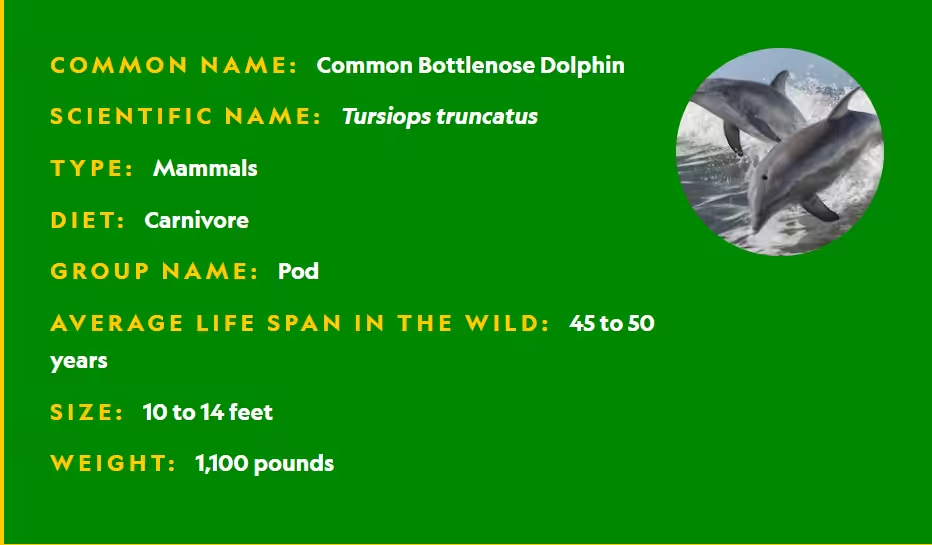
  • Dolphins are one of the oldest creatures in the world along with some species of turtles, crocodiles and sharks. The Ganges river dolphin was officially discovered in 1801.
  • The Ganges river dolphin can only live in freshwater and is essentially blind.
  • They hunt by emitting ultrasonic sounds, which bounces off of fish and other prey, enabling them to “see” an image in their mind.
  • Females are larger than males and give birth once every two to three years to only one calf.
  • The government of India declared it the National Aquatic Animal in 2009.
  •  Females are larger than males. 
  • The gestation period is 9-11 months and a female gives birth to only one calf, once in 2-3 years. 

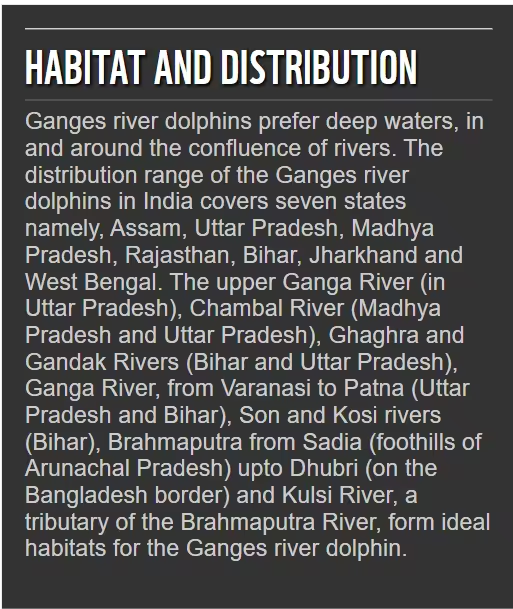
Habitat and Distribution:

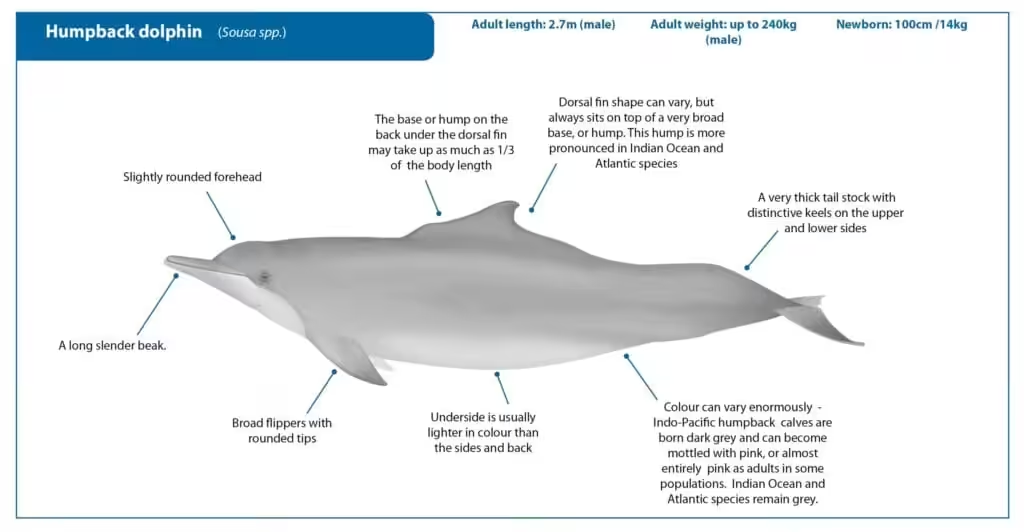
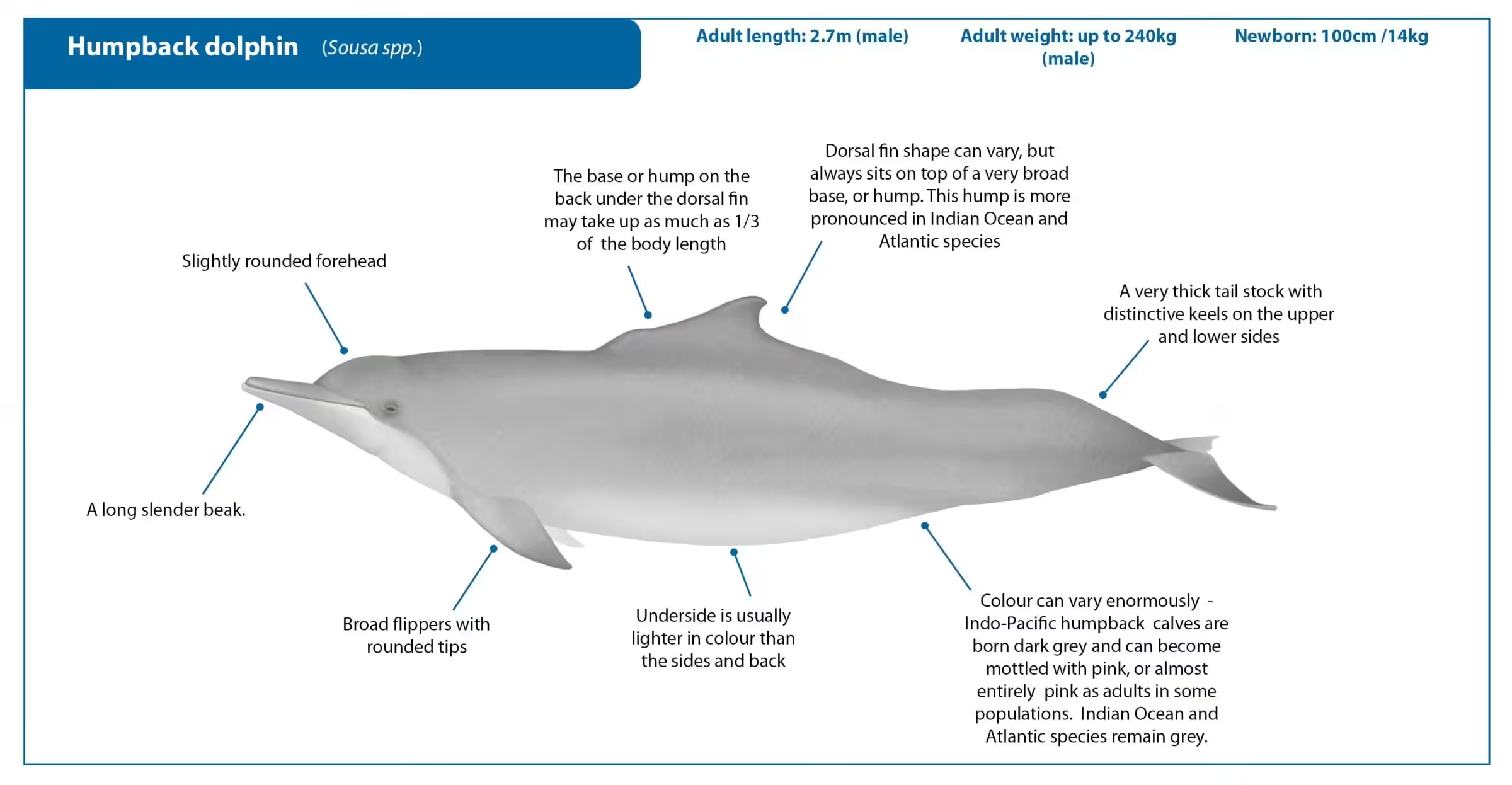
Humpback dolphins:

  • Humpback dolphins are found in relatively shallow nearshore waters throughout their range which includes most of the coastlines in Australia, Africa and Asia.
  • There are four recognized species of humpback dolphins with very little overlap between their ranges: the, Indo-Pacific humpback dolphin (Sousa chinensis), the Indian Ocean humpback dolphin (S. plumbea) the Atlantic humpback dolphin (S. teuszi) and the Australian humpback dolphin (S. sahulensis

Distribution:

  • Indian Ocean humpback dolphins are native to: Bahrain; Bangladesh; Comoros; Djibouti; Egypt, Eritrea; India; Iran; Iraq; Israel; Kenya; Kuwait; Madagascar; Mayotte; Mozambique; Myanmar; Oman; Pakistan; Qatar; Saudi Arabia; Somalia; South Africa; Sri Lanka; Sudan; Tanzania; UAE; Yemen.

Feeding:

Humpback dolphins seem to be fairly adaptable in their diet, with studies from South Africa, Hong Kong, Australia and Oman revealing a variety of fish species, and sometimes crustaceans, squids, octopus and cuttlefish in the stomachs of by-caught or stranded animals.

Conservation status:

Digital Personal Data Protection Rules, 2025

Open article →Download PDF

Why in news?

The Ministry of Electronics and IT (MeitY) has notified the Digital Personal Data Protection (DPDP) Rules, 2025, paving the way for India’s first functional privacy law, eight years after the Supreme Court declared privacy a fundamental right.

UPSC Relevance 

Prelims, GS2 – Important legislations are often asked, GS3 – Role of Media and Social Networking Sites in Internal Security Challenges, Basics of Cyber Security

PYQ 

2024 – GS2 – What are the aims and objectives of recently passed and enforced, The Public Examination (Prevention of Unfair Means) Act, 2024? Whether University/State Education Board examinations, too, are covered under the Act?

2024 – GS3 – Describe the context and salient features of the Digital Personal Data Protection Act, 2023.

DPDP Act, 2023

  • The Act directly is the statutory fulfillment of the constitutional mandate laid down in the Justice K.S. Puttaswamy (Retd.) v. Union of India (2017) Supreme Court judgment, which unanimously declared privacy as a fundamental right inherent in Article 21 (Right to Life and Personal Liberty) of the Constitution.
  • New Rights: It empowers individuals, referred to as Data Principals, with rights that reflect constitutional values, such as:
    • The Right to Access information about their personal data. 
    • The Right to Correction and Erasure of their data.
    • The requirement of specific, informed consent for data processing. 
  • Cybersecurity and Accountability – The Act imposes strict obligations and heavy penalties on entities, known as Data Fiduciaries, forcing a paradigm shift in how digital personal data is handled and secured. 

Features of DPDP Act, 2023

  • Objective: To recognise both the individual’s right to protect their personal data and the need to process such data for lawful purposes.
  • Scope: Applies to the processing of digital personal data within the territory of India. It also applies to processing outside India if it is related to offering goods or services to Data Principals within India.
  • Grounds for Processing: Processing of personal data must be for a lawful purpose and based on either the Data Principal’s consent or for “certain legitimate uses” (as defined in the Act).
  • Data Principal Rights: Includes the right to access information about their personal data and the right to correction and erasure of their personal data. 
  • Data Fiduciary Obligations: Imposes obligations on Data Fiduciaries to ensure data security, provide notice, and erase data when no longer needed
  • Supremacy of the Act: The provisions of the Act are in addition to and not in derogation of any other law, but in the event of a conflict, the DPDP Act shall have an overriding effect. 

Definitions under DPDP Act, 2023

  • Data Principal: The individual to whom the personal data relates. This includes a parent or lawful guardian in the case of a child (an individual under eighteen years of age) or a person with disability.
  • Data Fiduciary (DF): Any person who determines the purpose and means of processing personal data.
  • Data Processor: Any person who processes personal data on behalf of a Data Fiduciary.
  • Personal Data: Any data about an individual who is identifiable by or in relation to such data.
  • Personal Data Breach: Any unauthorised processing or accidental loss of personal data that compromises its confidentiality, integrity, or availability.
  • Consent Manager: A person registered with the Board, acting as a single point of contact for the Data Principal to give, manage, review, and withdraw consent via an accessible, transparent, and interoperable platform.

DPDP Rules, 2025

  • The notification of the rules comes over two years after the DPDP Act received the President’s assent in August 2023.
  • The law is now operational, but only parts are currently in force.
  • Most important protections will take longer—between 12 to 18 months—to be fully implemented.
    • Commencement after One Year (November 2026): The rules regarding the Registration and obligations of Consent Manager (Rule 4) will come into force
  • The following provisions will only become operational after18 months:
    • Data Fiduciary Notice requirements (Rule 3)
    • Reasonable Security Safeguards (Rule 6)
    • Personal Data Breach Notification (Rule 7) 
    • Processing of Children’s Personal Data (Rule 10) 
    • Additional obligations for Significant Data Fiduciaries (Rule 13) 

The Rules 

  • Notice and Informed Consent: The Data Fiduciary’s notice must be presented clearly, in simple language, and independently of other information. It must detail the items of personal data and the specific purpose for processing to enable the Data Principal to give informed consent.
  • Data Erasure: A Data Fiduciary must erase personal data when the specified purpose is no longer being served, unless retention is necessary for compliance with any law or for a corresponding period specified in the rules. 
  • Child Data Processing: Data Fiduciaries must adopt appropriate measures to obtain verifiable consent from the parent or guardian before processing a child’s personal data. 
  • Data Localization and International Transfers
    • The Centre will specify the kind of personal data that “significant data fiduciaries” can process, subject to the restriction that such data is not transferred outside the territory of India.
  • This is effectively a data localization requirement, which the industry has previously resisted.
  • A committee will be formed by the government to determine this.
  • Processing Children’s Personal Data
    • Tech companies are required to implement a mechanism for collecting “verifiable” parental consent before processing the personal data of children.
    • The government refrained from prescribing a specific mechanism, giving companies the flexibility to adopt a system of their choice.
    • Behavioural tracking and targeted advertising to children are generally prohibited, though limited processing is allowed to prevent harmful content and ads.
  • Government Processing: Personal data processing by the State or its instrumentalities for providing a subsidy, benefit, or service must adhere to the standards specified in the Second Schedule of the Rules.
    • The Act also permits exemptions for government processing on grounds such as ‘national security’, ‘friendly relations with other states’, and ‘public order’.
  • Breach Reporting: In case of a Personal Data Breach, the Data Fiduciary must inform the affected Data Principal and the Board ‘without delay’.  A detailed report must be submitted to the Board within seventy-two hours of awareness.

Types of Data Fiduciaries

  • Data Fiduciary (DF): The standard category of entity processing personal data. 
  • Significant Data Fiduciary (SDF): A class of Data Fiduciaries notified by the Central Government based on the volume and sensitivity of personal data processed, risk to the Data Principal, and factors like the potential impact on India’s sovereignty, security of the State, and public order.(e.g., Meta, Google, Apple, Microsoft, Amazon).
    • Additional Obligations: SDFs must appoint a Data Protection Officer who must be based in India and conduct a Data Protection Impact Assessment and an audit once every twelve months.

Penalties

  • The Act specifies significant monetary penalties for non-compliance, ranging from ₹ 10,000 to ₹250 Cr, including:
    • Breach of the obligation to take reasonable security safeguards: May extend up to ₹250 crore
    • Breach in observing obligations in relation to children: May extend up to ₹200 crore. 
    • Breach in observing additional obligations of a Significant Data Fiduciary: May extend up to ₹150 crore. 

DPDP Board

  • The Data Protection Board of India (DPB) has been established by the Central Government via notification on November 13, 2025
  • It will be a subordinate office of MeitY with total 4 members.
  • Head Office: The DPB’s head office shall be located in the National Capital Region of India
  • Comprises a Chairperson and 3 Members appointed by the Central Government.
  • Role: The Board acts as the key adjudicatory body to exercise powers and perform functions assigned under the Act.
    • Functions as an independent body and digital office, with powers to inquire into breaches, impose penalties, and issue directions.
    • No civil court has jurisdiction over matters for which the Board is empowered

Three Tier Dispute Resolution

  • Grievance Redressal: A Data Principal must first address grievances to the Data Fiduciary or Consent Manager, who must respond within a prescribed period. 
  • Complaint to Board: A Data Principal may make a complaint to the Data Protection Board of India. 
  • Appeals: Appeals against the orders of the Data Protection Board will lie with the Telecom Disputes Settlement and Appellate Tribunal (TDSAT).

Controversies around DPDP Act 2023

  • A controversial provision that amends the Right to Information (RTI) Act is now in force.
    • This provision disallows disclosure of personal information about public officials, even when justified in larger public interest.
  • The DPDP Act has faced scrutiny for granting wide-ranging exemptions to the government or its agencies while processing citizens’ personal data on grounds such as ‘national security’, ‘friendly relations with other states’, and ‘public order’.
  • The Act and Rules are criticized for potentially hindering investigative journalism. The earlier draft had an exemption for journalistic work, which was later removed.  Experts suggest that journalists may find it harder to identify or even mention individuals involved in wrongdoing without their express permission, risking high penalties and thus restricting free speech and investigative reporting.
  • The provision, which effectively acts as a data localisation requirement, is expected to face pushback from large international tech companies and could complicate cross-border data flows for the industry.
  • While the administrative rules and the Data Protection Board (DPB) are effective immediately, most of the core compliance requirements for entities (like seeking informed consent, breach notification to users, etc.) are deferred for an 18-month transition window. Critics have urged for shorter and clearer implementation timelines.