UPSC CSE 2026 Essay Paper Discussion

Daily Digest · Thursday

11 December 2025 Current Affairs for UPSC

2 current affairs published on Thursday, 11 December 2025

11 December 2025 Current Affairs for UPSC — every Why-in-News article AnantamIAS published on Thursday, 11 December 2025, broken down with Why in News?, the exact GS paper it feeds, sub-topic mapping, MCQ-ready facts and a UPSC-style practice question. 2 articles in total, covering Polity, Economy, Environment, S&T, IR, Geography, History, Society and Internal Security — the same Why-in-News + GS-paper-mapping + practice-question format the Compass uses across every daily digest on the site.

Daily current affairs for UPSC is where new material enters your prep stream. Read this 11 December 2025 digest end-to-end in 25–35 minutes, attempt the practice question at the foot of each article (it's MCQ for some, 10/15-marker for others), then bookmark the entries that fall inside your active revision window. Everything stays cross-linked: tap any subject pill to jump to that subject's hub, or use the table of contents above to skip straight to a specific story.

Use this page three ways. Read sequentially for a one-sitting scan of everything that mattered on 11 December 2025. Download the 11 December 2025 PDF below for offline study or print revision. Or use the December 2025 Current Affairs compilation to see this day in the month's full context. For the previous day's reading, see 10 December 2025 Current Affairs; the next day's is 12 December 2025 Current Affairs.

Why we publish daily current affairs separately from the monthly compilation: daily is learning, monthly is revision. Use the daily page to add fresh material to your notes the day it breaks; come back to the December 2025 compilation 60 days before Prelims when the noise has settled and only the lasting takeaway is worth re-reading.

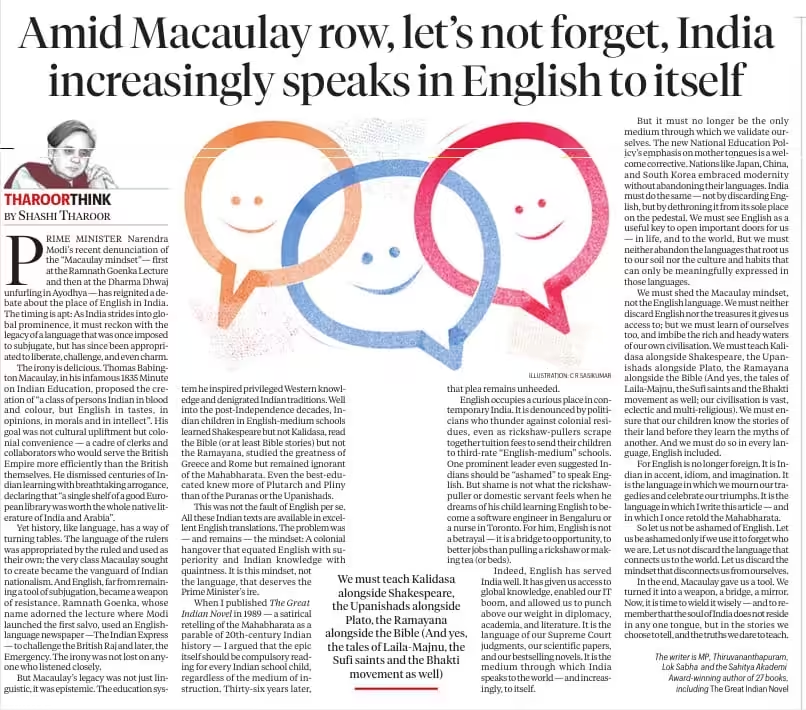
Macaulay legacy in India

Open article →Download PDF

Context:

M Modi’s recent criticism of the “Macaulay mindset” and colonial hangover. Shashi Tharoor argues that English is no longer just a colonial legacy, but an Indian language that India now “speaks to itself.” The debate is connected to nationalism, education reforms (NEP), decolonisation, and linguistic identity.

Macaulay Mindset:

  • Advocated creating a class of Indians “English in tastes, opinions, morals, and intellect.”
  • Promoted English and dismissed Indian knowledge systems.
  • Aimed to create intermediaries for the British administration.
  • PM Modi’s argument:
    • India must reject colonial mental chains and restore civilizational confidence.
  • Tharoor’s counter-point:
    • India has already appropriated English; it is no longer a foreign tool of domination.

THAROOR’S CENTRAL ARGUMENTS:

  • Irony in attacking Macaulay now:
    • English was meant to be an elitist tool.
    • Macaulay did not envision English becoming a mass language in India.
    • But Indians democratised it: rickshaw-pullers, migrant workers, domestic workers, and lower-middle class parents demand English education for upward mobility.
  • India increasingly uses English for self-communication:
    • India no longer uses English just to talk to the world, but also to itself.
    • English is the language of:
      • courts and contracts
      • science and technology
      • business
      • higher education
      • competitive exams
      • media
      • internal policy discourse
  • English is now an Indian language, not a colonial imposition
    • Nations like China, Japan, South Korea retained cultural confidence while embracing modernity.
    • India’s problem was not English but the pedestal English was placed on.
    • NEP rightly wants Indian languages to flourish but without discarding English.
  • English enables access to global knowledge:
    • Indian students would be handicapped without English access to science, philosophy, literature.
    • English allows India to “unlock important doors” domestically and globally.

➡️ Teach Kalidasa + Shakespeare,
➡️ Ramayana + Bible,
➡️ Upanishads + Plato,
➡️ Laila-Majnu + Sufi thinkers + Bhakti movement.

Balanced civilizational education, not cultural isolation.

Reality:

  • India’s economy needs English.
  • India’s global ambition needs English.
  • Students and parents WANT English.

Thus, anti-English speeches do not match societal aspirations.

Solution:

  • Adopt multilingualism, not English abolition
    • Keep English + strengthen Indian languages
  • Increase mother-tongue education WITHOUT reducing English exposure
    • NEP’s direction is correct but must be implemented realistically.
  • Cultural confidence must be rooted in knowledge of:
    • Indian texts
    • Indian philosophies
    • Western and global knowledge too
  • Use English as a tool, not a marker of superiority
    • Dethrone English from privilege, not from usefulness.

For Reference:

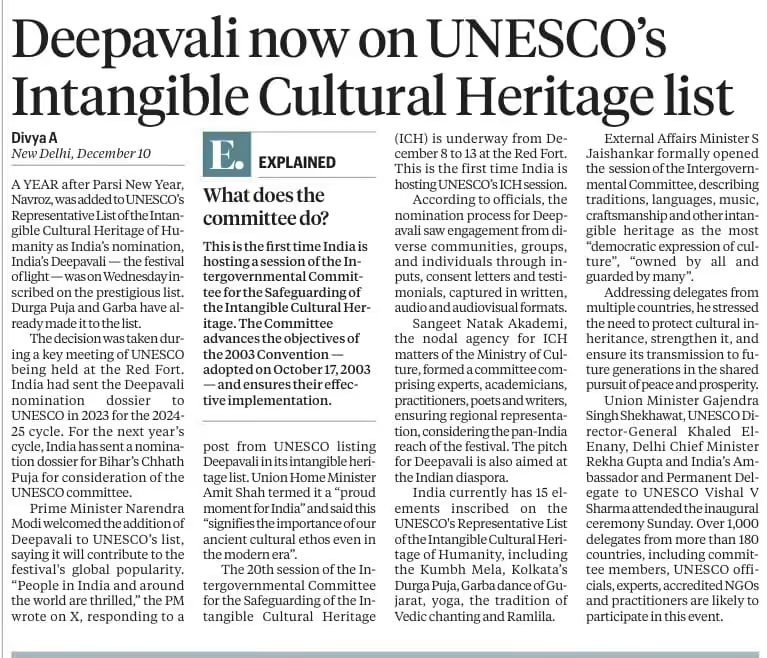
Deepavali on UNESCO Intangible Cultural Heritage List

Open article →Download PDF

Context:

Deepavali (Diwali), India’s major festival of lights, has been added to UNESCO’s Representative List of the Intangible Cultural Heritage of Humanity. This comes a year after Parsi New Year Navroz was added. Other Indian elements already on the list include Durga Puja, Garba, Kumbh Mela, Ramlila, Vedic chanting, etc.

UPSC Relevance:

Art and Culture

UPSC PYQ:

Q. Which one of the following was the latest inclusion in the Intangible Cultural Heritage List of UNESCO?

[A] Chhau dance

[B] Durga puja.

[C] Garba dance

[D] Kumbh mela

About:

Decision at UNESCO Meeting:

  • Decision taken during UNESCO’s ICH Committee session, being hosted by India for the first time, in Delhi’s Red Fort.

India’s Nomination Process:

  • India submitted the Deepavali dossier in 2023 for 2024–25 cycle.
  • For next year, India has nominated Bihar’s Chhath Puja for consideration.

Sangeet Natak Akademi (nodal agency for ICH in India) coordinated the nomination.

UNESCO’s Intangible Cultural Heritage:

  • According to UNESCO’s 2003 Convention for the Safeguarding of the Intangible Cultural Heritage, ICH is manifested into five broad domains:
    • Oral traditions and expressions, including language as a vehicle of the intangible cultural heritage.
    • Performing arts
    • Social practices, rituals and festive events
    • Knowledge and practices concerning nature and the universe
    • Traditional craftsmanship

ICH list India:

S.No.Intangible Cultural Heritage ElementYear of Inscription
1.Kutiyattam, Sanskrit Theater2008
2.Tradition of Vedic Chanting2008
3.Ramlila, the Traditional Performance of the Ramayana2008
4.Ramman, Religious Festival and Ritual Theatre of the Garhwal Himalayas, India2009
5.Chhau Dance2010
6.Kalbelia Folk Songs and Dances of Rajasthan2010
7.Mudiyettu, Ritual Theatre and Dance Drama of Kerala2010
8.Buddhist Chanting of Ladakh: Recitation of Sacred Buddhist Texts in the Trans-Himalayan Ladakh region, Jammu and Kashmir, India2012
9.Sankirtana, ritual singing, drumming and dancing of Manipur2013
10.Traditional Brass and Copper Craft of Utensil Making among the Thatheras of Jandiala Guru, Punjab, India2014
11.Nowruz2016
12.Yoga2016
13.Kumbh Mela2017
14.Durga Puja in Kolkata2021
15.Garba of Gujarat2023