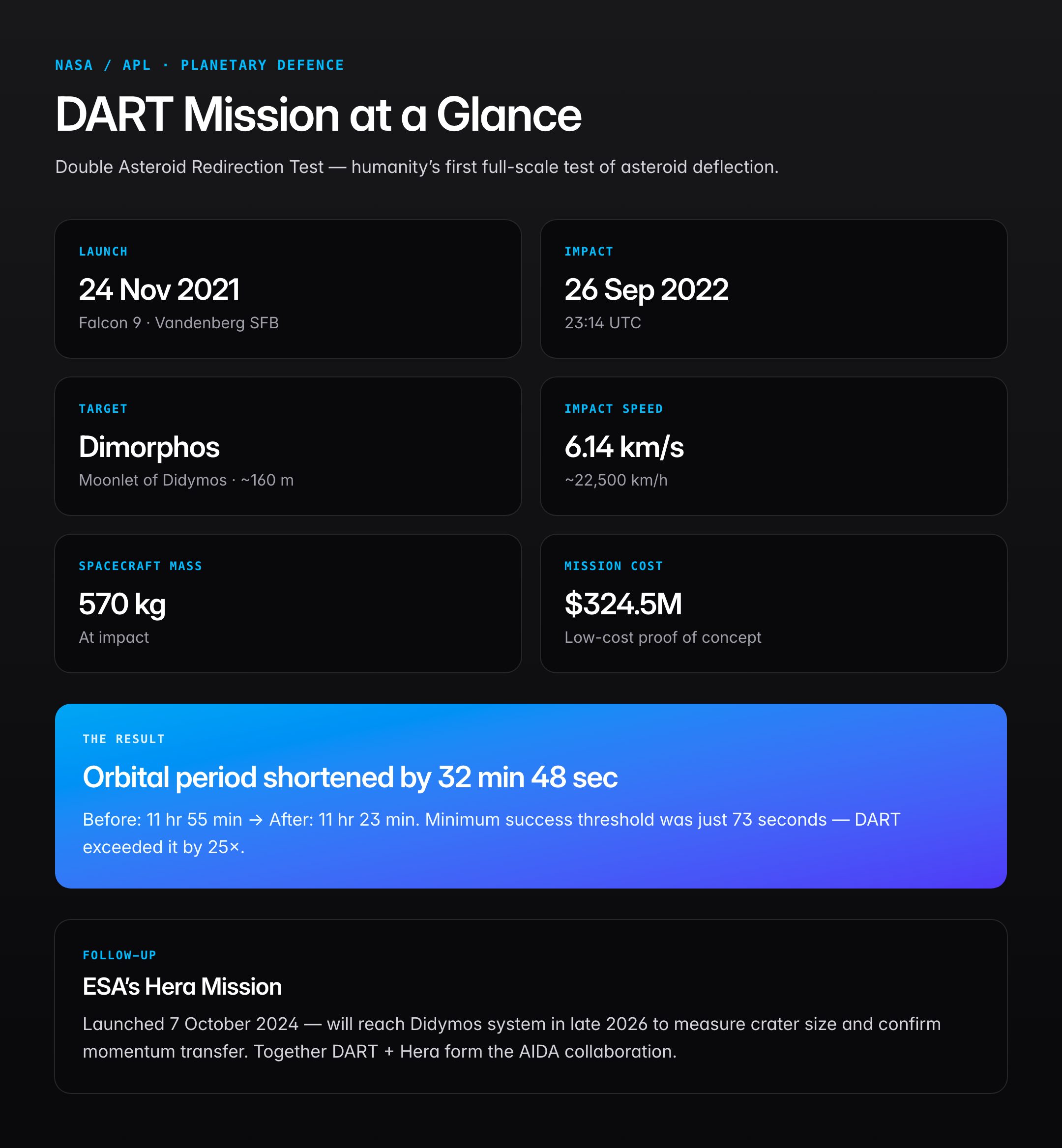
The Double Asteroid Redirection Test (DART) was NASA's first full-scale planetary defence mission. Launched on 24 November 2021 and impacted on 26 September 2022, DART deliberately crashed a spacecraft into the asteroid moonlet Dimorphos to test whether humanity can deflect an asteroid on a collision course with Earth. It succeeded — changing Dimorphos's orbital period by ~33 minutes, far more than the 73-second threshold set as the minimum success criterion.
For UPSC, DART is a top-tier Science & Technology (GS3) topic covering space science, planetary defence, and India's role in future cosmic-hazard preparedness.
What Is Planetary Defence?
Planetary defence is the science and technology of detecting, characterising and mitigating the threat from Near-Earth Objects (NEOs) — asteroids and comets whose orbits bring them close to Earth.
| Term | Meaning |
|---|---|
| NEO | Near-Earth Object; orbits within 1.3 AU of the Sun |
| PHA | Potentially Hazardous Asteroid; ≥140 m and within 0.05 AU of Earth's orbit |
| AU | Astronomical Unit; ~149.6 million km |
| Kinetic impactor | Spacecraft used to physically deflect an asteroid |
| Gravity tractor | Spacecraft that uses its gravity to slowly pull an asteroid |
The 1908 Tunguska event in Siberia and the 2013 Chelyabinsk meteor in Russia are recent examples of the damage asteroids can cause.
DART Mission: Basic Facts
| Aspect | Detail |
|---|---|
| Full name | Double Asteroid Redirection Test |
| Operator | NASA with Johns Hopkins Applied Physics Laboratory (APL) |
| Launch date | 24 November 2021 |
| Launch vehicle | Falcon 9 (SpaceX) |
| Launch site | Vandenberg Space Force Base, California |
| Target | Dimorphos, moonlet of near-Earth asteroid Didymos |
| Impact date | 26 September 2022 |
| Impact speed | ~6.14 km/s (~22,500 km/h) |
| Spacecraft mass at impact | ~570 kg |
| Mission cost | ~$324.5 million |
The Target: Didymos and Dimorphos
Didymos is a binary asteroid system — two asteroids orbiting each other.
| Body | Diameter | Role |
|---|---|---|
| Didymos | ~780 m | Primary asteroid; not hit |
| Dimorphos | ~160 m | Moonlet; DART's impact target |
Dimorphos orbited Didymos every 11 hours 55 minutes before the impact. DART sought to shorten this orbital period, which would demonstrate that a spacecraft can measurably alter an asteroid's trajectory.
Crucially, neither body posed a threat to Earth — the mission was a controlled test, not a real deflection.
The Kinetic Impactor Technique
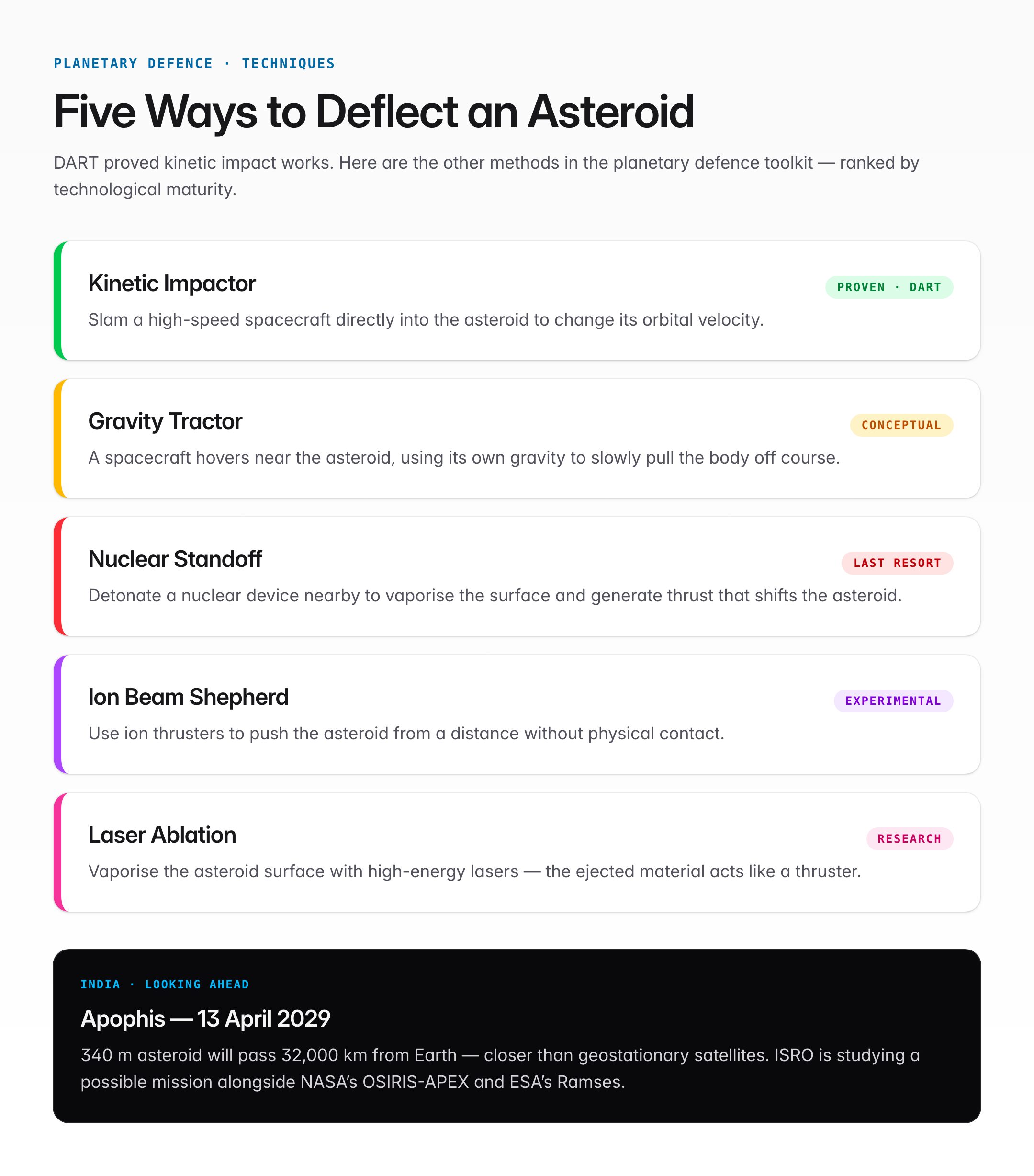
DART tested the kinetic impactor method, the most mature of several proposed deflection techniques.
| Technique | How It Works | Status |
|---|---|---|
| Kinetic impactor | Slam a spacecraft into the asteroid to change its velocity | Tested by DART |
| Gravity tractor | Spacecraft hovers near asteroid, uses gravity to pull it | Conceptual |
| Nuclear standoff | Detonate nuclear device nearby to vaporise surface | Last resort |
| Ion beam shepherd | Use ion thrusters to push asteroid | Experimental |
| Laser ablation | Vaporise surface to create thrust | Research stage |
DART Spacecraft and Payload
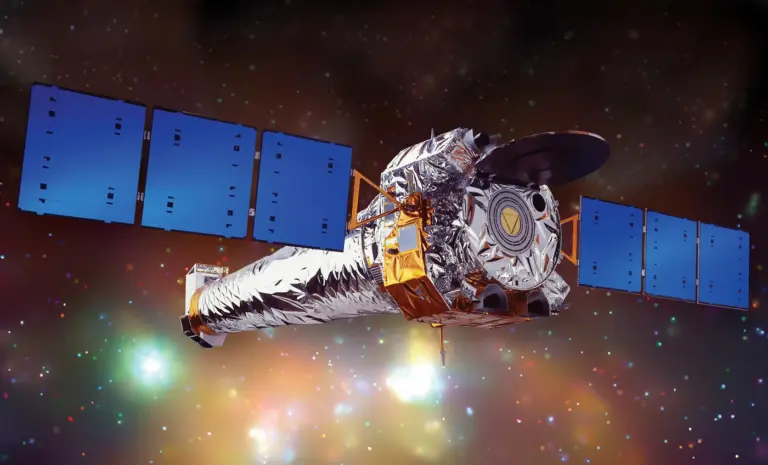
DART was a small box-shaped spacecraft with solar arrays.
| Component | Purpose |
|---|---|
| DRACO | Didymos Reconnaissance and Asteroid Camera for Optical navigation — autonomous targeting |
| NEXT-C | Ion propulsion system (demonstration; not primary propulsion) |
| ROSA | Roll Out Solar Arrays — novel solar panel technology |
| SMART Nav | Onboard autonomous navigation software |
| LICIACube | Italian Space Agency's companion CubeSat that recorded impact from close range |
LICIACube separated from DART 15 days before impact and captured the first images of the impact plume and crater.
Impact and Outcome
On 26 September 2022 at 23:14 UTC, DART collided with Dimorphos.
| Parameter | Before Impact | After Impact | Change |
|---|---|---|---|
| Orbital period | 11 hr 55 min | 11 hr 23 min | -32 min 48 sec |
| Dimorphos shape | Oblate spheroid | Triaxial ellipsoid | Deformed |
| Ejecta produced | None | ~1,000 tonnes | Large plume |
| Minimum success threshold | 73-second change | 33-minute change | 25× over |
The mission proved that kinetic impact is a viable planetary defence technique.
Follow-up: ESA's Hera Mission
Launched on 7 October 2024 by the European Space Agency, Hera will reach the Didymos system in late 2026 to:
- Measure the final crater size
- Assess Dimorphos's internal structure and composition
- Confirm the precise momentum transfer efficiency
- Study the post-impact binary dynamics
DART + Hera together form the AIDA (Asteroid Impact and Deflection Assessment) collaboration.
Planetary Defence Ecosystem
Several agencies and observatories work on the NEO threat.
| Organisation | Role |
|---|---|
| NASA's Planetary Defense Coordination Office (PDCO) | US lead on NEO detection and mitigation |
| ESA Space Safety Programme | European planetary defence; includes Hera |
| International Asteroid Warning Network (IAWN) | UN-endorsed; coordinates asteroid discovery alerts |
| Space Mission Planning Advisory Group (SMPAG) | UN-endorsed; plans deflection campaigns |
| Minor Planet Center (IAU) | Catalogues all known asteroids |
As of 2024, over 35,000 near-Earth asteroids have been discovered, including more than 2,400 PHAs.
India and Planetary Defence
India does not yet have a dedicated planetary defence mission, but several building blocks exist.
| Indian Asset | Relevance |
|---|---|
| ISRO | Capability in interplanetary missions (Mangalyaan, Aditya-L1) |
| Indian Institute of Astrophysics (IIA) | NEO observation research |
| Physical Research Laboratory (PRL) | Small body (asteroid, comet) studies |
| MACE Telescope, Hanle | High-altitude gamma-ray and optical astronomy |
| ISRO's proposed NEO programme | Discussed for future roadmap |
ISRO Chairman S. Somanath has indicated (2023) that ISRO is studying a mission to the asteroid Apophis, which will make an extremely close approach to Earth in April 2029.
Apophis — Why It Matters
| Feature | Detail |
|---|---|
| Discovered | 2004 |
| Diameter | ~340 m |
| Close approach | 13 April 2029 |
| Distance | ~32,000 km (closer than geostationary satellites) |
| Current risk | Zero impact probability for next 100+ years (post re-evaluation in 2021) |
Apophis's 2029 flyby is a once-in-a-lifetime scientific opportunity — several agencies (NASA's OSIRIS-APEX, ESA's Ramses, and possibly ISRO) plan to study it.
Why DART Matters
| Dimension | Significance |
|---|---|
| Scientific | Confirmed kinetic impactor technique works |
| Engineering | Demonstrated autonomous targeting at planetary scale |
| Strategic | Built international planetary defence framework |
| Policy | Reinforced UN-level coordination (IAWN, SMPAG) |
| Economic | Low-cost (~$324 million) proof of concept |
Asteroid Impact History — Why Worry?
| Event | Year | Impact |
|---|---|---|
| Chicxulub | 66 million BCE | Killed non-avian dinosaurs |
| Tunguska | 1908 | Flattened 2,000 sq km of Siberian forest |
| Chelyabinsk | 2013 | Over 1,500 injured in Russia by ~20 m meteor |
| Meteor Crater, Arizona | ~50,000 BCE | 1.2 km wide crater |
A Chelyabinsk-class event (~20 m object) occurs roughly once a century; larger objects are less frequent but far more destructive.
Limitations and Open Questions
- DART tested only one asteroid type and size; results may differ for rubble-pile vs monolithic asteroids
- Warning time is critical — a kinetic impactor needs months to years of lead time
- Very large asteroids (>1 km) may need multiple impacts or nuclear options
- Detection of small but dangerous asteroids (<140 m) remains incomplete
- International legal framework for deflection decisions is still evolving
UPSC Relevance
GS3 (Science & Technology): Space science, planetary defence, global scientific cooperation.
Key Prelims facts:
- DART = Double Asteroid Redirection Test; NASA mission
- Launched: 24 November 2021; Impact: 26 September 2022
- Target: Dimorphos, moonlet of binary asteroid Didymos
- Impact speed: ~6.14 km/s
- Orbital period change: ~33 minutes (minimum threshold was 73 seconds)
- Italian CubeSat LICIACube captured impact images
- Hera (ESA) launched 7 October 2024; arrives at Didymos system in 2026
- DART + Hera = AIDA collaboration
- NASA's PDCO is lead US agency for planetary defence
- IAWN and SMPAG are UN-endorsed coordination bodies
- Apophis will pass Earth on 13 April 2029 at ~32,000 km
- Kinetic impactor is the most mature deflection technique
Tell Google you want more of this.
Add Anantam IAS as a preferred sourceOne tap, and this site shows up more often in your own Top Stories, AI Overviews and AI Mode. Remove it any time.