A civil servant's attitude is the lens through which she sees every citizen, every file, every order. Two officers with identical training, identical seniority, and identical rule books can produce wildly different administrative experiences for the same set of citizens — because their attitudes differ. UPSC GS-IV places attitude high in the syllabus precisely because attitude is the upstream psychological condition that shapes downstream behaviour.
This guide consolidates the compass extracts on Defining Attitude (Chapter 23) and Features / Nature of Attitude (Chapter 25) into one Mains-quality reference.
Editorial note — merge. This article merges the compass chapters Defining Attitude (66 words) and Features / Nature of Attitude (42 words). The two are tightly linked stubs — the second simply expands what the first asserts — and merging produces a coherent argument rather than two padded definitional shells.
What Is Attitude?
The compass extract gives the canonical definition.
Attitude is a learned tendency to act, think and feel in particular ways towards a class of people, objects, place, event or idea.
In simpler language, attitude is an expression of favour or disfavour towards a person, place, thing or event.
Three features of the definition deserve attention.
- Attitude is learned — not inherited. It is acquired through experience and socialisation.
- Attitude is a tendency — a disposition, not an act. It predicts behaviour without fully determining it.
- Attitude is directed — it is always toward some object, person, idea, or event. Free-floating attitude is not a coherent concept.
The Spectacles Metaphor
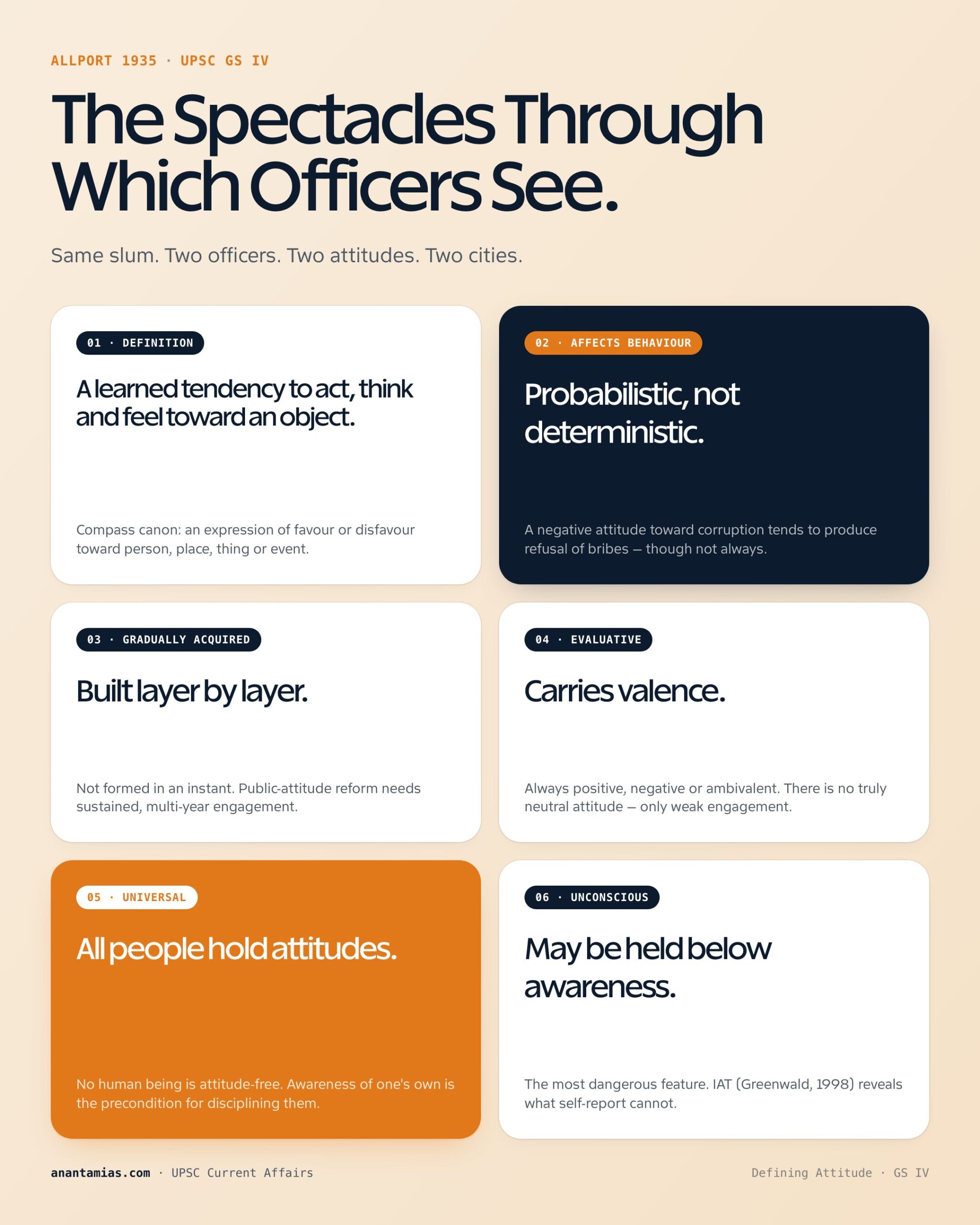
The compass offers a memorable metaphor: attitude is akin to spectacles through which a person sees the world. The same external reality, refracted through different attitudinal lenses, produces different inner experiences and different outward responses.
Two officers walking through a slum: one sees disorder, encroachment, unhygienic conditions, citizens to be managed. The other sees enterprise under constraint, dignity in scarcity, citizens to be supported. The slum is the same. The attitude is different.
"We don't see things as they are; we see them as we are." — Anaïs Nin
This is why the compass calls attitude a subjective interpretation of the objective world by an individual. Attitude is not the world; it is the way of seeing.
Five Features of Attitude (Compass Chapter 25)
The compass extract on Features / Nature of Attitude lists five features. Each unpacks a different dimension of how attitudes operate.
1. Attitudes Often Result in and Affect Behaviour
Attitude is not the same as behaviour, but it predisposes behaviour. A negative attitude toward corruption tends to produce refusal of bribes; a positive attitude toward citizen service tends to produce courteous counter behaviour.
The link is probabilistic, not deterministic. A person can hold a strong negative attitude toward smoking and still smoke (cognitive dissonance, addiction, situational pressure). The compass treatment of Factors Influencing Relation Between Attitude and Behaviour (a sister chapter) develops this further.
2. Attitudes Are Gradually Acquired Over Time
Attitude is not formed in an instant. It is built layer by layer through repeated exposure — to family, peers, school, media, life experience. A child's attitude toward authority crystallises across thousands of interactions with parents and teachers; her later attitude toward government takes shape across her interactions with the police constable, the school clerk, the BDO.
For the civil servant, the corollary is patient: attitudes cannot be changed overnight. Public-attitude reform — toward sanitation, gender, environment — needs sustained, multi-year engagement.
3. Attitudes Are Evaluative Statements
Every attitude carries a valence — favourable, unfavourable, or somewhere on a continuum. There is no such thing as a "neutral attitude"; what is sometimes called neutral is in fact ambivalence (a separate two-dimensional state).
This evaluative core is what distinguishes attitude from belief. A belief is a proposition ("crime rates have risen"). An attitude is an evaluation ("this rise in crime is alarming and intolerable").
4. All People Hold Attitudes
The compass notes: all people, irrespective of their status and intelligence, hold attitudes. There is no human being who does not hold attitudes. The IAS officer and the citizen at the counter both arrive with attitudes; ethical practice asks the officer to suspend her own while remaining respectful of the citizen's.
This universality matters because it disposes of the myth that "objective" professionals do not have attitudes. They do. Awareness of one's own attitudes is the precondition of disciplining them.
5. An Attitude May Be Unconsciously Held
This is the most dangerous feature. An attitude may be unconsciously held. The agent may not realise what attitude she is enacting. Implicit caste bias, unconscious gender preference, unstated regional prejudice — these often operate without the agent's awareness.
The civil-service training response is self-audit, peer feedback, and structured reflection — to surface the implicit and bring it under conscious control.
"Until you make the unconscious conscious, it will direct your life and you will call it fate." — C.G. Jung
Nature of Attitude — Six Working Properties
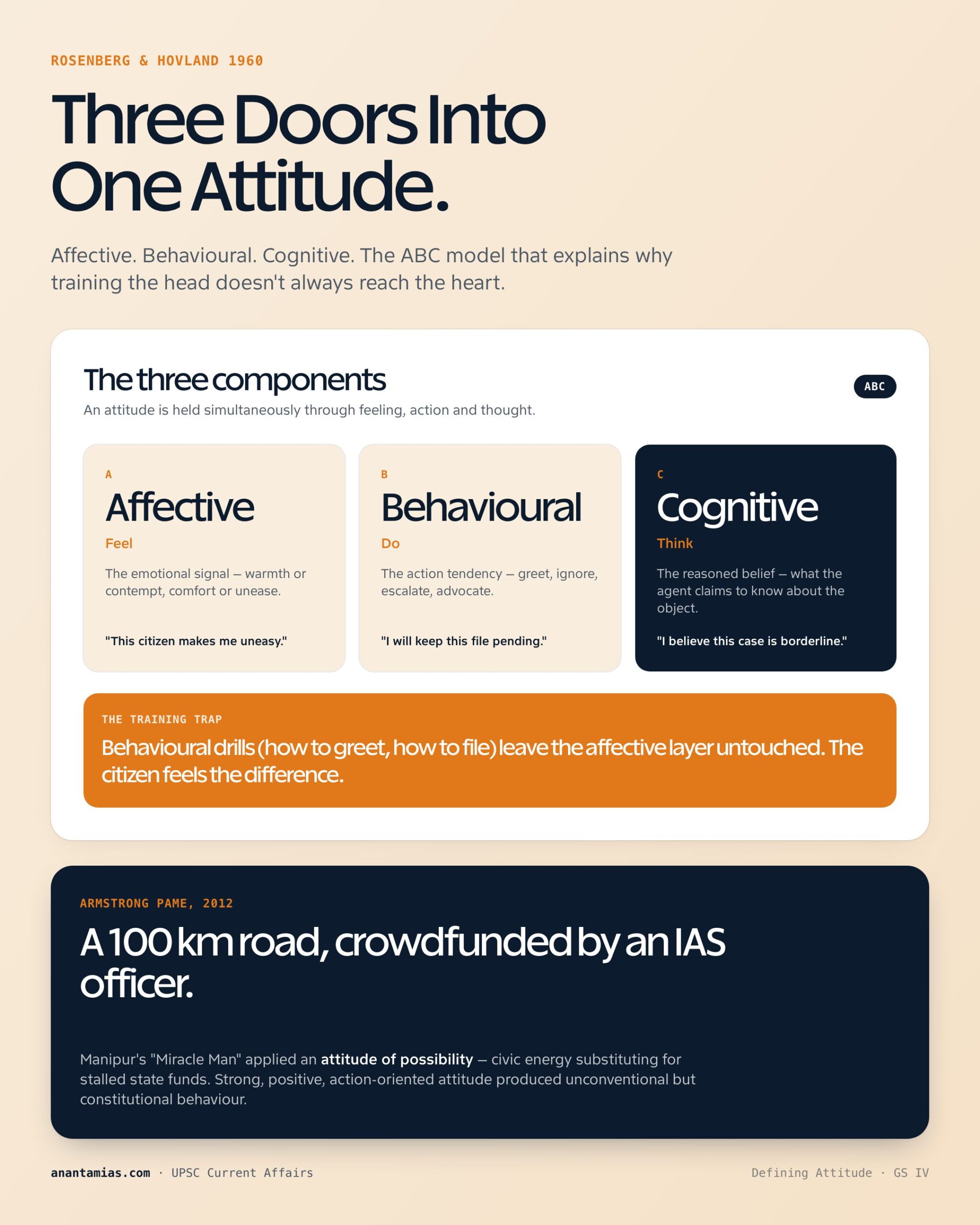
Beyond the compass list, the standard psychology literature (Allport, 1935; Rosenberg & Hovland, 1960; Eagly & Chaiken, 1993) identifies six working properties.
| Property | What It Means |
|---|---|
| Object-directed | Always toward something specific |
| Evaluative | Carries a positive / negative valence |
| Learned | Acquired through socialisation |
| Relatively stable | Persists over time, but can change |
| Three-component (ABC) | Affective + Behavioural + Cognitive |
| Latent / Inferred | Not directly observable; inferred from speech and behaviour |
The ABC model — Affective (feel), Behavioural (do), Cognitive (think) — is so central that it gets a dedicated treatment in the Functions of Attitude and the consolidated Attitude: Meaning, Components and Functions drafts.
Attitude vs Adjacent Concepts
| Concept | Working Definition | Distinction From Attitude |
|---|---|---|
| Belief | A proposition held to be true | Attitude is evaluative; belief is descriptive |
| Value | An enduring preference for what is important | Attitude is object-specific; value is general |
| Opinion | A stated position | Attitude is the deeper disposition; opinion is its surface |
| Trait | A stable personality characteristic | Attitude is learned and object-specific; trait is broader |
| Habit | A learned behaviour pattern | Attitude is mental; habit is behavioural |
| Mood | A short-term affective state | Attitude is durable; mood is fleeting |
A clean Mains answer can pick three of these to demonstrate the precision of the candidate's vocabulary.
Attitude in the Civil Servant — Three Critical Domains
Attitude Toward Citizens
The affective component is decisive. An officer with cognitively correct knowledge of the rules and procedurally correct behaviour can still produce a humiliating experience for the citizen if her affective component is one of contempt or impatience.
Training programmes that focus only on the behavioural layer (how to greet, how to file) without addressing the affective layer often produce robotic compliance without warmth. The citizen feels the difference.
Attitude Toward Subordinates
A senior officer's attitude toward her subordinates determines the operating culture of the office. An attitude that treats subordinates as colleagues with their own competence produces participatory governance; an attitude of contempt or fear produces a culture of compliance and silence.
Attitude Toward Change
The knowledge function of attitude (how attitudes simplify and organise the world) inclines officers toward familiar mental maps. New technology, new policy, and new governance models challenge those maps. The conscientious officer audits her attitude toward change and updates it deliberately.
"It is not the strongest of the species that survives, nor the most intelligent that survives. It is the one that is the most adaptable to change." — Charles Darwin (paraphrased)
Two Indian Case Studies
Case 1 — The Counter Clerk and the Affective Component
A district passport office records routine high citizen-satisfaction on procedural compliance but low satisfaction on overall experience. Internal audit reveals that counter clerks are procedurally correct but emotionally hostile — gestures, tone, eye contact, body posture all signal dismissal. The attitude is negative affective with neutral cognitive and compliant behavioural components. Reform requires intervention at the affective layer — mentoring, role models, reframing of the citizen as the reason the office exists. Three months of attitudinal training combined with leadership modelling moved the satisfaction scores meaningfully upward. The case illustrates Feature 1 (attitude affects behaviour at the qualitative level) and Feature 5 (the operating attitude was unconscious).
Case 2 — Armstrong Pame and the Attitude of Possibility
IAS officer Armstrong Pame ("Miracle Man") used social media in 2012 to crowdfund a 100-km road in his Manipur district where state funds were stuck. His underlying attitude of possibility — that civic energy could substitute for stalled bureaucratic processes — produced a behaviour (crowdfunding by a serving officer) that was without precedent. The case illustrates Feature 1 again — strong, positive, action-oriented attitude produced unconventional but constitutional behaviour.
How Attitude Forms — A Brief Note
The compass dedicates a separate chapter to Procedures of Attitude Formation. In short, attitudes form through:
- Classical (Pavlovian) conditioning — pairing of objects with affective responses.
- Operant conditioning — reinforcement and punishment.
- Direct instruction — explicit teaching.
- Satisfaction of wants — favourable attitudes toward what satisfies needs.
The features described above are the end states; the procedures are the means by which those states are produced.
UPSC Syllabus Relevance
GS-IV explicitly names attitude — content, structure, function; its influence and relation with thought and behaviour; moral and political attitudes; social influence and persuasion. The definition and features sit at the head of this entire syllabus block.
Past-Year Prompts
- "What do you understand by attitude? How is attitude formed and changed?" — 2014, 2018 (multiple variants).
- "Distinguish between 'Attitude' and 'Behaviour'." — 2017.
- "Effective utilization of public funds is crucial to meet development goals. Critically examine the reasons for under-utilization and mis-utilization of public funds and their implications." — 2019 (involves attitudinal analysis).
- "What does attitude mean for the public servant? Why is attitudinal change important in civil service?" — 2020 paraphrased.
Mains Answer-Writing Tips
- Open with the canonical compass definition — examiner recognises the source.
- Use the spectacles metaphor — it is memorable and signals understanding.
- List the five features; elaborate at least three.
- Anchor with one Indian case (passport counter, Armstrong Pame, Swachh Bharat) and one psychological quote (Jung, Anaïs Nin, Allport).
- Close by linking attitude to the affective bottleneck of administrative ethics.
Prelims Pointers
- Gordon Allport (1935) — attitude is the most distinctive and indispensable concept in social psychology.
- Daniel Katz — Functional Theory of Attitudes (1960).
- Leon Festinger (1957) — cognitive dissonance.
- ABC Model — Affective, Behavioural, Cognitive.
- Implicit Association Test — measure of unconscious attitude (Greenwald, 1998).
FAQ
What is the simplest definition of attitude?
A learned tendency to evaluate something favourably or unfavourably. The compass version adds to act, think and feel in particular ways, which is more comprehensive.
Is attitude the same as personality?
No. Personality is a broad pattern of traits across many domains. Attitude is object-specific. A person of agreeable personality may still have negative attitudes toward specific things (corruption, injustice).
Can someone have a u0022neutral attitudeu0022?
Strictly, no. What appears neutral is usually either weak attitude (low intensity), absence of attitude (the object has not been evaluated), or ambivalence (simultaneous positive and negative attitudes — a two-dimensional state).
Are attitudes always negative or positive?
They are evaluative — but the evaluation can be at any point on a continuum. Strong-positive, mild-positive, mild-negative, strong-negative, and ambivalent are all possible attitudinal states.
Why does the compass treat u0022definitionu0022 and u0022featuresu0022 as separate chapters?
Pedagogical scaffolding for an exam-prep textbook. In a Mains answer, the two should be continuously integrated — define, then immediately list the features that operationalise the definition.
The five features the compass lists are not five facts to memorise — they are the operating shape of every attitude that walks into an office. The conscientious civil servant audits each of her own attitudes against these five features and learns, over the course of a career, to wear different spectacles for different files without ever forgetting that she is wearing them.
The five features the compass lists are not five facts to memorise — they are the operating shape of every attitude that walks into an office. The conscientious civil servant audits each of her own attitudes against these five features and learns, over the course of a career, to wear different spectacles for different files without ever forgetting that she is wearing them.
Tell Google you want more of this.
Add Anantam IAS as a preferred sourceOne tap, and this site shows up more often in your own Top Stories, AI Overviews and AI Mode. Remove it any time.