Indian businesses, particularly MSMEs, spend a staggering share of their working hours on compliance. Filing returns, renewing licences, responding to inspectors, and maintaining the registers required by dozens of central, state, and municipal laws can take a small enterprise’s owner two full working days a week. Many of these laws are remnants of an older economic order. Some were drafted in the 1860s. Some replicate each other. Some prescribe penalties for offences that no longer exist. The economic literature has a phrase for this accumulated layer of redundant rules: “regulatory cholesterol.”
The proposed Deregulation Commission of India is the latest, and most ambitious, attempt to clean up that cholesterol. The Government of India, in its 2025 budget cycle and policy announcements, signalled the creation of a statutory or institutional body whose task is to review, repeal, or amend outdated and overlapping laws, regulations, rules, circulars, and government orders. Unlike previous one-off committees, the Commission is conceived as a standing institution with a continuous mandate, applying tools borrowed from international regulatory reform practice such as the regulatory guillotine and sunset clauses.
This guide explains what the Deregulation Commission is meant to do, how it differs from the existing Law Commission, what tools it will deploy, and what the prospects are for its effect on the Indian economy.
Quick Facts on the Deregulation Commission
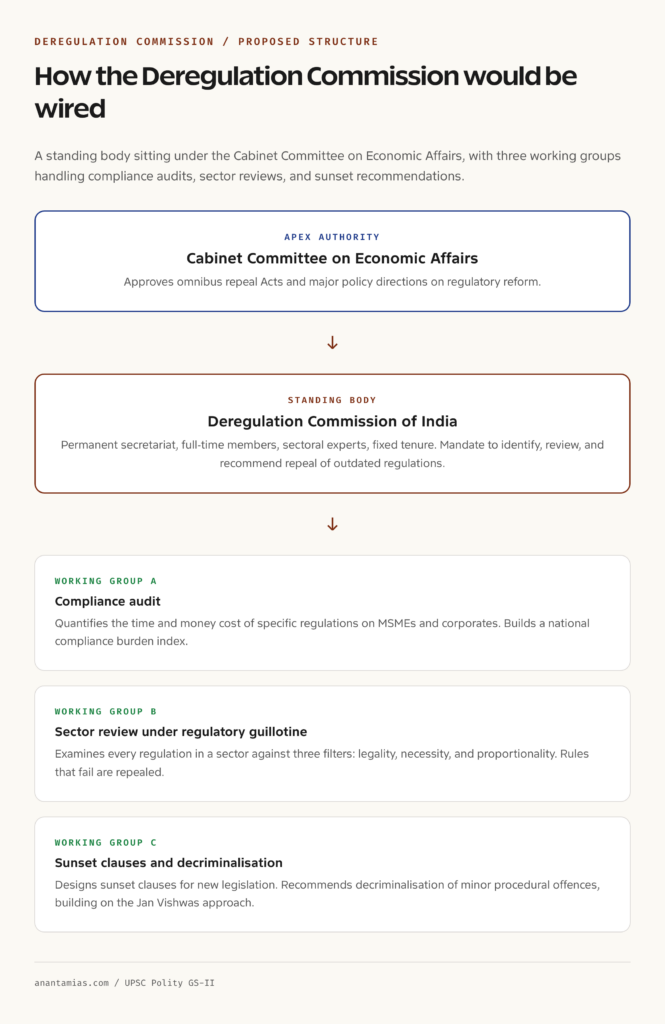
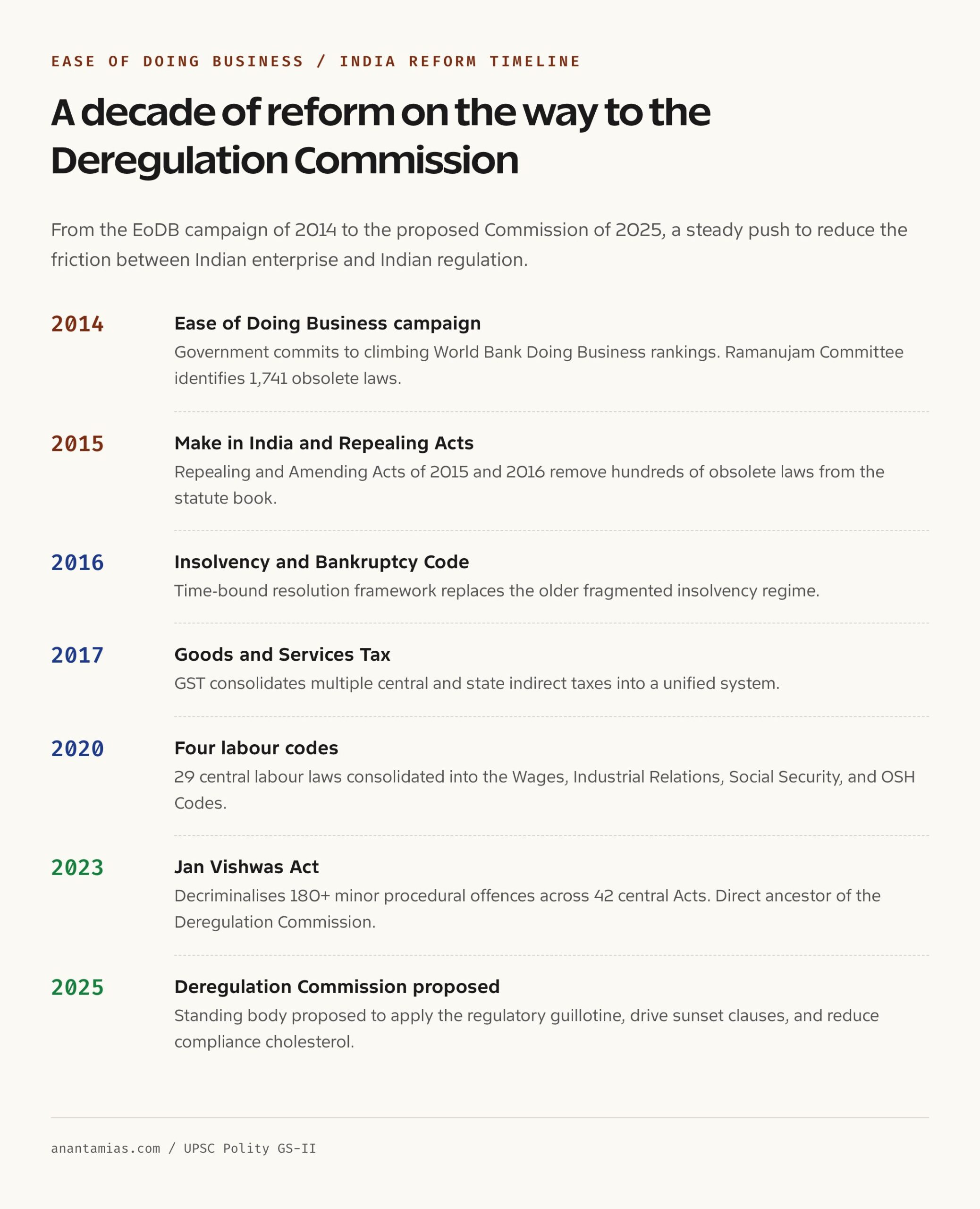
The Deregulation Commission is a proposed standing body to systematically identify, review, and recommend the repeal or amendment of outdated, redundant, and overlapping laws and regulations in India. Its objective is to reduce the compliance burden on businesses and citizens, in line with the broader policy aim of “Minimum Government, Maximum Governance.” Its principal tool is the regulatory guillotine, an enmasse review process under which regulations not justified by current evidence are repealed by default. The Commission’s work builds on the Jan Vishwas (Amendment of Provisions) Act, 2023, which decriminalised over 180 minor offences across 42 central laws, and on the Ramanujam Committee, which earlier reviewed archaic central laws for repeal. The Commission is expected to push for sunset clauses in future legislation, requiring laws to expire at fixed intervals unless Parliament reviews and renews them. The Commission is institutionally distinct from the Law Commission of India, which focuses on substantive legal reform rather than regulatory and procedural reform.
What the Deregulation Commission Is Designed to Do
The Commission’s mandate has three operational pillars. The first is the regulatory guillotine. This is a fast-track review process developed in countries like Sweden, South Korea, and Mexico, where every regulation in a sector is examined within a fixed window. Each regulation must clear three filters: it must be legal, that is, it must trace its authority to a valid parent statute, it must be necessary, that is, the policy goal cannot be achieved with less restrictive means, and it must be business-friendly, in the sense that the compliance cost is proportionate to the public benefit. Rules that fail any of these filters are repealed automatically.
The second pillar is cost-of-compliance assessment. The Commission is meant to develop a methodology to quantify the economic cost imposed by specific rules on MSMEs, corporates, and citizens, including the time cost, the documentary cost, and the indirect cost of delayed approvals. Once compliance costs are measurable, they become amenable to budgeting and trade-offs. India has historically lacked this kind of structured cost data, which is one reason “ease of doing business” reforms have been hard to evaluate.
The third pillar is simplification. Many regulatory frictions are not the result of bad rules but of badly designed processes. Multiple forms duplicate the same information across different agencies. Tax filings, factory registrations, environmental compliance, and labour registers each demand the same employer details. The Commission is expected to drive single-window systems, common forms, and digital integration that allows one filing to satisfy multiple legal obligations.
Background and Historical Context
India’s experiments with regulatory reform predate the Deregulation Commission by decades. The economic liberalisation of 1991 was itself a deregulation programme, dismantling the licence-permit-quota raj that had governed industrial activity since the 1950s. The years that followed saw sectoral deregulation in telecom, civil aviation, banking, and insurance. By the 2010s, the focus shifted from sectoral to horizontal reform, that is, reducing compliance burden across all sectors at once.
The Ramanujam Committee, set up under the chairmanship of R. Ramanujam in 2014, was an early structured effort to identify archaic central laws ripe for repeal. The Committee recommended the repeal of 1,741 obsolete laws, many of them dating from the colonial era. The Repealing and Amending Acts of 2015 and 2016 implemented a substantial portion of those recommendations, removing laws like the Hackney Carriage Act of 1879 and the Sarais Act of 1867 from the statute book.
The Jan Vishwas (Amendment of Provisions) Act, 2023 is the most direct ancestor of the Deregulation Commission. It decriminalised more than 180 minor procedural offences across 42 central Acts, replacing imprisonment penalties with civil monetary fines. Provisions of the Drugs and Cosmetics Act, the Environment Protection Act, the Air Act, and several others were softened, on the principle that procedural lapses by businesses should not carry criminal jail terms unless wilful or harmful. The Jan Vishwas approach is now being extended into a permanent institutional framework.
State-level deregulation has also been picking up. Several states have introduced their own Jan Vishwas-style amendments. The States’ Business Reforms Action Plan, run jointly by the Department for Promotion of Industry and Internal Trade and the World Bank, ranks states on more than 300 reform parameters. The Deregulation Commission’s national-level work is intended to complement and accelerate these state efforts.
Key Functions and Tools of the Commission
The regulatory guillotine, as practised internationally, is implemented through a structured process. A baseline registry of every active regulation in a sector is compiled. Each regulation is mapped against the three filters of legality, necessity, and proportionality. Affected stakeholders, including industry bodies, consumer groups, and citizens, are consulted. A high-level panel reviews the staff recommendations. Regulations that survive the review are retained, regulations that fail are repealed automatically through a single omnibus repeal Act, and regulations that need modification are amended.
Sunset clauses are a complementary tool. A sunset clause is a provision in a statute that fixes an automatic expiry date for that law or specific provisions within it. Without legislative action to renew, the law lapses. Sunset clauses force periodic review and prevent the slow accumulation of obsolete legislation. The United States Defense Authorization Act, the United Kingdom’s Terrorism Prevention and Investigation Measures Act, and several Australian state laws use sunset clauses extensively. India has used sunset clauses sparingly, and the Deregulation Commission is expected to recommend their wider adoption in future legislation, particularly in technology, finance, and emergency-power regulation.
Cost-benefit and regulatory impact analysis, treated as routine in OECD economies, will become a default feature of the Commission’s work. Every new regulation under review will be assessed for its expected compliance cost, its enforcement cost, and its likely benefit, with the analysis published before final notification.
Why the Deregulation Commission Matters
The economic stakes are large. Studies by the Reserve Bank of India and FICCI have estimated that compliance costs amount to between 2% and 4% of MSME turnover, a margin large enough to determine whether a small enterprise is profitable. The World Bank’s Doing Business reports, before they were discontinued, repeatedly placed India in the bottom third on indicators like starting a business, obtaining construction permits, and enforcing contracts. The Deregulation Commission is the principal institutional mechanism through which India intends to climb on these indicators in the years ahead.
For citizens, the Commission’s work is less visible but equally important. Outdated regulations often produce absurd results: a citizen renewing a passport has to attest to documents already in possession of another government department, or a small landlord has to file the same property details with multiple agencies. The Commission’s simplification mandate targets exactly this kind of friction.
For governance, the Commission introduces a culture of permanent review rather than episodic reform. Every law on the statute book has an implicit expiry. Every regulation has a quantifiable cost. Every new rule must justify itself. This is a meaningful shift in the philosophy of Indian regulation, where, traditionally, rules have accumulated and seldom retreated.
Detailed Analysis: Comparison with the Law Commission
The Law Commission of India and the proposed Deregulation Commission are both reformist bodies, but they operate in different domains. The Law Commission, currently in its 22nd iteration and dating back in spirit to the First Law Commission under Macaulay in 1834, is a non-statutory body reconstituted by the government every three years. Its remit is substantive legal reform: how the law should treat marriage, succession, criminal offences, defamation, contempt, and constitutional questions. Its reports inform parliamentary debate on bills like the Uniform Civil Code, criminal justice reform, and contempt of court.
The Deregulation Commission, in contrast, will focus on procedural and regulatory reform. Its concern is not what the law should say but how compliance with the law should work. Should a manufacturing unit need three separate environmental clearances, or should they be combined into one? Should an MSME with under twenty employees need to file the same returns as a five-thousand-employee corporation? Should an offence be punishable by jail time or by a civil fine? These are the questions the Deregulation Commission is built to answer.
The two bodies will likely intersect on some questions. Decriminalisation of minor offences, for instance, has both a substantive legal element, namely the principle that the criminal law should be reserved for serious wrongs, and a regulatory element, namely the practical effect on businesses and inspectors. Sunset clauses for terror laws or emergency provisions touch both regulatory and constitutional design. Coordination between the two commissions will need an explicit institutional framework.
Comparative Perspective: International Models
The regulatory guillotine model has a documented track record. South Korea cut its regulatory stock by approximately 50% in the late 1990s using a guillotine process. Mexico, under its Federal Commission on Regulatory Improvement, repealed thousands of obsolete regulations through the early 2000s. Sweden and the United Kingdom have used the model for periodic reviews. The OECD has documented the methodology and lessons learned, which the Indian Deregulation Commission can borrow from.
International experience also offers cautionary lessons. The guillotine works only with strong political backing at the top, since affected ministries often resist losing their regulatory turf. The methodology must be transparent, with public consultation built into the process, otherwise the reform loses legitimacy. The commission must have permanent staff with sectoral expertise, since one-off reviews tend to skim the surface. The Indian design will need to incorporate these lessons.
Challenges and Implementation Risks
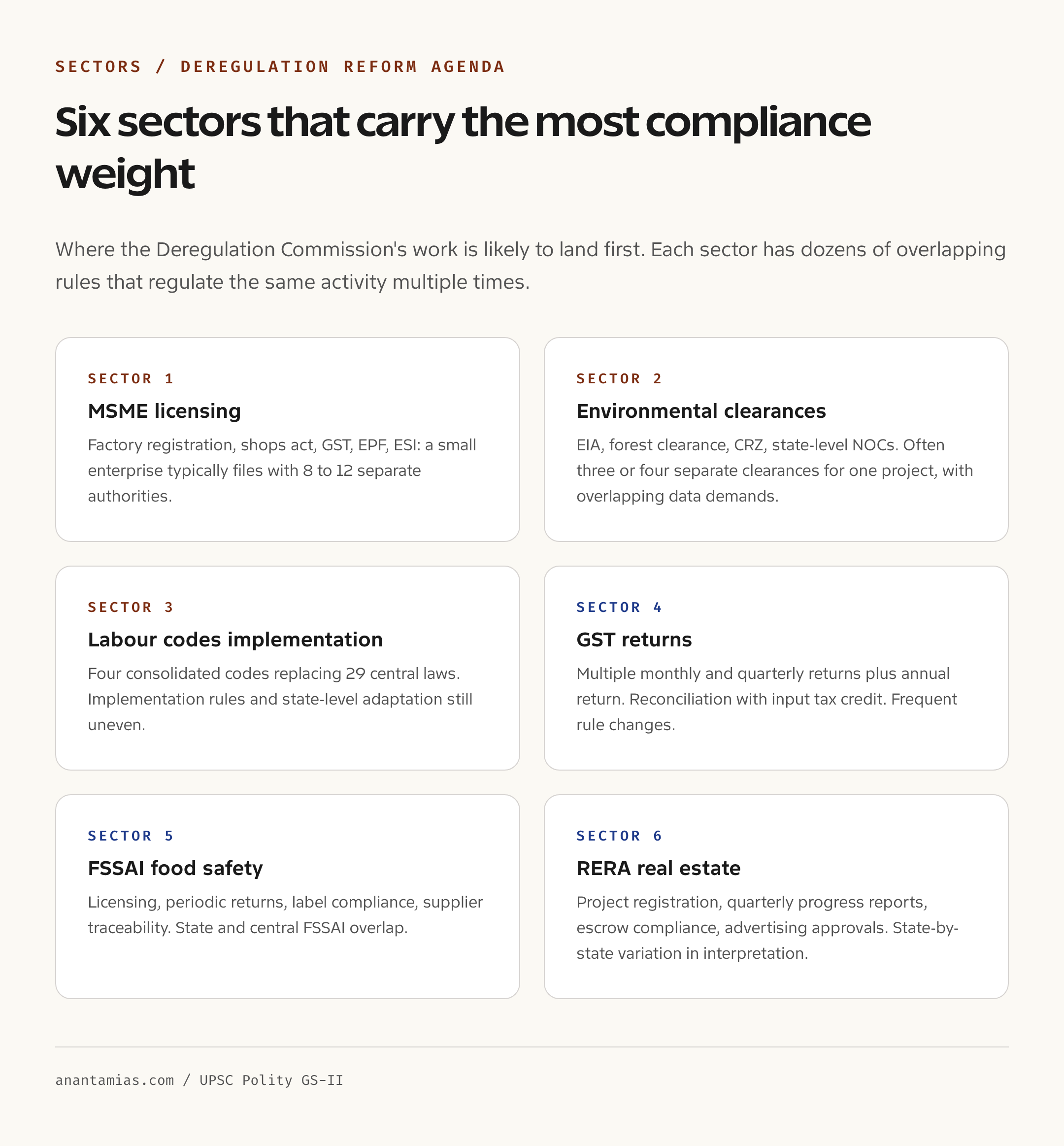
The Deregulation Commission faces five clear challenges. First, federalism. Many regulations that burden businesses are state-level, not central. Factory licences, shops and establishments registrations, GST state returns, building approvals, and environmental clearances often involve state and municipal authorities. The Commission can recommend reforms but cannot implement them in state subjects without cooperation. Second, ministerial capture. Each central ministry has its own regulatory turf. Persuading the Ministry of Environment to part with environmental clearance overheads, or the Ministry of Labour to consolidate compliance forms, will require sustained political will at the top.
Third, the trade-off between deregulation and protection. Some regulations exist for genuine public interest reasons: worker safety, environmental protection, consumer rights. The Commission must distinguish redundant rules from protective ones, and resist pressure to repeal protective rules in the name of ease of doing business. Fourth, implementation drift. Repealing a law on paper does not automatically end the practice on the ground. Inspector behaviour, citizen awareness, and digital infrastructure all need to keep pace. Fifth, evaluation. The Commission will need to publish measurable outcomes, including reductions in compliance time, cost savings, and reduction in regulatory disputes, otherwise its work will be perceived as cosmetic.
Prelims Pointers
The Deregulation Commission is a proposed standing body to recommend repeal or amendment of outdated regulations. The regulatory guillotine is the principal tool: a fast-track review process repealing rules that fail a structured filter. The Jan Vishwas (Amendment of Provisions) Act, 2023 is the most direct legislative ancestor, decriminalising more than 180 minor offences across 42 central Acts. Sunset clauses are statutory provisions fixing an automatic expiry date for a law unless Parliament renews it. The Ramanujam Committee in 2014 identified 1,741 obsolete laws for repeal, leading to the Repealing and Amending Acts of 2015 and 2016. The Law Commission focuses on substantive legal reform; the Deregulation Commission, on procedural and regulatory reform. The phrase “compliance cholesterol” describes the accumulated layer of redundant rules that burden businesses. The policy slogan associated with the Commission is “Minimum Government, Maximum Governance.”
Mains Practice Questions
What is the Deregulation Commission, and how does it relate to the broader agenda of regulatory reform in India? Discuss its key functions and the tools it is expected to deploy. (15 marks, 250 words)
Differentiate between the Law Commission of India and the proposed Deregulation Commission. Examine how both bodies can complement each other in the reform of Indian law. (10 marks, 150 words)
The regulatory cholesterol on Indian businesses is an obstacle to economic growth. Critically evaluate the case for a permanent institutional mechanism for deregulation, and discuss the federal challenges in such reform. (15 marks, 250 words)
Way Forward
The Deregulation Commission has the potential to be a quietly transformational institution, but only if its design respects three principles. First, permanence. A standing body with continuous remit will outperform a series of one-off committees. The Commission must be set up by statute, not merely by executive order, with secure funding and protected tenure for its members. Second, transparency. Every guillotine review must be open to public consultation, with the underlying cost-benefit analysis published. Industry capture is a real risk; transparent process is the antidote.
Third, federal cooperation. The Centre cannot deregulate state and municipal turf alone. The Commission’s design should include a mechanism for state-level partnership, perhaps modelled on the GST Council, that gives states an active role in joint review of overlapping regulations. NITI Aayog’s existing platforms for centre-state cooperation could anchor this work, building on the architecture already in place under the NITI Aayog framework.
If these design choices are made, the Deregulation Commission can become an enduring fixture of Indian governance, comparable in importance to the Reserve Bank or the Election Commission, and a durable answer to the compliance burden that has long held Indian enterprise back.
Frequently Asked Questions
What is the Deregulation Commission of India?
The Deregulation Commission is a proposed standing body whose mandate is to systematically identify, review, and recommend the repeal or amendment of outdated, redundant, and overlapping laws and regulations. Its purpose is to reduce the compliance burden on businesses and citizens and to promote the policy of “Minimum Government, Maximum Governance.”
What is a regulatory guillotine?
A regulatory guillotine is a fast-track review process in which every regulation in a given sector is examined within a fixed window. Each regulation is tested against three filters: legality, necessity, and proportionality. Regulations that fail any filter are repealed automatically through an omnibus repeal Act.
How does the Jan Vishwas Act 2023 relate to the Deregulation Commission?
The Jan Vishwas (Amendment of Provisions) Act, 2023 is the most direct legislative ancestor of the Deregulation Commission. It decriminalised more than 180 minor procedural offences across 42 central Acts, replacing imprisonment penalties with civil fines. The Commission is intended to extend this approach into a permanent institutional framework.
What is a sunset clause?
A sunset clause is a provision in a statute that sets an automatic expiry date for a law or for specific provisions. Without legislative action to renew, the law lapses on that date. Sunset clauses force periodic review and prevent the accumulation of obsolete legislation.
How is the Deregulation Commission different from the Law Commission?
The Law Commission focuses on substantive legal reform: what the law should say on subjects like marriage, succession, criminal justice, and constitutional questions. The Deregulation Commission focuses on procedural and regulatory reform: how compliance with the law works in practice, including form simplification, cost reduction, and decriminalisation of minor offences.
Will the Deregulation Commission cover state-level regulations?
The Commission’s direct authority will extend to central regulations. State-level regulations require state cooperation, since they cannot be repealed unilaterally by the Centre. The Commission is expected to recommend reforms and work with state governments through cooperative federalism, similar to the model used by the GST Council and other intergovernmental forums.
What is meant by compliance cholesterol?
“Compliance cholesterol” is the metaphor for the accumulated layer of redundant, overlapping, and outdated regulations that burden businesses and citizens with paperwork, inspections, and procedural costs without delivering proportionate public benefit. The Deregulation Commission’s work is aimed at reducing this layer.
What are the main risks to the success of the Deregulation Commission?
The principal risks are ministerial capture by central departments protecting regulatory turf, federalism gaps that limit Commission authority over state regulations, the difficulty of distinguishing protective from redundant regulation, and implementation drift where laws are repealed on paper but practices continue on the ground. Transparent process and measurable outcomes are essential to mitigate these risks.
Tell Google you want more of this.
Add Anantam IAS as a preferred sourceOne tap, and this site shows up more often in your own Top Stories, AI Overviews and AI Mode. Remove it any time.