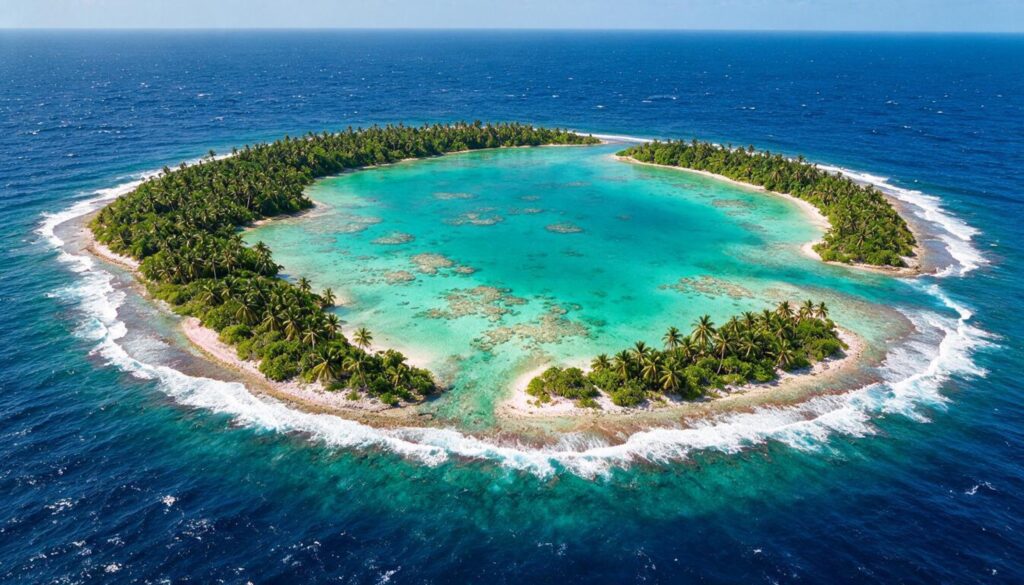
A single coral atoll, barely 30 square kilometres of land, sits almost exactly in the middle of the Indian Ocean and quietly shapes the security of a quarter of the planet. That atoll is Diego Garcia, home to one of the most important American military bases outside the United States. The confusion most aspirants carry is that they cannot say who actually owns it. Is it British? American? Mauritian? The honest answer, for sixty years, has been “it depends who you ask,” and that ambiguity is exactly what the story is about. Get the ownership question straight and the geography, the law, and the great-power stakes all fall into place.
Where Diego Garcia sits, and why the map decides everything
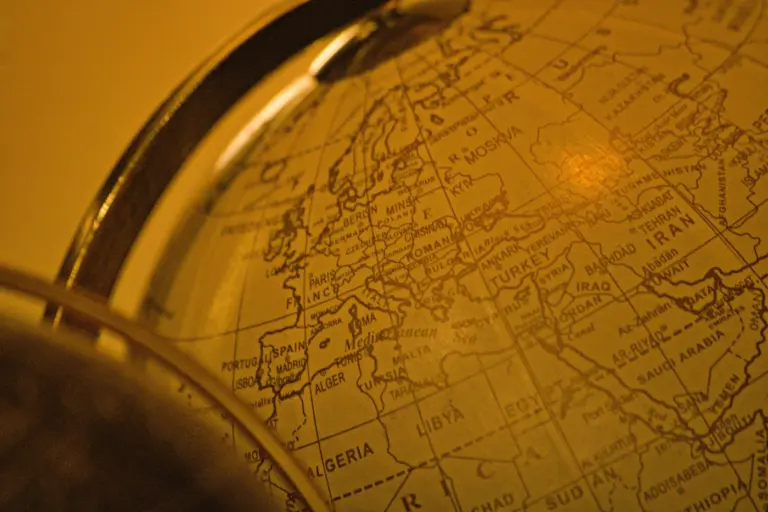
Diego Garcia is the largest island of the Chagos Archipelago, a cluster of seven atolls and more than sixty small islands roughly 500 kilometres south of the Maldives, at about 7 degrees south of the equator. Picture the Indian Ocean as a room, and Diego Garcia as the light switch in the exact centre of it. From that one point, aircraft and warships can reach the Persian Gulf, the Strait of Malacca, and the coast of East Africa without needing anyone else’s permission to refuel or land.
That central location is the whole reason the island matters. It gives a resident power what strategists call “reach”: the ability to project force across the Indian Ocean region without depending on a nervous host government nearby. Analysts sometimes call Diego Garcia an “unsinkable aircraft carrier,” and the phrase is exact, because a carrier can be sunk or sent home but an island cannot. B-52 and B-2 bombers have flown missions to Afghanistan and Iraq from Diego Garcia. The lagoon is deep enough to pre-position ships loaded with tanks, fuel and ammunition so that an American force arriving in a crisis finds its heavy equipment already waiting. There is no substitute anywhere in the ocean for a base this isolated and this central, which is why so much diplomatic energy has gone into keeping it.
What sits on the island is worth picturing, because it explains the value. Diego Garcia carries a long military runway able to take heavy bombers and transport aircraft, a sheltered anchorage for a squadron of pre-positioning ships, fuel farms, and communications and space-tracking facilities, including a ground station that helps run the American GPS satellite network and sensors that watch objects in orbit. In other words, the island is not just a parking spot for ships and planes; it is a node in the systems that make modern militaries work. Take it away and a superpower loses a chunk of its ability to see and reach across half the globe.
The isolation cuts both ways. The nearest large population centre is far away, the island has no native civilian economy, and everything, from drinking water to jet fuel, is shipped or flown in. This is a base, not a country. And that engineered emptiness is not an accident of nature. It was manufactured, and the way it was manufactured is where the trouble starts.
How a British territory ended up in the middle of the ocean
The short version: Britain carved Chagos out of a colony that was about to become independent, then leased the biggest island to the United States for a base. In 1965, while Mauritius was negotiating its independence from British rule, the United Kingdom detached the Chagos Archipelago (along with some islands later returned to Seychelles) and created a new colony called the British Indian Ocean Territory, or BIOT. Mauritius, still a colony and in no position to refuse, agreed to the separation in exchange for a payment and other concessions. It became independent in 1968 without Chagos.
Under international law this is the load-bearing problem. A United Nations principle from the decolonisation era holds that a colony’s territory should not be broken up before independence. By splitting Chagos away first, Britain arguably violated that principle, and Mauritius has argued exactly that ever since. Delhi has consistently backed the Mauritian reading, framing it as an unfinished piece of decolonisation rather than a mere real-estate dispute.
Having created BIOT, Britain then signed a 1966 agreement with the United States allowing US forces to use the islands for defence purposes. The arrangement ran for 50 years, until 2016, with an option to extend by 20 years to 2036, and that option was taken. Construction of the base on Diego Garcia began in the early 1970s. Britain kept legal title; America built and ran the facility and paid, in part, through a discount on the Polaris nuclear missile system. It was a colonial handover dressed as a lease, and it required one more step that the maps never show.
The Chagossians: the people the base displaced
To build an “unsinkable aircraft carrier,” the islands had to be emptied of their inhabitants, and they were. Between roughly 1967 and 1973, Britain forcibly removed the entire population of the Chagos Islands, a Creole-speaking community descended largely from enslaved and indentured labourers brought to work the coconut plantations. They are known as the Chagossians, or Ilois. Estimates of the number expelled range from around 1,500 to 2,000 people. They were deported mainly to Mauritius and Seychelles, given little or no resettlement support, and left to sink into poverty in the slums of Port Louis.
The detail that tends to stay with students is the killing of the islanders’ pet dogs, gassed and burned to signal that return was impossible, a moment of official cruelty that later featured in British court cases. Their exile is the human centre of the whole affair. Any account of Diego Garcia that treats it purely as a basing arrangement misses the fact that a base was built on a cleared island in a way a court would later call unlawful.
The Chagossians did not go quietly, and the legal fight they waged is worth knowing in outline. Led by activists such as Olivier Bancoult, they won a ruling in the British High Court in 2000 that their removal had been unlawful. The government’s response was to use royal prerogative powers, the Orders in Council of 2004, to bar return anyway, and in 2008 the House of Lords upheld that ban. Then, in 2010, Britain declared a vast Marine Protected Area around Chagos, one of the world’s largest no-take marine reserves. It looked like conservation, but a leaked US diplomatic cable suggested a quieter purpose, to make resettlement of the islanders effectively impossible. In 2015 the Permanent Court of Arbitration, hearing a case Mauritius brought under the Law of the Sea Convention, ruled that Britain had created the reserve in breach of international law. Each defeat for the islanders in a domestic court was slowly matched by a defeat for Britain in an international one, and the pattern set the stage for the decisive ruling.
This is where the story stops being a Cold War footnote and becomes live international law.
What the ICJ said in 2019, and why it carried weight
In February 2019, the International Court of Justice, the principal judicial organ of the United Nations, delivered an advisory opinion that went firmly against Britain. Mauritius had persuaded the UN General Assembly to ask the court a legal question: had the decolonisation of Mauritius been lawfully completed when Chagos was detached in 1965? The court’s answer, by a vote of 13 to 1, was no. It found that the separation of the archipelago had not been based on the free and genuine will of the Mauritian people, that Britain’s continued administration was therefore a wrongful act, and that the UK was obliged to end it “as rapidly as possible.”
Two things about that opinion trip people up, so pin them down now. First, it was an advisory opinion, not a binding judgment in a contentious case, so it did not by itself force Britain to hand anything over. Second, it still mattered enormously, because it stripped away Britain’s claim to legal legitimacy and gave Mauritius a powerful moral and diplomatic weapon. Three months later, in May 2019, the UN General Assembly endorsed the opinion by 116 votes to 6, demanding Britain withdraw within six months. Britain ignored the deadline, but the vote showed how isolated its position had become. A body that started as a court’s opinion had turned into an international consensus, and consensus of that size eventually reshapes policy.
The UK-Mauritius agreement, explained
After the ICJ opinion and years of pressure, Britain agreed in principle to hand sovereignty of the Chagos Archipelago to Mauritius while keeping the base, and the two sides signed a treaty on 22 May 2025. The framework had first been announced in October 2024. Under the deal, Mauritius gains sovereignty over the whole archipelago, but the United Kingdom (and through it the United States) retains operational control of the Diego Garcia base under a lease.
The headline terms are worth memorising because they show how the sovereignty question was squared with the security one:
| Element | What the 2025 treaty provides |
|---|---|
| Sovereignty | Transfers to Mauritius over the entire Chagos Archipelago, including Diego Garcia |
| Base lease | UK retains Diego Garcia for an initial 99 years, extendable by a further 40 years if both sides agree |
| Total payment | Around £3.4 billion from the UK to Mauritius over the 99 years, in 2025/26 prices |
| Development grant | About £45 million a year for 25 years for Mauritian development |
| Chagossian fund | A trust fund of roughly £40 million for the benefit of Chagossians |
| Security guarantees | Buffer zone around Diego Garcia; restrictions on foreign forces on the other islands |
Here is the part the headlines often skip: as of mid-2026 the treaty has been signed but not yet ratified, and so it has not entered into force. In Britain, enabling legislation (the Diego Garcia Military Base and British Indian Ocean Territory Bill) stalled in Parliament, held up by opposition politics, cost arguments, and public criticism from the United States. The American angle matters because the base is used by US forces, so Washington’s comfort with the arrangement was always a precondition, and doubts voiced from the US side gave British opponents of the deal fresh ammunition. So the legal ownership of Diego Garcia is, at the time of writing, still formally British, with sovereignty scheduled to pass to Mauritius only once ratification is complete. Treat any statement that Mauritius “now owns” Chagos with care: the deal is agreed on paper, but the switch has not yet been flipped.
Where India stands, and why the base matters to Delhi
India welcomed the UK-Mauritius deal and has long supported Mauritius on Chagos, and the reasons are both principled and strategic. When the treaty was signed, the Ministry of External Affairs described it as a milestone that completed the decolonisation of Mauritius and called it a positive development for the region. That fits a consistent Indian line: support for sovereignty, territorial integrity, and the unwinding of colonial-era carve-ups, the same principle Delhi invokes on its own territorial questions.
There is hard interest underneath the principle. Mauritius is one of India’s closest partners in the western Indian Ocean, with deep diaspora, economic and security ties, part of the wider Indian diaspora presence in Africa. A Chagos under Mauritian sovereignty is, in effect, a Chagos in the hands of a friendly state rather than a lingering colonial anomaly. Delhi also runs its own maritime outreach across these waters, from coastal-security cooperation to development projects, and a stable, sovereignty-respecting settlement strengthens the rules-based order India wants in the region. You can see the same logic in India’s broader Indian Ocean diplomacy and in its investments in access points like Chabahar Port on the Iranian coast, which sit alongside its wider relationship with Iran.
At the same time, Delhi is realistic about the American base. A US presence at Diego Garcia is not something India opposes: a capable, status-quo naval power in the central Indian Ocean helps balance China’s growing footprint. Over the past two decades China has built its first overseas military base at Djibouti, taken a 99-year lease on Hambantota port in Sri Lanka, and invested in harbours from Pakistan to Myanmar, a spread that Indian strategists have long watched warily as a potential “string of pearls” around the subcontinent. Against that backdrop, a friendly base anchoring the ocean’s centre is more reassuring to Delhi than threatening. India’s own stake is in keeping these sea lanes open and stable, the same interest that drives its investment in the maritime sector and its role in disaster response, as after the 2004 Indian Ocean tsunami. The comfortable Indian position, then, is a Chagos that is legally Mauritian, strategically stable, and open to friendly navies. The 2025 treaty, if ratified, delivers roughly that.
How to study Diego Garcia for the exam
Anchor this topic to four dates and one distinction, and you can answer almost anything asked about it. The four dates are 1965 (Chagos detached, BIOT created), 1966 (UK-US base agreement), 2019 (ICJ advisory opinion and UN General Assembly resolution), and 2025 (UK-Mauritius sovereignty treaty signed). The one distinction is advisory opinion versus binding judgment: the ICJ’s 2019 opinion was advisory, which is why it shaped the politics without forcing an immediate handover. If a question hinges on why Britain could ignore the court, that distinction is the answer.
For prelims, expect factual hooks: the location relative to the Maldives, the fact that Diego Garcia hosts a US base on British territory, the number of atolls, and the identity of the Chagossians. For mains, the richer angles are decolonisation and self-determination, the tension between international law and great-power security, and India’s Indian Ocean strategy. A strong answer links the legal story (ICJ, UN principles on non-fragmentation of colonies) to the strategic one (why the base exists, why India is comfortable with it) rather than treating them separately.
Keep your facts current on one point above all: the treaty’s ratification status. This is genuinely time-bound, and it has moved slowly. Before an exam, confirm whether the UK has completed ratification and the sovereignty transfer has taken legal effect, because that single fact decides whether you write “Mauritius has gained sovereignty” or “Mauritius is set to gain sovereignty.” Getting the tense right is the mark of an aspirant who reads the news rather than an old note.
Frequently Asked Questions
Who owns Diego Garcia right now?
Legally, Diego Garcia is still part of the British Indian Ocean Territory as of mid-2026, because the 2025 UK-Mauritius treaty transferring sovereignty has been signed but not yet ratified. Once ratification is complete, sovereignty over the whole Chagos Archipelago passes to Mauritius, while the United Kingdom keeps the Diego Garcia base under a 99-year lease.
Why is there a US military base on British territory?
Britain detached Chagos from Mauritius in 1965 to create the British Indian Ocean Territory, then signed a 1966 agreement letting the United States use the islands for defence. The US built and operates the base; Britain has held the legal title. It is a British territory hosting an American facility.
What did the International Court of Justice decide in 2019?
In an advisory opinion in February 2019, the ICJ found by 13 votes to 1 that Britain’s separation of Chagos in 1965 was unlawful and that its continued administration should end as rapidly as possible. Because it was an advisory opinion rather than a binding judgment, it did not by itself force a handover, but it isolated Britain diplomatically.
Who are the Chagossians and what happened to them?
The Chagossians, or Ilois, are the islands’ original Creole-speaking inhabitants. Between about 1967 and 1973 Britain forcibly removed all of them, an estimated 1,500 to 2,000 people, mainly to Mauritius and Seychelles, to clear the way for the base. They have fought for decades, mostly unsuccessfully, for the right to return.
What are the key terms of the UK-Mauritius deal?
Mauritius gains sovereignty over the archipelago; the UK keeps Diego Garcia on an initial 99-year lease, extendable by 40 years. Britain pays around £3.4 billion over the lease in 2025/26 prices, including roughly £45 million a year for 25 years for Mauritian development and a trust fund of about £40 million for Chagossians.
What is India’s position on Chagos?
India welcomed the deal and has consistently supported Mauritius, framing the issue as completing Mauritian decolonisation and respecting sovereignty and territorial integrity. Delhi is also comfortable with a continued US base at Diego Garcia, seeing a stable balance of naval power as good for open Indian Ocean sea lanes.
Why is Diego Garcia so strategically important?
Its position near the centre of the Indian Ocean lets aircraft and ships reach the Persian Gulf, Southeast Asia and East Africa without depending on a nearby host government. The deep lagoon allows pre-positioning of heavy equipment, making the island a launch pad for operations across a huge area.
Practice Questions
1. The British Indian Ocean Territory (BIOT), which includes Diego Garcia, was created by detaching the Chagos Archipelago from which colony?
a) Seychelles
b) Maldives
c) Mauritius
d) Sri Lanka
Answer: c) Mauritius
2. The 2019 International Court of Justice ruling on the Chagos Archipelago was in the form of:
a) A binding judgment in a contentious case
b) An advisory opinion
c) A provisional measures order
d) An arbitral award
Answer: b) An advisory opinion
3. Diego Garcia is located closest to which of the following island groups?
a) Andaman and Nicobar Islands
b) Lakshadweep
c) Seychelles
d) Maldives
Answer: d) Maldives
4. Under the UK-Mauritius agreement signed in 2025, the United Kingdom retains the Diego Garcia base under a lease of an initial:
a) 25 years
b) 50 years
c) 99 years
d) 150 years
Answer: c) 99 years
5. Consider the following statements about the Chagos issue and choose the correct option:
- India has supported Mauritius’s claim over the Chagos Archipelago.
- The Chagossians were resettled mainly in Mauritius and Seychelles after being removed.
a) 1 only
b) 2 only
c) Both 1 and 2
d) Neither 1 nor 2
Answer: c) Both 1 and 2
Mains-style questions
- “The Chagos dispute shows that international law can shape great-power behaviour without commanding it.” Discuss with reference to the 2019 ICJ advisory opinion and the 2025 UK-Mauritius agreement.
- Examine the strategic significance of Diego Garcia for the balance of power in the Indian Ocean region.
- Trace the process by which the British Indian Ocean Territory was created and explain why it is described as an incomplete act of decolonisation.
- Evaluate India’s position on the Chagos Archipelago in the context of its wider Indian Ocean policy.
- “Security imperatives and human rights obligations often pull in opposite directions.” Analyse this tension using the case of the Chagossians and Diego Garcia.
The lasting lesson of Diego Garcia is not that a small island can matter to big powers, though it does. It is that a legal wrong and a strategic asset can sit on the same square kilometre for sixty years, and that unwinding one without losing the other takes decades of patient diplomacy. Mauritius has won the argument in law and, on paper, in sovereignty; the base survives; the Chagossians are still largely in exile. For an aspirant, the value of the case is precisely that it refuses to resolve into a simple moral. Hold the geography, the four dates, and the advisory-versus-binding distinction in your head, keep the ratification status current, and you will read the next headline about Chagos with understanding rather than confusion.
Tell Google you want more of this.
Add Anantam IAS as a preferred sourceOne tap, and this site shows up more often in your own Top Stories, AI Overviews and AI Mode. Remove it any time.