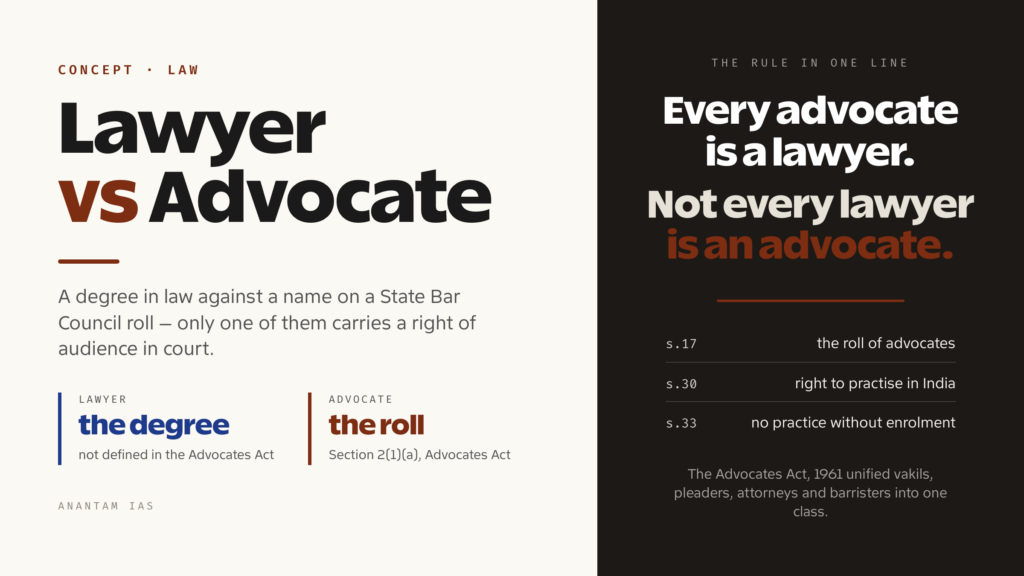
A lawyer is anyone qualified in law — typically a person holding an LLB or an integrated five-year law degree. An advocate is a lawyer who has gone one step further and had their name entered on the roll of a State Bar Council under the Advocates Act, 1961, which is what confers the right to appear and plead before courts. Every advocate is a lawyer; not every lawyer is an advocate.
In ordinary conversation the two words are used interchangeably, and outside India the usage differs again. But in Indian law the difference is statutory, not stylistic. “Advocate” is a defined term with a defined roll behind it, while “lawyer” appears nowhere in the Advocates Act at all. The gap between the two words is the gap between holding a degree and holding a licence.
Defining Each Term
Lawyer is a descriptive, non-statutory word. It covers anyone trained in law — a fresh graduate who has not enrolled anywhere, a legal researcher, an in-house counsel, a law teacher, a policy analyst drafting legislation. All of them work in law and none of them necessarily has the right to walk into a courtroom and argue a case. The Advocates Act does not define the term, does not regulate it, and attaches no privileges to it.
Advocate is defined in Section 2(1)(a) of the Advocates Act, 1961 as an advocate entered in any roll under the provisions of the Act. That definition is circular on purpose: the status comes entirely from the roll. Section 17 requires every State Bar Council to prepare and maintain a roll of advocates, and Section 24 sets out who may be admitted to it — an Indian citizen (with a reciprocity proviso for certain foreign nationals), at least 21 years old, holding a law degree that satisfies the conditions the section lays down, and paying the prescribed enrolment fee.
The Act was passed on the recommendations of the All India Bar Committee and the Law Commission’s fourteenth report, and its central achievement was to unify a fragmented profession. Before 1961, India had vakils, pleaders, mukhtars, attorneys, barristers and revenue agents, each with different rights before different courts. The Act swept those into a single class — advocates — recognising only one further distinction, in Section 16: senior advocates and other advocates.
Two provisions do the real work. Section 30 gives every advocate on a State roll the right to practise throughout India in all courts including the Supreme Court, before any tribunal or person legally authorised to take evidence, and before any other authority where an advocate is entitled to practise. That section sat unnotified for fifty years and was brought into force by the central government only on 15 June 2011. Section 33 closes the door from the other side: no person may practise in any court or before any authority unless enrolled as an advocate under the Act. Section 45 backs this up with a criminal sanction — practising where you are not entitled to may attract imprisonment of up to six months.
The Key Differences at a Glance
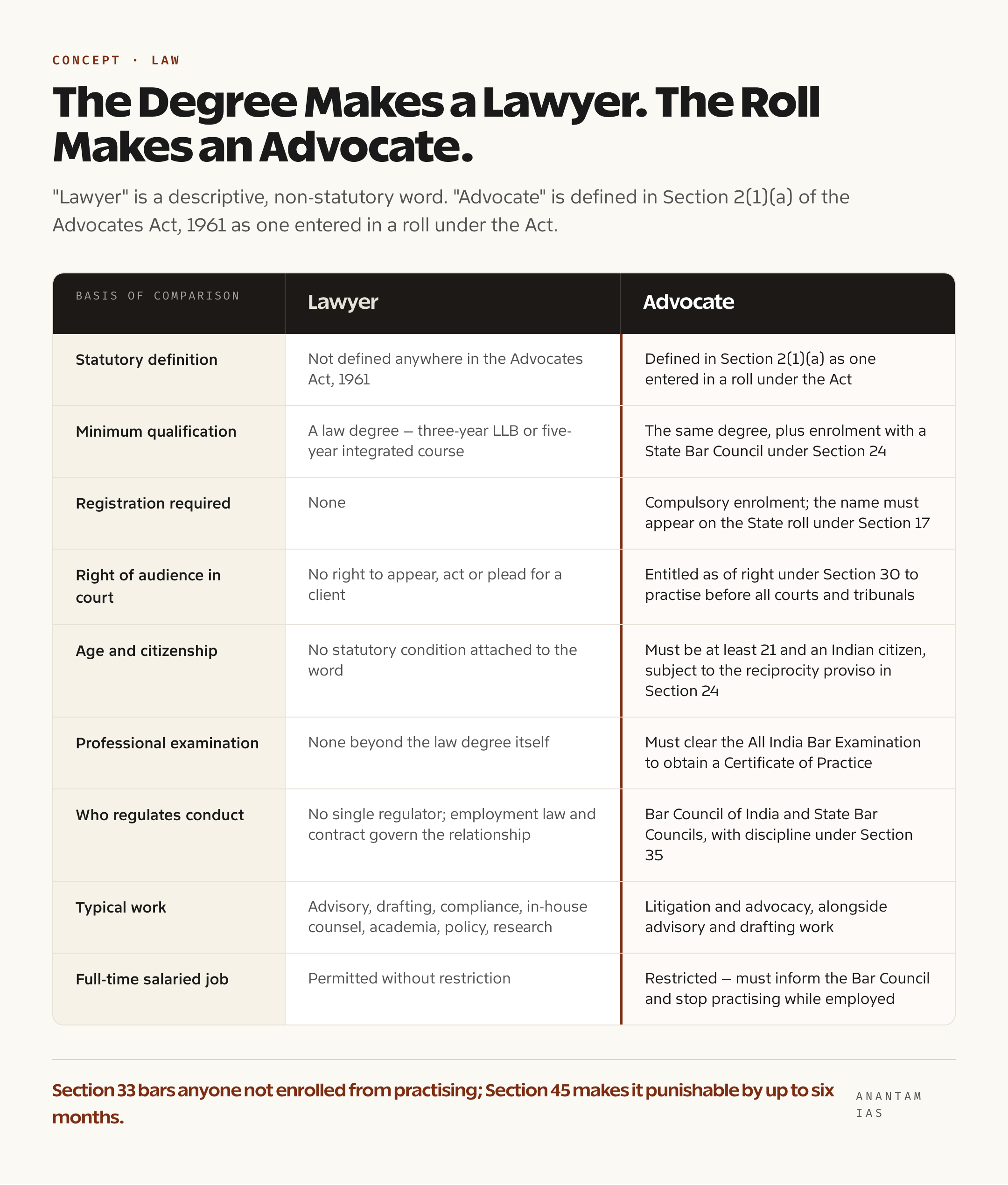
| Basis of Comparison | Lawyer | Advocate |
|---|---|---|
| Statutory definition | Not defined anywhere in the Advocates Act, 1961 | Defined in Section 2(1)(a) as one entered in a roll under the Act |
| Minimum qualification | A law degree — three-year LLB or five-year integrated course | The same degree, plus enrolment with a State Bar Council under Section 24 |
| Registration required | None | Compulsory enrolment; the name must appear on the State roll under Section 17 |
| Right of audience in court | No right to appear, act or plead for a client | Entitled as of right under Section 30 to practise before all courts and tribunals |
| Age and citizenship condition | No statutory condition attached to the word | Must be at least 21 and an Indian citizen, subject to the reciprocity proviso in Section 24 |
| Professional examination | None beyond the law degree itself | Must clear the All India Bar Examination to obtain a Certificate of Practice |
| Who regulates conduct | No single regulator; employment law and contract govern the relationship | Bar Council of India and State Bar Councils, with discipline under Section 35 |
| Consequence of misconduct | Ordinary employment or civil consequences | Reprimand, suspension from practice, or removal from the roll |
| Typical work | Advisory, drafting, compliance, in-house counsel, academia, policy, research | Litigation and advocacy, alongside advisory and drafting work |
| Client relationship | Usually an employee or consultant | A professional bound by a vakalatnama and by the Bar Council’s rules on conduct |
| Full-time salaried employment | Permitted without restriction | Restricted — an advocate taking full-time salaried employment must inform the Bar Council and stop practising while employed |
| Common usage abroad | The general term in most jurisdictions, including the United States | The specific term in India and in several civil-law and Commonwealth systems |
How a Law Graduate Becomes an Advocate
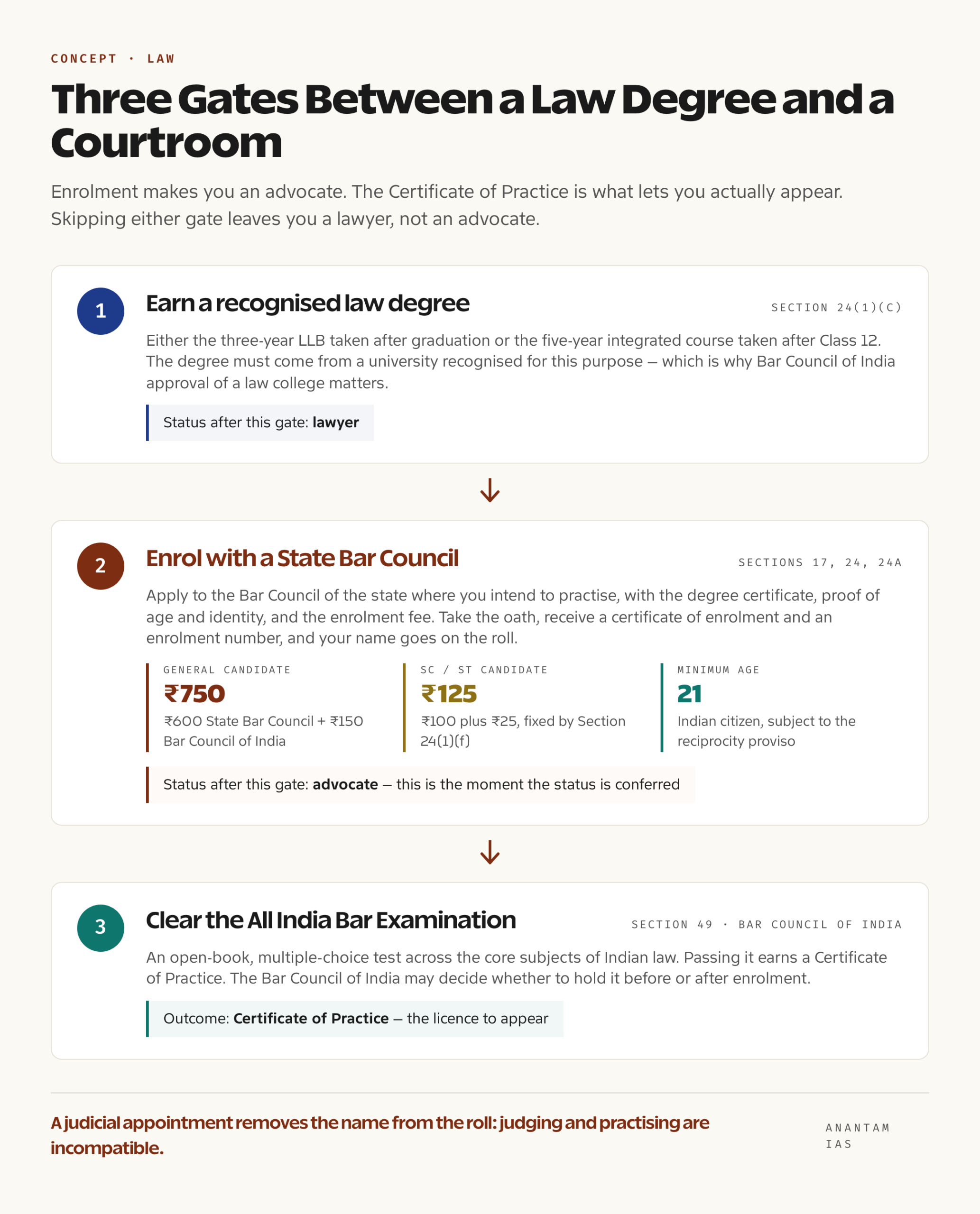
The route from degree to courtroom runs through three gates, and skipping any of them leaves you a lawyer rather than an advocate.
1. Earn a recognised law degree. Either the three-year LLB taken after graduation or the five-year integrated course taken after Class 12. Section 24(1)(c) is specific that the degree must come from a university recognised for this purpose, which is why Bar Council of India approval of a law college matters so much to its students.
2. Enrol with a State Bar Council. The application goes to the Bar Council of the state where you intend to practise, with the degree certificate, proof of age and identity, and the enrolment fee. Section 24(1)(f) fixes that fee at ₹600 for the State Bar Council and ₹150 for the Bar Council of India — ₹750 in all for general candidates, and ₹100 plus ₹25 for Scheduled Caste and Scheduled Tribe candidates. State Bar Councils had for years charged tens of thousands of rupees on top, and in Gaurav Kumar v. Union of India, decided on 30 July 2024, the Supreme Court held they have no power to demand more than the statutory figure, though it made the ruling prospective. Section 24A separately disqualifies anyone convicted of an offence involving moral turpitude, with the bar lifting two years after release.
Once enrolled, you take the oath, receive a certificate of enrolment and an enrolment number, and your name goes on the roll. This is the moment you become an advocate in law.
3. Clear the All India Bar Examination. The Bar Council of India introduced the AIBE in 2010 under its rule-making power in Section 49, and the first examination was held in March 2011. It is an open-book, multiple-choice test across the core subjects of Indian law, and passing it earns a Certificate of Practice. A five-judge bench of the Supreme Court settled the long-running challenge to it in Bar Council of India v. Bonnie Foi Law College, decided on 10 February 2023, upholding the Council’s authority to require such an examination and leaving it to decide whether to hold it before or after enrolment.
Enrolment and the AIBE do different jobs, which is where most of the confusion sits. Enrolment makes you an advocate. The Certificate of Practice is what lets you actually appear.
What Lawyers Who Are Not Advocates Actually Do
A large share of India’s legal workforce never appears in court, and that is a deliberate career choice rather than a failure to qualify.
In-house counsel sit inside companies, banks and public sector undertakings, handling contracts, regulatory filings and disputes strategy. Rule 49 of Part VI, Chapter II of the Bar Council of India Rules says an advocate shall not be a full-time salaried employee of any person, government, firm, corporation or concern, and that on taking such employment they must inform the State Bar Council and cease to practise for as long as it lasts. So most in-house counsel either never enrol, or enrol and then suspend the licence.
Academics, researchers and compliance officers teach in law schools, staff commissions and think tanks, or run regulatory compliance inside banks and insurers. The work is legal in substance and never touches a courtroom, and many in this group never enrol.
Judicial officers occupy a separate category. On appointment to the bench, an advocate’s name is removed from the roll, because judging and practising are incompatible. A judge is emphatically a lawyer and just as emphatically not a practising advocate.
Government legal officers in ministries draft legislation, vet contracts and give opinions. When the state needs someone to argue in court, it appoints a public prosecutor or a government pleader — and those appointees must be advocates.
Barrister, Solicitor, Senior Advocate and Advocate-on-Record
Four more titles surround this question, and each means something specific.
Barrister has no legal meaning in India. It refers to a person called to the Bar in England and Wales through one of the four Inns of Court. In colonial India, barristers enjoyed privileged rights of audience; the Advocates Act ended that. Someone who trained as a barrister in London and wants to practise here must still enrol with a State Bar Council. The word survives as a courtesy title, not a qualification.
Solicitor is likewise not a category the Advocates Act recognises. Britain’s split profession — solicitors who instruct, barristers who plead — was never adopted at independence, and India runs a fused profession where the same advocate advises, drafts and argues. One remnant persists: the Bombay Incorporated Law Society still conducts a Solicitors’ examination. It is a voluntary additional qualification, not a licence to practise, which still comes from the Bar Council roll.
Senior Advocate is the one internal distinction the Act permits. Under Section 16(2), the Supreme Court or a High Court may designate an advocate as senior, with their consent, if by virtue of ability, standing at the Bar or special knowledge or experience in law the advocate deserves the distinction. The status brings restrictions as well as prestige: a senior advocate may not file a vakalatnama, accept a brief directly from a client, or appear without an instructing advocate. The selection process has been contested repeatedly — the Supreme Court’s Indira Jaising rulings of 2017 and 2023 built a points-based assessment system, and a three-judge bench in Jitender @ Kalla v. State (NCT of Delhi) discarded it on 13 May 2025 as unworkable, since when the Court has notified fresh guidelines restoring a consensus-based Full Court decision.
Advocate-on-Record is a Supreme Court-specific licence. Under Order IV of the Supreme Court Rules, 2013, only an AOR may file documents or act for a party before the Supreme Court. Qualifying means several years at the Bar, a year of training under an AOR of ten years’ standing, passing the AOR examination conducted by the Court, and keeping a registered office near it. Every AOR is an advocate; only a small fraction of advocates are AORs.
A fifth category has grown in importance. Foreign lawyers and foreign law firms may register with the Bar Council of India under rules first notified in 2023 and substantially revised in May 2025, but their permitted work is confined to non-litigious advisory and transactional matters in foreign and international law. The exclusive right of audience before Indian courts and tribunals stays with enrolled advocates.
Where Readers Get Confused
“An advocate is a more senior lawyer.” Seniority has nothing to do with it. A graduate enrolled last week is an advocate; a general counsel with thirty years of experience who never enrolled is not. The difference is registration, not standing.
“Passing the AIBE makes you an advocate.” Enrolment does. The AIBE gives you the Certificate of Practice, which is what permits you to appear. The sequence in practice is enrol first, then clear the examination.
“Attorney and advocate mean the same thing.” In American usage, attorney is the standard word for a licensed practitioner and is roughly equivalent to advocate. In Indian usage, attorney usually refers to someone holding a power of attorney, which involves no legal qualification at all. The Attorney General for India, appointed under Article 76 of the Constitution, is a distinct constitutional office.
“India has barristers and solicitors like England.” It does not. The profession here is fused, and the Advocates Act abolished the separate classes in 1961. The Bombay solicitors’ examination is the single surviving remnant, and it is optional.
“Anyone can represent a party in any forum.” Section 33 restricts practice before courts and authorities to advocates, and Section 45 makes unauthorised practice punishable by up to six months’ imprisonment. Some statutes carve out exceptions — chartered accountants and company secretaries appear before certain tribunals, and a party may argue their own case in person — but those are express exceptions, not a general licence.
FAQ
Q1. Is every advocate a lawyer? Yes. An advocate is a lawyer who has additionally been enrolled on a State Bar Council roll under the Advocates Act, 1961. The reverse does not hold — a law graduate who has not enrolled is a lawyer but not an advocate.
Q2. Can a lawyer who is not enrolled appear in court for a client? No. Section 33 of the Advocates Act permits only enrolled advocates to practise before courts and authorities, and Section 45 makes unauthorised practice punishable with imprisonment of up to six months. A party may still argue their own case in person.
Q3. What does the All India Bar Examination actually certify? It certifies competence to practise, and passing it yields a Certificate of Practice from the Bar Council of India. It is separate from enrolment, which is what confers the status of advocate in the first place.
Q4. How much can a State Bar Council charge for enrolment? Section 24(1)(f) fixes ₹600 for the State Bar Council and ₹150 for the Bar Council of India, and ₹100 plus ₹25 for Scheduled Caste and Scheduled Tribe candidates. In Gaurav Kumar v. Union of India, decided in July 2024, the Supreme Court held that Bar Councils cannot demand more than these statutory amounts.
Q5. Can an advocate work as a full-time salaried employee? Not while continuing to practise. Rule 49 of the Bar Council of India Rules requires an advocate who takes full-time salaried employment to inform the State Bar Council and stop practising for the duration. Many in-house counsel deal with this by suspending their enrolment and restoring it if they return to litigation.
Practice Questions
Practice MCQs
- Under which provision of the Advocates Act, 1961 is the term “advocate” defined? (a) Section 2(1)(a) (b) Section 16 (c) Section 24 (d) Section 30 — Answer: (a) Section 2(1)(a) defines an advocate as one entered in any roll under the provisions of the Act.
- Which section entitles an advocate whose name is on a State roll to practise throughout India, including before the Supreme Court? (a) Section 24 (b) Section 29 (c) Section 30 (d) Section 35 — Answer: (c) Section 30 confers the right to practise and was brought into force by notification in June 2011.
- Who may designate an advocate as a Senior Advocate under the Advocates Act, 1961? (a) The Bar Council of India (b) The State Bar Council (c) The Supreme Court or a High Court, with the advocate’s consent (d) The Ministry of Law and Justice — Answer: (c) Section 16(2) vests the power in the Supreme Court or a High Court, subject to the advocate’s consent.
- The All India Bar Examination is conducted by (a) the Supreme Court of India (b) the Bar Council of India (c) the National Law Universities consortium (d) the Ministry of Law and Justice — Answer: (b) The Bar Council of India introduced the AIBE in 2010 and awards the Certificate of Practice to those who clear it.
- Which statement about the legal profession in India is correct? (a) India follows the English division between barristers and solicitors (b) India has a fused profession with advocates as the only recognised class of practitioners (c) Only barristers may appear before High Courts (d) Solicitors alone may draft pleadings — Answer: (b) The Advocates Act, 1961 unified the earlier categories into a single class of advocates, recognising only senior advocates as a further distinction.
Tell Google you want more of this.
Add Anantam IAS as a preferred sourceOne tap, and this site shows up more often in your own Top Stories, AI Overviews and AI Mode. Remove it any time.