Imagine a country where the central bank cannot print a single note of its own money, where the interest rate is set by a foreign central bank thousands of kilometres away, and where citizens shop, save and borrow entirely in another nation’s currency. That is not a thought experiment. It is everyday reality in Ecuador, El Salvador and Panama, and it is the policy Argentina’s President Javier Milei rode to power promising to deliver.
This is dollarisation, and it sits at the heart of one of economics’ oldest trade-offs: stability bought at the price of sovereignty. For a GS III Economy aspirant, it’s a single concept that unlocks a whole cluster of ideas — money’s basic functions, monetary policy autonomy, seigniorage, the global reserve system, and the de-dollarisation debate now reshaping how countries trade. Get dollarisation right and you can speak confidently about all of them.
What Dollarisation Actually Means
Let’s define it cleanly. Dollarisation is when residents of a country use a foreign currency — almost always the US dollar — in place of, or alongside, their own currency to do the three jobs money does: act as a medium of exchange, a store of value, and a unit of account. The label is generic; a country that adopts the euro is “euroised,” but the principle is identical.
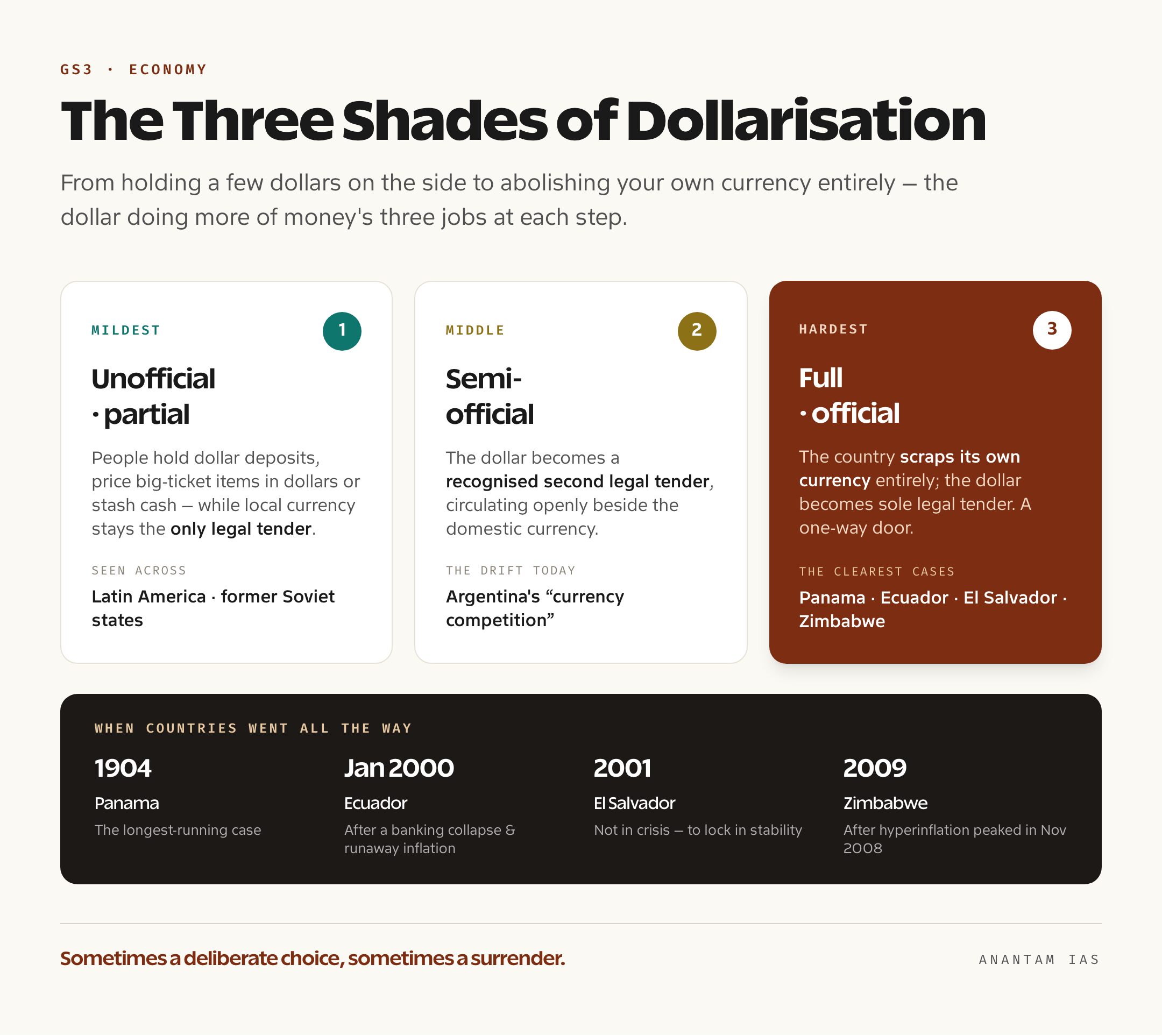
Economists sort it into three shades, and examiners reward candidates who keep them apart. Unofficial or partial dollarisation is the mildest: people hold dollar deposits, price big-ticket items in dollars, or stash dollars under the mattress, while the local currency stays the only legal tender. This is common across Latin America, parts of the former Soviet Union, and any economy where people have learned not to trust their own money. Semi-official dollarisation is when the dollar becomes a recognised second legal tender circulating beside the domestic currency. Full or official dollarisation is the hard version: the country scraps its own currency entirely and the foreign one becomes sole legal tender.
The cleanest examples of full dollarisation are instructive. Panama has used the US dollar since 1904, the longest-running case. Ecuador switched in January 2000 after a banking collapse and runaway inflation, and El Salvador followed in 2001 — not in crisis, but to lock in stability and attract investment. The starkest case is Zimbabwe: after hyperinflation peaked in November 2008 at a barely sayable rate, the government abandoned the Zimbabwe dollar in 2009 and let the US dollar and other currencies take over, which stopped the inflation almost overnight by removing the state’s power to print. So dollarisation is sometimes a deliberate choice and sometimes a surrender — a country reaching for a stable currency because its own has already died.
Why the Dollar Still Dominates
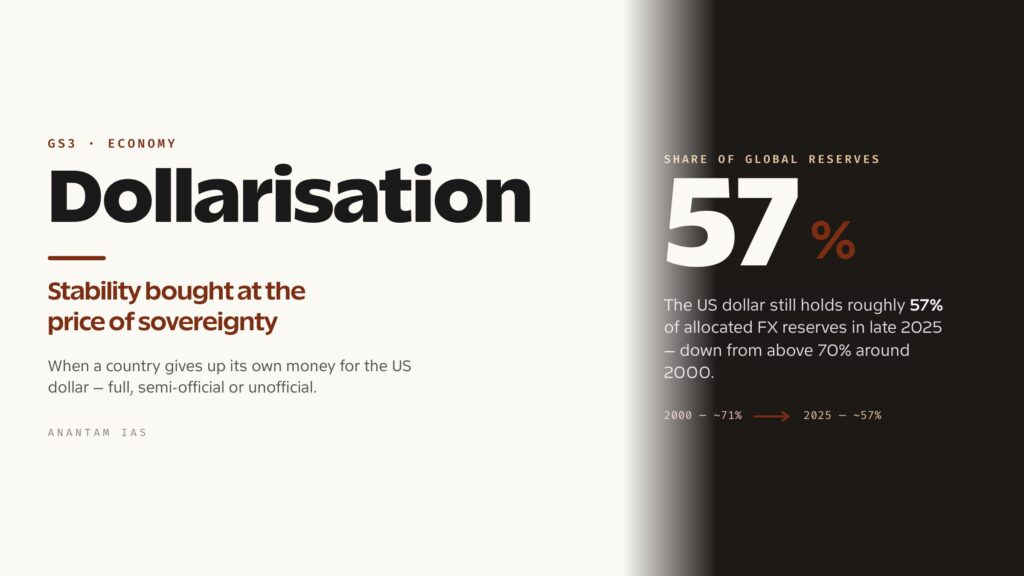
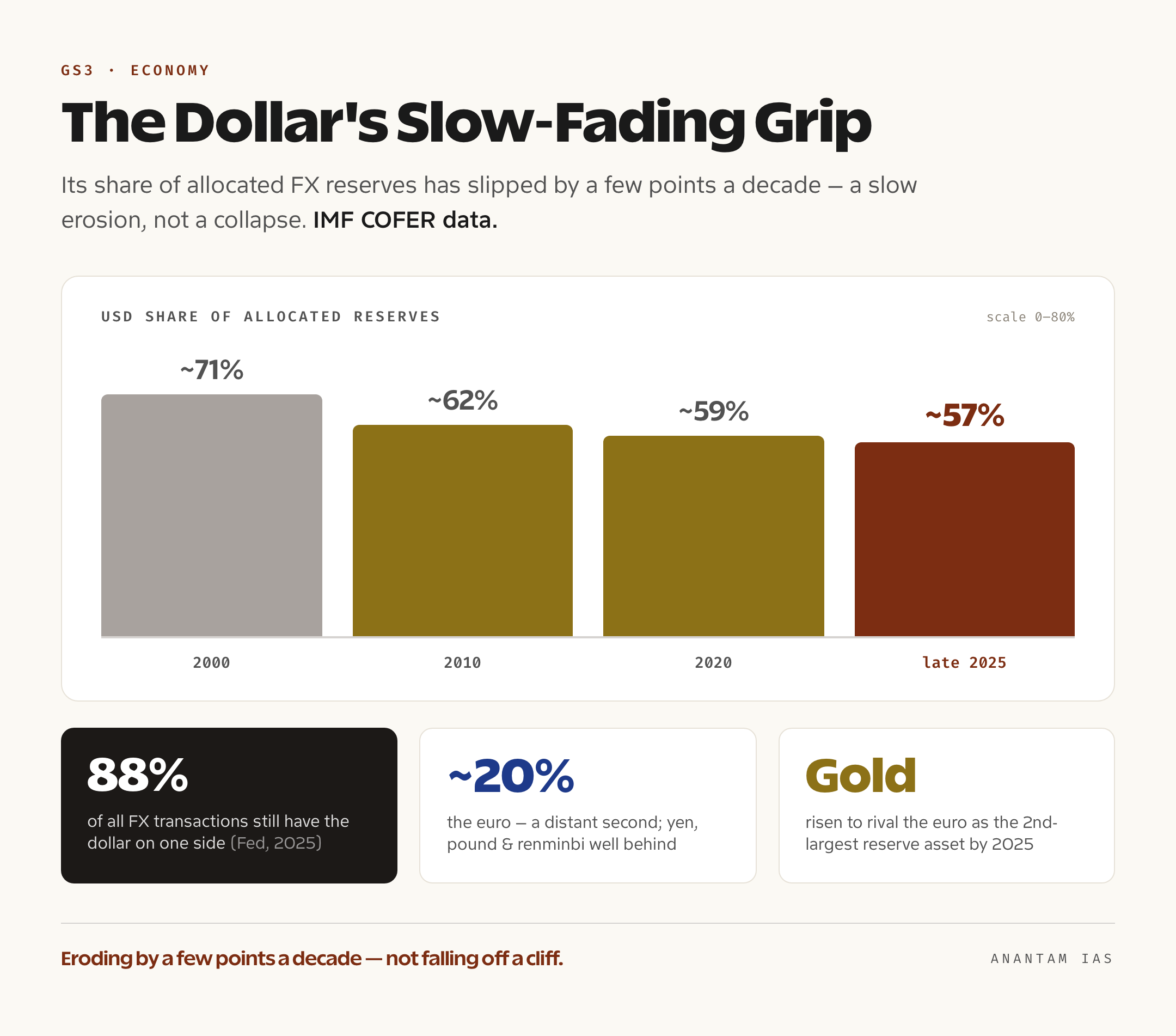
Before judging whether to adopt the dollar, you have to understand why the dollar is the currency countries reach for in the first place — and why, despite years of headlines about its decline, it remains the anchor of the global system. According to the IMF’s COFER data, the US dollar’s share of allocated foreign exchange reserves stood at roughly 57% in late 2025, down from a peak above 70% around 2000. That is a slow erosion, not a collapse — the dollar has lost ground by a few percentage points a decade, not fallen off a cliff. The euro is a distant second near 20%, with the yen, pound and a slowly rising Chinese renminbi well behind.
Three forces explain the staying power. The first is network effects: a currency is useful precisely because everyone else uses it, so the dollar’s incumbency is self-reinforcing the way a dominant language or operating system is. The US Federal Reserve’s own 2025 review found the dollar still on one side of about 88% of all foreign-exchange transactions and the dominant invoicing currency for trade outside Europe. The second is deep, liquid markets: the US Treasury market is the largest and safest pool of assets on earth, so central banks park their reserves there because they can always sell without moving the price. The third is the petrodollar habit — oil and most globally traded commodities have long been priced and settled in dollars, which forces every importing nation to hold them.
But none of this is permanent, and that is the analytical edge. The dollar’s dominance rests on trust in American institutions and the willingness of others to keep using it. When the US weaponises that centrality — freezing reserves, cutting countries out of the dollar payment system through sanctions — it gives every rival a reason to build an alternative. That tension between the dollar’s convenience and its growing use as a tool of coercion is the engine driving the de-dollarisation story.
The Costs of Giving Up Your Currency
Now the hard part, and the reason most economists are wary of full dollarisation: it is a one-way door that takes away a country’s most important macroeconomic tools.
The biggest loss is monetary policy autonomy. A dollarised country cannot set its own interest rates, cannot expand or tighten its money supply, and cannot respond to a domestic recession the way an independent central bank would. It imports US monetary policy wholesale. So when the Federal Reserve raises rates to cool an overheating American economy, Ecuador or El Salvador swallows the same tightening even if its own economy is sliding into recession — a textbook case of a policy that fits one country being forced on another.
The second loss is the lender of last resort. A central bank that can create its own currency can flood a panicking banking system with liquidity to stop a bank run. A dollarised central bank cannot conjure dollars it does not have, so its banks are far more fragile in a crisis — it can only lend out whatever dollar reserves it has managed to accumulate. The third cost is seigniorage, the profit a government earns from issuing currency that costs almost nothing to make. Under dollarisation that profit flows to the US Treasury and Federal Reserve instead, a real revenue loss for a developing country. And the fourth is the lost devaluation valve: a country with its own currency can let it weaken to make exports cheaper and absorb a shock, but a dollarised economy can only adjust through the slow, painful route of cutting domestic wages and prices.
The benefits are real too, which is why the trade-off is genuine and not one-sided. Ecuador’s inflation, which had run near 96% in 2000, fell to single digits within two years of dollarising. Dollarised economies typically enjoy lower inflation, lower interest rates, no exchange-rate risk against their largest trading partner, and the credibility that draws foreign investment. The honest verdict is that dollarisation can be a rational escape hatch for an economy whose own currency has lost all credibility — but it buys that stability by surrendering the flexibility a healthy economy needs. That’s why even Milei’s Argentina, after sharply cutting inflation, has drifted toward “currency competition” — letting the peso and dollar circulate together — rather than the clean full dollarisation he once promised.
The De-Dollarisation Push
The flip side of dollarisation is the global effort to need the dollar less, and it has accelerated sharply this decade. De-dollarisation means reducing reliance on the US dollar for trade, reserves and finance — and it is being driven less by economics than by geopolitics. The freezing of Russia’s foreign reserves after the 2022 invasion of Ukraine was the turning point: it showed every government that dollar reserves can be switched off, which made holding alternatives look prudent rather than paranoid.
The push runs along three tracks. The first is local-currency trade settlement — countries paying each other in their own currencies to bypass the dollar entirely, which Russia, China, India and Gulf states have all expanded. The second is institutional, through the BRICS bloc, which has discussed alternative payment rails such as BRICS Pay and debated, though not delivered, a shared settlement unit; talk of a single “BRICS currency” remains far more rhetoric than reality. The third, and most concrete, is gold. Central banks — led by China, India, Russia and Turkey — have been buying gold at the fastest pace in decades, adding to reserves precisely because gold cannot be sanctioned or frozen by any foreign power. By 2025, gold had climbed back to rival the euro as the second-largest reserve asset after the dollar.
The scale of the gold pivot is worth a figure. Central banks have bought well over 1,000 tonnes of gold a year through the mid-2020s, roughly double the pace of the previous decade, and BRICS members have accounted for the bulk of it. The logic is defensive: gold is the one reserve asset that carries no other country’s liability and cannot be frozen by a foreign treasury. That is also why India’s own gold holdings have climbed as a share of reserves, crossing into the mid-teens by 2026 — not a rejection of the dollar so much as an insurance policy against being cut off from it.
But it pays to be sober here, and good answers always are. De-dollarisation is real at the margins and gathering pace, yet no credible rival can replace the dollar’s role any time soon. The renminbi is held back by China’s capital controls and the fact that few trust a currency they cannot freely move money in and out of. The euro lacks a unified bond market. Gold cannot run a modern payment system, and a shared BRICS currency would require members with rival interests — India and China among them — to surrender monetary control to a common authority, which none will do. So the realistic forecast is not a dollar collapse but a slow drift toward a more multipolar currency world, where the dollar remains first among several rather than nearly alone.
Where India Fits — and Why It’s the Opposite Story
India is nowhere near dollarising, and understanding why is the most exam-useful part of this topic. India has exactly what dollarised countries gave up: a credible, independent monetary framework. Since 2016 the RBI has run flexible inflation targeting with a CPI target of 4% within a 2% band, foreign exchange reserves of roughly $680 billion in 2026 that rank among the world’s largest, and a flexible exchange rate that lets the rupee absorb shocks. A country with all of that has no reason to surrender its currency.
So India’s trajectory points the other way — not toward dollarisation but toward internationalising the rupee, which means getting the rupee used and accepted beyond India’s borders for trade and investment. The flagship mechanism is the Special Rupee Vostro Account, or SRVA, which the RBI introduced in July 2022. A vostro account is simply an account a foreign bank holds with an Indian bank; the SRVA lets a trading partner settle its imports from and exports to India in rupees rather than dollars. By early 2025, the RBI had permitted around 123 correspondent banks from roughly 30 countries to open over 150 such accounts, and in August 2025 it loosened the rules further so that Indian banks no longer need prior RBI approval to open them. Alongside this, the RBI has pushed rupee invoicing of trade and signed a local-currency settlement framework with the UAE in July 2023, allowing exporters and importers to deal directly in rupees and dirhams.
It’s worth being candid about the scale, because overselling India’s progress is a trap. The actual rupee balances in these vostro accounts have stayed modest — a few billion dollars’ worth — and the early hope that the India-UAE deal would quickly shift a quarter of bilateral trade into local currencies has run into a stubborn problem: a country that earns rupees through trade needs somewhere useful to spend or invest them, and the pool of rupee-denominated assets open to foreigners is still small. So the SRVA network has been most useful with partners where rupee trade balances naturally even out, such as in dealing with sanctioned suppliers like Russia, and far less so where India runs a large surplus or deficit. Recognising this, the RBI’s roadmap leans on widening that asset pool and deepening offshore rupee markets rather than forcing the pace.
Here is the distinction worth carrying into the exam hall, because candidates routinely blur it. A rupee rising as a trade and reserve currency is not the same thing as global de-dollarisation, and it is the exact opposite of dollarisation. Dollarisation is surrendering monetary sovereignty by adopting a foreign currency. Rupee internationalisation is extending India’s monetary footprint by getting others to hold and use the rupee — a gain in sovereignty, not a loss. India’s strategy is deliberately gradual: full capital account convertibility carries risks of volatile capital flight, so the RBI’s own Inter-Departmental Group has laid out a careful, staged roadmap rather than a leap. The honest assessment is that the rupee is making real but modest progress as a regional trade currency, while remaining a long way from challenging the dollar — and that incremental, risk-managed posture is itself the point.
For Your Mains Answer
Dollarisation maps squarely onto GS Paper III — “Indian Economy… mobilization of resources,” monetary policy, and the effects of liberalisation and globalisation on the economy. It also feeds GS Paper II on India’s bilateral and grouping relations (BRICS, India-UAE) and the impact of policies of developed countries on India’s interests. The smart move is to treat dollarisation, de-dollarisation and rupee internationalisation as three connected ideas and show the examiner you can tell them apart.
How to Build the Answer
Open by defining dollarisation and naming its three shades in one tight sentence, then state the central trade-off — stability versus sovereignty — because that tension is the whole answer in miniature. Use one success case (Ecuador taming hyperinflation) and one cost (loss of the lender of last resort) to keep it concrete. Then pivot to the bigger picture: the dollar’s slowly fading reserve share, the de-dollarisation push after the Russia sanctions, and finally India’s opposite strategy of rupee internationalisation. Close on the distinction between de-dollarisation and a rising rupee. That arc — definition, trade-off, global trend, India — fits almost any framing of the question.
Common Mistakes to Avoid
Don’t conflate dollarisation, de-dollarisation and rupee internationalisation; they are three different things and mixing them is the single most common error. Don’t claim the dollar is “collapsing” — it is eroding slowly and still dominates, and overstating its decline reads as careless. Don’t say India is “de-dollarising” when the precise point is that India is internationalising the rupee. And don’t forget the costs of dollarisation are mostly about lost flexibility, not lost prestige.
A Compact Answer Spine
Dollarisation = using a foreign currency for money’s three functions → three shades (unofficial, semi-official, full) → examples (Panama, Ecuador, El Salvador, Zimbabwe) → benefit: kills inflation, anchors stability → cost: no monetary autonomy, no lender of last resort, lost seigniorage, no devaluation valve → dollar still ~57% of reserves on network effects, deep markets, petrodollar → de-dollarisation push (Russia sanctions, BRICS, gold buying) but no real rival yet → India’s opposite move: rupee internationalisation via SRVAs, rupee invoicing, UAE local-currency settlement → conclusion: a rising rupee is a sovereignty gain, dollarisation is a sovereignty loss.
Diagram or Flowchart Idea
Draw a simple two-arrow contrast. One arrow points down-and-in, labelled “Dollarisation = adopt foreign currency = lose monetary sovereignty,” with Ecuador and Zimbabwe beneath it. The opposite arrow points up-and-out, labelled “Rupee internationalisation = others adopt your currency = gain footprint,” with SRVA and India-UAE beneath it. A clean contrast like this earns marks fast and shows you grasp the core distinction.
A Balanced-Conclusion Line
A serviceable closer: “Dollarisation can rescue a country whose currency has already failed, but it trades autonomy for stability — which is why India, armed with a credible inflation-targeting framework and deep reserves, is rightly moving the other way, internationalising the rupee step by careful step rather than surrendering it.”
How to Use Data Without Cramming
Carry just four numbers and deploy them precisely: the dollar near 57% of allocated reserves (declining); India’s forex reserves around $680 billion; the SRVA reach of roughly 30 countries; and Ecuador’s inflation falling from about 96% to single digits after dollarising. Attribute them in-prose — “according to the IMF’s COFER data” — and you sound like someone who has read the source, not memorised a coaching sheet.
FAQ
What is dollarisation in simple terms? Dollarisation is when a country uses a foreign currency, usually the US dollar, instead of or alongside its own to buy, sell and save. In its full form the country scraps its own currency entirely — as Ecuador, El Salvador, Panama and Zimbabwe have done — and the dollar becomes the only legal tender.
What is the difference between dollarisation and de-dollarisation? They point in opposite directions. Dollarisation means adopting the dollar and giving up your own currency, which surrenders monetary control. De-dollarisation means reducing reliance on the dollar — settling trade in local currencies, holding more gold, building alternative payment systems — to regain independence. India is doing neither in the strict sense; it is internationalising the rupee, which is a different, third thing.
Why does the US dollar still dominate global reserves? Three reasons. Network effects make a widely used currency more useful the more it is used; the US Treasury market is the deepest and safest place to park reserves; and oil and most commodities have long been priced in dollars. Together these keep the dollar near 57% of allocated reserves even as that share slowly falls.
Why doesn’t India dollarise? India has no need to. It already has a credible monetary framework — flexible inflation targeting since 2016, a 4% CPI target, large foreign exchange reserves, and a flexible exchange rate. Dollarising would mean surrendering all of that. Instead India is moving the other way, promoting the rupee in international trade through Special Rupee Vostro Accounts and local-currency settlement deals.
Practice Questions
Prelims MCQs
- With reference to dollarisation, consider the following statements about its different forms.
Which one of the following best describes “full” or “official” dollarisation?
(a) Citizens hold dollar deposits while the local currency remains sole legal tender
(b) The dollar circulates as a recognised second legal tender alongside the domestic currency
(c) The domestic currency is abolished and the foreign currency becomes the sole legal tender
(d) The central bank pegs the local currency rigidly to the dollar through a currency board
Answer: (c) — Full dollarisation means scrapping the national currency entirely, as in Ecuador, El Salvador, Panama and post-2009 Zimbabwe; the other options describe unofficial dollarisation, semi-official dollarisation and a currency board respectively. - Which of the following is NOT a consequence a country accepts when it fully dollarises its economy?
(a) Loss of monetary policy autonomy
(b) Loss of seigniorage revenue
(c) An impaired lender-of-last-resort function
(d) Higher long-run inflation than a comparable independent-currency economy
Answer: (d) — Dollarisation typically lowers inflation by removing the power to print money; the genuine costs are lost monetary autonomy, lost seigniorage and a weakened lender of last resort. - The Special Rupee Vostro Account (SRVA) mechanism is associated with which of the following?
(a) Allowing Indian citizens to hold US dollar deposits domestically
(b) Settling India’s international trade in Indian rupees through foreign banks’ accounts with Indian banks
(c) Pegging the rupee to a basket of reserve currencies
(d) Permitting full capital account convertibility of the rupee
Answer: (b) — Introduced by the RBI in 2022, an SRVA is an account a foreign bank holds with an Indian bank to settle bilateral trade in rupees, advancing rupee internationalisation. - Consider the following as drivers of the recent de-dollarisation push:
1. Freezing of Russia’s foreign reserves after 2022 2. Aggressive central-bank gold buying 3. Expansion of local-currency trade settlement.
How many of the above are correct?
(a) Only one
(b) Only two
(c) All three
(d) None
Answer: (c) — All three are recognised drivers; the Russia sanctions were the trigger, while gold accumulation and local-currency settlement are the two main practical responses. - Which of the following best explains why the US dollar retains its dominance in global reserves despite a slowly declining share?
(a) The US runs persistent trade surpluses
(b) Network effects, deep and liquid US Treasury markets, and commodity pricing in dollars
(c) A binding international treaty mandating dollar use
(d) The dollar is formally backed by gold
Answer: (b) — The dollar’s dominance rests on self-reinforcing network effects, the depth and safety of US Treasury markets, and the long-standing pricing of oil and commodities in dollars; the US in fact runs deficits, there is no such treaty, and the dollar has not been gold-backed since 1971.
Mains Practice Questions
- “Dollarisation buys monetary stability at the cost of monetary sovereignty.” Critically examine this trade-off with reference to the experiences of Ecuador and Zimbabwe. (15 marks, 250 words)
- Despite a slowly declining share in global reserves, the US dollar remains the anchor of the international monetary system. Discuss the factors behind this dominance and the limits to its erosion. (15 marks, 250 words)
- Distinguish between de-dollarisation and the internationalisation of the rupee. Why is India pursuing the latter rather than the former? (10 marks, 150 words)
- Examine the role of geopolitical factors, particularly the use of financial sanctions, in accelerating the global de-dollarisation push. To what extent can these efforts succeed in the near term? (15 marks, 250 words)
- Evaluate India’s recent steps toward rupee internationalisation, including Special Rupee Vostro Accounts and local-currency settlement arrangements. What risks must India manage as it pursues this goal? (15 marks, 250 words)
Tell Google you want more of this.
Add Anantam IAS as a preferred sourceOne tap, and this site shows up more often in your own Top Stories, AI Overviews and AI Mode. Remove it any time.