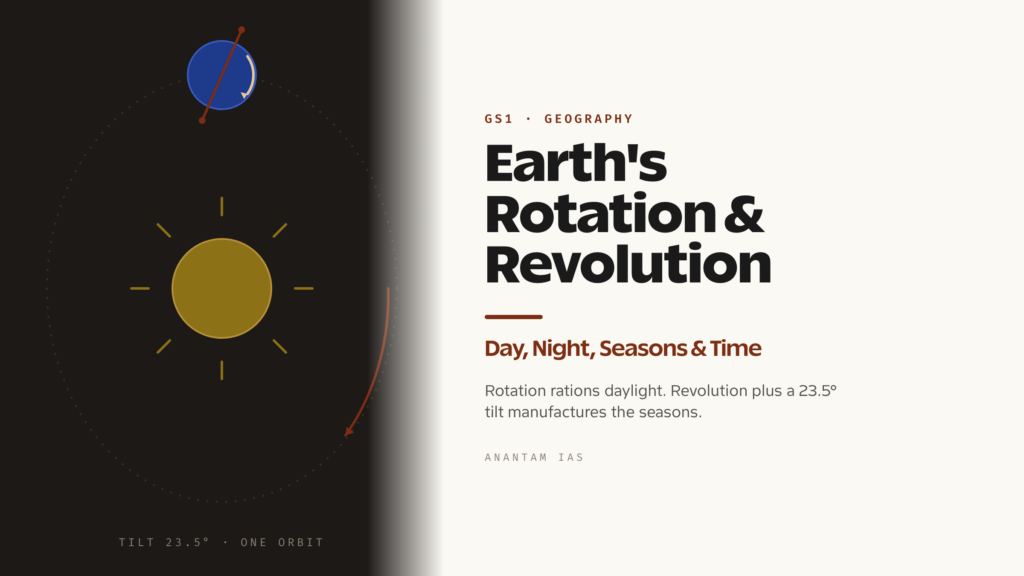
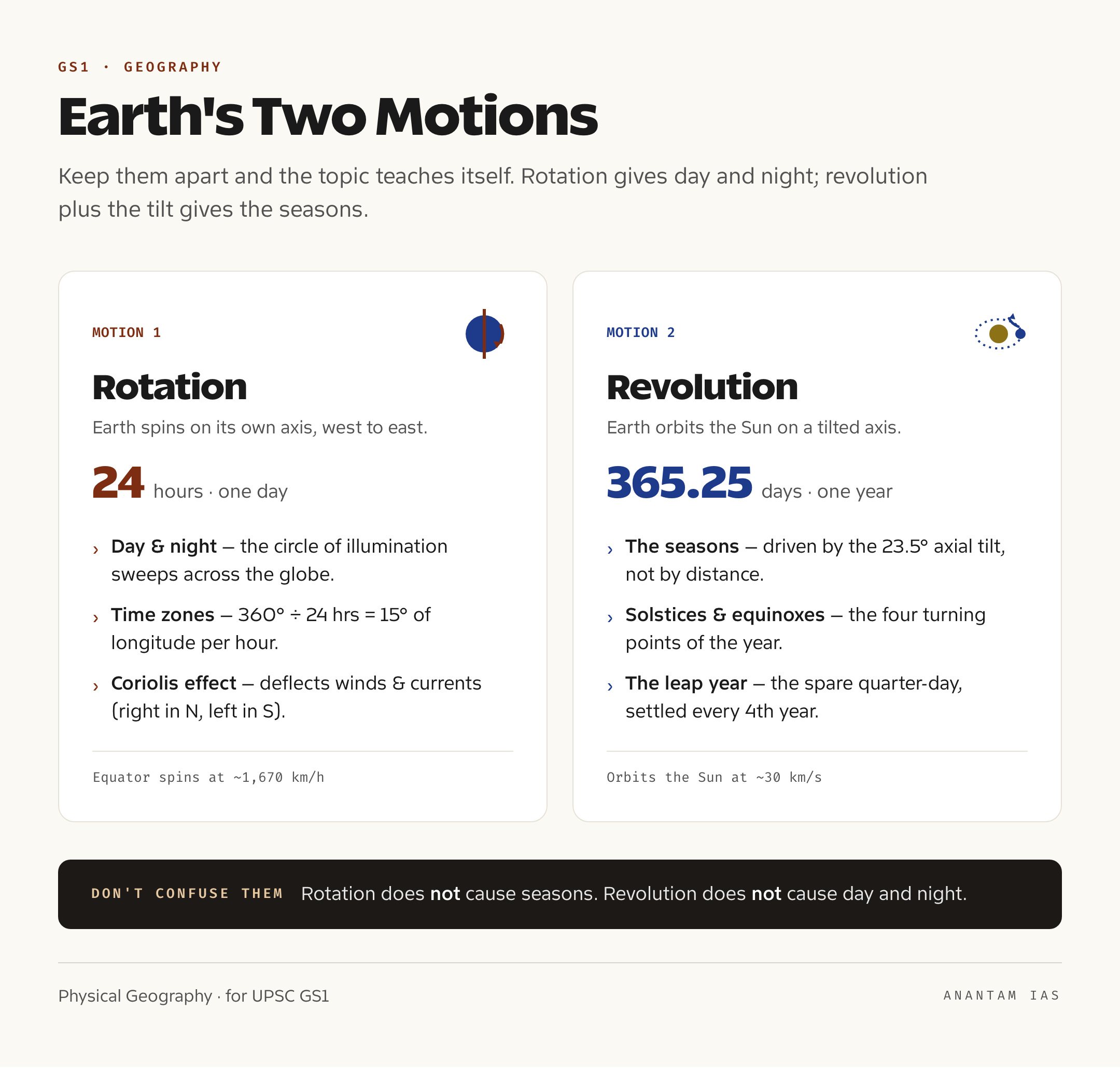
Earth has two motions. Rotation is Earth spinning once on its own axis every 24 hours, which gives us day and night; revolution is Earth orbiting the Sun once every 365.25 days, which — combined with the 23.5° tilt of the axis — gives us the seasons. Rotation also produces time zones and the Coriolis effect; revolution sets up the solstices, equinoxes and the leap year. Keep the two apart and the rest of the topic almost teaches itself.
| Feature | Rotation | Revolution |
|---|---|---|
| Motion | Spin on its own axis | Orbit around the Sun |
| Duration | ~24 hours (one day) | 365.25 days (one year) |
| Direction | West to east | West to east (anticlockwise) |
| Chief effects | Day & night, time zones, Coriolis effect | Seasons, solstices, equinoxes, leap year |
| Key number | ~1,670 km/h at the equator | 23.5° axial tilt |
Stand still for a moment and you feel like the steadiest thing in the universe. You are not. At this instant you are being whirled eastward at hundreds of kilometres an hour by a planet spinning on its axis, and that spinning planet is itself hurtling around the Sun at about thirty kilometres a second. We sense none of it, because everything around us — the air, the oceans, the chair you are sitting on — moves with us. Yet almost everything we feel about time and weather flows from these two motions, and once you see how they fit together, a surprising amount of physical geography clicks into place.
Earth has exactly two motions that matter here, and the trick to never confusing them is to remember what each one produces. Rotation — Earth spinning once on its own axis — gives us day and night. Revolution — Earth travelling once around the Sun — combined with the tilt of that axis, gives us the seasons. Mix those two up and you will get a whole family of exam questions wrong; keep them apart and the rest of the topic almost teaches itself. So let’s take the machine apart and put it back together, piece by piece.
Rotation: Why We Have Day and Night
Rotation is the spin of Earth on its own axis — an imaginary line running through the North and South Poles. Earth turns from west to east, which is why the Sun appears to rise in the east and set in the west; it isn’t the Sun moving across us, it’s us turning toward it and then away. One full spin takes very close to 24 hours, and that is what defines a day. To be precise about it, a day measured against the distant stars — the sidereal day — is 23 hours 56 minutes, while the slightly longer solar day of 24 hours is the one our clocks keep, because Earth has to turn a few extra minutes each day to “catch up” with the Sun as it also moves along its orbit.
The speed of this spin is genuinely startling. Because the planet is a sphere, a point on the equator has to cover the full circumference of about 40,000 kilometres in one rotation, so it travels at roughly 1,670 kilometres an hour — faster than most passenger jets. Move toward the poles and that speed drops, because the circles of latitude get smaller, until at the poles themselves a person simply turns slowly on the spot. This is no idle fact: rockets are launched eastward, and from sites as close to the equator as possible, precisely to borrow that free 1,670-km/h head start.
At any moment, the Sun lights up exactly one half of the globe while the other half lies in shadow. The line dividing the lit half from the dark half is called the circle of illumination, and as Earth rotates, this circle sweeps steadily across the surface, carrying dawn into one region and dusk into another. That sweep is sunrise and sunset. It is also why, when it is noon in India, it is the middle of the night over the Pacific — the same planet, the same Sun, just a different part of the globe currently facing the light.
Rotation does more than ration daylight. It is the reason we have time zones at all: since the whole 360-degree planet turns past the Sun in 24 hours, each hour corresponds to 15 degrees of longitude, which is exactly how the world’s time zones are spaced. And it produces one of the most important forces in all of physical geography — the Coriolis effect. Because the ground is moving faster near the equator than near the poles, anything that travels a long distance over the surface — winds, ocean currents, even long-range artillery — gets deflected: to the right in the Northern Hemisphere and to the left in the Southern. That deflection is why cyclones spin the way they do, why the trade winds blow as they do, and why the great ocean gyres turn in opposite directions on either side of the equator.
Revolution and the Tilt: Why We Have Seasons
Now to the motion people most often misunderstand. Revolution is Earth’s journey around the Sun, and it takes 365 days and roughly a quarter — about 365.25 days — to complete one lap along a path that is very nearly, but not perfectly, a circle. The plane of that orbit is called the plane of the ecliptic, and here is the single most important fact in this entire topic: Earth’s axis is not standing upright in that plane. It is tilted by about 23.5 degrees, and it stays pointed in the same direction in space — toward the Pole Star — all the way around the orbit. That fixed tilt, not the spin and not the distance from the Sun, is what manufactures the seasons.
It is worth killing the most stubborn misconception right here, because almost everyone carries it. We do not get summer because Earth is closer to the Sun. The proof is simple and decisive: Earth is actually closest to the Sun in early January, when the Northern Hemisphere is shivering through winter, and farthest in early July, when the same hemisphere is sweating through summer. If distance drove the seasons, the entire planet would be hot at once and cold at once — yet when it is summer in India it is winter in Australia. Distance cannot explain that. Tilt can.
Here is how the tilt actually works. As Earth circles the Sun while leaning at a fixed 23.5 degrees, different hemispheres get tipped toward the Sun at different points in the orbit. When the Northern Hemisphere leans toward the Sun, it receives sunlight that strikes more directly — closer to overhead — and for more hours each day; that concentrated, long-lasting heat is summer. At the same time the Southern Hemisphere is tipped away, catching slanting rays that spread their energy thinly over a larger area for fewer daylight hours, which is winter. Six months later the geometry reverses, and so do the seasons. The seasons are opposite in the two hemispheres for the same reason and at the same time — one neat consequence of a single tilted axis.
The Four Positions: Solstices and Equinoxes
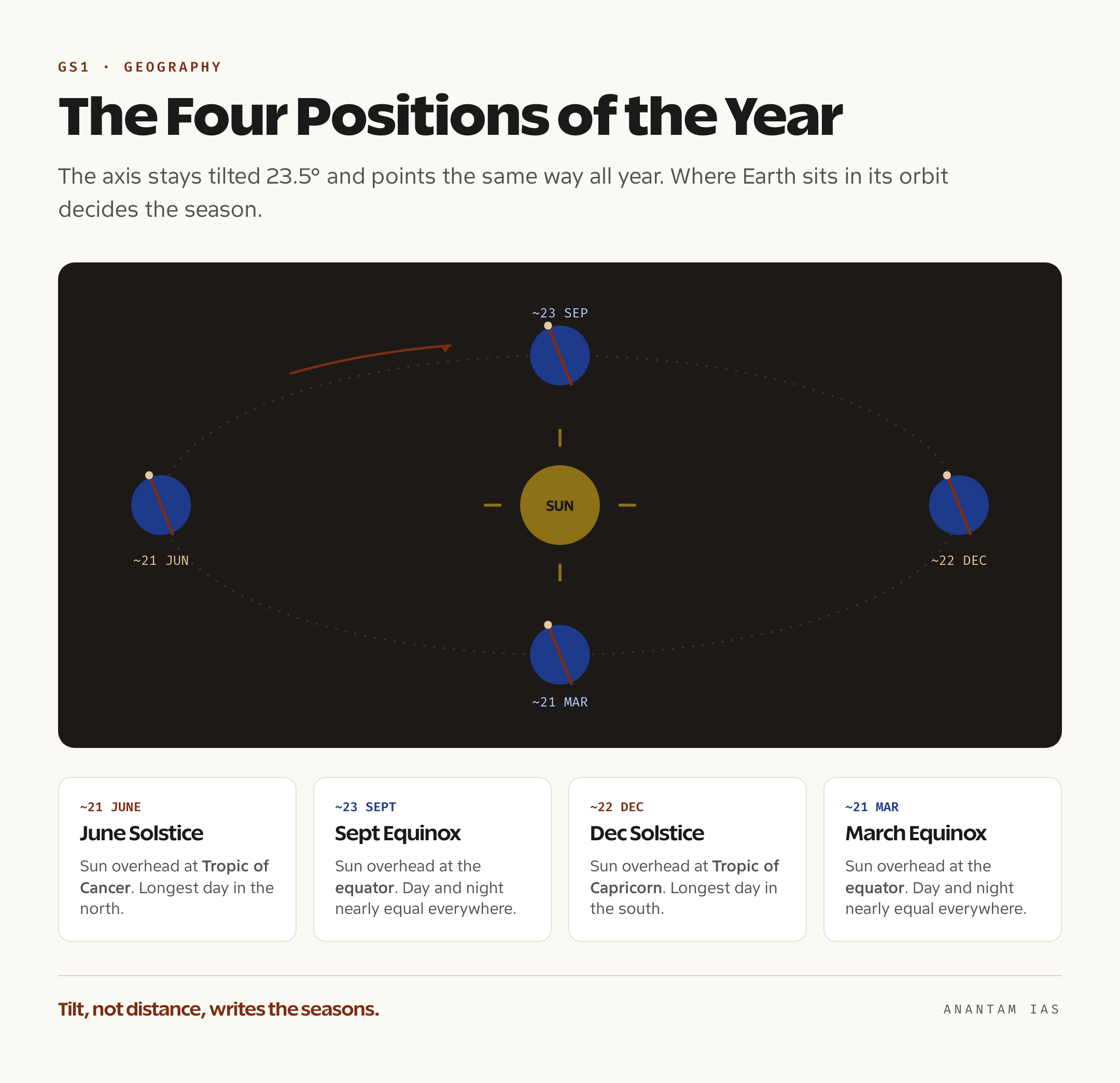
Because the seasons come from Earth’s changing position in a fixed-tilt orbit, the year has four turning points worth memorising — two solstices and two equinoxes — and they fall at predictable dates. Picture Earth at four stations spaced around its orbit, and the whole calendar of seasons falls out of where the tilt is pointing.
The June solstice, around 21 June, is the moment the North Pole is tilted most directly toward the Sun. The Sun is overhead at the Tropic of Cancer (23.5° N), the Northern Hemisphere has its longest day and shortest night of the year, and it is the start of summer in the north — and of winter in the south. Six months later comes the December solstice, around 22 December, the mirror image: the South Pole now leans toward the Sun, the Sun is overhead at the Tropic of Capricorn (23.5° S), and it is the Southern Hemisphere’s longest day while the north endures its shortest. The word “solstice” comes from Latin for “sun stands still,” because at these points the Sun’s overhead position reaches its furthest limit north or south and pauses before reversing.
Between the solstices sit the two equinoxes, around 21 March (the spring or vernal equinox in the north) and 23 September (the autumnal equinox in the north). At an equinox, neither pole tilts toward or away from the Sun; the Sun shines directly over the equator, and the circle of illumination passes neatly through both poles. The result is the one thing the name promises — equi-nox, “equal night” — day and night of nearly equal length, roughly twelve hours each, across the entire planet. The equinoxes are also the moments when the Sun crosses the equator, heading north in March and south in September, which is why they mark the changeover of seasons everywhere at once.
Perihelion, Aphelion and the Shape of the Orbit
Now for the detail that turns a good answer into a precise one, and that trips up the careless: Earth’s orbit is not a perfect circle but a gentle ellipse, so our distance from the Sun does change over the year — it just isn’t what causes the seasons. The point in the orbit where Earth is closest to the Sun is called perihelion, and it occurs in early January, around the 3rd, at a distance of roughly 147 million kilometres. The farthest point, aphelion, comes in early July, around the 4th to 6th, at about 152 million kilometres. The gap between near and far is only about 5 million kilometres — a small fraction of the total distance.
So the seasons and the distance to the Sun are almost the reverse of what intuition expects: the Northern Hemisphere has winter at perihelion (when Earth is nearest the Sun) and summer at aphelion (when it is farthest). This is the cleanest possible disproof of the “summer means closer” idea, and it is exactly the kind of counter-intuitive fact examiners love. The roughly 3.5 percent difference in distance does have a mild effect — it makes southern-hemisphere summers slightly more intense and the northern-hemisphere ones a touch milder, and it makes the seasons of the two hemispheres unequal in length by a few days — but it is a minor modifier riding on top of the tilt, not the main engine. Axial tilt writes the seasons; the elliptical orbit only adds a faint accent.
Why the Calendar Needs a Leap Year
The last piece ties the whole system back to the calendar on your wall, and it follows directly from the length of the revolution. One trip around the Sun takes not a clean 365 days but about 365.25 — more exactly 365.2422 days. A calendar of 365 whole days falls behind the real Earth by very nearly a quarter of a day every year, and left uncorrected the dates would drift out of step with the seasons until, over centuries, the equinoxes wandered into the wrong months entirely.
The fix is the leap year. We let three ordinary years run at 365 days and then, every fourth year, add a 29th day to February to make 366 — roughly cashing in the four accumulated quarter-days as one whole day. Because the figure is 365.2422 and not exactly 365.25, even this slightly overcorrects, so the Gregorian calendar adds a small refinement: century years are leap years only if divisible by 400, which is why 2000 was a leap year but 1900 and 2100 are not. It is a humble piece of arithmetic, but it exists for a grand reason — to keep our human calendar locked to Earth’s actual orbit, so that 21 June stays the longest day and 25 December stays in winter, year after year after year.
For Your Mains Answer
This is core GS Paper 1 territory — “salient features of world’s physical geography” — and the concepts here also feed straight into climatology questions on pressure belts, wind systems and ocean currents, because the Coriolis effect and the seasonal march of the Sun underlie all of them. A clear command of rotation versus revolution is the foundation the rest of physical geography is built on, so it is worth being able to explain it crisply and correctly.
How to Build the Answer
State the two motions in the first two lines, and tie each firmly to its effect: rotation → day, night, time zones, Coriolis effect; revolution + axial tilt → seasons, solstices, equinoxes. Then go one level deeper on whichever the question asks for. If it is about seasons, lead with the tilt and explicitly knock down the distance myth, because doing so demonstrates real understanding. Anchor everything to the four positions and their dates — they are the scaffold an examiner is looking for.
Common Mistakes to Avoid
The fatal error is attributing seasons to Earth’s distance from the Sun; never write it, and ideally rebut it. Don’t swap the effects of the two motions — rotation does not cause seasons and revolution does not cause day and night. Get the solstice and equinox dates and tropics right (Cancer in June, Capricorn in December). And don’t forget that the hemispheres experience opposite seasons simultaneously — that single line proves you have understood the tilt.
A Compact Answer Spine
Two motions → rotation (24 hrs, west-to-east) gives day/night, time zones, Coriolis deflection → revolution (365.25 days) along a tilted axis (23.5°, fixed direction) → tilt, not distance, gives seasons → four positions: June solstice (Tropic of Cancer), December solstice (Tropic of Capricorn), March and September equinoxes (equator, equal day-night) → perihelion in January, aphelion in July disproves the distance myth → leap year keeps the calendar aligned.
Diagram or Flowchart Idea
Draw the Sun at the centre and Earth at the four cardinal points of an elliptical orbit, with the axis tilted at a consistent 23.5 degrees and pointing the same way at all four positions. Label which hemisphere leans sunward at each station and name the date and the tropic. One clean, correctly-tilted orbit diagram earns marks faster than a paragraph and instantly shows you have grasped the mechanism.
How to Use Data Without Cramming
A few precise anchors do all the work: axial tilt 23.5°, equatorial spin ~1,670 km/h, year 365.25 days, solstices around 21 June / 22 December, equinoxes around 21 March / 23 September, perihelion ~147 million km in January, aphelion ~152 million km in July. Drop two or three of these into an answer and it reads as authoritative; list all of them and it reads as a data dump. Pick the ones the question actually needs.
FAQ
What is the difference between rotation and revolution of the Earth? Rotation is Earth spinning once on its own axis from west to east, which takes about 24 hours and gives us day and night. Revolution is Earth travelling once around the Sun, which takes about 365.25 days and, together with the axial tilt, gives us the seasons. In short: rotation makes the day; revolution makes the year.
Why do we have seasons on Earth? Seasons happen because Earth’s axis is tilted about 23.5 degrees and keeps pointing in the same direction as Earth orbits the Sun. This means different hemispheres lean toward the Sun at different times of the year, receiving more direct sunlight and longer days (summer) or more slanting sunlight and shorter days (winter). Seasons are caused by this tilt, not by Earth’s changing distance from the Sun.
Why isn’t the Earth’s distance from the Sun the cause of the seasons? Because the facts run the other way. Earth is actually closest to the Sun (perihelion, about 147 million km) in early January and farthest (aphelion, about 152 million km) in early July. Yet January is winter in the Northern Hemisphere and July is summer there. If distance caused the seasons, the whole planet would be hot or cold at the same time — but when it is summer in India it is winter in Australia. Only the axial tilt explains opposite seasons in the two hemispheres.
What are solstices and equinoxes? Solstices are the two days when the Sun is overhead at its furthest point from the equator — around 21 June over the Tropic of Cancer (longest day in the Northern Hemisphere) and around 22 December over the Tropic of Capricorn (longest day in the Southern Hemisphere). Equinoxes are the two days, around 21 March and 23 September, when the Sun is overhead at the equator and day and night are nearly equal everywhere on Earth.
Practice Questions
Prelims MCQs
- Which of the following is a direct consequence of Earth’s rotation?
(a) The change of seasons
(b) The occurrence of day and night
(c) The varying length of the year
(d) Perihelion and aphelion.
Answer: (b) — Rotation, the spin of Earth on its axis, produces day and night; the seasons come from revolution combined with the axial tilt. - The angle of inclination of Earth’s axis to the plane of its orbit is approximately:
(a) 0 degrees
(b) 15 degrees
(c) 23.5 degrees
(d) 66.5 degrees from the orbital plane.
Answer: (c) — Earth’s axis is tilted about 23.5 degrees from the vertical (equivalently, it makes an angle of 66.5 degrees with the orbital plane itself). - On the June solstice (around 21 June), the Sun is directly overhead at the:
(a) Equator
(b) Tropic of Cancer
(c) Tropic of Capricorn
(d) Arctic Circle.
Answer: (b) — At the June solstice the North Pole is tilted most toward the Sun and the Sun is overhead at the Tropic of Cancer (23.5° N), giving the Northern Hemisphere its longest day. - Consider Earth’s position in its orbit. Which statement is correct?
(a) Earth is closest to the Sun in July
(b) Earth is closest to the Sun in January, at perihelion
(c) Earth’s distance from the Sun causes the seasons
(d) Earth is equidistant from the Sun throughout the year.
Answer: (b) — Earth reaches perihelion, its closest point to the Sun (about 147 million km), in early January; it is farthest (aphelion) in early July. Distance does not cause the seasons. - The deflection of winds and ocean currents — to the right in the Northern Hemisphere and to the left in the Southern Hemisphere — is caused by:
(a) Earth’s revolution
(b) Earth’s axial tilt
(c) Earth’s rotation, through the Coriolis effect
(d) The gravitational pull of the Moon.
Answer: (c) — The Coriolis effect arises because Earth’s surface moves faster near the equator than near the poles; it is a consequence of rotation, not revolution.
Mains Practice Questions
- “It is the tilt of Earth’s axis, not its distance from the Sun, that gives us the seasons.” Examine this statement with reference to the four key positions of Earth in its orbit. (15 marks, 250 words)
- Explain how Earth’s rotation gives rise to day and night, time zones and the Coriolis effect. (10 marks, 150 words)
- Distinguish between solstices and equinoxes, and describe what happens to day length and the position of the overhead Sun at each. (10 marks, 150 words)
- Discuss the significance of the circle of illumination and the changing angle of the Sun’s rays in determining the duration and intensity of daylight across latitudes. (15 marks, 250 words)
- Why does the calendar require a leap year? Relate your answer to the precise length of Earth’s revolution around the Sun. (10 marks, 150 words)
Tell Google you want more of this.
Add Anantam IAS as a preferred sourceOne tap, and this site shows up more often in your own Top Stories, AI Overviews and AI Mode. Remove it any time.