

A common confusion — especially among beginners preparing for UPSC, SSC, and state PCS examinations — is the belief that ED is a wing or sub-department of the CBI. It is not. ED stands for Enforcement Directorate, and CBI stands for Central Bureau of Investigation. They are two distinct central agencies, operating under different ministries, created by different statutes, and tasked with different mandates. Conflating them is a common error that blunts answer writing in GS Paper II (Polity and Governance). This guide unpacks both agencies, their parent ministries, jurisdictions, powers, and recent controversies — with a clean comparison table and the UPSC angle at the end.
What Is the Enforcement Directorate (ED)?
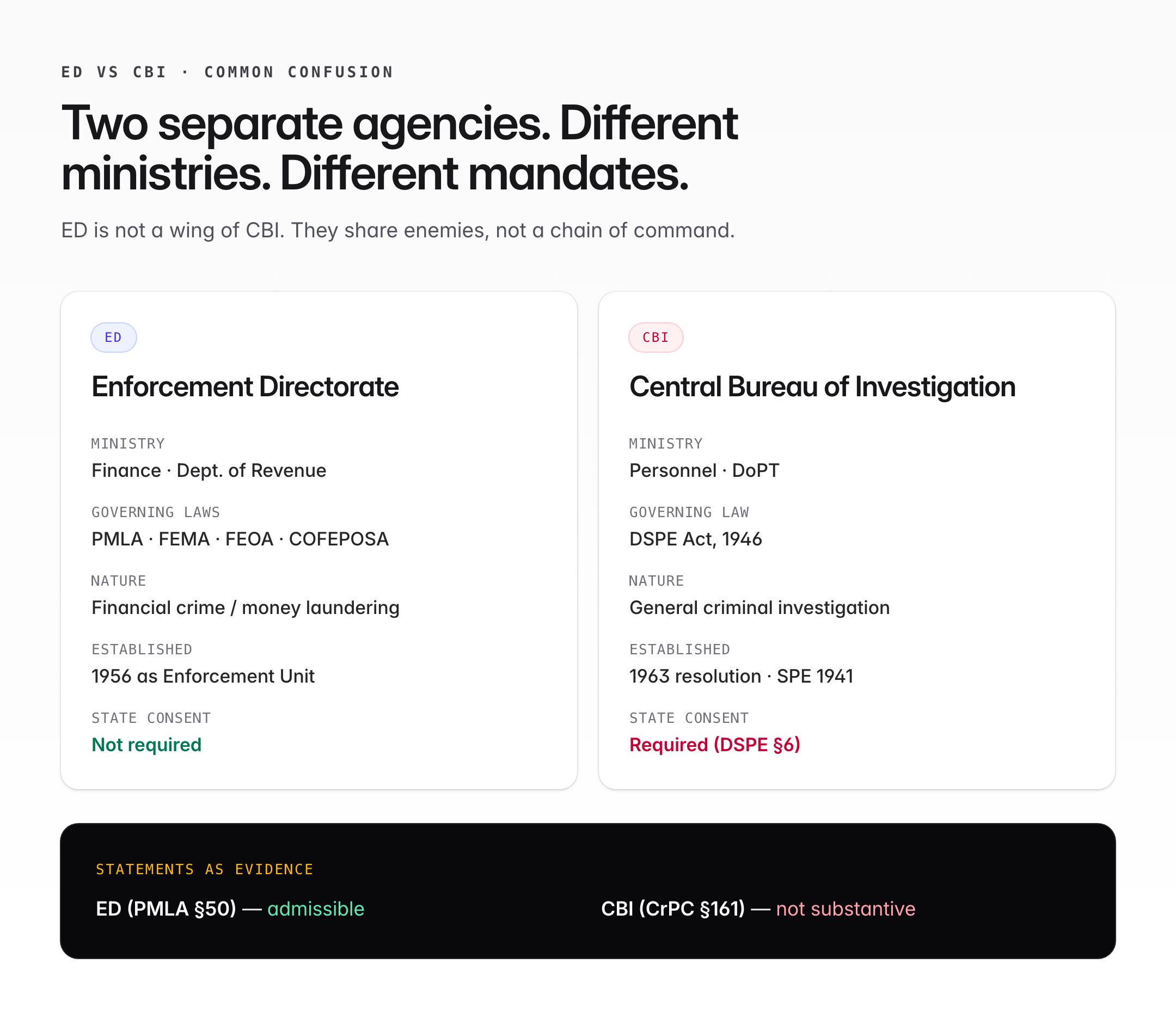
The Enforcement Directorate is a specialised financial investigation agency under the Department of Revenue, Ministry of Finance, Government of India. Its roots go back to 1 May 1956, when an "Enforcement Unit" was created in the Department of Economic Affairs to handle violations under the Foreign Exchange Regulation Act (FERA), 1947. It was renamed Enforcement Directorate in 1957. Today, ED operates through a headquarters in New Delhi, five regional offices, and multiple zonal/sub-zonal offices. It is headed by a Director at the level of Additional/Special Secretary.
Statutes Enforced by ED
| Act | Purpose |
|---|---|
| Prevention of Money Laundering Act (PMLA), 2002 | Core statute — investigate money laundering, attach proceeds of crime |
| Foreign Exchange Management Act (FEMA), 1999 | Civil enforcement of foreign exchange rules |
| Fugitive Economic Offenders Act (FEOA), 2018 | Attach properties of fugitives (e.g., Vijay Mallya, Nirav Modi) |
| Foreign Exchange Regulation Act (FERA), 1973 | Legacy cases |
| Conservation of Foreign Exchange and Prevention of Smuggling Activities Act (COFEPOSA), 1974 | Sponsoring preventive detention cases |
Powers of ED
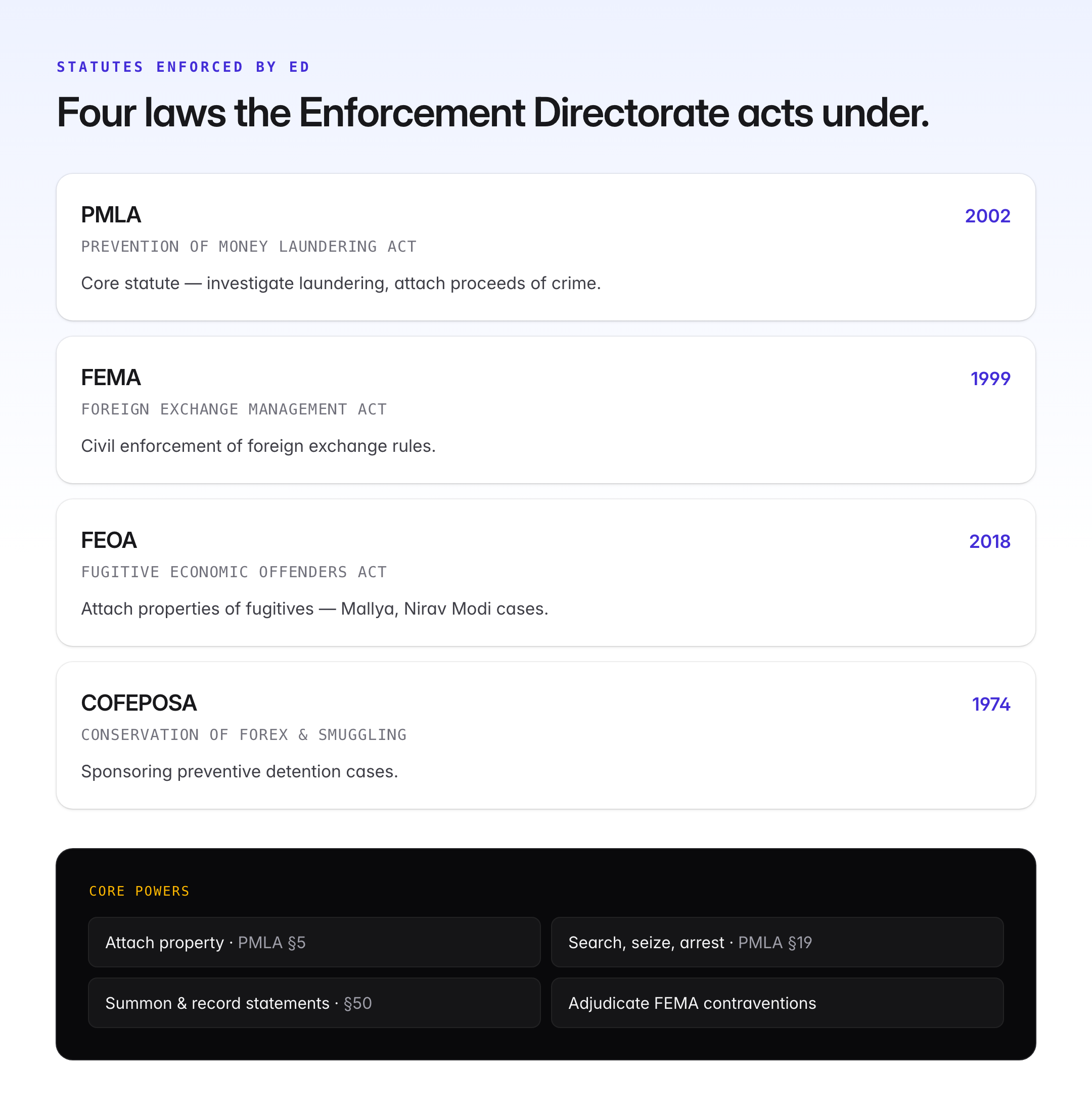
- Attach property "proceeds of crime" under PMLA Section 5.
- Search, seize, and arrest under PMLA Section 19 (arrest grounds must be recorded in writing).
- Summon persons for statements under Section 50 (admissible as evidence — unlike statements under CrPC).
- Prosecute through Special PMLA Courts.
- Adjudicate FEMA contraventions (civil, not criminal).
A PMLA investigation usually begins only after a predicate (scheduled) offence has been registered by another agency such as CBI, state police, or SFIO.
What Is the Central Bureau of Investigation (CBI)?
The Central Bureau of Investigation is India's premier criminal investigation agency. It functions under the Department of Personnel and Training (DoPT), Ministry of Personnel, Public Grievances and Pensions, reporting ultimately to the Prime Minister's Office. It was established through a Government of India resolution in 1963, tracing its origin to the Special Police Establishment set up in 1941 (WWII era). The Delhi Special Police Establishment Act, 1946 (DSPE Act) is its legal foundation — CBI is not a statutory body by its own Act, but derives its police powers from DSPE.
Divisions of CBI
| Division | Mandate |
|---|---|
| Anti-Corruption Division | Corruption cases against central government officials, PSU employees |
| Economic Offences Division | Bank frauds, cybercrime, financial scams |
| Special Crimes Division | Conventional crime (murder, terrorism) with inter-state/international ramifications |
| Directorate of Prosecution | Conducts prosecution in CBI courts |
Jurisdictional Limits
CBI cannot investigate a case in a state without the state's consent (general or specific), under Section 6 of DSPE. Several states (Maharashtra, Kerala, Punjab, West Bengal, Tamil Nadu at various points) have withdrawn general consent. CBI can, however, investigate on the direction of the Supreme Court or a High Court, bypassing state consent — a doctrine affirmed in Vineet Narain v. Union of India (1997).
ED vs CBI: A Side-by-Side Comparison
| Parameter | Enforcement Directorate (ED) | Central Bureau of Investigation (CBI) |
|---|---|---|
| Full form | Enforcement Directorate | Central Bureau of Investigation |
| Established | 1956 (as Enforcement Unit) | 1963 (resolution); 1941 (SPE) |
| Parent ministry | Ministry of Finance (Dept. of Revenue) | Ministry of Personnel (DoPT) |
| Governing law | PMLA, FEMA, FEOA | DSPE Act, 1946 |
| Nature | Financial crime / money laundering | General criminal investigation |
| Statutory body? | No (administrative) | No (admin, via DSPE) |
| Headed by | Director of Enforcement | Director of CBI |
| Selection of Director | Committee under CVC Act | Committee: PM + LoP + CJI/nominee judge |
| Tenure of Director | Up to 5 years (CVC Amendment 2021) | Up to 5 years (DSPE Amendment 2021) |
| Requires state consent? | No (central Act, all-India jurisdiction) | Yes under Section 6, DSPE |
| Arrest power | Yes (PMLA Section 19) | Yes (as police officer under CrPC) |
| Statements admissible as evidence? | Yes (PMLA Section 50) | No (CrPC Section 161 — not substantive evidence) |
| Prosecutes before | PMLA Special Courts | CBI Special Courts |
| Recent case example | Vijay Mallya (FEOA), Nirav Modi | 2G spectrum, Commonwealth Games |
Oversight and Accountability
Both agencies are supervised by the Central Vigilance Commission (CVC) — the CVC Act, 2003 gives the CVC superintendence over CBI for corruption cases and over ED for PMLA matters. The Lokpal and Lokayuktas Act, 2013 empowers Lokpal to direct CBI in cases involving public servants under its purview. Parliament’s Departmentally Related Standing Committees also scrutinise both.
Controversies
- "Caged parrot" — In CBI v. Ranjit Sinha (2013), the Supreme Court described the CBI as a "caged parrot speaking its master's voice," prompting reform debates.
- Extension of Directors' tenure — The 2021 amendments allowing up to 5-year tenure for both ED and CBI Directors were challenged as executive encroachment on institutional autonomy.
- Statistical concerns on ED — Parliament data has shown a low conviction rate under PMLA despite a surge in registrations after 2014, inviting criticism of investigative rigour.
- State consent withdrawal — The trend of states withdrawing general consent under DSPE Section 6 has created a federalism flashpoint.
- Vijay Madanlal Choudhary v. Union of India (2022) — Supreme Court upheld wide ED powers under PMLA; review petitions pending.
Coordination Between ED and CBI
Far from being rivals, ED and CBI often work sequentially on the same case. CBI registers a predicate offence (for example, a bank fraud). Once an FIR is filed, ED opens a PMLA case based on the proceeds of crime. Coordination is formal through the Multi-Agency Centre (MAC) and FIU-IND (Financial Intelligence Unit).
UPSC Relevance
Clarifying that ED and CBI are separate is a baseline expectation. For Prelims, remember: ED — Ministry of Finance (DoR), PMLA/FEMA; CBI — DoPT, DSPE Act. A classic MCQ tests which Act governs which agency. The Director's selection committee composition (CJI-nominee judge for CBI; CVC-led panel for ED) is frequently asked. For GS Paper II, this topic maps onto statutory vs non-statutory bodies, federalism and state consent, constitutionalism of investigative agencies, accountability mechanisms (CVC, Lokpal), and separation of powers. Landmark judgments — Vineet Narain (1997), Prakash Singh (2006) (by analogy), Vijay Madanlal Choudhary (2022), and the Jagdish Ram Arora line on PMLA arrest grounds — form the jurisprudential backbone. For GS Paper III (Economy), ED's FEMA and FEOA work ties into external sector regulation and fugitive economic offenders. Build answers around three axes — mandate, accountability, federalism — and avoid the trap of treating ED as a wing of CBI. They share enemies, not a chain of command.
Tell Google you want more of this.
Add Anantam IAS as a preferred sourceOne tap, and this site shows up more often in your own Top Stories, AI Overviews and AI Mode. Remove it any time.






