For decades, Indian criminal courts faced a peculiar paradox. A person accused of murder, terrorism, or massive financial fraud could flee the country, settle in a jurisdiction that would not extradite them, and effectively halt the entire trial process. Witnesses faded, evidence aged, and in many cases the proceedings collapsed before judgment because the accused never appeared. Section 299 of the old Code of Criminal Procedure permitted courts only to record evidence in the accused’s absence, not to deliver a final verdict or sentence. The system rewarded patience over justice.
Section 356 of the Bharatiya Nagarik Suraksha Sanhita, 2023, which came into force on July 1, 2024, changes this logic. For serious offences, a court can now complete the trial, convict the accused, and pronounce sentence even when the accused is absent from the courtroom. The provision is designed primarily for proclaimed offenders, those who have been formally declared by a court to be in flight from the law. The mechanism builds in conditions and safeguards: a 90-day waiting period from the framing of charges, a requirement of two unexecuted warrants, public notice in two newspapers, and the appointment of a defence counsel paid by the state.
This guide walks through the new framework, the constitutional questions it raises, the comparative perspective from other democracies, and the practical implications for the Indian criminal justice system.
Quick Facts on Trial in Absentia under Section 356 BNSS
Section 356 of the Bharatiya Nagarik Suraksha Sanhita, 2023 permits the trial of a Proclaimed Offender to be completed and judgment pronounced even in the absence of the accused, provided strict conditions are met. The accused must first be declared a Proclaimed Offender under Section 84 of the BNSS, which corresponds to Section 82 of the CrPC. The provision applies only to offences punishable with death, life imprisonment, or imprisonment of ten years or more. The court must have issued at least two warrants of arrest that were returned unexecuted before triggering trial in absentia. A public notice requiring the accused to appear must be published in two newspapers, one in English and one in a vernacular language. The court must wait at least 90 days from the date of framing charges before proceeding in absentia. The state is required to provide a defence counsel for the absent accused at its own expense. The convicted accused has a right of appeal exercisable within three years from the date of judgment. The provision replaces Section 299 of the CrPC, which allowed only the recording of evidence in absentia, not final judgment.
What “Trial in Absentia” Means under Section 356
Trial in absentia is the legal process by which a court conducts a full criminal trial, including the recording of prosecution evidence, the framing and adjudication of charges, and the pronouncement of judgment and sentence, without the physical presence of the accused. Section 356 is not an automatic mechanism. The court must apply judicial mind at each stage, satisfy itself that all the conditions of the section have been met, and document its satisfaction on the record. The accused, while physically absent, is treated as a party to the proceedings represented by counsel.
The provision is targeted at a specific category of accused: proclaimed offenders, that is, persons who have been formally declared by a court to be evading the process of law. A person becomes a proclaimed offender after the court issues a proclamation under Section 84 of the BNSS, which is the equivalent of Section 82 of the CrPC, requiring the accused to appear at a stated place on a stated date. If the accused fails to appear, the court can record that the person is a proclaimed offender and proceed with attachment of property under Section 85 of the BNSS or other measures.
Trial in absentia adds a new step. Once a person has been declared a proclaimed offender, the court can, after the procedural safeguards of Section 356, proceed with the trial without further attempts to secure the accused’s presence. This is a significant break from the earlier doctrine, which insisted that no Indian court could pronounce sentence on a person not standing before it.
Background and Historical Context
The principle that the accused must be present for trial has deep roots in Anglo-Indian criminal procedure. The audi alteram partem doctrine, the right to be heard before being condemned, requires the physical presence of the person whose liberty is at stake. The Indian Code of Criminal Procedure of 1898 and its 1973 successor were both built on this foundation. Section 299 of the 1973 CrPC made a narrow exception, allowing courts to record evidence of witnesses in the absence of the accused if the accused had absconded, but the section did not permit final judgment.
The practical consequences of this doctrine became increasingly difficult to defend. High-profile fugitives accused of major offences, including economic offenders like Vijay Mallya and Nirav Modi, terror suspects, and serious financial fraudsters, fled abroad before trial. Some lived openly in jurisdictions that India did not have functioning extradition arrangements with. Years passed. Witnesses became unavailable, key evidence was lost, and the prosecution’s case weakened. The Indian state had no procedural lever to bring the proceedings to a conclusion in the meantime.
The Fugitive Economic Offenders Act, 2018, was an early attempt to address part of this problem. It created a procedure for the attachment and confiscation of the property of fugitive economic offenders, defined as persons against whom warrants have been issued for scheduled offences and who have left the country to avoid criminal prosecution. The Act did not address criminal trial in absentia, only property confiscation. Section 356 of the BNSS picks up where the Fugitive Economic Offenders Act left off, extending the rationale to the trial itself.
The drafting of the BNSS, which was passed in 2023 and came into force on July 1, 2024, considered international precedents from countries that already permitted trial in absentia for serious offences. Italy and France allow extensive in absentia procedures. The United States Federal Rules of Criminal Procedure permit trial to continue in absentia in certain circumstances under Rule 43. The United Kingdom, while traditionally averse, has developed jurisprudence allowing in absentia trials in narrow situations under Crown Court guidance.
Conditions for Invoking Section 356
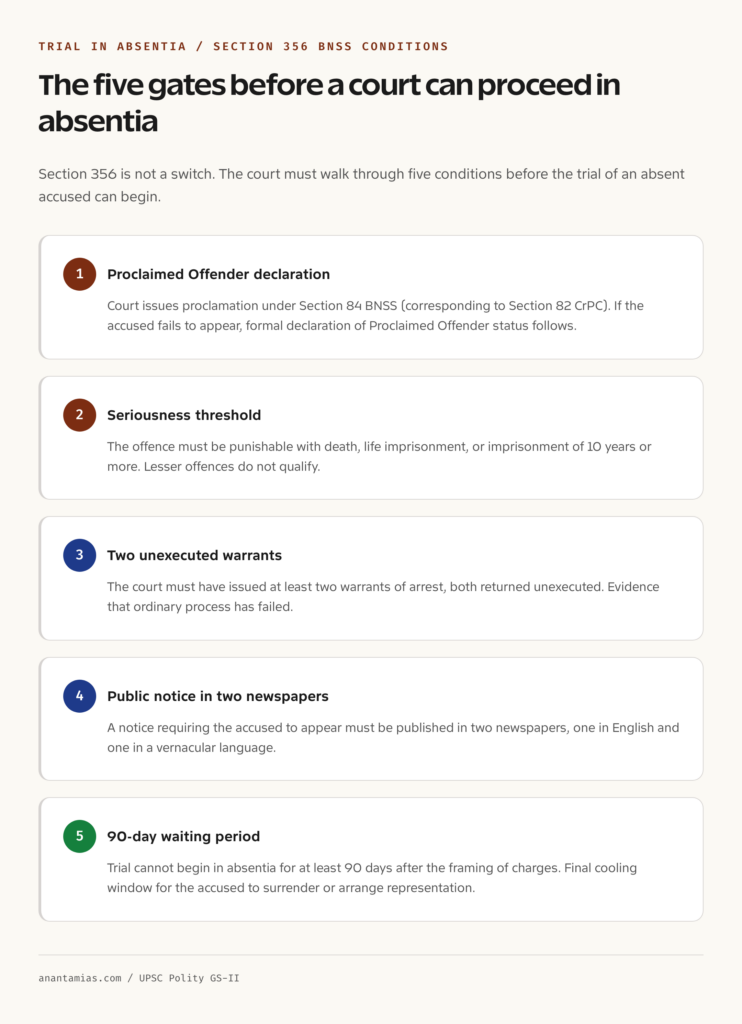
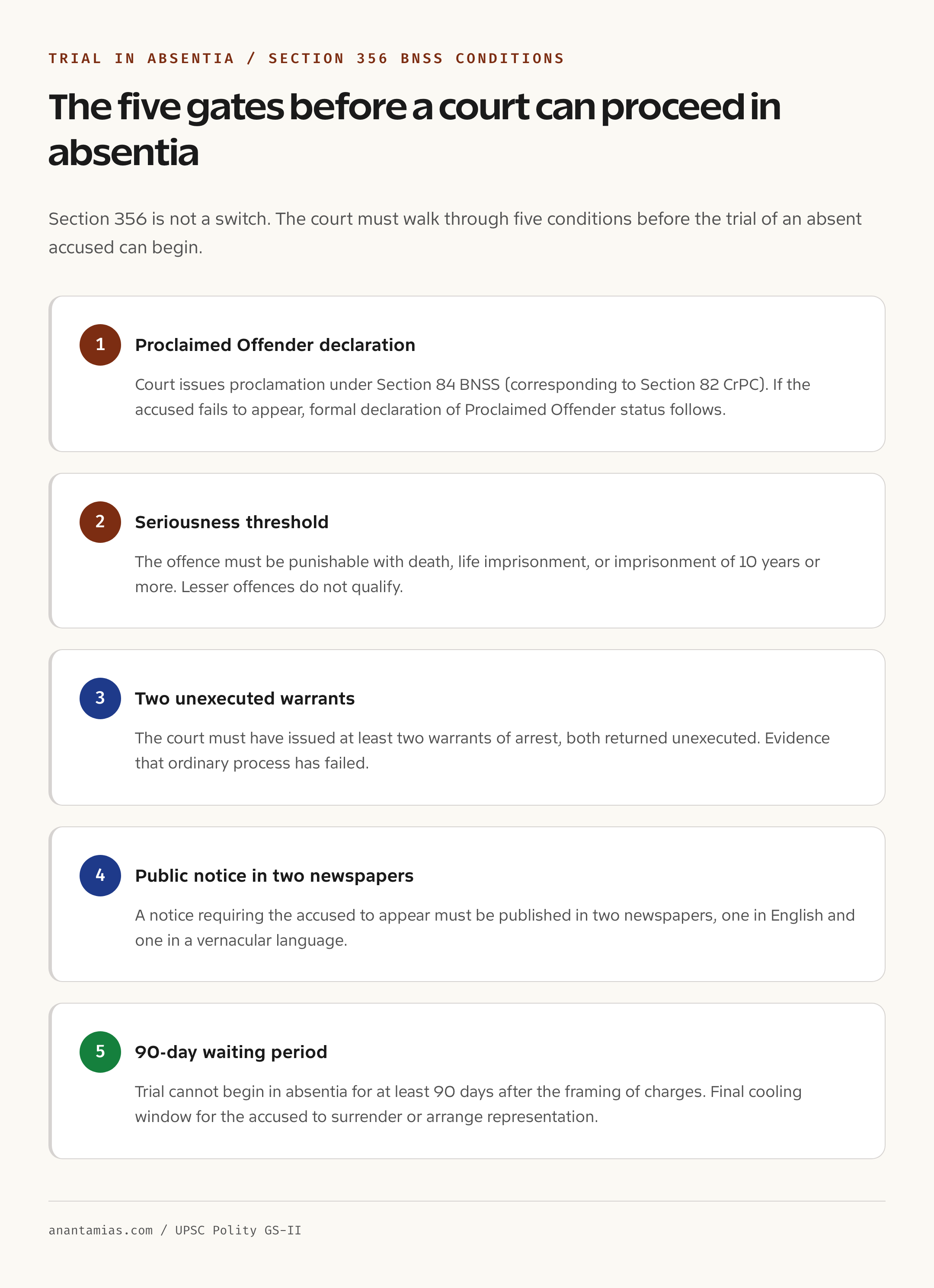
The five conditions of Section 356 are designed as a procedural funnel. Each must be satisfied before the court can lawfully proceed in absentia.
First, the accused must be declared a Proclaimed Offender under Section 84 BNSS. This requires the court to issue a proclamation in the prescribed manner and to wait for the period specified before the accused is so declared. Without the formal declaration, Section 356 cannot be invoked.
Second, the offence charged must be punishable with death, life imprisonment, or imprisonment of ten years or more. The provision does not apply to lesser offences. This threshold is meant to ensure that trial in absentia is reserved for serious cases where public interest in completing the trial outweighs the procedural cost of doing so without the accused.
Third, two warrants of arrest must have been issued and returned unexecuted. This is evidence that ordinary process has failed to secure the accused’s presence and that a proclamation was warranted. The two-warrants rule, distinct from the proclamation procedure, adds an additional check.
Fourth, a public notice requiring the accused to appear must be published in two newspapers, one in English and one in a vernacular language. The notice must be calculated to bring the proceedings to the accused’s attention even if they are abroad.
Fifth, the court must wait at least 90 days from the date of framing charges before commencing trial in absentia. This 90-day cooling period is the final procedural safeguard, giving the accused a defined window to surrender or arrange representation before the trial moves forward without them.
Why Section 356 Matters
For the criminal justice system, Section 356 is a structural shift in how serious offences are processed. Trials that earlier stalled on a fugitive’s absence can now reach judgment. Witnesses can be examined while their memories are fresh. Documentary evidence can be put on record while it is still available. Convictions, where warranted, can be pronounced. The deterrent effect of the criminal law is partially restored even where the accused has fled.
For victims and their families, the section offers something important: closure. A trial that drags on for years while the accused enjoys liberty abroad is a continuing injury to victims. A judicial finding, even an in absentia conviction that may need to be revisited if the accused is later captured, is a public statement about what happened and who is responsible.
For diplomatic and extradition processes, an in absentia conviction can be a useful instrument. A foreign court considering an extradition request from India can be shown a final Indian judgment, which often weighs more heavily than a pending charge. The criminal record of conviction becomes a fact in the international legal system.
For the constitutional question of fair trial, Section 356 introduces a delicate balance. The accused’s right to be heard is protected by state-appointed counsel. The right to appeal within three years gives the convicted person a meaningful post-judgment remedy. The right to challenge evidence and bring fresh material on physical appearance is preserved through reopening provisions. Whether these procedural protections are sufficient to satisfy Article 21’s guarantee of life and personal liberty is a question that constitutional courts will continue to evaluate, building on the wider jurisprudence of fundamental rights that has developed since Maneka Gandhi.
Detailed Analysis: Safeguards and Rights of the Absent Accused
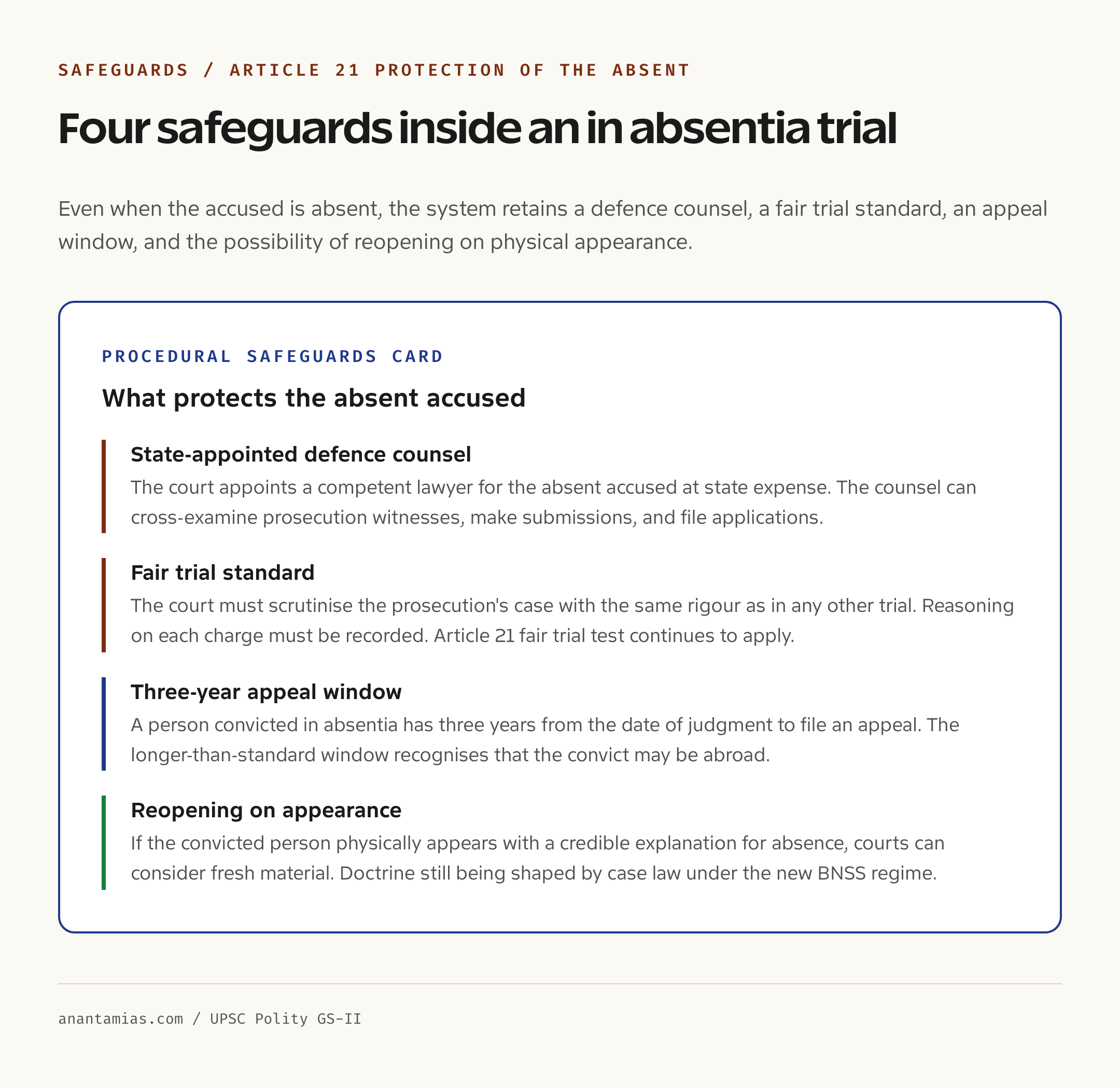
The most important safeguard is the appointment of a defence counsel at state expense. The court is required to appoint a competent lawyer for the absent accused, drawing from the legal aid panel maintained under the Legal Services Authorities Act, 1987. This counsel has the same rights as any other defence counsel: to cross-examine prosecution witnesses, to make submissions on the law and the evidence, to argue on bail and on procedural questions, and to file appeals if convicted.
The right of appeal is the second major safeguard. A person convicted in absentia under Section 356 has three years from the date of judgment to file an appeal. Three years is longer than the standard limitation period for criminal appeals, recognising that the convicted person may be abroad, may not have immediate notice of the judgment, and may need time to engage counsel and prepare grounds.
A further safeguard is the implicit possibility of reopening the proceedings on the accused’s physical appearance. While Section 356 does not say so in terms, criminal procedure jurisprudence allows a court to consider fresh material if circumstances change, particularly where the accused offers a credible explanation for the absence. The Supreme Court and High Courts will need to develop this aspect of the doctrine through case law.
The fair trial requirement runs through the entire framework. The state-appointed counsel must be competent and motivated. The court must scrutinise the prosecution’s case with the same rigour it would apply if the accused were present. The judgment must record the reasoning on each charge. If the conviction is later challenged, the appellate court can examine whether the in absentia trial was conducted fairly.
Comparative Perspective: India, United States, and United Kingdom
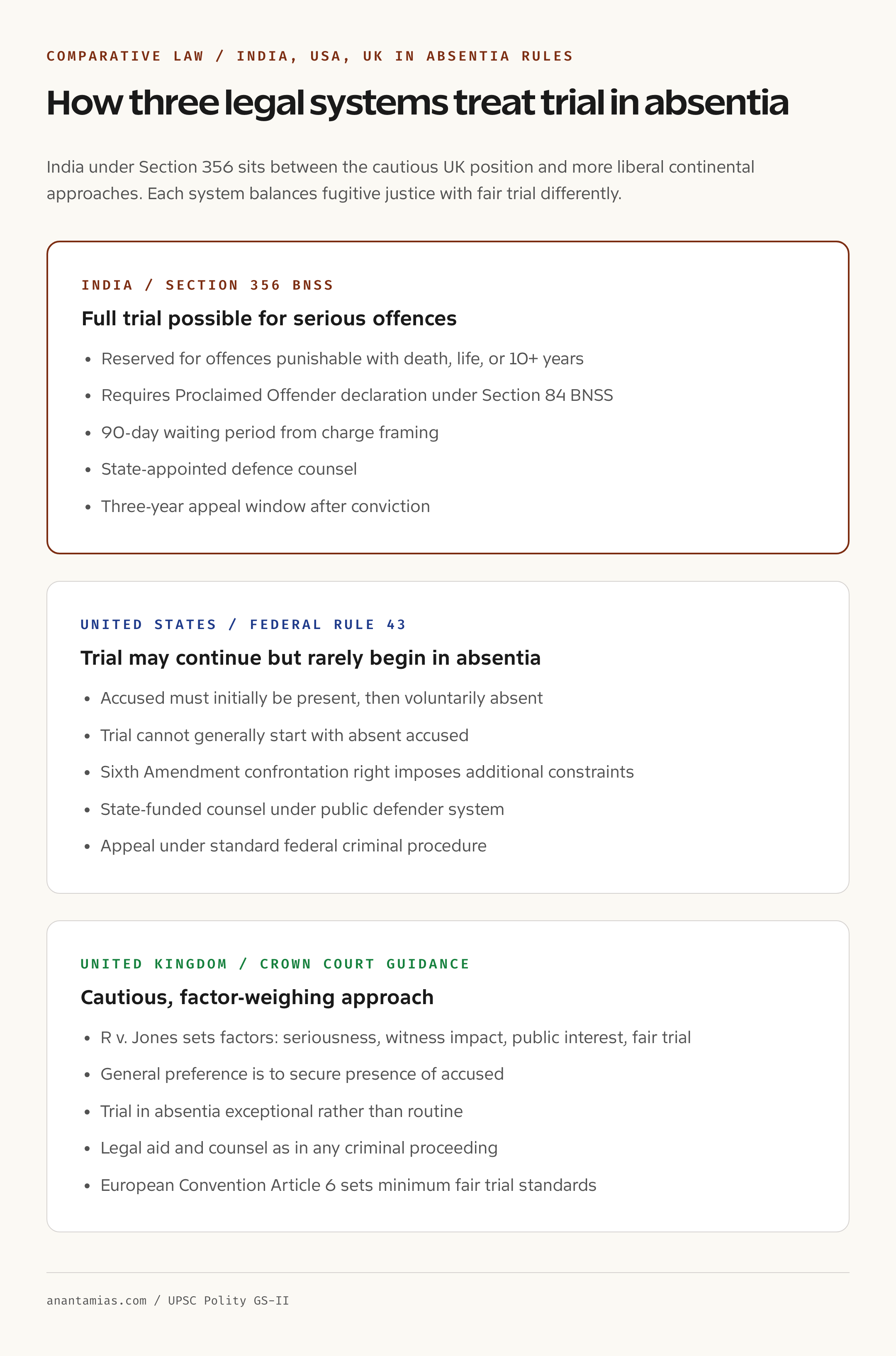
The Indian framework under Section 356 places it among a small group of common law jurisdictions that permit full trial in absentia for serious offences. The United States, under Federal Rule of Criminal Procedure 43, permits the trial to continue in absentia in cases where the accused was initially present and then voluntarily absented themselves. The U.S. rule is therefore narrower than the Indian provision; trial cannot generally begin in absentia, but can continue in absentia. The Sixth Amendment right to confront witnesses imposes additional constraints.
The United Kingdom is more cautious. Crown Court guidance, distilled in cases like R v. Jones, allows trial in absentia only after the court has carefully weighed factors including the seriousness of the offence, the likely impact on witnesses if the trial is delayed, the public interest, and the possibility of an unfair trial. The general inclination remains to secure the accused’s presence wherever possible.
Italy and France, both civil law jurisdictions, have long permitted trial in absentia subject to procedural conditions and a right to a fresh trial on physical appearance. The European Convention on Human Rights, in Article 6, has been interpreted to require that any in absentia conviction be subject to the right to a fresh adjudication if the accused appears.
The Indian framework under Section 356, with its 90-day waiting period, two-warrants rule, public notice requirement, state counsel, and three-year appeal window, sits between the cautious UK position and the more liberal Italian-French position. The provision reflects a deliberate policy choice that India will use in absentia trials primarily for proclaimed offenders charged with the most serious offences.
Challenges and Constitutional Concerns
Three challenges face the new provision. First, the constitutional question. Article 21 of the Constitution guarantees life and personal liberty, which the Supreme Court has read to include the right to a fair trial. Whether a trial conducted entirely in the absence of the accused, however careful the procedural safeguards, satisfies this requirement is a question that will inevitably be litigated. The state’s response will rest on the conditions of Section 356 and on the right of appeal as a meaningful remedy.
Second, the practical question of state-appointed counsel quality. Legal aid panels in India are uneven, with some states having well-trained empanelled lawyers and others relying on junior or under-resourced advocates. A state-appointed counsel for an in absentia trial in a serious case must be of high quality. Otherwise, the safeguard becomes formal rather than substantive. Investment in legal aid quality is essential to making Section 356 work fairly.
Third, the international dimension. Many proclaimed offenders are abroad, and an in absentia conviction does not automatically lead to extradition. Foreign jurisdictions vary in their willingness to extradite a person convicted in absentia, with some refusing on the ground that the conviction was procured without the accused’s presence. India’s extradition treaties and the practical politics of extradition will determine whether Section 356 convictions translate into actual custody and punishment.
Prelims Pointers
Section 356 of the Bharatiya Nagarik Suraksha Sanhita, 2023, replaces and substantially expands Section 299 of the CrPC. The BNSS came into effect on July 1, 2024. Trial in absentia under Section 356 applies only to offences punishable with death, life imprisonment, or imprisonment of ten years or more. The accused must be declared a Proclaimed Offender under Section 84 of the BNSS (corresponding to Section 82 CrPC) before trial in absentia can begin. The court must have issued at least two warrants returned unexecuted. Public notice must be published in two newspapers, one in English and one in vernacular. The court must wait 90 days from framing of charges before proceeding in absentia. The state must provide defence counsel at its own expense. The convicted person has three years from the date of judgment to file an appeal. The Fugitive Economic Offenders Act, 2018 deals with property attachment of fugitive economic offenders but did not earlier provide for in absentia criminal trial.
Mains Practice Questions
Section 356 of the BNSS introduces trial in absentia for serious offences in Indian criminal law. Discuss the conditions, safeguards, and constitutional implications of this provision. (15 marks, 250 words)
Compare the Indian framework for trial in absentia under Section 356 BNSS with that of the United Kingdom and the United States. What lessons can India draw from international experience? (10 marks, 150 words)
The doctrine of fair trial under Article 21 places limits on procedures that affect personal liberty. Critically examine whether trial in absentia under Section 356 BNSS adequately protects this fundamental right. (15 marks, 250 words)
Way Forward
Section 356 will need three things to deliver its intended benefits. First, judicial discipline in applying the conditions. Each of the five conditions, the proclamation, the seriousness threshold, the two warrants, the public notice, and the 90-day wait, must be insisted upon. Courts that take shortcuts will undermine the legitimacy of the provision and will see their judgments overturned in appeal. Second, sustained investment in legal aid. The quality of state-appointed counsel determines whether the procedural safeguard is real or formal. Bar councils and legal services authorities will need to develop a senior empanelment specifically for in absentia trials in serious cases.
Third, integration with the international extradition framework. India’s diplomatic and consular machinery will need to use in absentia convictions effectively in extradition requests, presenting the Indian conviction as evidence of substantive guilt where the foreign jurisdiction permits. Treaties will need to be updated where they currently bar extradition based on in absentia convictions.
In the long run, Section 356 will probably reduce the appeal of fleeing the country as a strategy for serious offenders. The certainty that trial will proceed in their absence, that property may be attached, and that conviction will follow, changes the calculus. For the criminal justice system, the provision returns finality to processes that had become indefinite. For victims, it returns the prospect of justice within a reasonable time. The constitutional balance will be tested, but the underlying policy direction is consistent with how comparable democracies have evolved.
Frequently Asked Questions
What is trial in absentia under Section 356 BNSS?
Trial in absentia is the legal process by which a court conducts and concludes a criminal trial without the physical presence of the accused. Section 356 of the Bharatiya Nagarik Suraksha Sanhita, 2023, permits this for proclaimed offenders charged with offences punishable by death, life imprisonment, or ten or more years of imprisonment, subject to specified procedural conditions.
Who is a Proclaimed Offender?
A Proclaimed Offender is a person formally declared by a court to be evading the process of law. The declaration follows a proclamation under Section 84 of the BNSS, which requires the accused to appear at a stated place on a stated date. If the accused fails to appear, the court records the declaration of proclaimed offender status.
What offences qualify for trial in absentia?
Only offences punishable with death, life imprisonment, or imprisonment of ten years or more qualify. The provision is reserved for serious cases where the public interest in completing the trial outweighs the procedural cost of proceeding without the accused.
What safeguards apply during trial in absentia?
The five main safeguards are: a formal declaration of proclaimed offender status, the issuance of two unexecuted warrants, public notice in two newspapers (one English, one vernacular), a 90-day waiting period from the framing of charges, and the appointment of a defence counsel at state expense. The accused also has three years to file an appeal after conviction.
How is Section 356 BNSS different from Section 299 CrPC?
Section 299 of the old CrPC permitted only the recording of evidence in the absence of the accused; the court could not pronounce final judgment or sentence. Section 356 of the BNSS permits the entire trial, including judgment and sentence, to be completed in absentia, subject to the procedural conditions listed in the section.
Can a person convicted in absentia challenge the verdict?
Yes. The convicted person has three years from the date of judgment to file an appeal. The longer-than-standard appeal window is designed to give the absent person, who may be abroad, sufficient time to obtain notice, engage counsel, and prepare grounds.
Does an in absentia conviction help in extradition?
An in absentia conviction can strengthen an extradition request because it provides the foreign court with a final Indian judgment rather than a pending charge. However, extradition rules vary by jurisdiction. Some jurisdictions refuse extradition based purely on in absentia convictions; others accept it subject to a guarantee of fresh trial on the accused’s return.
Is trial in absentia constitutionally valid?
The provision is new and its constitutional validity will be tested in the courts. The state’s case rests on the procedural safeguards, particularly state-appointed counsel and the right of appeal, as adequate protections of the accused’s right to a fair trial under Article 21. International precedent from Italy, France, the United States, and the United Kingdom supports the principle that trial in absentia, with proper safeguards, is consistent with fair-trial guarantees.
Tell Google you want more of this.
Add Anantam IAS as a preferred sourceOne tap, and this site shows up more often in your own Top Stories, AI Overviews and AI Mode. Remove it any time.