Disclosure: this guide contains Amazon affiliate links. As an Amazon Associate, Anantam IAS earns from qualifying purchases — at no extra cost to you.
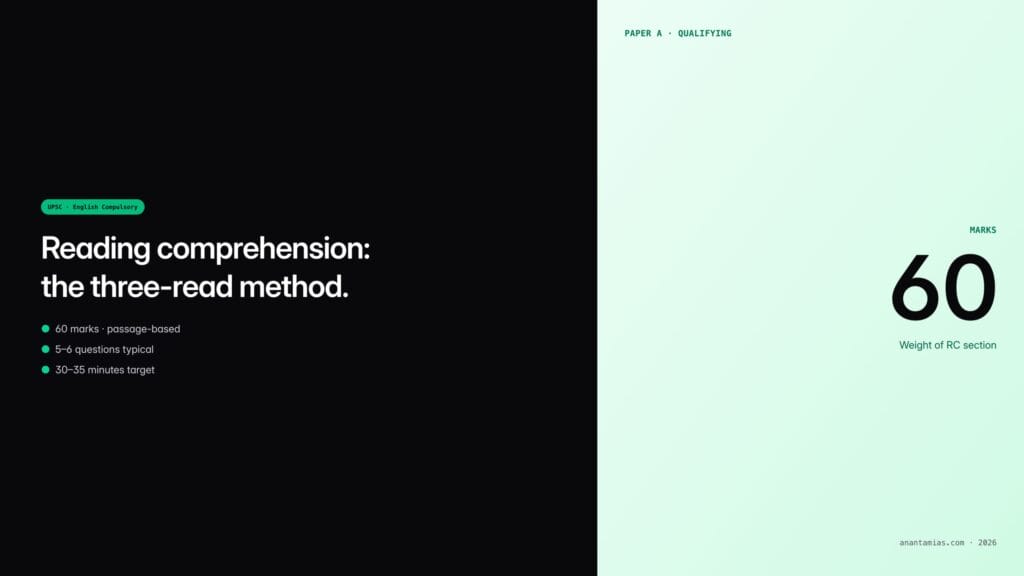
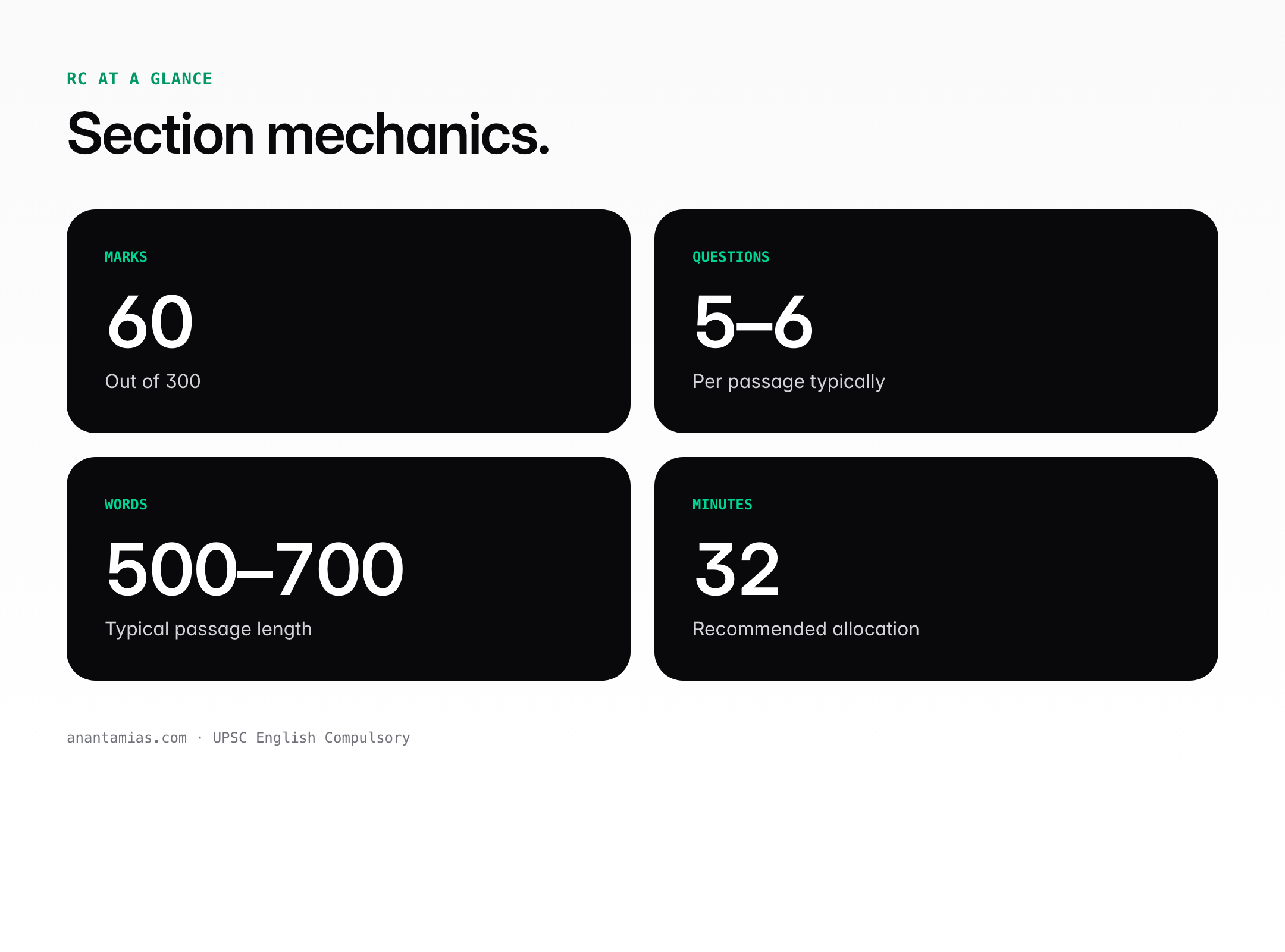
The reading comprehension section carries 60 marks in UPSC English Compulsory. Candidates are given one or two unseen passages of 400–700 words and asked five to eight questions — some factual, some inferential, and usually one on vocabulary in context. Done well, this is the highest strike-rate section in the paper.
Passage Sources UPSC Draws From
- Serious periodicals: The Economist, The Atlantic, Foreign Affairs
- Essays by Russell, Orwell, E.M. Forster, J.B.S. Haldane
- Reports from the World Bank, UN, UNESCO
- Indian commentators: Ramachandra Guha, Amartya Sen, Shashi Tharoor
- Old UPSC passages rotate with slight edits — study previous papers
Question Types
| Type | Approximate weight | How to approach |
|---|---|---|
| Factual | 25% | Locate the exact sentence; paraphrase |
| Inferential | 40% | Trace author’s logic; answer in own words |
| Vocabulary-in-context | 15% | Check the sentence meaning first, then synonym |
| Tone/attitude | 10% | Look at adjectives and evaluative verbs |
| Summary/main idea | 10% | Identify thesis — often the first or last paragraph |
The Three-Read Method
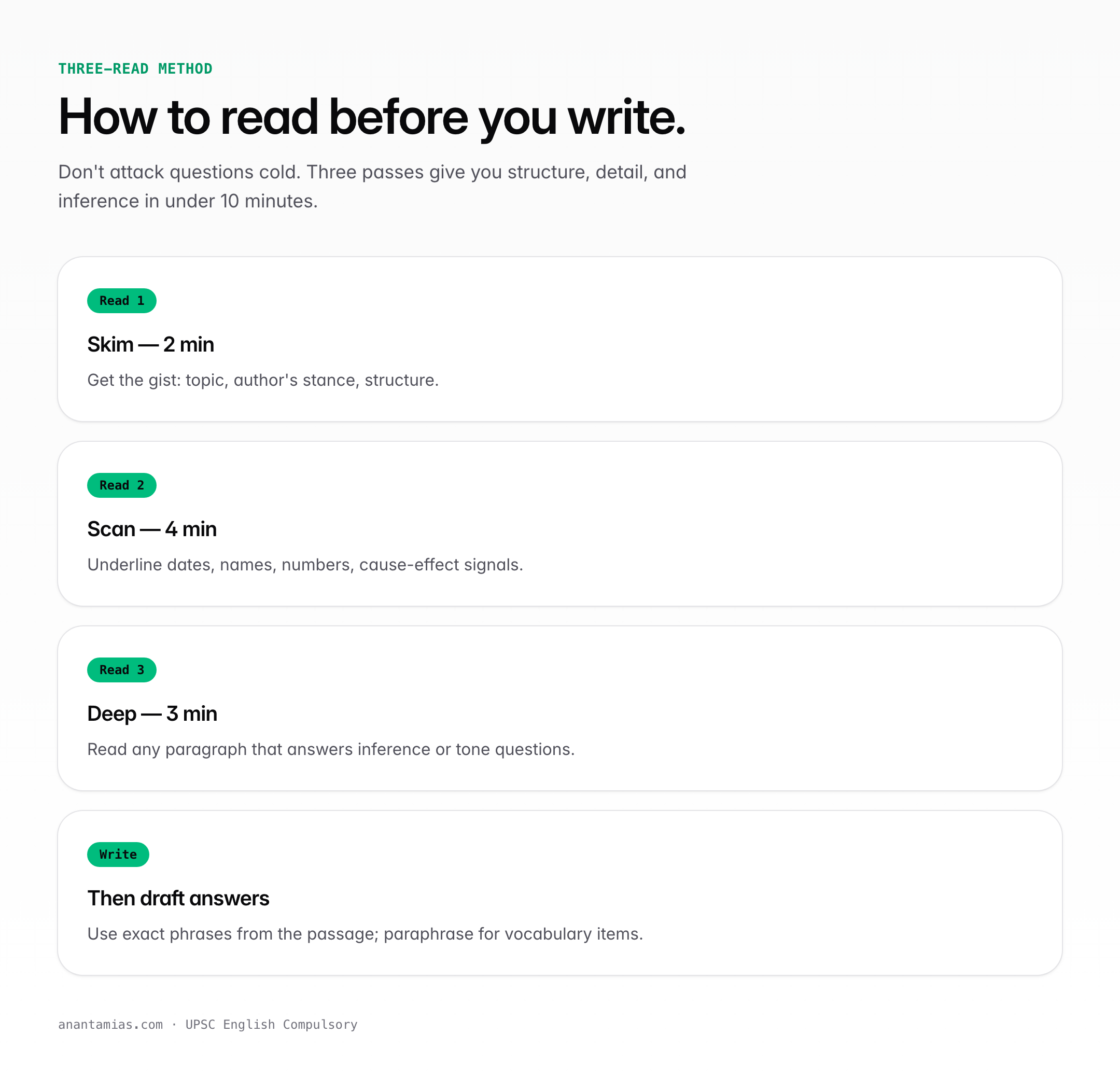
- First read (3 min): skim for topic and structure; note each paragraph’s main idea in one word in the margin.
- Questions scan (2 min): read the questions to know what details matter.
- Second read (5 min): read actively, underlining nouns and verbs that answer your questions.
- Write (25 min): answer in complete sentences, sticking close to the author’s framing.
Writing Comprehension Answers
Each answer must be in your own words — not a copy-paste from the passage. Start with a direct reply; follow with a one-sentence justification referencing the passage. Keep answers short: 2–3 sentences for 4-mark questions, 4–5 for 8-mark questions.
Sample Passage and Questions (UPSC-style)
“The disappearance of the small trader is often lamented as the loss of a way of life. Yet the picture is more complicated. The modern supermarket offers variety and price that the corner shop cannot match; but the shop offered something the supermarket cannot — conversation, community, memory. A society that values only efficiency slowly finds it has nothing else to value.”
Q1. What does the author imply about the small trader?
Model answer: The author implies that while small traders have economic disadvantages compared to supermarkets, they offered intangible social goods — conversation, community, and memory — which modern retail cannot replicate.
Q2. What is the author’s attitude toward efficiency?
Model answer: The author is critical. He suggests that a society which treats efficiency as the sole good will eventually find itself impoverished in every other respect.
Vocabulary-in-Context Questions
Words such as sanguine, desultory, obdurate, obsequious, laconic recur. Read the sentence first; then pick the synonym that fits the sentence’s grammar and polarity. If the sentence is negative, the answer must be negative in tone.
Common Errors in RC
- Copying phrases verbatim (penalty: 1–2 marks per answer)
- Writing long answers for low-mark questions
- Missing the inferential leap in ‘why’ and ‘imply’ questions
- Not returning to the passage — answering from general knowledge
- Ignoring the tone question; it is rarely missed by prepared candidates
30-Day RC Practice Plan

Word Power Made Easy — Norman Lewis (Goyal)
- The authorised Goyal edition of the 1979 classic
- Roots, prefixes and suffixes taught in daily sessions, not word lists
- A self-test after every session so the words stay
- Week 1: One passage from Norman Lewis’s Word Power Made Easy daily.
- Week 2: Two passages daily — one opinion, one scientific.
- Week 3: Timed attempts (12 min read, 25 min write).
- Week 4: Past 10 years’ UPSC passages under full exam conditions.
Scoring Patterns of Past Toppers
Topper notebooks (publicly available for 2018–2022 batches) show average RC scores of 45–52 out of 60. The gap between 40 and 50 is closed almost entirely by writing in one’s own words and keeping answers concise.
Frequently Asked Questions
How many passages come in UPSC English Compulsory RC?
Usually one long passage with multiple questions, occasionally two shorter passages. Total questions are 5–8, cumulatively worth 60 marks.
Can I copy answers from the passage?
No. Answers must be in your own words. Copying phrases verbatim attracts a 1–2 mark penalty per answer.
How long are the passages?
Typically 400–700 words. They are drawn from serious periodicals and essays, not news pieces.
How do I handle vocabulary-in-context questions?
Read the sentence first; pick the synonym that fits both the grammar and the tone of the sentence, not just any dictionary synonym.
How much time should RC take in the exam?
About 40 minutes — 10 for reading and planning, 25 for writing, 5 for revision.
What is the biggest mistake aspirants make in RC?
Writing long answers for small marks. A 4-mark question needs 2–3 sentences, not a full paragraph.
Tell Google you want more of this.
Add Anantam IAS as a preferred sourceOne tap, and this site shows up more often in your own Top Stories, AI Overviews and AI Mode. Remove it any time.