The Global Methane Pledge, launched at COP26 in Glasgow in 2021, is the largest single multilateral effort ever assembled to bring down a non-CO2 greenhouse gas. Led by the United States and the European Union, the pledge commits its signatories to reducing collective global methane emissions by at least 30 percent by 2030 against a 2020 baseline. Achieving the target could prevent more than 0.2 degrees Celsius of warming by 2050, a meaningful chunk of the headroom remaining under the Paris Agreement’s 1.5 degree target. India has not joined the pledge, and the reasons reveal a great deal about the structural constraints of climate diplomacy in agriculture-dependent economies.
For a UPSC aspirant, methane is one of the highest-yielding topics in the entire climate syllabus. It connects climate negotiations to agriculture, fossil fuels, and waste management. It opens up the GWP versus lifetime debate, which separates short-lived climate forcers from long-lived ones. And it forces a thoughtful answer to the tricky question of why a country like India, which has signed the Paris Agreement and is already deploying major emission reduction policies, can still decline to join an apparently sensible pledge.
Quick Facts on the Global Methane Pledge
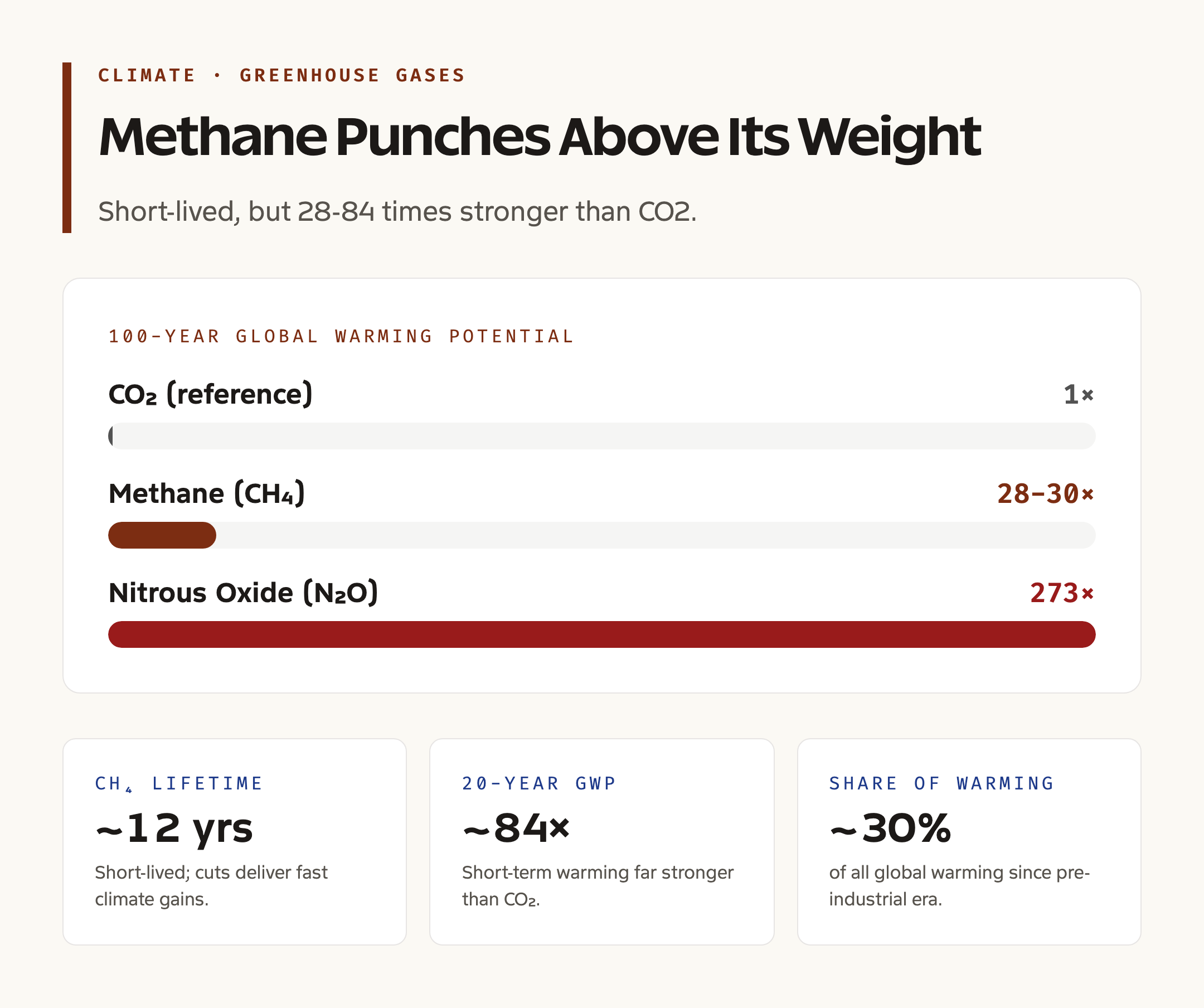
The Global Methane Pledge was launched on 2 November 2021 at the COP26 climate conference in Glasgow. It was led by the United States and the European Union and gathered around 100 signatories at launch. The number has grown since to more than 150 countries. The collective target is a 30 percent reduction in global methane emissions by 2030, measured against 2020 levels. Successful achievement could prevent over 0.2 degrees Celsius of warming by 2050.
Major emitters that have not joined the pledge include India, China, Russia, and Iran. India’s stated reason is that strict reduction targets could affect the agriculture and livestock sector, which is the largest single source of Indian methane emissions and the livelihood of hundreds of millions of small farmers. The pledge is voluntary and has no enforcement mechanism, but signatories are expected to publish methane action plans and report progress through national greenhouse gas inventories under the UNFCCC.
What Methane Is and Why It Matters
Background and Historical Context
For most of the climate negotiation history that began with the UNFCCC in 1992, methane was treated as a secondary concern compared to carbon dioxide. CO2 dominates total emissions, lingers in the atmosphere for centuries, and provides a convenient single metric for national pledges. Methane, by contrast, is a short-lived gas that breaks down to CO2 and water in the atmosphere over about a dozen years, and its emissions are scattered across diffuse sources like rice paddies and cattle that are politically difficult to regulate.
The shift came in the late 2010s. The Intergovernmental Panel on Climate Change’s Sixth Assessment Report and a series of analyses by the Climate and Clean Air Coalition demonstrated that methane was responsible for approximately 30 percent of all global warming since the pre-industrial period, and that aggressive cuts to methane emissions could deliver fast climate gains within a single decade, buying time for the slower transition away from fossil CO2.
The Global Methane Pledge was the diplomatic response. It moved methane from the margins to the centre of the climate agenda. It is also part of a wider methane architecture that includes the Global Methane Initiative, the International Methane Emissions Observatory, and OGMP 2.0, the Oil and Gas Methane Partnership 2.0. Read this against the broader picture of UNFCCC and Paris Agreement, and the mounting evidence flagged in the State of India Environment 2026 report.
Key Provisions and Architecture
The Global Methane Pledge sits at the top of a four-part global methane architecture. Below it are three operational instruments that translate the pledge into action.
The Global Methane Initiative, GMI, is a voluntary multi-partner initiative whose secretariat is hosted by the United States Environmental Protection Agency. It helps countries reduce methane emissions by capturing and converting methane from coal mines, oil and gas systems, agricultural waste, and landfills into usable energy. India has been a partner country since GMI’s predecessor, the Methane to Markets Partnership, and continues to engage with the technical work even though it has not joined the headline pledge.
The International Methane Emissions Observatory, IMEO, was established by the United Nations Environment Programme and launched at the G20 and COP26 in 2021. Its purpose is to create a global, transparent, science-based methane emissions monitoring system using satellite data, ground measurements, and industry reporting. Satellites such as TROPOMI on Sentinel-5P and the dedicated MethaneSAT have made it possible to detect large methane plumes from individual oil and gas facilities, and IMEO collates these observations into a public database.
OGMP 2.0, the Oil and Gas Methane Partnership 2.0, is led by the Climate and Clean Air Coalition and UNEP. It is the most rigorous methane reporting framework for oil and gas companies, requiring measurement-based reporting at the asset level rather than the older practice of using emission factors. More than 100 oil and gas companies, accounting for roughly a third of global production, have signed up.
Why the Pledge Matters
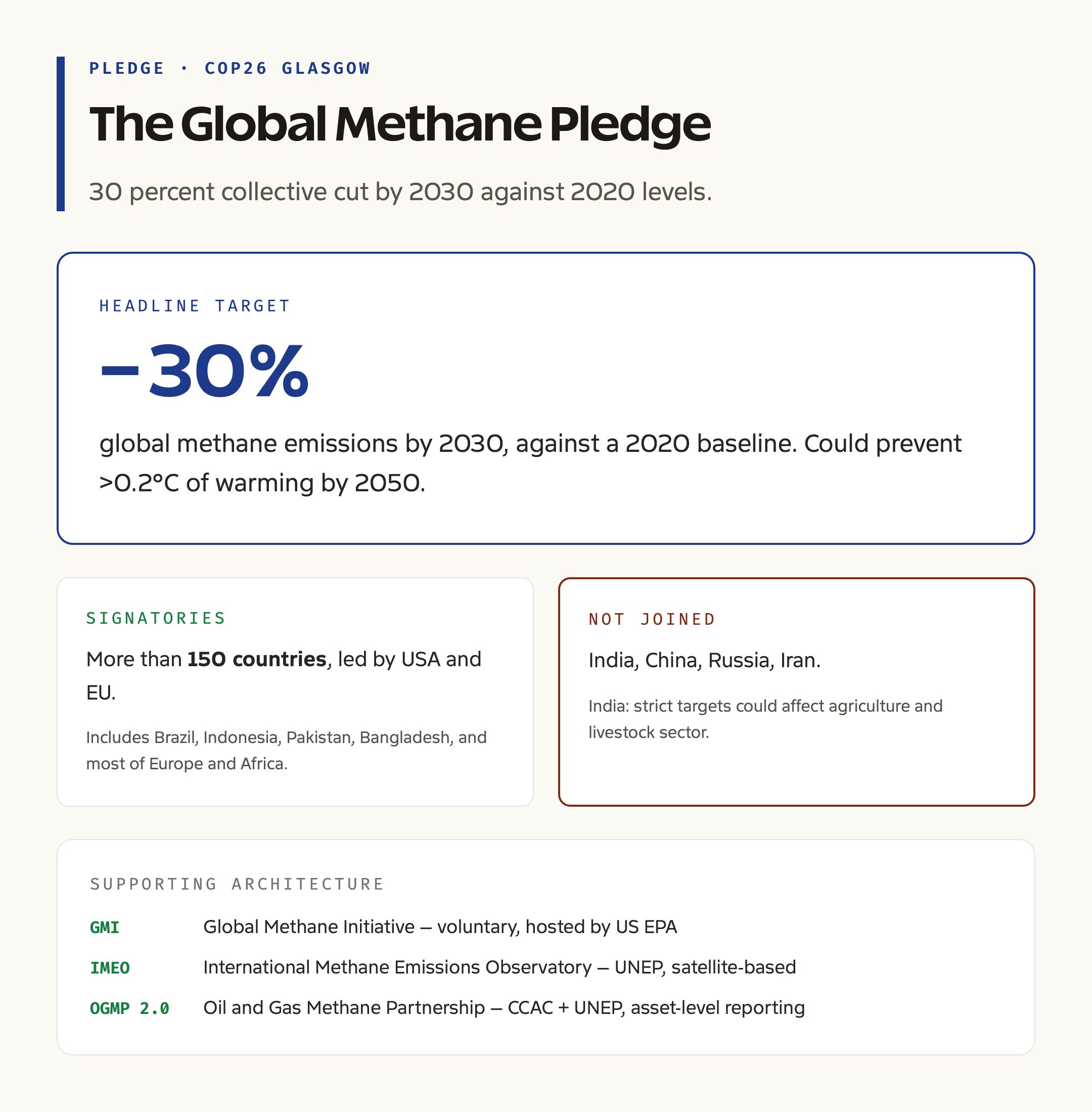
The pledge matters first for the sheer scale of the climate gain. Methane has a 20-year global warming potential of around 84 times that of CO2 and a 100-year GWP of around 28 times. A short-lived gas with that intensity offers a unique opportunity: cuts now produce climate benefits within a decade, unlike CO2 cuts whose effect on temperature plays out over centuries. The 0.2 degrees Celsius of avoided warming by 2050 is approximately one-quarter of the entire remaining 1.5 degree budget.
The pledge matters second for the technology and economics. Around half of global methane emissions can be reduced using existing technologies at low or even negative cost. Plugging leaks in oil and gas systems pays back in saved gas. Capturing methane from landfills produces electricity. Improved livestock feed reduces enteric fermentation. The technical case is unusually strong.
It matters third for the diplomatic signal. Methane has become the test case for whether the global climate regime can move beyond CO2-only thinking. The countries that have joined have committed to publishing national methane action plans. The countries that have not, including India, find themselves having to defend their choice in every successive COP.
Detailed Analysis: India’s Methane Profile
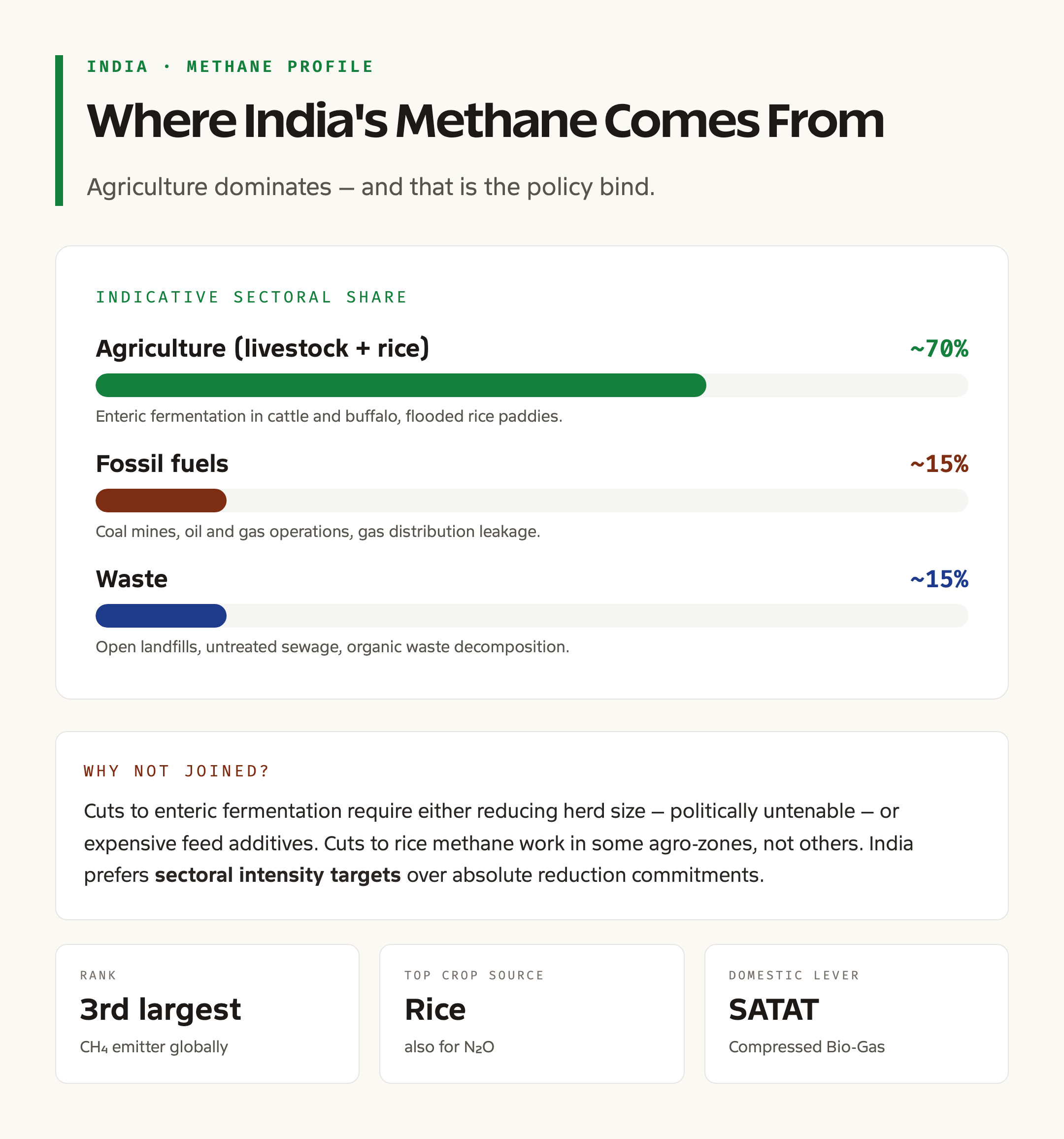
India is the world’s third-largest methane emitter after China and the United States. India’s methane emissions are dominated by agriculture, particularly enteric fermentation in cattle and buffalo, and rice paddy cultivation. Together these account for roughly 70 percent of national methane emissions. The fossil fuel sector, mainly coal mines, oil and gas operations, and gas distribution, accounts for around 15 percent. Waste, especially open landfills and untreated sewage, accounts for the remaining 15 percent.
The agricultural dominance is what makes the pledge politically difficult for India. Cuts to enteric fermentation require either reducing herd size, which is unacceptable in a country where livestock is integral to rural livelihood and food security, or shifting to feed additives that are still expensive. Cuts to rice methane require system-of-rice-intensification techniques and the alternate wetting and drying of paddy fields, which work in some agro-ecological zones but not others. The Government of India has therefore preferred sectoral programmes that reduce methane intensity per unit of output, rather than absolute reduction targets that risk affecting farm output.
In waste, the picture is more promising. Solid Waste Management Rules 2016, the Swachh Bharat Mission, and the city-level push for landfill remediation have already begun to capture methane in some major cities. In oil and gas, India’s smaller fossil sector limits the scope, but the Compressed Bio-Gas programme under the SATAT initiative offers a structural lever, turning waste into transport fuel.
Comparative Look: CO2 vs CH4 vs N2O
| Gas | Atmospheric Lifetime | 100-year GWP | Major Sources |
|---|---|---|---|
| Carbon Dioxide (CO2) | Centuries to millennia | 1 (reference) | Fossil fuel combustion, deforestation |
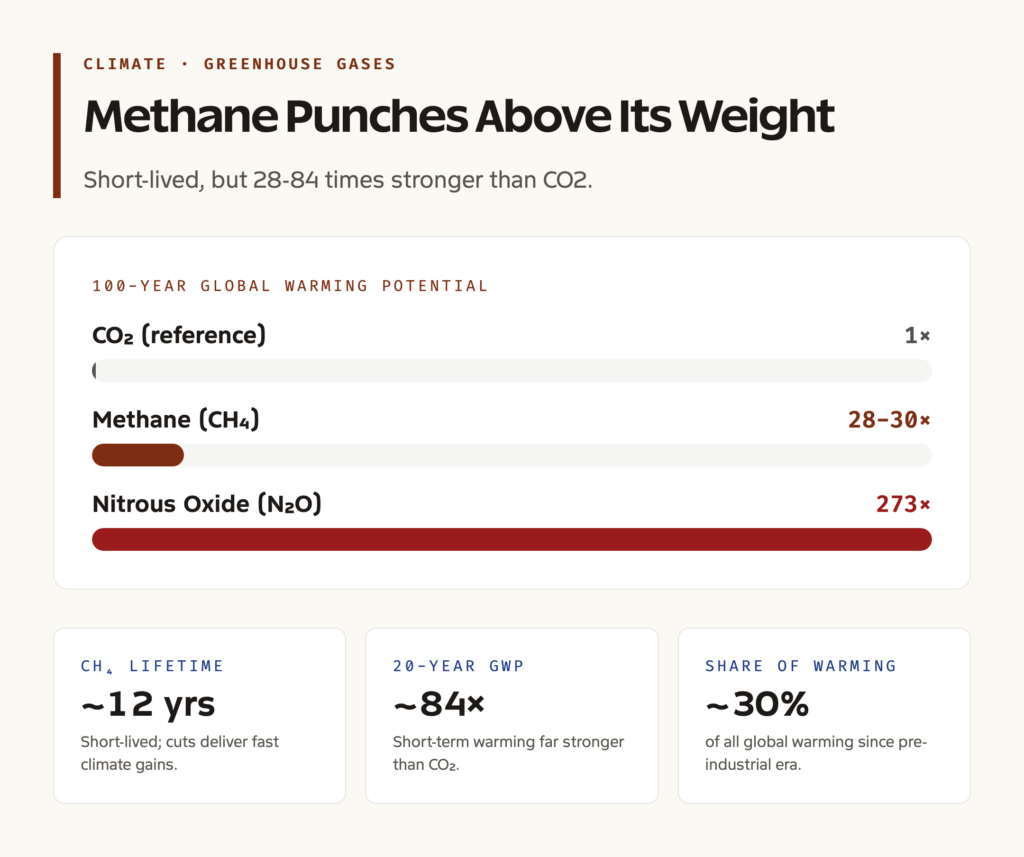
| Methane (CH4) | About 12 years | 28 to 30 | Agriculture, fossil fuels, waste |
| Nitrous Oxide (N2O) | About 114 years | 273 | Fertilisers, livestock, industrial processes |
The 20-year GWP of methane is around 84, much higher than the 100-year figure of 28 because methane breaks down within the first dozen years. This is why methane mitigation produces fast climate benefits and why the pledge focuses on a 2030 deadline rather than mid-century.
This is also where methane connects to the wider climate negotiation and the broader UNFCCC framework. Article 4 of the Paris Agreement requires national greenhouse gas inventories to cover methane and nitrous oxide alongside CO2.
Challenges in Methane Mitigation
The first challenge for India is the agriculture-livelihood lock. Sixty percent of methane comes from livestock and rice, both intimately tied to rural employment and food security. The second is data. India’s methane inventory still relies heavily on emission factors and activity data rather than direct measurement, and the gap between bottom-up inventories and satellite observations is wider than for most major emitters.
A third challenge is the fossil fuel sector. India’s coal mines emit significant amounts of methane that could in principle be captured and used as gas, but the existing coal seam gas regime is fragmented and poorly enforced. The fourth is institutional. Methane policy in India is split across the Ministry of Agriculture, Ministry of Petroleum, Ministry of Environment, and Ministry of Housing and Urban Affairs. No single agency has clear ownership.
Prelims Pointers
Methane has the chemical formula CH4 and an atmospheric lifetime of around 12 years. Its 20-year global warming potential is approximately 84 times that of CO2, and its 100-year GWP is around 28 to 30 times. Methane is responsible for around 30 percent of global warming since the pre-industrial period.
The Global Methane Pledge was launched at COP26 in Glasgow in 2021 by the United States and the European Union. The collective target is a 30 percent reduction by 2030 against 2020 levels. India has not joined. The Global Methane Initiative is hosted by the US EPA. The International Methane Emissions Observatory was established by UNEP. OGMP 2.0 is the leading methane reporting framework for oil and gas, led by the Climate and Clean Air Coalition.
Among Indian crops, rice is the most important anthropogenic source of both methane and nitrous oxide.
Mains Questions on Methane
Critically examine India’s decision not to join the Global Methane Pledge in light of the country’s emission profile and rural livelihood concerns. Discuss the role of methane mitigation in achieving the 1.5 degree Celsius goal of the Paris Agreement. Evaluate the architecture of global methane governance, including the Global Methane Pledge, GMI, IMEO, and OGMP 2.0.
A complete answer would acknowledge the climate logic of methane mitigation while explaining the structural constraints on Indian agricultural emissions. It would also recognise that not joining the pledge is not the same as inaction, since India runs sectoral programmes on biogas, landfill management, and rice cultivation that reduce methane intensity even without an absolute target.
Way Forward
The route forward involves four reforms. The first is direct measurement of methane emissions from priority sources, using satellite, drone, and ground-based instruments to replace emission-factor-based inventories. The second is sector-specific intensity targets in agriculture, paired with crop insurance and farmer support to absorb the transition cost.
The third is rapid scale-up of the Compressed Bio-Gas programme and city-level landfill capture, both of which produce methane mitigation as a co-benefit of waste-to-energy. The fourth is engagement with the global methane architecture without joining the headline pledge, ensuring that India remains part of GMI, IMEO, and OGMP 2.0 even as it preserves its policy space on absolute targets.
The Global Methane Pledge has changed the climate conversation. Whether India eventually joins or continues to engage from the outside, the pressure to measure, report, and reduce methane is no longer optional.
Frequently Asked Questions
What is the Global Methane Pledge?
The Global Methane Pledge is a voluntary international agreement launched at COP26 in Glasgow on 2 November 2021. Signatories commit to collectively reducing global methane emissions by at least 30 percent by 2030, measured against 2020 levels.
Who launched the Global Methane Pledge?
The pledge was launched by the United States and the European Union. More than 150 countries have signed since launch, although major emitters including India, China, Russia, and Iran have not joined.
Why has India not joined the Global Methane Pledge?
India’s stated reason is that strict absolute reduction targets could adversely affect the agriculture and livestock sector, which is the largest source of Indian methane emissions and the livelihood of hundreds of millions of small farmers. India prefers sectoral intensity targets that reduce emissions per unit of output without compromising rural employment.
What is the global warming potential of methane?
Methane has a 20-year global warming potential of around 84 times that of CO2 and a 100-year GWP of around 28 to 30 times. This means each tonne of methane causes much more warming over the short term than each tonne of CO2.
What is the atmospheric lifetime of methane?
Around 12 years. Methane is a short-lived greenhouse gas, which is why mitigation produces rapid climate benefits, unlike CO2 which lingers for centuries.
What are the major sources of methane emissions globally?
Agriculture, particularly enteric fermentation in cattle and rice paddy cultivation. Fossil fuel operations, including oil and gas leakage and coal mining. Waste, including landfills and sewage.
What is the Global Methane Initiative?
The Global Methane Initiative, GMI, is a voluntary multi-partner initiative whose secretariat is hosted by the United States Environmental Protection Agency. It helps countries reduce methane emissions by converting methane into energy from coal mines, oil and gas systems, agricultural waste, and landfills.
What is the International Methane Emissions Observatory?
The International Methane Emissions Observatory, IMEO, was established by the United Nations Environment Programme and launched at COP26 in 2021. It creates a global, transparent, science-based methane emissions monitoring system using satellite data, ground measurements, and industry reporting.
What is OGMP 2.0?
The Oil and Gas Methane Partnership 2.0 is the world’s most rigorous methane reporting framework for oil and gas companies. Led by the Climate and Clean Air Coalition and UNEP, it requires measurement-based reporting at the asset level.
Which Indian crop is the most important anthropogenic source of methane?
Rice. Flooded paddy fields create anaerobic conditions in which methanogenic bacteria thrive, releasing methane to the atmosphere. Rice is also the most important anthropogenic source of nitrous oxide in India.
How much warming could the Global Methane Pledge prevent?
Achieving the 30 percent reduction target by 2030 could prevent over 0.2 degrees Celsius of warming by 2050, a meaningful share of the remaining headroom under the Paris Agreement’s 1.5 degree target.
Tell Google you want more of this.
Add Anantam IAS as a preferred sourceOne tap, and this site shows up more often in your own Top Stories, AI Overviews and AI Mode. Remove it any time.