
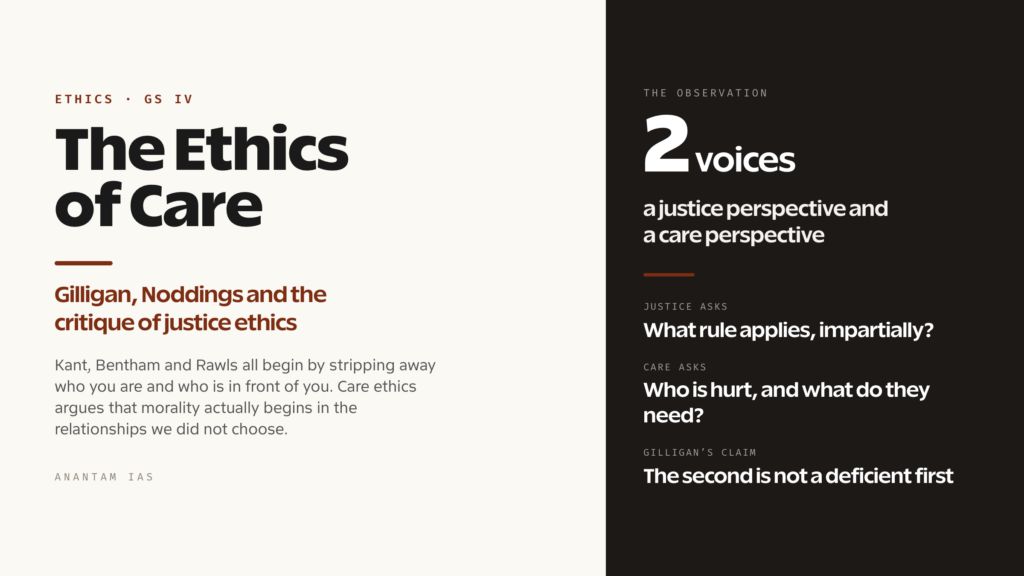
Almost everything else in the ethics syllabus reasons the same way. Kant asks what rule you could will universally. Bentham asks which action maximises aggregate welfare. Rawls asks what you would choose behind a veil of ignorance. Each begins by stripping away who you are and who is in front of you, because impartiality is treated as the mark of moral seriousness.
Care ethics starts from the opposite end. It holds that moral life actually begins in relationships — in the concrete, unequal, particular attachments we do not choose — and that a framework which treats attachment as bias will systematically misdescribe most of what people do for each other. It emerged from a specific observation: that when psychologists measured moral development, one recognisable way of reasoning kept scoring badly.
Gilligan and the Different Voice
Lawrence Kohlberg’s stages of moral development, built from studies of boys, ranked reasoning by how far it moved towards abstract, universal principle. His highest stage reasons from impartial rules; conventional stages reason from relationships and expectations. The framework is set out in Kohlberg’s stages of moral development.
Carol Gilligan, who had worked with Kohlberg, noticed that girls and women often placed lower — and that the reason was not weaker reasoning but a different kind of reasoning. Faced with a dilemma, many of her subjects declined to treat it as a contest of rights to be settled by ranking principles. They asked who would be hurt, what the relationships could bear, whether the dilemma could be dissolved rather than adjudicated, and what else they needed to know about the people involved. Scored against a scale that rewarded abstraction, contextual reasoning looks like failure to abstract.
Her argument in In a Different Voice was therefore double. Descriptively, there are two moral orientations: a justice perspective concerned with rights, fairness and impartial rules, and a care perspective concerned with relationships, responsibility and preventing harm to particular people. Normatively, the second is not a deficient version of the first — and a psychology that had measured only one had mistaken a partial account for a complete one.
The gender claim is the part most often overstated, including by people who invoke her approvingly. Gilligan’s mature position is that the two voices are not biologically assigned to sexes; they are differently distributed by socialisation, and a mature moral agent can use both. Reading care ethics as “how women reason” is both bad scholarship and, as critics pointed out, a way of re-essentialising exactly what she was trying to unsettle.
Noddings: Caring as the Ethical Relation
Nel Noddings gave the position its fullest philosophical statement. For her the basic moral unit is not the isolated agent applying a principle but the relation between the one-caring and the cared-for.
She distinguishes natural caring — the immediate, unforced response to someone we love — from ethical caring, which is what we summon when the natural impulse is absent. Ethical caring draws on our memory of having cared and having been cared for, and it is where the moral effort lies: the difficult client, the hostile petitioner, the person whose situation we find tiresome.
Two features make her account distinctive. Caring requires engrossment — genuine attention to the other’s reality as they experience it, not as we imagine it — and motivational displacement, where their needs actually redirect our energy. And it is not complete until it is received: care that the cared-for does not experience as care has failed, however well-intentioned. That last point is a sharper test of a welfare programme than any output indicator.
Tronto: Care as a Political Practice
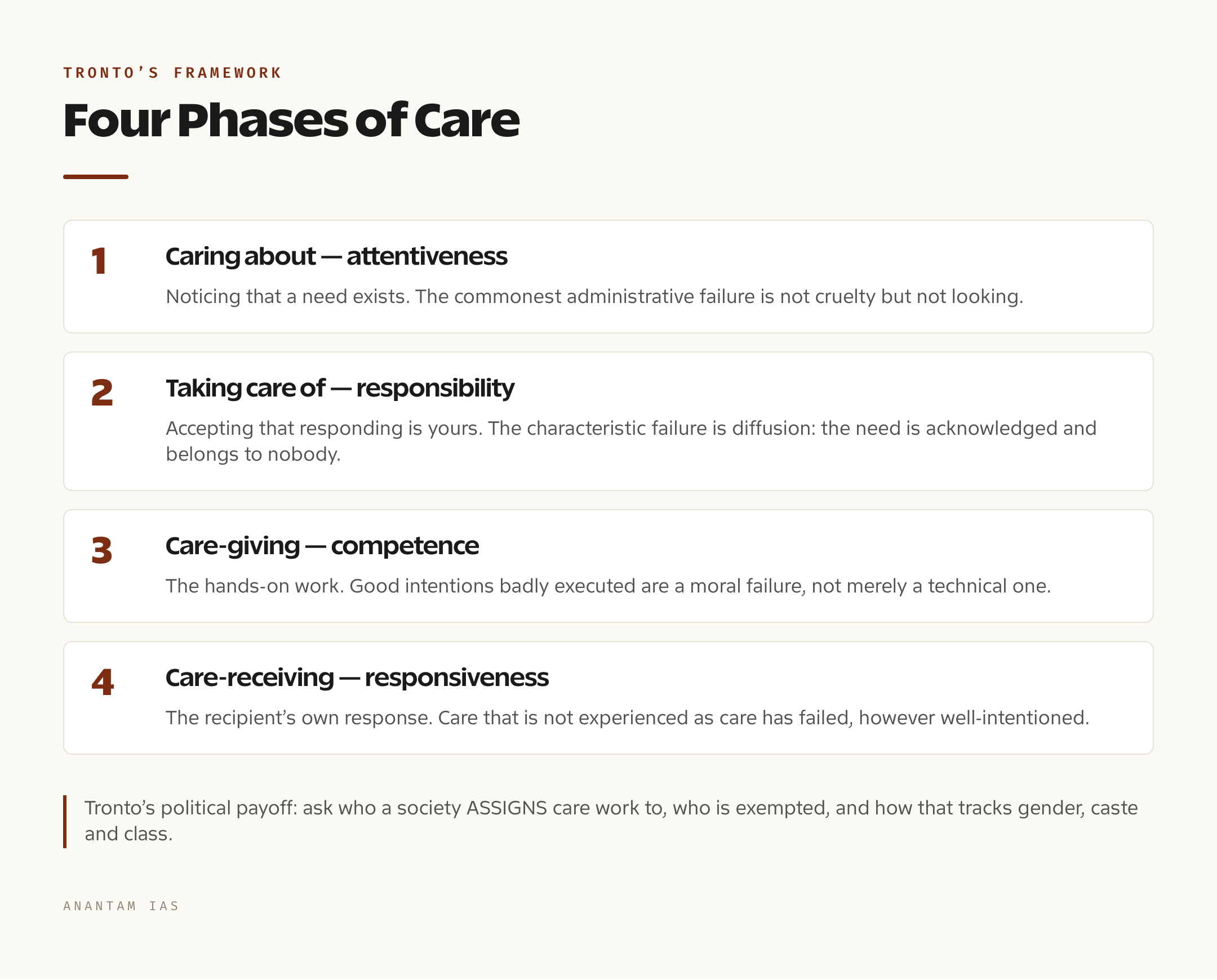
Joan Tronto moved care ethics out of the household and into institutions, which is what makes it usable in public administration. She describes care as a practice with four phases, each carrying its own virtue.
Caring about — noticing that a need exists. The virtue is attentiveness, and its failure is the commonest one in administration: not cruelty but not looking.
Taking care of — accepting responsibility to respond. The virtue is responsibility, and the characteristic failure is diffusion, where a need is acknowledged and belongs to nobody.
Care-giving — the actual hands-on work. The virtue is competence, and Tronto’s point is that good intentions badly executed are a moral failure, not merely a technical one.
Care-receiving — the response of the person cared for. The virtue is responsiveness, which requires attending to the recipient’s account rather than the provider’s.
The political payoff is that Tronto lets us ask who in a society is assigned care work, who is exempted from it, and how that distribution tracks gender, caste and class. Care becomes a question about the division of labour rather than about private virtue.
The Criticisms
Care ethics has to answer three serious objections, and a good answer states them.
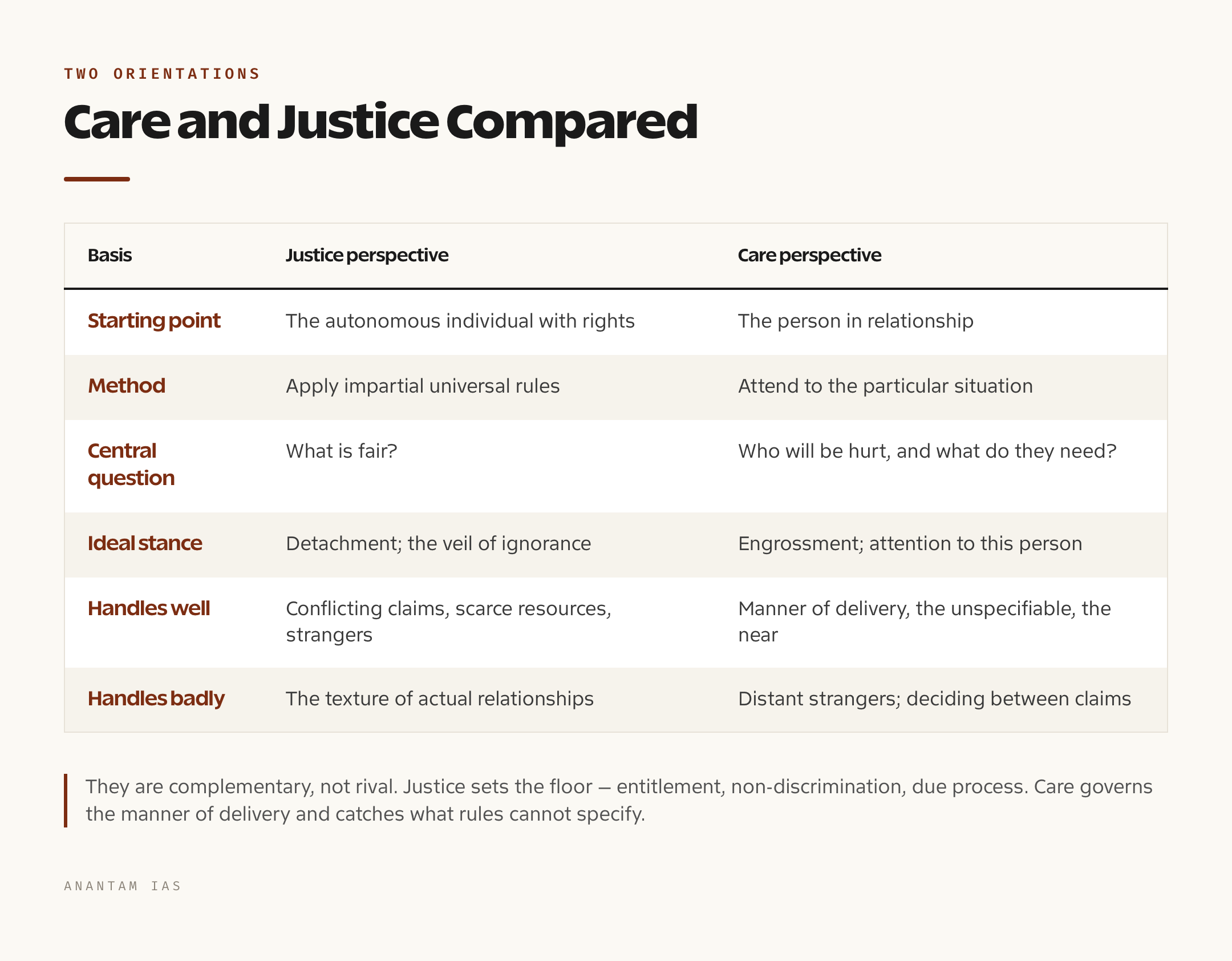
Parochialism. Care attends to those near us. But most large-scale injustice involves distant strangers, and an ethic anchored in relationship struggles to generate obligations to people we will never meet. Critics argue that impartial justice reasoning is precisely what corrects for the moral pull of proximity — which is the whole point of Rawls’ veil.
Exploitation of carers. If caring is elevated as a moral ideal, and care work is already done disproportionately by women and by the poor, valorising it can reinforce the arrangement. Noddings’ demand for engrossment and motivational displacement is demanding; asked of people with no power to refuse, it becomes a burden dressed as a virtue.
Indeterminacy. Care ethics gives no procedure for conflict. When two people in your care have incompatible needs, or when resources are finite, attentiveness does not tell you who gets the bed. Justice frameworks at least supply a decision rule.
The strongest reply is that care and justice are complementary rather than rival. Justice sets the floor — entitlements, non-discrimination, due process — while care governs the manner of delivery and catches what rules cannot specify. An administration that has one without the other fails in a predictable way: rule-bound and callous, or warm and arbitrary.
Where It Meets the Indian Syllabus
Care ethics maps onto parts of GS IV that otherwise sit awkwardly in a rules-based framework.
Empathy and compassion towards weaker sections is a named foundational value, and care ethics is the theory behind it — the reason it appears alongside impartiality rather than being crowded out by it. See empathy and compassion towards weaker sections.
The receiving test as a delivery standard. Noddings’ insistence that care must be received reframes service delivery. A grievance mechanism that logs and closes complaints without the complainant experiencing redress has satisfied its indicators and failed its purpose — a distinction that connects directly to quality of service delivery.
Survivor-centred policy. When a state designs an anti-trafficking or victim-support policy around the survivor’s own account of what they need, rather than around the convenience of the agencies involved, that is care ethics written into administration. Odisha’s proposed survivor-centred approach is the recent Indian instance.
The care economy. Unpaid domestic and care work, ASHA and anganwadi workers, and the recognition of care as labour are policy questions that Tronto’s framework states more precisely than either rights language or welfare economics.
Indian resonances. Care ethics is not simply an import. Gandhi’s insistence that means and relationships carry moral weight, the ethic of seva, and Buddhist karuna all locate morality in responsiveness to particular suffering rather than in impartial calculation. The account of compassion in Mother Teresa’s ethics of care is where the site already applies this in practice.
Using It in an Answer
The practical value in a case study is that care ethics asks questions the other frameworks skip.
- Who is actually in front of me, and what do they say they need? Not what the category of person typically needs.
- What does this decision do to the relationship between citizen and state, beyond the immediate outcome?
- Has the care been received? Test the recipient’s experience, not the process record.
- Who is bearing the care burden that my decision creates, and did they consent to it?
- Can the dilemma be dissolved rather than adjudicated? Gilligan’s subjects looked for this first, and administrators often can find it.
Deploy it as a supplement, not a trump. An answer that resolves a resource-allocation dilemma purely by appeal to care will look soft; one that applies a rule without asking who is in front of the officer will look mechanical. Naming both perspectives, and saying which governs which part of the decision, is what a strong answer does.
FAQ
What is the ethics of care? A moral framework holding that ethics begins in relationships and responsiveness to particular others, rather than in impartial rules applied to abstract persons. Its central concepts are attentiveness, responsibility and the receiving of care.
What was Gilligan’s criticism of Kohlberg? That his stages were built from studies of boys and rewarded abstract, universal reasoning, so a contextual and relational way of reasoning scored as less developed. She argued this was a different moral voice, not a deficient one.
Is care ethics a claim about women? Not in Gilligan’s mature position. The two voices are distributed differently by socialisation rather than assigned by sex, and a mature agent can use both. Treating care as “how women reason” re-essentialises what she was trying to unsettle.
What did Noddings mean by natural and ethical caring? Natural caring is the unforced response to someone we love. Ethical caring is what we summon when that impulse is absent, drawing on our memory of caring and being cared for — and it is where the real moral effort lies.
What are Tronto’s four phases of care? Caring about (attentiveness), taking care of (responsibility), care-giving (competence) and care-receiving (responsiveness). Her contribution was to treat care as a political practice and ask how care work is distributed in society.
What are the main criticisms of care ethics? Parochialism, since it struggles to ground duties to distant strangers; the risk of exploiting those who already do most care work; and indeterminacy, since it supplies no rule for deciding between competing claims on scarce resources.
Practice Questions
Prelims MCQs
- Carol Gilligan’s In a Different Voice was primarily a response to the work of: (a) John Rawls (b) Lawrence Kohlberg (c) Jeremy Bentham (d) Immanuel Kant — Answer: (b) She argued Kohlberg’s stages undervalued a relational, contextual moral voice.
- The distinction between “natural caring” and “ethical caring” is associated with: (a) Nel Noddings (b) Joan Tronto (c) Virginia Held (d) Martha Nussbaum — Answer: (a) Noddings distinguished the unforced response from the effort summoned when it is absent.
- In Tronto’s framework, the virtue attached to “caring about” is: (a) competence (b) responsiveness (c) attentiveness (d) responsibility — Answer: (c) Caring about means noticing a need exists; its virtue is attentiveness.
- Noddings holds that an act of caring is incomplete unless: (a) it is publicly recorded (b) it is received as care by the cared-for (c) it is reciprocated (d) it follows a universal rule — Answer: (b) Care that the recipient does not experience as care has failed.
- Which is a standard criticism of care ethics? (a) It is excessively rule-bound (b) It cannot easily ground obligations to distant strangers (c) It ignores the role of emotion (d) It requires the veil of ignorance — Answer: (b) The parochialism objection: care attends to those near us.
Mains Practice Questions
- “Care and justice are complementary rather than rival frameworks.” Examine this claim with reference to welfare administration in India. (15 marks, 250 words)
- Explain Gilligan’s critique of Kohlberg. Does the existence of a distinct “care voice” undermine the idea of stages of moral development? (15 marks, 250 words)
- Apply Tronto’s four phases of care to a public grievance-redress mechanism, identifying the characteristic failure at each phase. (15 marks, 250 words)
- “Valorising care can entrench the exploitation of those who already provide it.” Discuss this objection to care ethics. (10 marks, 150 words)
- Noddings holds that care must be received to be complete. Discuss what this implies for how service delivery should be measured. (10 marks, 150 words)
Tell Google you want more of this.
Add Anantam IAS as a preferred sourceOne tap, and this site shows up more often in your own Top Stories, AI Overviews and AI Mode. Remove it any time.