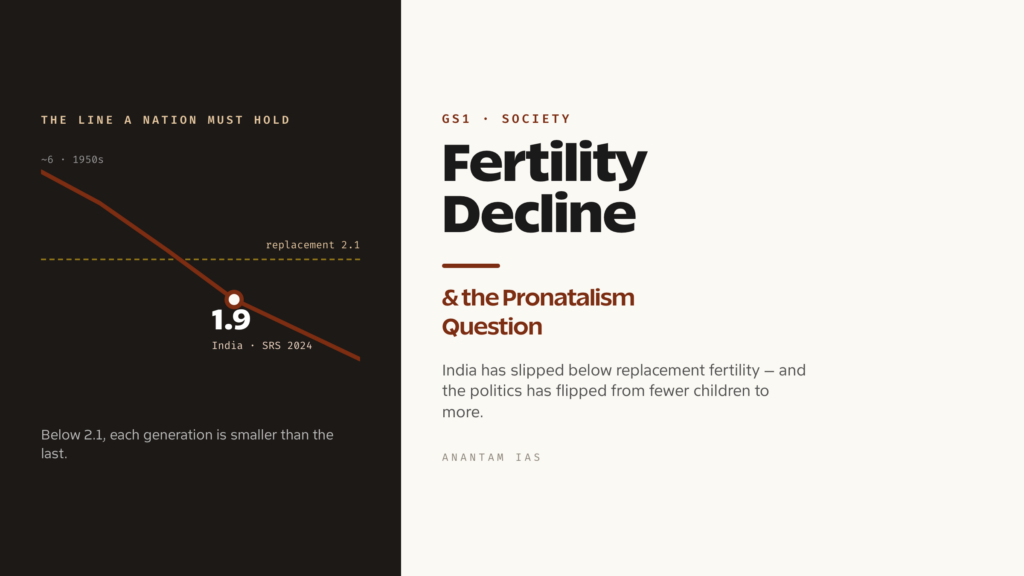
For most of living memory, India’s demographic story had one plot: too many people, growing too fast, straining land, jobs and water. So it lands strangely when the latest official numbers say the opposite is now happening. The Sample Registration System’s 2024 report, released in 2026, put India’s total fertility rate — the average number of children a woman has over her lifetime — at about 1.9. That is below the replacement level of 2.1, the threshold at which a population just renews itself without growing or shrinking. India is still adding people, because of past momentum and rising lifespans. But the engine that drives that growth has quietly slipped below the line, and the country has crossed a demographic frontier most Indians never expected to reach so soon.
This is not a small statistical footnote. Fertility decline reshapes everything downstream — the size of the workforce, the age of the median citizen, the pension and care burden, even the balance of political seats between states. And it has arrived unevenly, with the south and west already at fertility levels you’d find in Germany or Japan while parts of the north and centre are still well above replacement. For a UPSC aspirant, this sits at the heart of GS Paper 1 Society: population, ageing, the demographic dividend and the new debate over pronatalism — the deliberate effort by governments to push birth rates back up. Get the numbers and the logic right, and you can answer almost any question the examiner throws at this theme.
What Fertility Decline Means and How Far It Has Gone
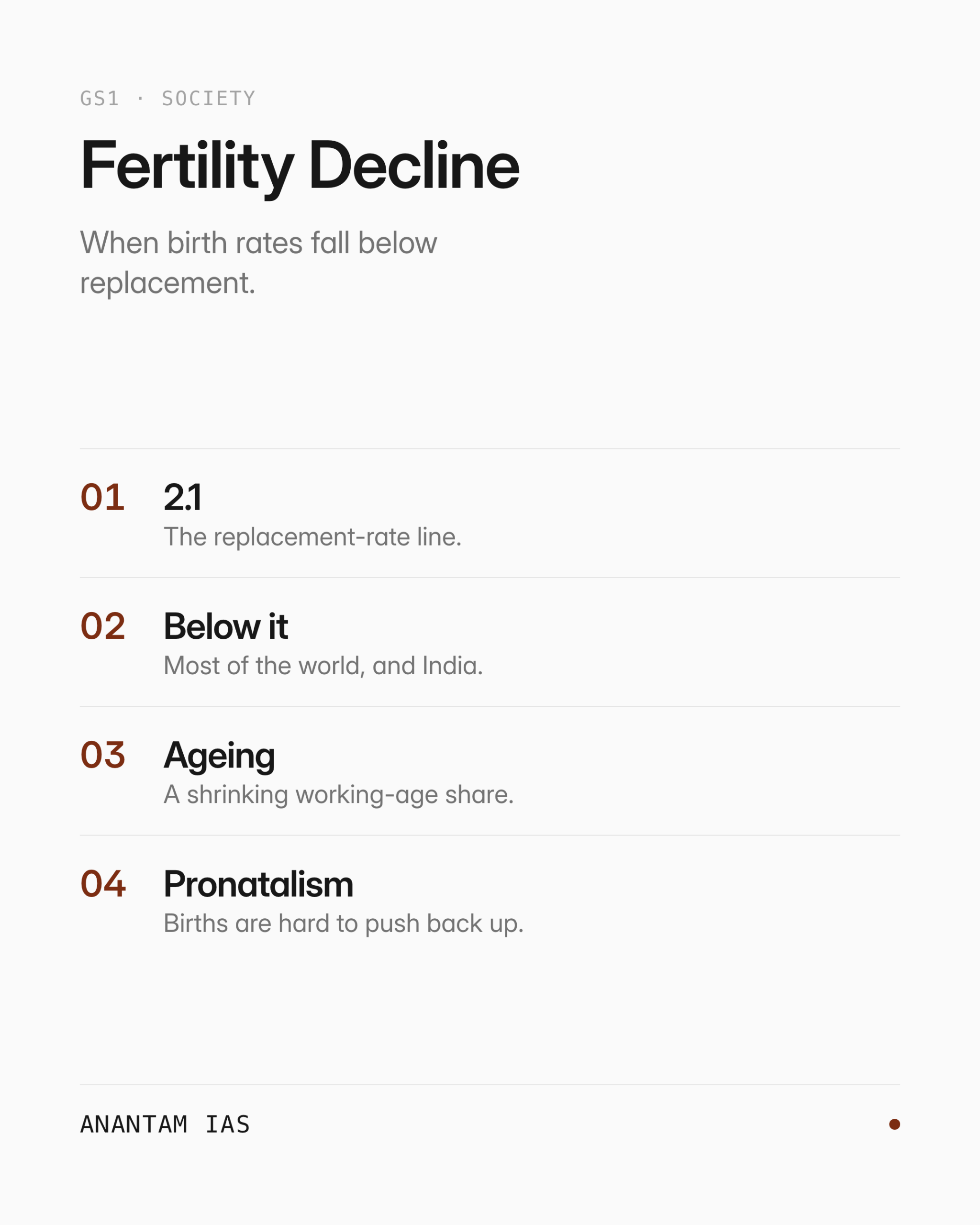
Start with the one number that does the heavy lifting. The total fertility rate, or TFR, is the average number of children a woman would bear if current age-specific birth rates held through her reproductive life. The magic figure is 2.1 — replacement level. Two children replace two parents, and the extra fraction covers those who die before adulthood or never have children. Above 2.1, a population grows on its own; below it, each generation is smaller than the last, and the population eventually shrinks once the momentum of past growth runs out. India’s TFR of about 1.9 means it has joined the club of nations breeding below replacement — a club that now contains most of humanity.
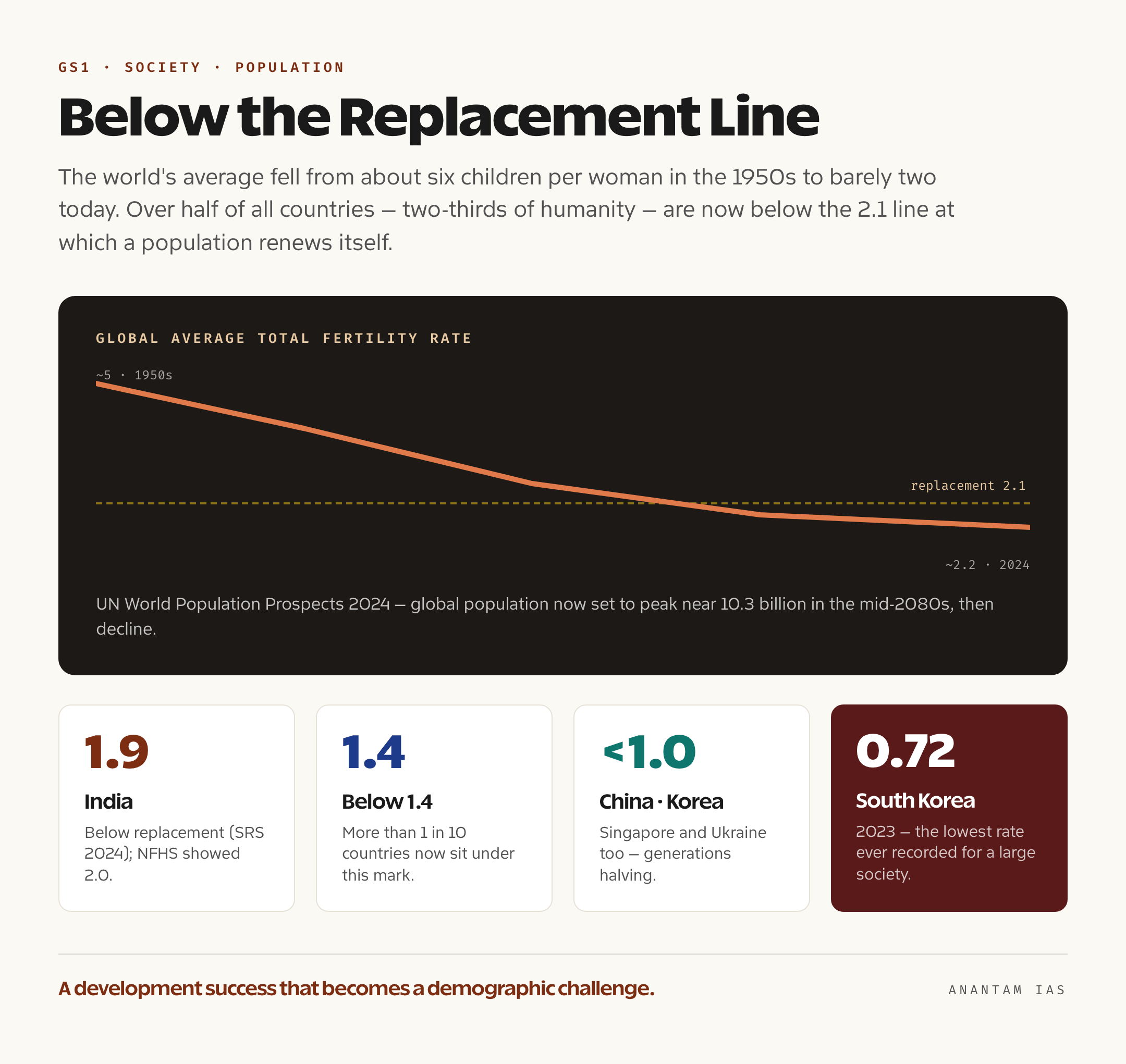
Because this is a global story, not an Indian one. The United Nations’ World Population Prospects 2024 found that more than half of all countries and territories — holding over two-thirds of the world’s people — are already below replacement fertility. The global average has fallen from around five children per woman in the 1950s to a shade above two today. In more than one in ten countries, fertility is now under 1.4. And in a handful — China, South Korea, Singapore and Ukraine — it has dropped below 1.0, meaning each generation is barely half the size of the one before. South Korea’s TFR touched 0.72 in 2023, the lowest ever recorded for a large society. The UN now projects the world’s population to keep rising for another six decades, peak at roughly 10.3 billion in the mid-2080s, and then begin a long decline — the first sustained fall in human numbers since the Black Death.
India’s own descent has been remarkably fast. Within living memory the average Indian woman had close to six children; the National Family Health Survey of 2019-21 already showed a national TFR of 2.0, and the SRS 2024 figure of about 1.9 confirms the country has settled below replacement. The crude birth rate has fallen to 18.3 per thousand in 2024, down from 21.0 a decade earlier. Cities are far below the national average — urban TFR is around 1.5 against roughly 2.1 in rural areas. This is, in one sense, a development success story: it reflects healthier children, educated women and smaller families chosen freely. But a success at the household level becomes a structural challenge at the national one, because a country that stops replacing itself eventually runs short of the young.
The South-North Divide: One Country, Two Demographies
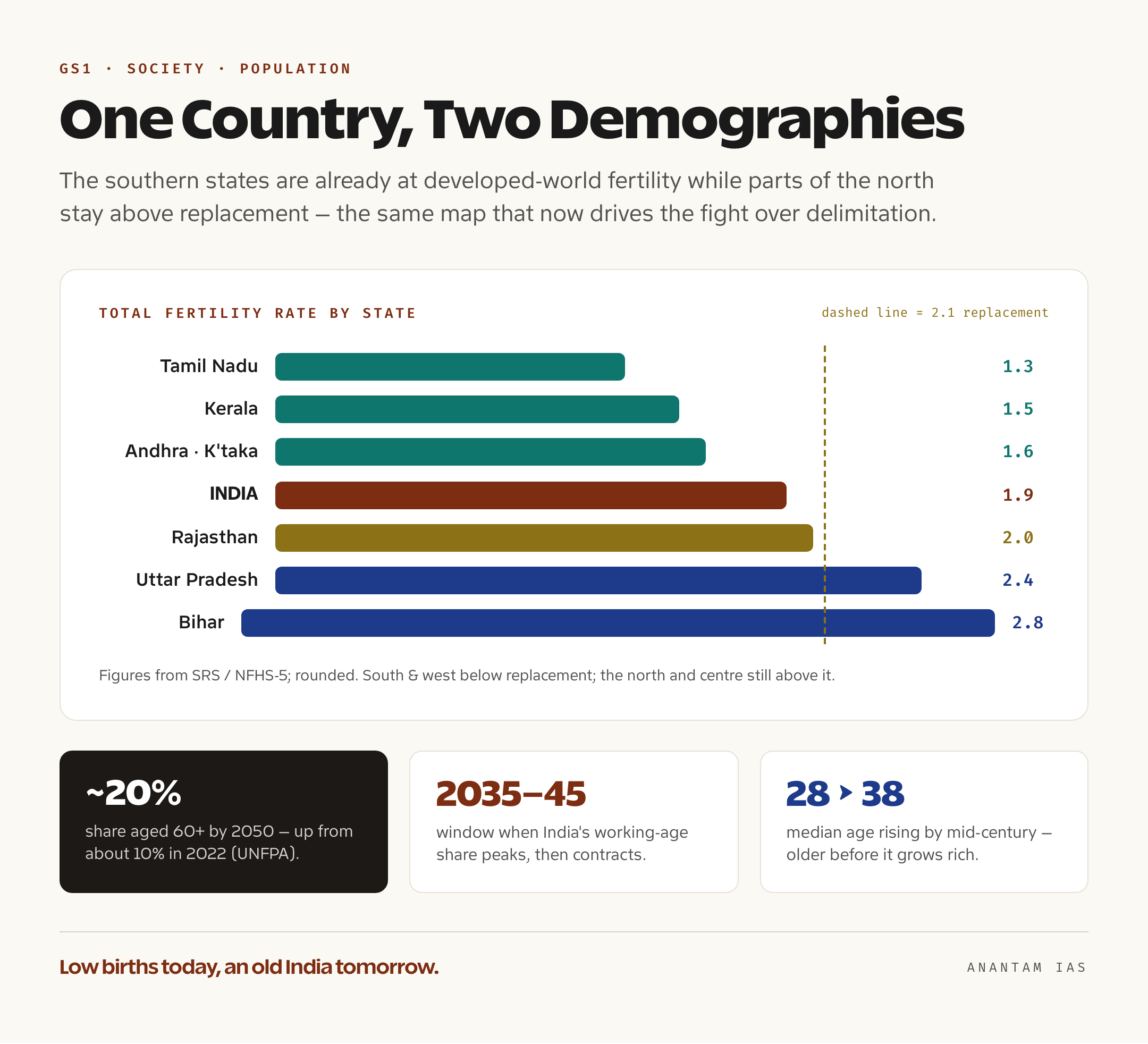
The national average hides the single most important fact about Indian fertility — that the country is splitting into two demographic worlds. The southern and western states crossed below replacement years ago and have kept falling. Tamil Nadu now records around 1.3 children per woman, among the lowest in the country and on par with much of East Asia. Kerala sits near 1.3 to 1.5, Karnataka and Andhra Pradesh around 1.5 to 1.7, Telangana close behind. Delhi, West Bengal and Maharashtra are all comfortably below replacement too. In these states fertility is now as low as in the rich world, and the people there are ageing at a developed-country pace — but on a developing-country income.
The northern and central belt tells the opposite story. Bihar still has the highest TFR in the country, in the region of 2.8 to 3.0 children per woman; Uttar Pradesh follows at roughly 2.4 to 2.6; Madhya Pradesh and Rajasthan hover near or just above replacement; Jharkhand and Chhattisgarh remain elevated. These are India’s youngest, fastest-growing states, and several of them have not yet reached replacement level at all — Bihar, on current trends, may not get there until close to 2040. So while Chennai worries about who will care for its elderly, Patna is still absorbing a surge of young workers. The same country contains both a Japan-in-the-making and a sub-Saharan growth profile, separated by a few hundred kilometres.
This divide is the spark behind one of India’s most delicate political fights. Parliamentary seats are meant to be reallocated by population through a process called delimitation, frozen since the 1970s and due to resume after 2026. If seats are redrawn on raw headcount, the populous north gains and the south — which curbed its fertility earliest and most successfully — loses representation. Estimates suggest Tamil Nadu could fall from 39 Lok Sabha seats toward 30 and Kerala from 20 toward 14, while Uttar Pradesh and Bihar gain. Southern leaders see a cruel irony: the states that did exactly what national population policy asked of them now face being politically penalised for it, and they fear the same logic could erode their share of central tax devolution. The grievance is demographic arithmetic turned into a federal flashpoint, and it is best understood through that lens — not any communal one. The fertility map of India is drawn by income, female education and urbanisation, and it tracks development, not faith.
Why Birth Rates Are Falling — The Drivers
Fertility decline is not an accident or a policy diktat; it is the predictable result of development, and the same forces operate worldwide. The first and strongest is the education and employment of women. When girls stay in school longer and women enter paid work, they marry later, plan their families and choose fewer children — and study after study finds female schooling the single best predictor of falling fertility. A woman with a degree and a job in Bengaluru simply lives a different reproductive life from her grandmother. As more Indian women cross that threshold, the national birth rate follows them down.
Then come the structural shifts that make large families harder and less rewarding. Urbanisation packs families into small flats where children are a cost rather than extra hands on a farm. Rising incomes paradoxically lower fertility, because parents shift from having many children to investing heavily in a few — paying for tuition, coaching and healthcare in a fierce competition for mobility. Better child survival means couples no longer need extra births as insurance against losing some, so India’s falling infant mortality, down to 24 per thousand, itself depresses fertility. Cheap, accessible contraception lets couples act on these smaller desired family sizes. And quietly underneath it all, social norms have changed: the two-child family is now the urban Indian ideal, and the old expectation of a houseful of children has faded. None of this needs coercion. It is what societies do as they grow richer, healthier and more urban — which is exactly why fertility decline is so hard to reverse.
The Consequences: Ageing, a Shrinking Workforce and the Care Burden
A low birth rate today is an old population tomorrow, and that arithmetic is inescapable. India’s great asset over the past two decades has been its demographic dividend — the growth boost a country enjoys when a bulge of working-age people supports relatively few children and elderly. That window is real but finite. India’s working-age share is projected to peak somewhere in the 2035-to-2045 stretch and then contract, giving the country only a couple of decades of prime demographic advantage left. The anxious phrase economists use is that India risks “growing old before it grows rich” — ageing while still at middle-income levels, without the wealth that lets Japan or Germany cushion the blow. India’s demographic dividend is already starting to close, and fertility decline is the clock running it down.
The ageing that follows is steep. The 60-plus population, around 149 million in 2022, is projected to more than double to roughly 347 million by 2050 — about one in five Indians. The median age, about 28 now, will climb toward 38 by mid-century. The old-age dependency ratio is set to rise from around 16 percent today toward 30 percent by 2050, meaning fewer workers support each retiree. That reshapes the whole economy: pension and healthcare costs balloon, the tax base per elderly person shrinks, and the family-based care that India has always relied on strains as families grow smaller and more scattered. A country with an underbuilt eldercare system is heading into mass ageing with little institutional cushion — even as a silver economy of goods and services for older citizens opens up as a genuine opportunity. The dividend years are precisely the time to build that cushion, because the bill arrives whether or not the country is ready.
Pronatalism: Can Governments Pay People to Have Babies?
As the numbers sink in, the politics flips. For decades India’s population policy was about having fewer children; now, in the low-fertility states, leaders are urging families to have more. In 2025 Andhra Pradesh’s Chief Minister N. Chandrababu Naidu said his government would frame a policy to encourage larger families and floated incentives for couples with more children; Tamil Nadu’s M. K. Stalin has made similar remarks. This is pronatalism — the deliberate use of public policy to raise birth rates — and India is a latecomer to a global experiment. Across the rich world, governments worried about shrinking and ageing have tried baby bonuses, cash grants, generous parental leave, subsidised childcare and tax breaks to nudge couples toward parenthood.
The sobering lesson from those experiments is how little they achieve. The countries that have spent most lavishly have the least to show for it. South Korea has poured enormous sums into family incentives and still saw its TFR fall to 0.72. Hungary devotes several percent of its economy to pronatal benefits, yet its fertility rate in 2024 was about 1.39 — and researchers find even that modest bump came mostly from couples having children slightly earlier, not from having more overall. Singapore, Japan and Russia set fertility targets and missed them. The pattern is consistent: family policies are genuinely good for parents and children and worth doing on their own merits, but as levers to reverse fertility decline they barely move the needle, because the deeper drivers — women’s autonomy, the cost of children, urban life, changed aspirations — are not things a cash bonus can undo.
There is a sharper objection too. A pronatalism that frames women mainly as producers of future workers and taxpayers risks rolling back the reproductive freedom that drove fertility down in the first place. Critics of the southern push warn it can slide from incentive toward pressure, and from a worry about the future of the population toward an attempt to put women back in the nursery. The more credible response is indirect: make it genuinely possible to combine work and parenthood — affordable childcare, real paternity leave, secure jobs, decent housing — so that those who want children aren’t forced to choose against them, while leaving the choice with the family. That is the thread connecting this to the older debate over a coercive two-child norm, which most demographers reject precisely because India’s fertility fell fastest where the state pushed least. The honest conclusion is that there is no easy dial to turn. The smarter bet is to prepare for an older, smaller-growing India — building eldercare, lifting productivity and extending working lives — rather than chasing a baby boom the evidence says won’t come.
For Your Mains Answer
This is core territory for GS Paper 1 Society, which covers population and associated issues, social empowerment and the effects of urbanisation. Fertility decline also bleeds into GS Paper 2 (ageing as a governance and welfare challenge, the delimitation and federalism angle) and GS Paper 1/3 (the demographic dividend and the economy). It is a ready-made Essay theme on development, women’s autonomy and the future of the nation. The skill examiners reward is the one this article uses: anchor a few exact figures, show the south-north divide, and connect fertility to ageing, federalism and the limits of pronatalism in one clean chain.
How to Build the Answer
Open by defining TFR and replacement level, then state where India is — about 1.9, below 2.1. Move in a logical arc: what fertility decline is, how far it has gone (global and Indian numbers), the south-north divide and why it matters politically, the drivers (women’s education, urbanisation, income, contraception, norms), the consequences (ageing, shrinking workforce, the dividend window closing), and finally pronatalism and why it mostly fails. Close by judging the right policy response. That sequence — define, measure, explain the divide, diagnose causes, project consequences, evaluate the policy choice — fits almost any version of the question.
Common Mistakes to Avoid
Don’t confuse fertility decline with population fall — India is still growing on past momentum and longer lives even as TFR drops below replacement. Don’t treat the south-north divide as anything but a development and federal issue; keep it strictly demographic. Don’t present pronatalism as a proven fix — the strongest, most examinable point is that lavish spenders like South Korea and Hungary largely failed. And don’t ignore women’s autonomy: an answer that reduces the issue to “we need more babies” misses the rights dimension entirely.
A Compact Answer Spine
TFR = average lifetime births per woman; replacement = 2.1 → India now about 1.9 (SRS 2024), below replacement → global trend: most countries and two-thirds of people already below 2.1, some under 1.0 → sharp Indian divide: south/west ~1.3-1.7 (Tamil Nadu ~1.3) versus Bihar ~2.8-3.0 → drivers: female education and work, urbanisation, income, contraception, norms → consequences: ageing (60+ to ~20% by 2050), workforce peak ~2035-45, dividend closing, care burden, delimitation flashpoint → pronatalism (Korea, Hungary) spends big, achieves little → verdict: prepare for ageing and protect choice, don’t chase a baby boom.
Diagram or Flowchart Idea
Sketch a simple line crossing the 2.1 replacement threshold from above, with India’s dot just below it, beside a two-bar contrast of a low-fertility southern state and a high-fertility northern state against the same 2.1 line. Add a short arrow chain: lower TFR → ageing population → shrinking workforce → higher dependency. The visual carries the whole argument — the crossing of the line, the internal divide, and the downstream consequence.
A Balanced-Conclusion Line
A line that earns the marks: “India’s fertility decline is a development success that has become a demographic challenge — the answer is not to pressure women into more births, which the evidence shows rarely works, but to invest now in productivity, eldercare and the freedom to combine work and family while the dividend years last.”
How to Use Data Without Cramming
You need four anchors, not a table: about 1.9 (India’s TFR), 2.1 (replacement level), Tamil Nadu around 1.3 versus Bihar around 2.8 (the divide), and 60-plus rising to roughly 20 percent by 2050 (the ageing payoff). Attribute them plainly — “as the SRS 2024 report showed” or “on UN and UNFPA projections” — rather than scattering numbers loose.
Frequently Asked Questions
What is fertility decline and has India fallen below replacement level?
Fertility decline is the long-run drop in the total fertility rate (TFR) — the average number of children a woman has over her lifetime. Replacement level is 2.1, the rate at which a population just renews itself. India’s SRS 2024 report put the national TFR at about 1.9, and the NFHS of 2019-21 showed 2.0, so India is now below replacement. The country is still growing because of past momentum and longer lifespans, but its underlying birth rate no longer sustains long-term growth.
Why is fertility so much lower in south India than in the north?
The southern and western states modernised earlier — higher female literacy, more women in work, faster urbanisation and earlier access to contraception — so their fertility fell first. Tamil Nadu is now around 1.3 and the other southern states sit near 1.5 to 1.7. Much of the north and centre is still catching up: Bihar’s TFR remains close to 2.8 to 3.0 and Uttar Pradesh around 2.4 to 2.6. The divide tracks development, female education and income, not religion.
What is pronatalism and does it work?
Pronatalism is the use of government policy — cash bonuses, parental leave, childcare subsidies, tax breaks — to encourage couples to have more children, as some Indian leaders have begun proposing. The international evidence is discouraging: South Korea, Hungary, Japan and Singapore have spent heavily and seen little lasting rise in fertility, because the deeper causes (women’s autonomy, the cost of children, urban life) aren’t fixed by incentives. Such policies help parents but rarely raise birth rates much.
How will fertility decline affect India’s future?
It accelerates ageing and shrinks the future workforce. The 60-plus population is projected to more than double from about 149 million in 2022 to roughly 347 million — around one in five Indians — by 2050, while the working-age share peaks in the 2035-45 period and then contracts. That raises pension and healthcare costs, strains family-based eldercare, and means India’s demographic dividend window is closing. The risk is “growing old before growing rich,” which is why building productivity and eldercare now matters.
Practice Questions
Prelims MCQs
- The “replacement level” of fertility, often discussed with the total fertility rate, refers to which value?
(a) 1.0 child per woman
(b) 1.5 children per woman
(c) 2.1 children per woman
(d) 3.0 children per woman
Answer: (c) A TFR of about 2.1 is the level at which a population just replaces itself, accounting for child mortality and those who do not reproduce. - According to the SRS 2024 report, India’s national total fertility rate is closest to which figure?
(a) 1.9
(b) 2.4
(c) 2.7
(d) 3.1
Answer: (a) The SRS 2024 report put India’s TFR at about 1.9, below the 2.1 replacement level. - Among Indian states, which currently records one of the highest total fertility rates?
(a) Tamil Nadu
(b) Kerala
(c) Bihar
(d) Delhi
Answer: (c) Bihar has the highest TFR in the country, in the region of 2.8 to 3.0, while Tamil Nadu, Kerala and Delhi are all well below replacement. - The term “demographic dividend” refers to which of the following?
(a) The growth boost from a large working-age population relative to dependents
(b) Subsidies paid to families with more children
(c) The dividend earned by a country from exporting labour
(d) A tax rebate for senior citizens
Answer: (a) The demographic dividend is the economic boost a country can enjoy when its working-age share is large relative to children and the elderly. - Which of the following best explains why pronatalist policies have largely failed to raise fertility in countries like South Korea and Hungary?
(a) The policies were never actually implemented
(b) Deeper drivers such as women’s autonomy, urban life and the cost of children are not reversed by incentives
(c) These countries banned contraception
(d) Their populations were already growing too fast
Answer: (b) Cash bonuses and leave help parents but do not undo the structural and social forces behind low fertility, so birth rates barely move.
Mains Practice Questions
- “India’s fertility decline is a development success that has become a demographic challenge.” Critically examine this statement in the context of the country’s falling total fertility rate. (15 marks, 250 words)
- Discuss the south-north divide in India’s fertility rates. How does this divide complicate the politics of delimitation and fiscal federalism? (15 marks, 250 words)
- Examine the principal drivers of fertility decline in India. Why is this decline considered difficult to reverse through policy? (10 marks, 150 words)
- “India risks growing old before it grows rich.” Analyse the consequences of below-replacement fertility for India’s workforce, ageing and welfare systems, and suggest a way forward. (15 marks, 250 words)
- Evaluate pronatalism as a policy response to declining fertility. To what extent should the state intervene in reproductive decisions, and what are the more effective alternatives? (15 marks, 250 words)
Tell Google you want more of this.
Add Anantam IAS as a preferred sourceOne tap, and this site shows up more often in your own Top Stories, AI Overviews and AI Mode. Remove it any time.