Disclosure: this guide contains Amazon affiliate links. As an Amazon Associate, Anantam IAS earns from qualifying purchases — at no extra cost to you.
The first five year plan is the one chapter aspirants either ace or skip — and skipping it costs marks every cycle. I’ve watched candidates blank on “Harrod-Domar model” in Prelims 2022 and lose two marks they couldn’t afford. The First Five Year Plan (1951-56) is foundational. It launched India’s planning era, hit 3.6% growth against a 2.1% target, built Bhakra Nangal, and seeded the IITs and UGC. This guide covers the objectives, the model, sectoral allocation, achievements, criticisms, and exactly how examiners frame it. Let’s get into it.
What was the First Five Year Plan?
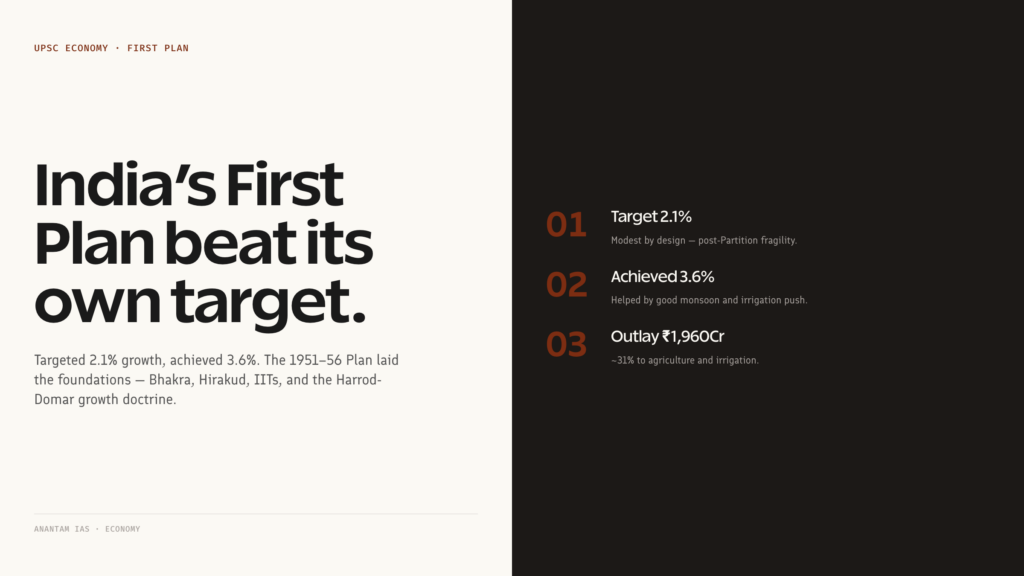
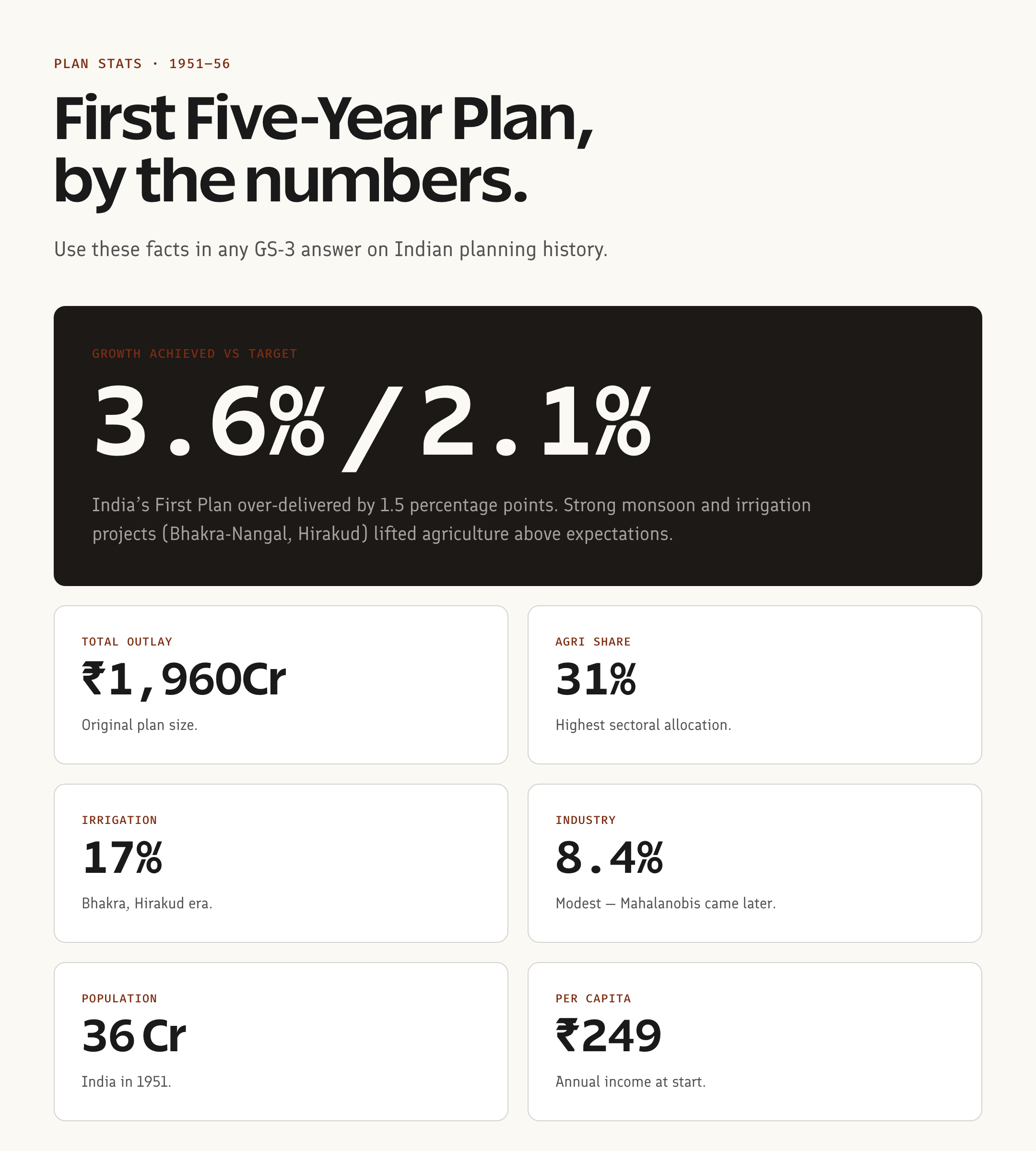
The First Five Year Plan (1951-56) was India’s first national economic plan, launched on 9 July 1951 by the Planning Commission under Jawaharlal Nehru. It was based on the Harrod-Domar model with modifications, prioritised agriculture and irrigation, ran for the period 1 April 1951 to 31 March 1956, and achieved 3.6% annual GDP growth against a target of 2.1%.
- Period — 1 April 1951 to 31 March 1956 (5 years)
- Model — Harrod-Domar (with modifications by K.N. Raj)
- Total outlay — ₹2,069 crore (revised from ₹2,378 crore)
- Sectoral focus — Agriculture, irrigation, and power (44.6% combined)
- Target growth — 2.1% annual GDP; Achieved — 3.6%
Why the First Five Year Plan exists at all
Look, the context matters here. India in 1947 had three problems stacked on top of each other.
One. Partition had displaced 14 million people and gutted the agrarian Punjab. Two. The Bengal famine of 1943 had killed 3 million Indians, and food security was a daily anxiety, not an abstract goal. Three. Foreign exchange reserves were near-empty after WWII, and India had no domestic capital base to fund industry on its own.
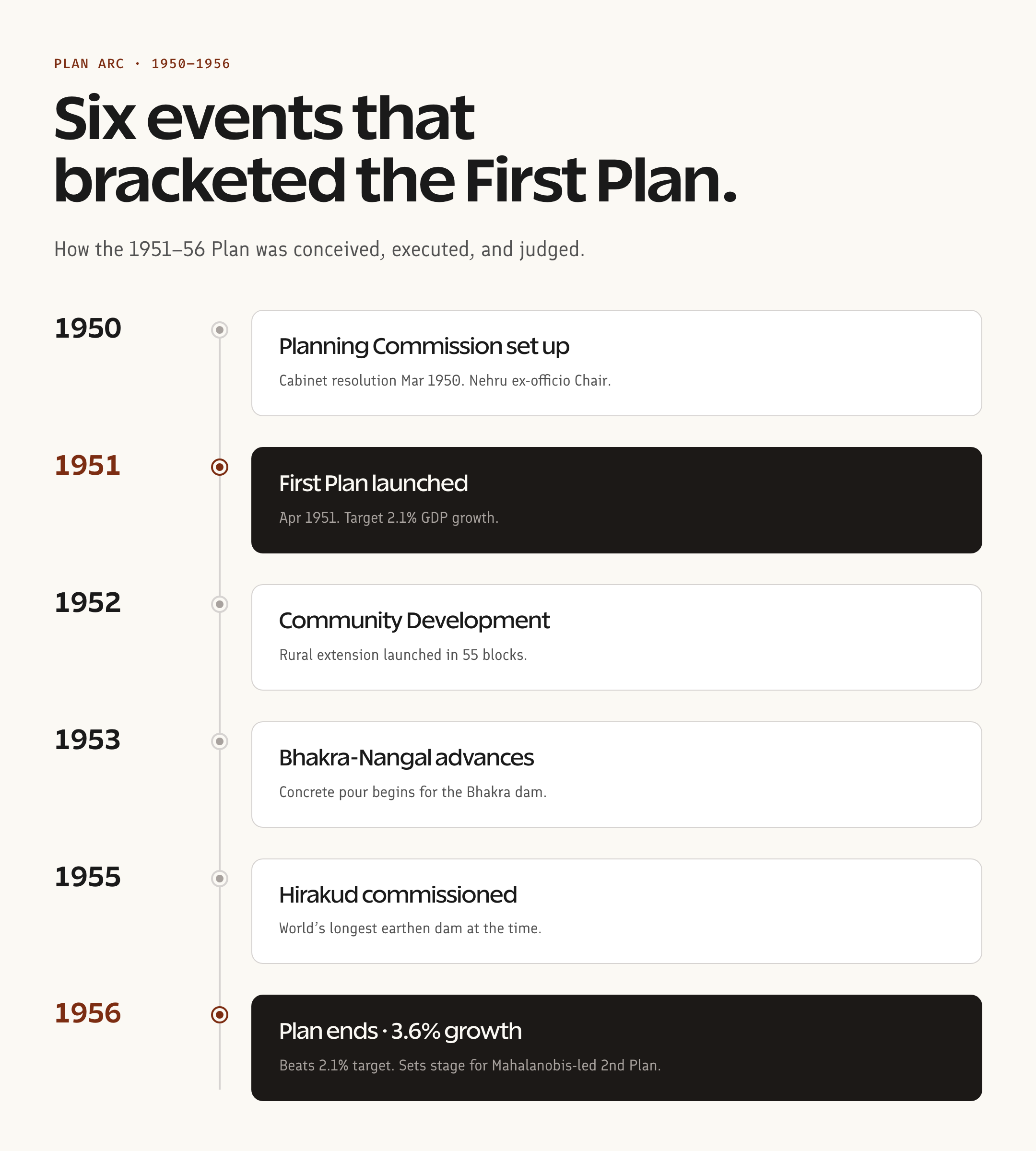
Nehru’s response was the Soviet-influenced model of central planning… adapted to a mixed economy. The Planning Commission was set up by an executive resolution on 15 March 1950. The First Five Year Plan was its first deliverable. The first five-year plan in India wasn’t just an economic document. It was a nation-building blueprint.
Objectives of the First Five Year Plan
Numbered. Aspirants memorise lists.
- Rehabilitation of refugees — resettling 14 million Partition migrants
- Food self-sufficiency — eliminating dependence on foreign food aid (PL-480 era was looming)
- Control of inflation — post-Korean War prices had spiked
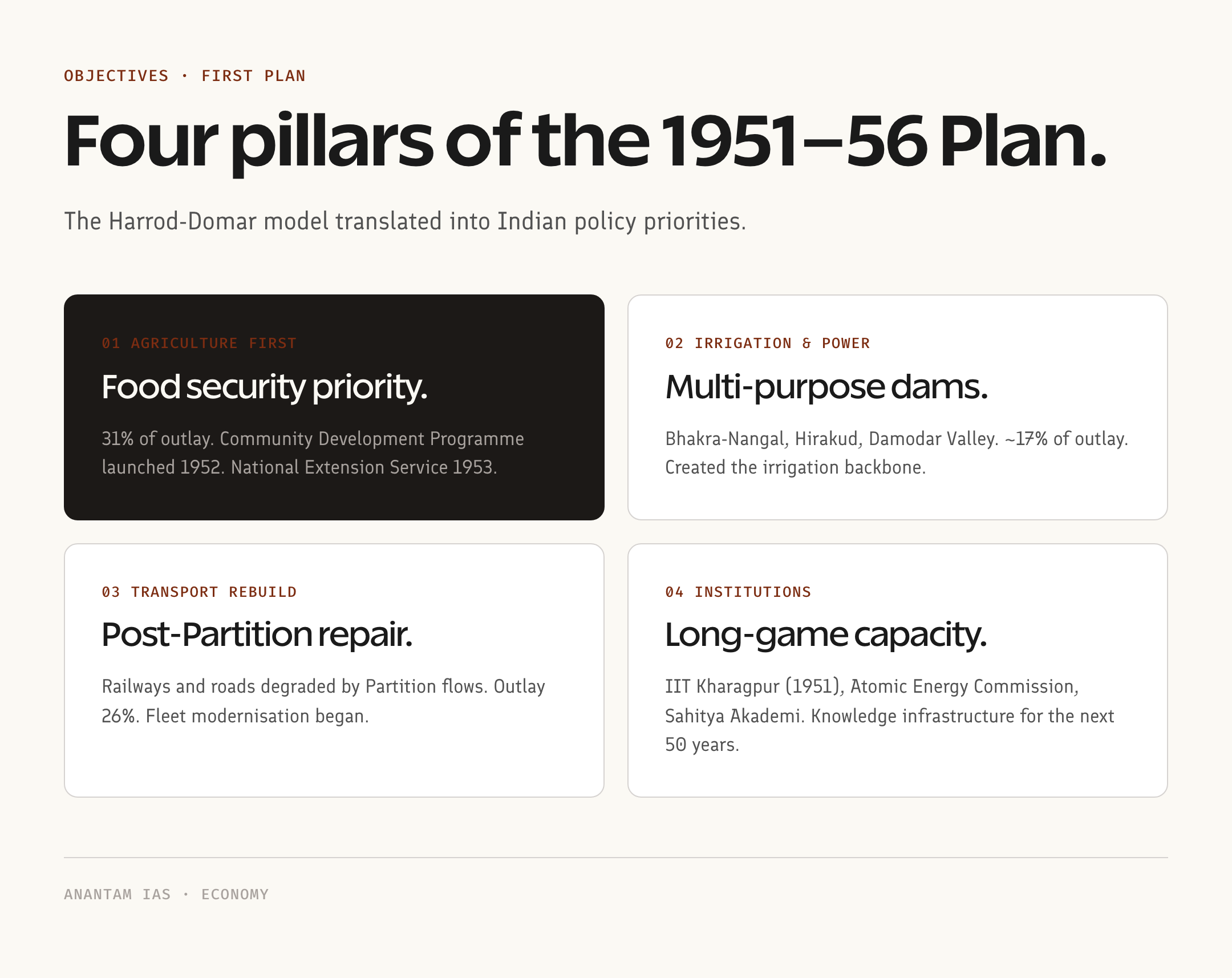
- Agriculture and irrigation primacy — expanding cultivable land via multipurpose river projects
- Power generation capacity — laying foundation for future industrial expansion
- Higher savings rate — moving from 5% to 7% of national income
- Comprehensive development — transport, communications, social services in parallel
The plan deliberately did not prioritise heavy industry. That came in the Second Plan (1956-61) under the Mahalanobis model. Aspirants confuse the two — don’t.
The Harrod-Domar model — what it actually says
Here’s where most coaching notes get sloppy. They name-drop “Harrod-Domar” without explaining what it means. Let me fix that.
The Harrod-Domar model — developed independently by Roy F. Harrod (1939, UK) and Evsey Domar (1946, USA) — argues that economic growth depends on two ratios:
- Savings rate (s) — what fraction of national income gets saved
- Capital-output ratio (k) — how much capital is needed to produce one unit of output
The growth equation: g = s ÷ k
If India saved 7% of national income and the capital-output ratio was 3:1, the growth rate would be 7 ÷ 3 = 2.33%. The First Five Year Plan targeted slightly below this at 2.1% — a deliberately conservative number because data quality in 1951 was weak.
K.N. Raj, the economist who modified the model for India, factored in agricultural primacy and the public sector’s role. Don’t oversimplify it as “Soviet-style planning” — Raj’s version was more nuanced.
The Harrod-Domar model was the foundation of the First Plan only. The Second Plan (1956-61) used the Mahalanobis model (heavy industry primacy). Aspirants who mix these up lose marks. Examiners ask this exact distinction.
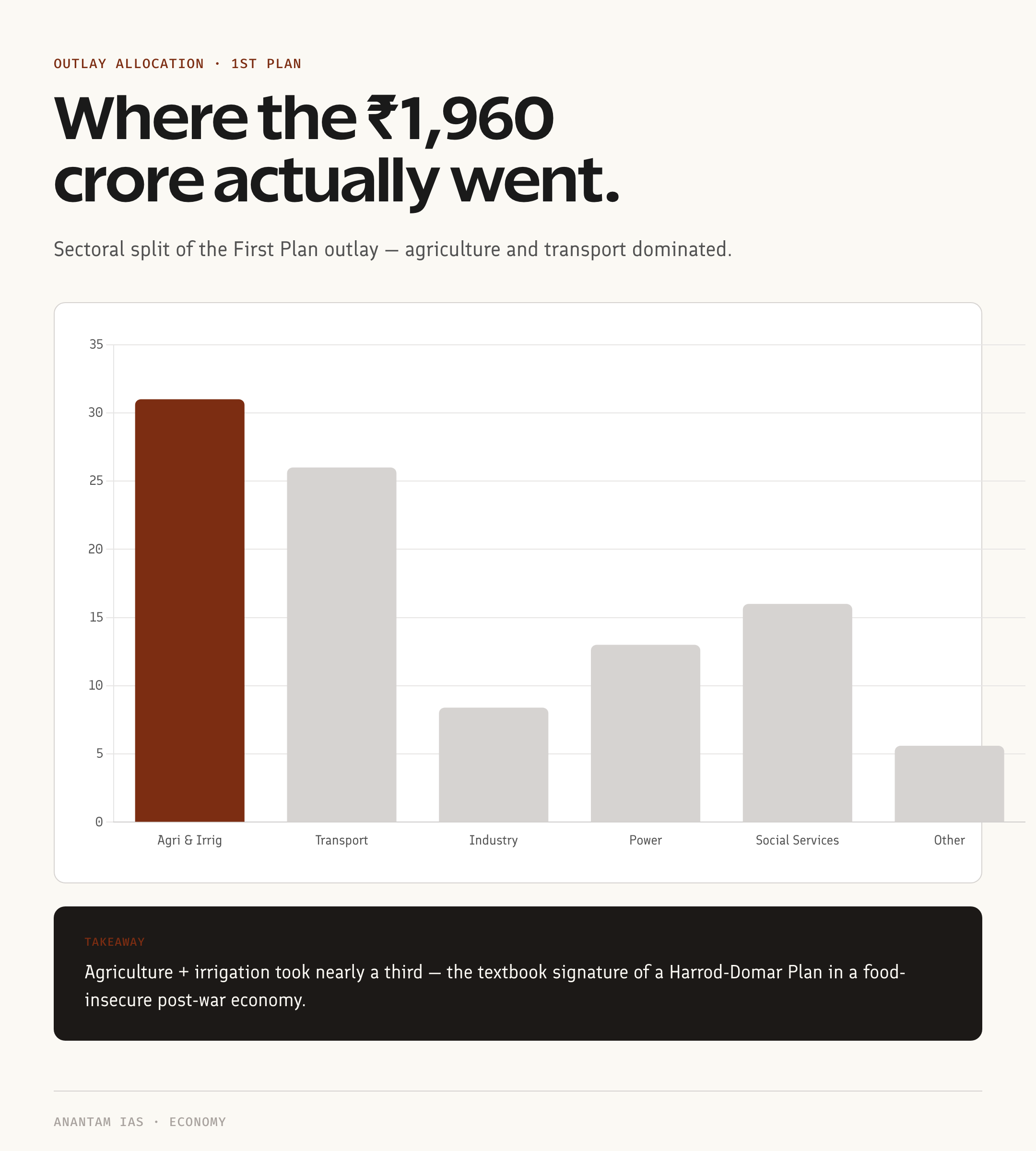
Sectoral allocation — where the ₹2,069 crore went
| Sector | Allocation | Share |
|---|---|---|
| Irrigation & Power | ₹561 crore | 27.2% |
| Transport & Communications | ₹497 crore | 24.0% |
| Social Services (education, health) | ₹340 crore | 16.4% |
| Agriculture & Community Development | ₹306 crore | 14.8% |
| Rehabilitation & Miscellaneous | ₹191 crore | 9.2% |
| Industry | ₹174 crore | 8.4% |
| Total | ₹2,069 crore | 100% |
Notice the distribution. Agriculture + Irrigation + Power together = 41.6%. Industry got just 8.4%. This was deliberate. The first plan was an “irrigation-and-food” plan, not an “industry” plan.
Major projects launched under the First Five Year Plan
The First Plan didn’t just allocate money — it built visible infrastructure. The dams from this era are still operational in 2026. Here’s the list aspirants are expected to know.
Multipurpose River Valley Projects:
- Bhakra Nangal Dam (Sutlej, Punjab-Himachal) — foundation laid 1948, completed 1963; tallest gravity dam in India at 226m
- Hirakud Dam (Mahanadi, Odisha) — world’s longest earthen dam at the time, 4.8 km
- Damodar Valley Project (DVC) — modelled on America’s Tennessee Valley Authority
- Mettur Dam expansion (Cauvery, Tamil Nadu)
- Nagarjuna Sagar Project (Krishna) — work commenced
- Kosi Project (Bihar) — flood control
Educational Institutions:
- Five IITs initiated — IIT Kharagpur (1951, first), Bombay (1958), Madras (1959), Kanpur (1959), Delhi (1961)
- University Grants Commission (UGC) — established 28 December 1953
Industrial Foundation:
- Steel plant contracts signed for Bhilai (USSR), Rourkela (West Germany), Durgapur (UK) — operationalised in the Second Plan
Achievements of the First Five Year Plan
This is where India’s first five year plan exceeded expectations. The numbers, with citations:
- GDP growth — 3.6% achieved vs 2.1% targeted. +71% over target.
- Per capita income — rose 8% over the plan period
- Foodgrain production — rose from 52.2 MT (1951-52) to 65.8 MT (1955-56) — +26%
- Inflation — dropped, prices stabilised after Korean War spike
- Irrigated area — added 16 million acres of irrigated land
- Power generation — capacity doubled from 2.3 GW to 3.4 GW
- Savings rate — rose from 5.0% to 7.3% of national income
- Investment rate — rose from 5.5% to 7.5%
The plan worked. Honestly, this was India’s most successful Five Year Plan in percentage terms — the gap between target and achievement (1.5 percentage points above) was never matched again.
Why the First Plan succeeded
Three reasons that examiners reward in Mains answers.
One — favourable monsoons. 1953-54 and 1955-56 were both good monsoon years. Foodgrain output overshoot wasn’t entirely due to planning; it was partially weather. Honest historians acknowledge this. The plan benefited from luck.
Two — low base effect. India’s economy was so depressed in 1950-51 that even modest investment produced visible gains. A 3.6% growth from a base of $30 billion is mathematically easier than a 3.6% growth from a $4 trillion base in 2026.
Three — focused execution. The plan didn’t try to do everything. Agriculture, irrigation, refugee rehabilitation. Three priorities. That focus mattered.
Criticisms of the First Five Year Plan
Plan apologists skip this section. Don’t.
- Industrial sector underinvestment — only 8.4% allocation. Critics like P.C. Mahalanobis argued this delayed India’s industrial take-off by 5 years.
- Public sector employment did not grow proportionally — the plan created infrastructure, not jobs at scale.
- Agricultural land reforms were uneven — Zamindari abolition was legislated in some states but tenancy reforms remained incomplete. Read more in Reorganisation of Agriculture for the land-reform context.
- Inter-regional inequality — the plan didn’t have a regional balancing framework. North-West India and parts of South benefited disproportionately.
- Statistical underdevelopment — pre-NSSO data quality meant the planners often guessed. Modern economists have questioned the 3.6% number itself.
The criticisms don’t invalidate the plan. They contextualise it.
End of the First Five Year Plan — what happened next
The First Plan ended on 31 March 1956. The Second Five Year Plan (1956-61) was launched on 1 April 1956, designed by P.C. Mahalanobis on the heavy-industry-led “Mahalanobis model.” This shift — from agriculture-led to industry-led — is the single most-tested transition in UPSC Prelims economy.
Five Year Plans continued in India until the 12th Plan ended on 31 March 2017. The Planning Commission was dismantled in 2014, replaced by NITI Aayog (1 January 2015). For the full arc, see Five Year Plans, NITI Aayog, and Planning Commission vs NITI Aayog. The Evolution of Planning in India and Dismantling of the Planning Commission deep-dives cover the institutional transition.
Why this matters for UPSC
The first five year plan in india appears in three layers of the exam.
- Prelims — direct factual MCQs on Harrod-Domar, target/achieved growth, sectoral allocation, Bhakra Nangal year
- Mains GS-III (Indian Economy) — “Critically examine the role of the First Five Year Plan in laying the foundation of Indian planning” — appears every 4-5 years
- Essay paper — economic planning vs market mechanism, Nehruvian model legacy
Examiners love this exact framing — the contrast between First Plan (agriculture-led) and Second Plan (industry-led) was directly asked in 2017, 2020, and 2024 Prelims.
Common misconceptions
Myth 1: “First Five Year Plan was based on the Mahalanobis model.” Wrong. The First Plan was based on the Harrod-Domar model. The Second Plan used the Mahalanobis model.
Myth 2: “First Plan launched the Green Revolution.” No. The Green Revolution was launched in the late 1960s, primarily during the Third Plan and Plan Holiday period. The First Plan focused on traditional agricultural expansion via irrigation, not high-yielding varieties.
Myth 3: “The Planning Commission was created by the Constitution.” No — it was an executive body created by a Cabinet resolution on 15 March 1950, never constitutionally enshrined. That’s why it could be dismantled in 2014 without an amendment.
Myth 4: “Bhakra Nangal was completed during the First Plan.” Construction began during the First Plan but the dam was completed in 1963, well into the Third Plan. Foundation work began in 1948.
How to revise this in 30 minutes
For Prelims revision:
- 5 minutes — Memorise the equation g = s/k and the target (2.1%) vs achieved (3.6%) numbers
- 5 minutes — Sectoral allocation top 3: Irrigation & Power 27.2%, Transport 24%, Social Services 16.4%
- 5 minutes — Six dams + IITs + UGC (1953)
- 5 minutes — Differences from Second Plan (Mahalanobis, heavy industry, 1956-61)
- 5 minutes — Three criticisms (low industry, regional inequality, weak land reforms)
- 5 minutes — Source check: NCERT Class 11 Indian Economic Development Chapter 2
Source priority: NCERT Class 11 → Ramesh Singh Chapter 6 → PRS planning briefs → previous year Prelims questions.
Frequently Asked Questions
: When was the First Five Year Plan launched in India?
The First Five Year Plan was launched on 9 July 1951 and ran from 1 April 1951 to 31 March 1956. It was the first plan formulated by the Planning Commission established on 15 March 1950.
: Which model was the First Five Year Plan based on?
The First Five Year Plan was based on the Harrod-Domar growth model, with modifications by K.N. Raj. The model linked growth (g) to savings rate (s) divided by capital-output ratio (k).
: What was the growth rate achieved in the First Five Year Plan?
The First Five Year Plan achieved 3.6% annual GDP growth against a target of 2.1%. This was India’s best target-to-achievement ratio across all 12 Five Year Plans.
: What were the major projects of the First Five Year Plan?
Bhakra Nangal Dam, Hirakud Dam, Damodar Valley Project, Nagarjuna Sagar (initiated), five IITs (Kharagpur first, 1951), and the University Grants Commission (1953).
: How was the First Plan different from the Second Plan?
The First Plan (1951-56) was based on Harrod-Domar and prioritised agriculture and irrigation. The Second Plan (1956-61) used the Mahalanobis model and prioritised heavy industry like steel and machinery.
: What is the total expenditure of the First Five Year Plan?
The First Five Year Plan had a final outlay of ₹2,069 crore (revised from an initial estimate of ₹2,378 crore), making it the smallest in nominal terms of any Five Year Plan.
: When did Five Year Plans end in India?
The 12th Five Year Plan (2012-17) was the last one. It ended on 31 March 2017. The Planning Commission itself was dismantled in 2014 and replaced by NITI Aayog on 1 January 2015.
Tell Google you want more of this.
Add Anantam IAS as a preferred sourceOne tap, and this site shows up more often in your own Top Stories, AI Overviews and AI Mode. Remove it any time.