Disclosure: this guide contains Amazon affiliate links. As an Amazon Associate, Anantam IAS earns from qualifying purchases — at no extra cost to you.
Introduction
The Gandhi-Irwin Pact, also called the Delhi Pact, was a political agreement signed on 5 March 1931 between Mahatma Gandhi and Lord Irwin, the Viceroy of India. It marked a rare moment when the British Raj formally negotiated with the Indian National Congress as an equal. The pact suspended the Civil Disobedience Movement, cleared the way for Gandhi's participation in the Second Round Table Conference, and crystallised both hopes and criticisms that would shape the final decade of the freedom struggle.
This guide explains the background, key clauses, Congress debates, aftermath, and UPSC relevance of the Gandhi-Irwin Pact.
Background: Road to the Pact
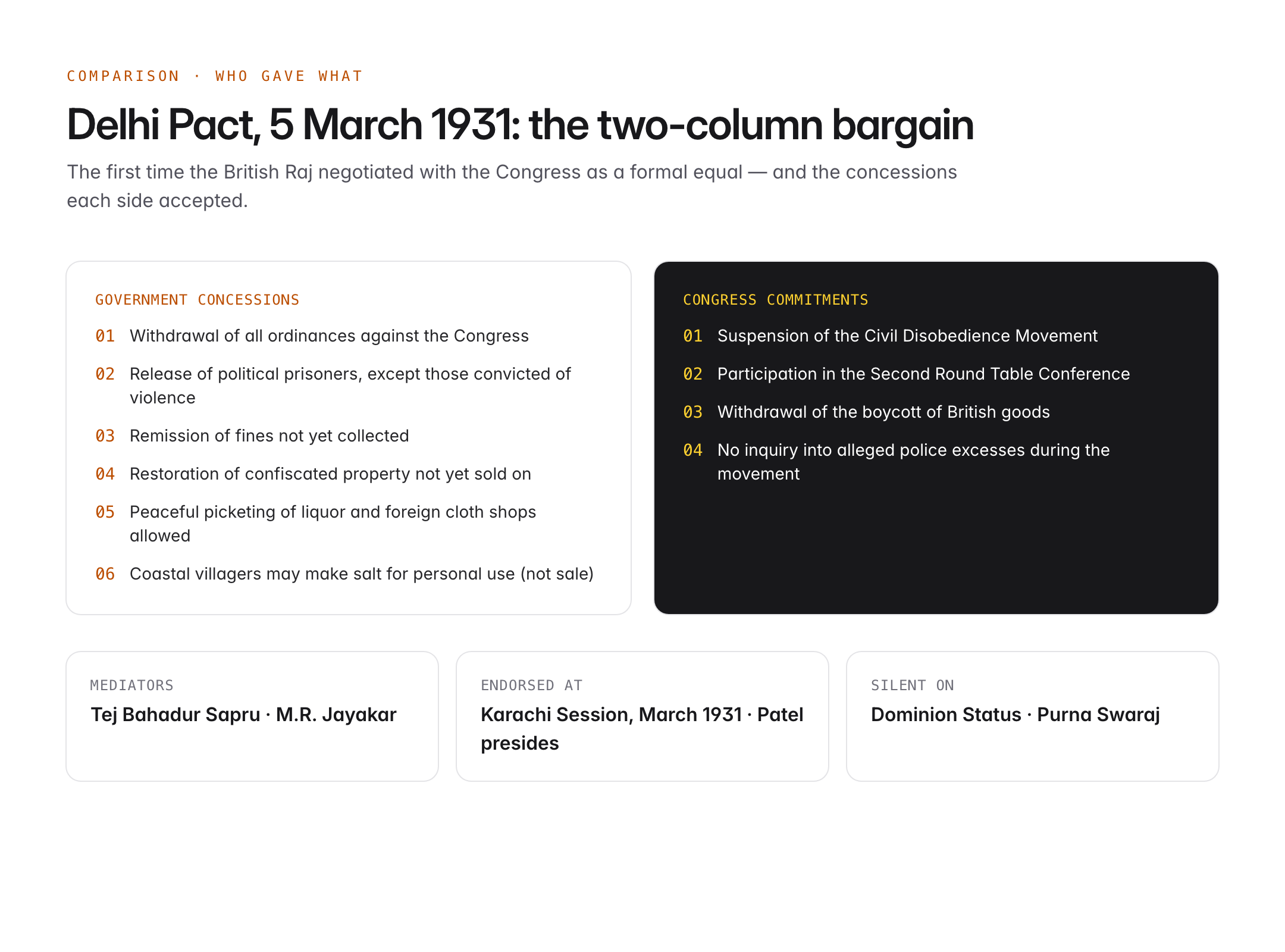
The Lahore Session of the Congress (December 1929) declared Purna Swaraj (complete independence) as the objective and authorised Gandhi to launch a civil disobedience campaign. Gandhi began with the Dandi March (12 March – 6 April 1930), breaking the salt law at Dandi on Gujarat's coast.
Civil Disobedience spread rapidly:
- Salt law defied across the country (Tamluk, Bombay, Karachi, Peshawar).
- Boycott of foreign cloth, liquor shops, and courts.
- Khudai Khidmatgars under Khan Abdul Ghaffar Khan mobilised the North-West Frontier.
- Chittagong Armoury Raid (April 1930) by Surya Sen.
- Women participated in unprecedented numbers.
The colonial response was brutal — over 90,000 arrests, lathi charges, press censorship, and outlawing of Congress. The First Round Table Conference (November 1930 – January 1931) convened in London without the Congress, weakening its legitimacy.
Lord Irwin, facing both domestic British liberal pressure and Indian unrest, sought a settlement. Mediation by moderates Tej Bahadur Sapru and M.R. Jayakar led to Gandhi's release from Yerwada jail on 26 January 1931, and talks began in Delhi in February.
Key Clauses of the Pact
The pact had mutual obligations for both sides.
Government Concessions
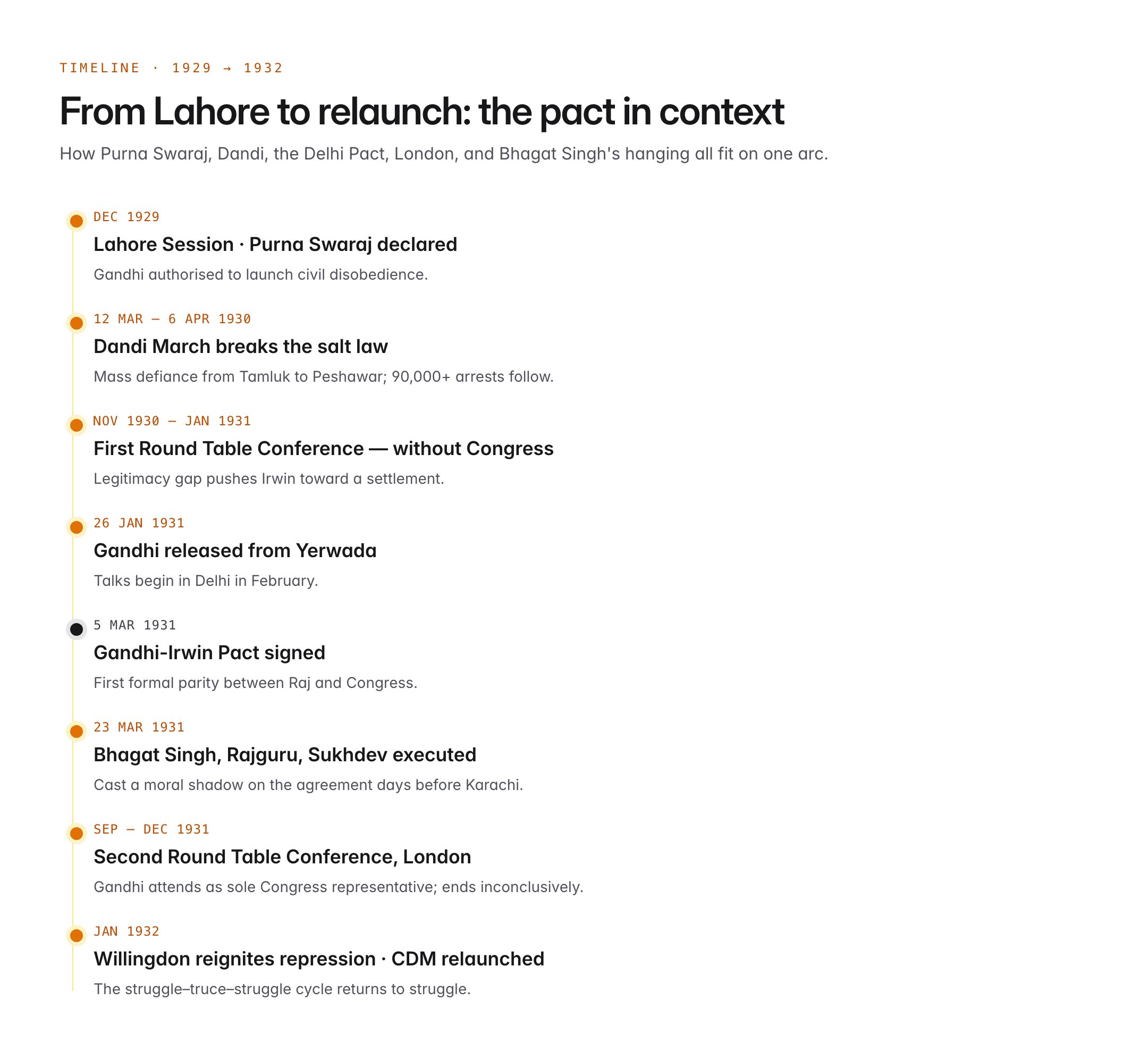
- Withdrawal of all ordinances issued to suppress the Congress.
- Release of political prisoners, except those convicted of violence.
- Remission of fines not yet collected.
- Restoration of confiscated property not yet sold to third parties.
- Permission for peaceful picketing of liquor and foreign cloth shops.
- Right of residents of coastal villages to make salt for personal use (but not sale).
Congress Commitments
- Suspension of the Civil Disobedience Movement.
- Participation in the Second Round Table Conference.
- Withdrawal of the boycott of British goods.
- No inquiry into alleged police excesses during the movement.
Significance of Terms
| Aspect | What it meant |
|---|---|
| Recognition | First time British negotiated with Congress as an equal party |
| Symbolic win | Limited but public right to make salt for personal use |
| Strategic pause | Allowed Gandhi to attend London talks |
| Silence on core | Did not commit Britain to Dominion Status or independence |
Reception Within the Congress
The pact was discussed at the Karachi Session of the Congress (March 1931), presided over by Sardar Vallabhbhai Patel. The Congress formally endorsed the pact but with audible discomfort.
Key concerns:
- Bhagat Singh, Rajguru, and Sukhdev were executed on 23 March 1931, days before the Karachi session. Many younger leaders felt Gandhi should have secured commutation.
- Left-leaning members including Jawaharlal Nehru and Subhas Chandra Bose questioned why the pact did not mention Dominion Status or Purna Swaraj explicitly.
- The Karachi session nevertheless passed the historic Resolution on Fundamental Rights and Economic Policy, drafted primarily by Nehru.
Second Round Table Conference
As per the pact, Gandhi travelled to London as the sole Congress representative for the Second Round Table Conference (September – December 1931). The conference, however, was dominated by communal representation demands:
- Muslim League, Sikhs, and B. R. Ambedkar (for Depressed Classes) pressed for separate electorates.
- Gandhi insisted only Congress represented all Indians.
- Britain refused to commit to independence or a firm dominion timetable.
- The conference ended inconclusively.
Gandhi returned in December 1931 empty-handed; Lord Willingdon (who had replaced Irwin) arrested Congress leaders and reignited repression, forcing Gandhi to relaunch Civil Disobedience in January 1932.
Criticism and Historiographical Debate
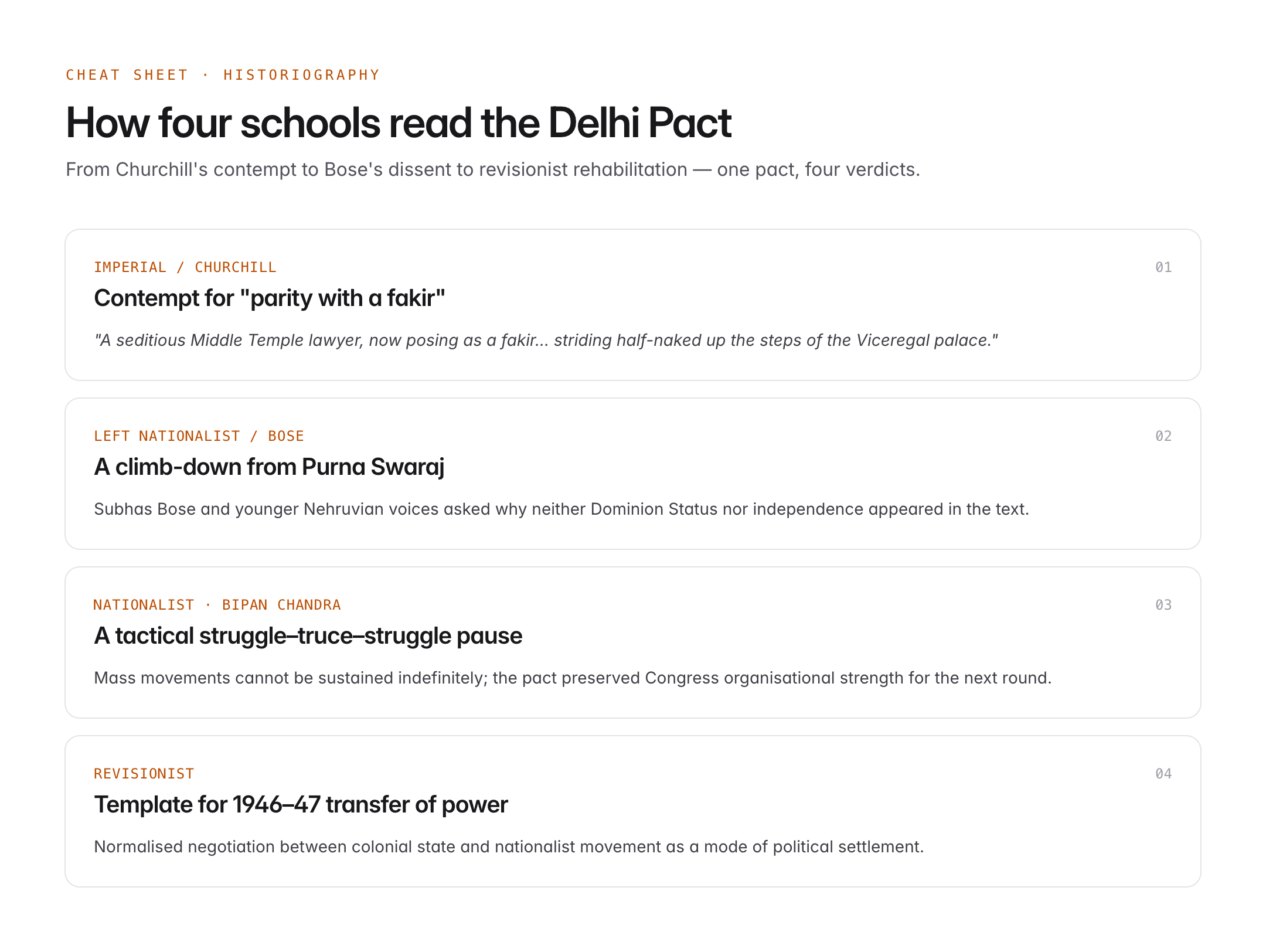
Historians have viewed the Gandhi-Irwin Pact in sharply different ways:
- Winston Churchill famously deplored the spectacle of "a seditious Middle Temple lawyer, now posing as a fakir… striding half-naked up the steps of the Viceregal palace."
- Subhas Bose saw it as a climb-down from Purna Swaraj.
- Nationalist historians (Bipan Chandra) argue it was a tactical truce — mass movements cannot be sustained indefinitely, and the pact preserved Congress's organisational strength.
- Revisionist historians note the pact normalised negotiation between colonial state and nationalist movement — a template used in 1946–47.
Lord Irwin: Context
Lord Irwin (Edward Wood, later Lord Halifax) served as Viceroy from 1926 to 1931. His tenure also saw the Simon Commission protests (1928), the Nehru Report (1928), and the Irwin Declaration (October 1929) promising eventual Dominion Status — which the Congress rejected as too vague.
Legacy
The pact is remembered for several firsts:
- First formal parity between the Raj and the Congress.
- Legitimised Gandhian mass mobilisation followed by negotiation as a strategy.
- Demonstrated that colonial concessions could be extracted through non-violent pressure.
- Exposed the limits of Gandhian compromise on revolutionary nationalists — Bhagat Singh's execution remains a moral shadow on the agreement.
UPSC Relevance
Prelims angle: Remember the date (5 March 1931), the parties (Gandhi and Lord Irwin), the mediators (Sapru and Jayakar), the Karachi session president (Sardar Patel), and the connection to the Second Round Table Conference. Direct MCQs often pair the pact with Dandi March, Karachi Resolution, or the First RTC.
Mains GS I angle: Use the pact to analyse the Gandhian strategy of struggle–truce–struggle, limits of negotiation with imperial power, intra-Congress dissent, and links between economic concessions (salt) and political symbolism.
PYQ angle:
- "Why did the 'Moderates' fail to carry conviction with the nation about their proclaimed ideology and political goals by the end of the nineteenth century?" (Mains 2017) — apply comparative logic.
- Prelims 2017: MCQ on the Karachi session's resolutions on fundamental rights.
- "Assess the role of Gandhiji in national freedom struggle after the Second Round Table Conference."
The Gandhi-Irwin Pact is essential reading for anyone mapping the 1930s freedom struggle.
Tell Google you want more of this.
Add Anantam IAS as a preferred sourceOne tap, and this site shows up more often in your own Top Stories, AI Overviews and AI Mode. Remove it any time.