Introduction
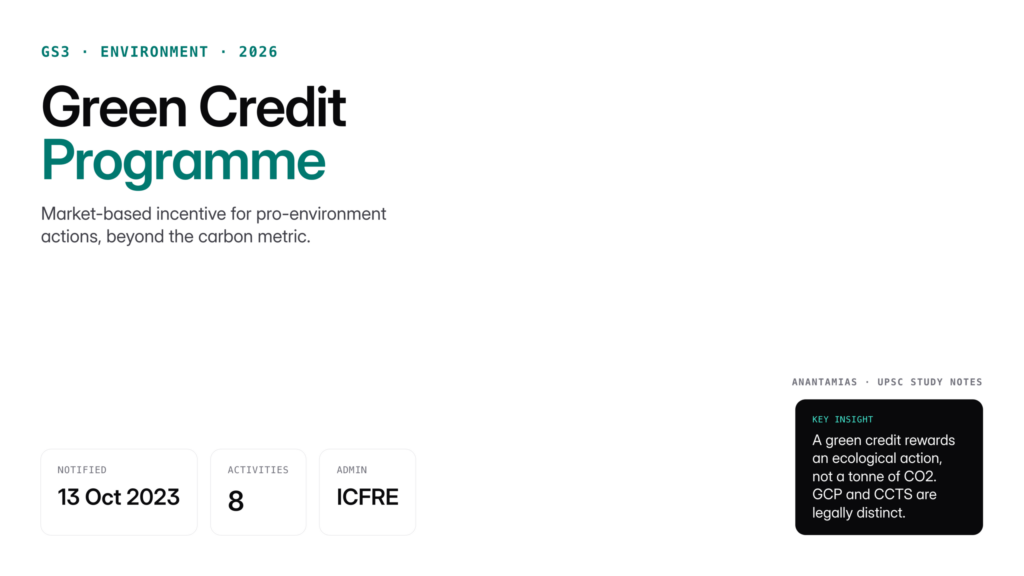
When Prime Minister Narendra Modi climbed the podium at the COP28 World Climate Action Summit in Dubai on 1 December 2023, he launched the Global Green Credit Initiative and invited world leaders to build a voluntary platform for pro-environment actions. Two months earlier the Ministry of Environment, Forest and Climate Change had already notified the Green Credit Rules, 2023 under Section 3 of the Environment (Protection) Act, 1986. The two moves are related but distinct. The Indian programme is a domestic market-based incentive; the global initiative is a proposed inter-governmental framework to scale pro-planet action beyond the carbon-only lens of Paris Agreement mechanisms.
For UPSC aspirants, the green credit program is a high-yield topic. It sits at the intersection of environment (GS3), economy (GS3 on carbon markets), international relations (GS2 on climate diplomacy) and ethics (GS4 on stewardship). It also poses the classic policy question of whether voluntary market instruments can substitute for hard regulation.
Quick Facts at a Glance
| Item | Details |
|---|---|
| Scheme | Green Credit Programme (GCP) |
| Notified by | MoEFCC, 13 October 2023 |
| Legal basis | Environment (Protection) Act, 1986, Section 3 |
| Global launch | COP28 Dubai, 1 December 2023 |
| Global partners (initial) | 13 countries signed LoI |
| Administrator | ICFRE (Indian Council of Forestry Research and Education) |
| Governing body | Steering Committee under Secretary, MoEFCC |
| Unit | 1 green credit per notified activity threshold |
| Eligible activities (initial) | 8 sectors, tree plantation first operationalised |
| Land unit for plantation | Degraded forest/wasteland, 5 hectares minimum |
| Registry | Digital, ICFRE-managed |
| Tradeability | Domestic market platform proposed |
Background and Historical Context
India announced five climate commitments at COP26 Glasgow 2021, famously called Panchamrit: 500 GW non-fossil capacity by 2030, 50 percent electricity from renewables by 2030, 1 billion tonnes reduction in projected emissions by 2030, 45 percent reduction in emissions intensity of GDP by 2030, and net zero by 2070. Prime Minister Modi then introduced the Mission LiFE (Lifestyle for Environment) at COP27 Sharm El-Sheikh in 2022, positioning individual and community behaviour as a lever for climate action.
The Green Credit Programme emerged from this policy lineage. The 2022-23 Union Budget had announced a proposal for a green credit programme. A draft notification was placed in the public domain in June 2023, and the final Green Credit Rules, 2023 were notified on 13 October 2023. The programme complements the Carbon Credit Trading Scheme, 2023 notified by the Ministry of Power under the Energy Conservation (Amendment) Act 2022, although the two are legally separate.
The Global Green Credit Initiative launched at COP28 extends the idea beyond India. Its proposed secretariat is hosted by ICFRE, with a science-based methodology framework envisaged to accommodate different kinds of environmental goods, including tree plantation, water stewardship and sustainable agriculture.
Key Features and Rules
Legal and Institutional Architecture
The Green Credit Rules, 2023 are issued under Section 3 of the Environment (Protection) Act, 1986, which empowers the central government to take measures to protect and improve environmental quality. The administrator is the Indian Council of Forestry Research and Education (ICFRE) headquartered at Dehradun. A Steering Committee chaired by the MoEFCC secretary oversees methodology approval. State governments and their designated agencies act as implementation partners.
Eight Eligible Activities
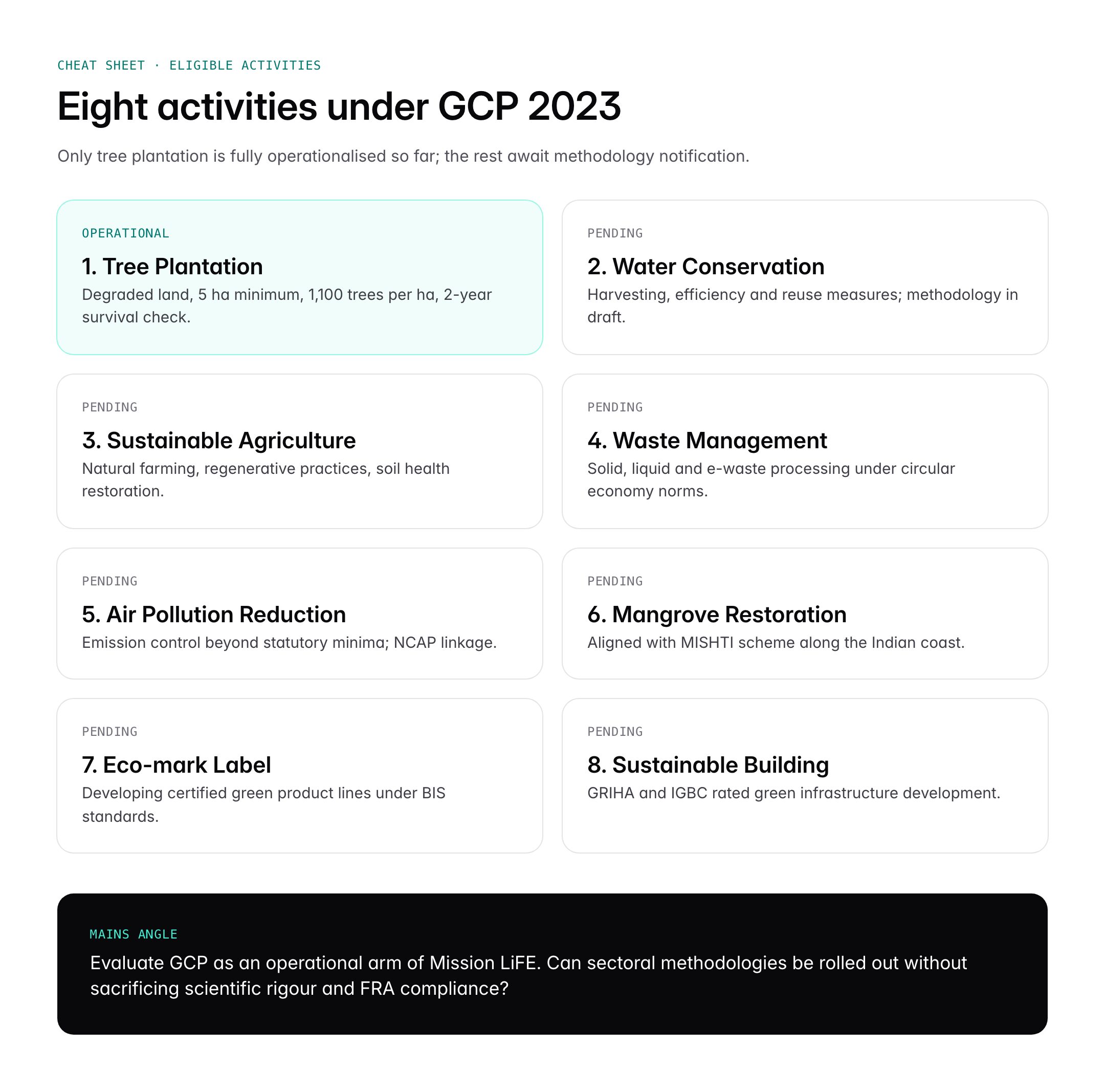
The rules identify eight activities for generating green credits:
- Tree plantation on notified degraded land
- Water conservation, harvesting and use efficiency
- Sustainable agriculture including natural and regenerative farming
- Waste management including solid, liquid and e-waste
- Air pollution reduction measures
- Mangrove conservation and restoration
- Eco-mark label development for certifying products
- Sustainable building and infrastructure with green building norms
Only tree plantation has been operationalised so far through a methodology approved in February 2024. The rules allow other activities to be operationalised sector by sector as their scientific methodologies mature.
Tree Plantation Methodology
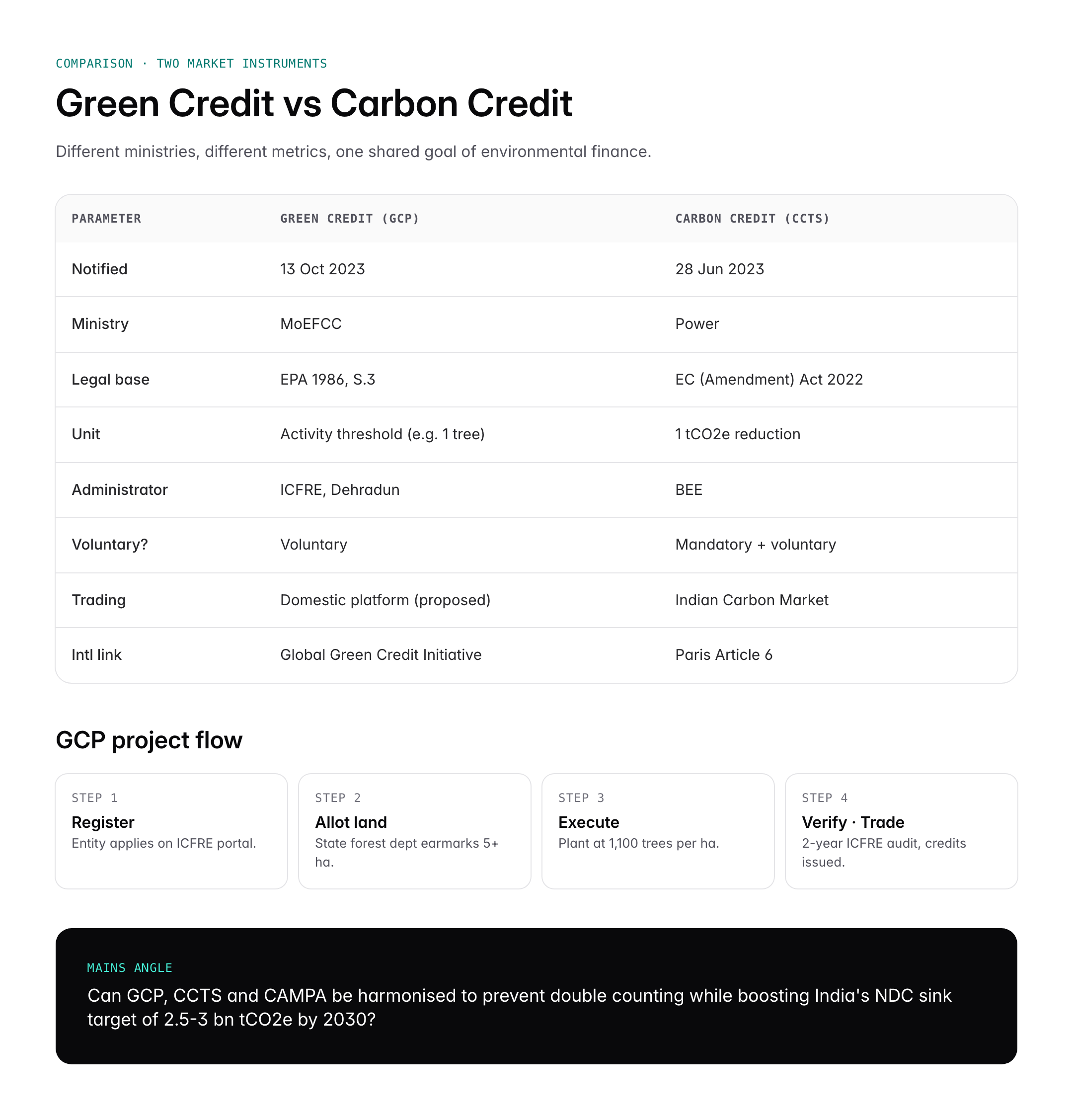
Entities apply to state forest departments to take up plantation on notified degraded forest land and wasteland. A minimum parcel of five hectares is required. After two years, ICFRE evaluates the plantation on survival, density and ecological parameters. If norms are met, one green credit is issued per successfully grown tree subject to a minimum density of 1,100 trees per hectare. Credits are recorded on a digital registry.
Use and Tradeability
Green credits can serve three purposes: meet domestic compliance obligations where notified, be traded on a proposed domestic exchange, or be used as a corporate ESG disclosure marker. The rules explicitly say green credits may be used to meet obligations under existing laws such as compensatory afforestation under the Compensatory Afforestation Fund Management and Planning Authority (CAMPA) framework, provided equivalence is demonstrated.
Global Green Credit Initiative
At COP28, India proposed that the Global Green Credit Initiative would act as a voluntary platform for pro-environment actions beyond carbon. Thirteen countries signed letters of interest at launch, and a web platform hosted by ICFRE provides repositories of methodologies and project registries. The initiative explicitly does not replace Paris Agreement Article 6 markets; it supplements them.
Significance for UPSC and General Knowledge
- GCP is a market-based environmental policy instrument, an important concept for GS3 and the Public Administration optional.
- It operationalises the polluter-pays principle and its counterpart, the conserver-gets principle.
- Tree plantation credits link directly to India’s Nationally Determined Contribution of an additional 2.5-3 billion tonnes of CO2-equivalent carbon sink by 2030.
- The scheme advances Mission LiFE by translating individual and institutional actions into tradeable recognition.
- At COP28 the Global Green Credit Initiative added to India’s climate diplomacy toolkit alongside the ISA and CDRI.
- The scheme raises important questions on additionality, permanence and leakage, which are standard Mains critique angles.
Detailed Analysis: How Green Credits Differ from Carbon Credits
Green credits and carbon credits are often confused but are legally and methodologically distinct. Carbon credits in India come under the Carbon Credit Trading Scheme, 2023 notified by the Ministry of Power under the Energy Conservation (Amendment) Act, 2022. One carbon credit equals one tonne of CO2-equivalent reduction. Carbon credits can be traded domestically and, subject to bilateral agreements under Article 6 of the Paris Agreement, internationally. The Bureau of Energy Efficiency (BEE) acts as administrator.
Green credits, by contrast, do not measure greenhouse gas emissions at all. One green credit corresponds to a notified activity-based threshold, for example one successfully grown tree under the plantation methodology. A project may simultaneously generate green credits (for ecological outcomes) and carbon credits (for sequestration). The rules explicitly permit dual crediting where methodologies differ.
The programme has seen uneven uptake. Public sector undertakings such as Coal India, NTPC, Oil India and IndianOil have registered large blocks of degraded land for tree plantation. Private sector participation remains thin in 2024-25 because methodologies for the other seven activities are still being developed. The ICFRE digital registry now lists hundreds of projects across Madhya Pradesh, Chhattisgarh, Odisha and Rajasthan, with about 10,000 hectares enrolled in the first operational year.
The international component has attracted both interest and criticism. Supporters argue that voluntary non-carbon instruments can finance forest restoration, water security and sustainable agriculture in the Global South. Critics argue that absent strict MRV (monitoring, reporting, verification) and safeguards, the initiative risks becoming a greenwashing pathway.
Comparative Perspective
| Parameter | Green Credit Programme | Carbon Credit Trading Scheme | CAMPA |
|---|---|---|---|
| Year | 2023 | 2023 | 2016 |
| Ministry | MoEFCC | Power | MoEFCC |
| Legal base | EPA 1986 S3 | EC Act 2022 | CAMPA Act 2016 |
| Unit | 1 credit per activity threshold | 1 credit per tCO2e | Compensatory afforestation obligation |
| Voluntary? | Voluntary, optional | Mixed, mandatory for obligated entities | Mandatory for forest diversion |
| Administrator | ICFRE | BEE | Ad hoc CAMPA |
| Tradeable? | Yes, domestic platform | Yes, on ICX | No, use-based |
The comparison is instructive for Mains answer structuring. GCP is broader in scope (eight activities) but less directly linked to the climate bottom line. The CCTS is narrower (only GHGs) but harder in legal consequence. CAMPA is an older instrument that is mandatory and specific to forest diversion compensation. An effective environmental finance architecture requires all three to work in concert rather than overlap.
Challenges and Criticisms
The first major criticism is additionality. Would a PSU undertake tree plantation on its degraded land anyway, as part of statutory CSR or CAMPA obligations? If so, the green credits issued do not represent new environmental value, raising the same additionality concerns that plague all offset markets.
Second, permanence and leakage. A tree planted today could be cut down in ten years, lost to fire, or displace natural regeneration elsewhere. The rules require two-year survival monitoring, but long-term trust rests on multi-decade stewardship that remains institutionally fragile. Independent third-party verification is not yet mandatory across all activities.
Third, community rights. Tree plantation projects on so-called degraded wasteland often overlap with lands used by forest-dependent communities. The Forest Rights Act, 2006 and Panchayat (Extension to Scheduled Areas) Act, 1996 require consent, but the Green Credit Rules do not contain an explicit free-prior-informed-consent clause. Civil society groups have flagged potential conflicts in Jharkhand, Odisha and Chhattisgarh.
Fourth, trading and price discovery. Until a liquid domestic exchange is operational, green credits will struggle to find a market price, and their ESG signalling value remains limited. Finally, international credibility depends on the science of methodologies. Without rigorous MRV protocols, the Global Green Credit Initiative risks perceptions of greenwashing at a time when trust in voluntary carbon markets is already strained.
Prelims Pointers
- The Green Credit Programme was notified on 13 October 2023 under Section 3 of the EPA 1986.
- The Global Green Credit Initiative was launched at COP28 Dubai on 1 December 2023.
- ICFRE at Dehradun is the administrator.
- The programme covers eight activities; tree plantation is operational first.
- Minimum land parcel for plantation is five hectares of degraded land.
- Minimum plantation density is 1,100 trees per hectare.
- Survival evaluation happens after two years.
- Green credits are separate from carbon credits under the CCTS 2023 administered by BEE.
- CCTS operates under the Energy Conservation (Amendment) Act, 2022.
- The governing body of GCP is a Steering Committee chaired by Secretary, MoEFCC.
- The scheme complements Mission LiFE and the Panchamrit commitments.
- India’s NDC sink target is an additional 2.5-3 billion tCO2e by 2030.
Mains Practice Questions
Q1. “The Green Credit Programme operationalises Mission LiFE but faces the classic additionality problem of offset markets.” Critically examine. (250 words, GS3)
- Describe GCP architecture: eight activities, ICFRE, steering committee, digital registry.
- Discuss how Mission LiFE’s focus on pro-planet actions is codified through tradeable recognition.
- Analyse additionality, permanence, community consent and MRV gaps; suggest reforms including third-party verification and FRA integration.
Q2. Distinguish between the Green Credit Programme and the Carbon Credit Trading Scheme. How can India harmonise the two with the CAMPA framework to build a coherent environmental finance architecture? (250 words, GS3)
- Compare legal bases, administrators, units and tradeability of GCP, CCTS and CAMPA.
- Identify overlaps, especially in forest restoration and plantation, and potential double counting.
- Propose a unified environmental finance dashboard, shared registries, and Article 6 alignment.
Conclusion
The Green Credit Programme is a distinctive Indian contribution to environmental policy design. By moving beyond the single-metric carbon market and recognising water, soil, waste and air actions, it reflects a broader philosophical position that the climate crisis is also an ecological and developmental crisis. The COP28 launch of the Global Green Credit Initiative extends that logic into the international domain and reinforces India’s climate leadership credentials.
For UPSC aspirants the programme is valuable less as a set of dates and numbers and more as a test case in environmental governance. It exercises the conceptual tools of market-based instruments, additionality, permanence, community rights and MRV. Candidates who can weave these strands into a balanced answer, acknowledging both the scheme’s ambition and its design risks, will have a robust Mains response and a sharp Prelims grip on a topic that is certain to recur in current-affairs cycles.
Frequently Asked Questions
What is the Green Credit Programme?
The Green Credit Programme is a voluntary market-based scheme notified by the MoEFCC on 13 October 2023 under Section 3 of the Environment (Protection) Act, 1986. It rewards entities with tradeable green credits for pro-environment actions across eight activities including tree plantation, water conservation, sustainable agriculture, mangrove restoration and waste management. ICFRE, Dehradun administers it.
Why is the Green Credit Programme important for UPSC?
The scheme is a high-yield GS3 environment and economy topic. It tests understanding of market-based instruments, the polluter-pays and conserver-gets principles, and the distinction from carbon markets. It also links to GS2 climate diplomacy through the Global Green Credit Initiative at COP28 and to Mission LiFE. Essay questions often use it as a case study.
What is the Global Green Credit Initiative?
The Global Green Credit Initiative was launched by Prime Minister Modi at COP28 Dubai on 1 December 2023. It is a proposed voluntary inter-governmental platform for pro-environment actions beyond carbon. Thirteen countries signed letters of interest. The initiative is hosted on an ICFRE-managed platform and complements rather than replaces Paris Agreement Article 6 markets.
How is Green Credit different from Carbon Credit?
A carbon credit under the Carbon Credit Trading Scheme 2023 equals one tonne of CO2-equivalent reduction, administered by BEE under the Energy Conservation Amendment Act 2022. A green credit corresponds to an activity-based threshold, such as one successfully grown tree, and does not measure greenhouse gases. Dual crediting is possible when methodologies differ.
Who administers the Green Credit Programme?
The Indian Council of Forestry Research and Education (ICFRE), headquartered at Dehradun, is the administrator. A Steering Committee chaired by the Secretary, Ministry of Environment, Forest and Climate Change, approves methodologies. State forest departments and designated state agencies implement projects on the ground, and a digital registry tracks credits.
Which activities are eligible under the Green Credit Rules 2023?
Eight activities are eligible: tree plantation, water conservation and harvesting, sustainable agriculture, waste management, air pollution reduction, mangrove conservation, eco-mark label development and sustainable building. Only tree plantation has been operationalised through a detailed methodology approved in February 2024. Other sectoral methodologies are being developed.
What are the rules for tree plantation under the programme?
Entities apply to state forest departments for plantation on notified degraded forest land or wasteland with a minimum parcel of five hectares. Plantation density must be at least 1,100 trees per hectare. After two years, ICFRE evaluates survival, density and ecological parameters. One green credit is issued per successfully grown tree meeting the norms.
What are the main criticisms of the Green Credit Programme?
Critics highlight four concerns: additionality risk as PSUs might plant anyway under CSR or CAMPA; permanence and leakage since trees may be lost over decades; lack of an explicit free-prior-informed-consent clause for forest-dependent communities; and weak monitoring, reporting and verification for the planned domestic trading platform and international Global Green Credit Initiative.
Tell Google you want more of this.
Add Anantam IAS as a preferred sourceOne tap, and this site shows up more often in your own Top Stories, AI Overviews and AI Mode. Remove it any time.