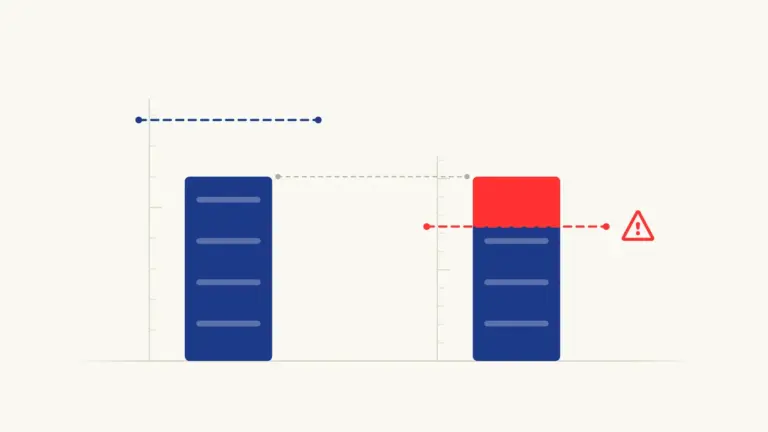
The rate at which a country saves sets the ceiling on how fast it can invest without borrowing from abroad. Gross domestic savings is the metric that captures this: the total amount of a nation’s income retained after final consumption expenditure. In India, it is falling at a point when the investment requirement is rising, and that mismatch is the central macroeconomic tension of the decade.
Total savings breaks into three components, each with a distinct behaviour and a distinct policy lever.
The Three Components
Household savings. The largest source, split into two forms.
- Financial savings: bank deposits, mutual funds, insurance, pension funds, stocks and bonds. The relevant measure is net financial savings, which is gross financial savings minus financial liabilities.
- Physical savings: real estate, gold and other physical assets.
Corporate savings. Retained earnings, that is profits not distributed as dividends, held to finance future investment. This component moves with the profit cycle and with firms’ appetite for capital expenditure.
Public sector savings. The revenue surplus of government and public enterprises. When a government runs a revenue deficit, this component is negative and subtracts from the national total.
Why the Split Matters
Only some of what households save is available to fund investment through the financial system. Gold in a locker and an apartment held as an investment are both savings in the national accounts sense. Neither is intermediated into a factory or a transmission line.
That is why a country can have a respectable headline savings rate and still face a shortage of investable capital. The composition matters as much as the level.
The same logic applies to the public component. A government running a revenue deficit is consuming out of borrowed money, which means the public sector is dissaving and drawing on the pool that households and firms are trying to fill.
What a Falling Savings Rate Costs
- Slower capital formation. Domestic investment either falls or has to be financed externally.
- Greater external dependence. The gap between investment and savings is financed by foreign capital, which appears as a current account deficit and rises and falls with global risk appetite.
- Strategic exposure. Reliance on external funding for defence, space, atomic energy and critical infrastructure carries implications beyond the balance sheet.
- Financial fragility. Where the gap is bridged by rising consumer credit rather than by saving, risk migrates into the retail lending book.
The Honest Limits
Two qualifications belong in a serious answer.
First, a high savings rate is not automatically good. Savings that sit in unproductive assets, or that reflect precautionary behaviour driven by weak social security, indicate a problem rather than a strength. The East Asian comparison is often made carelessly.
Second, raising savings by suppressing consumption is self-defeating in an economy where domestic demand is the main growth engine. The objective is not less consumption; it is a higher share of income saved in forms that reach the financial system.
The Way Forward
- Keep real returns positive. Deposit and small savings returns that lag inflation push households towards gold and property.
- Restore public sector savings through fiscal consolidation on the revenue account, which is the component most directly under policy control.
- Deepen financial markets so that households have graded options between a deposit and equity, particularly in retail debt.
- Regulate unsecured retail credit prudentially, since borrowing directly reduces net household savings.
- Formalise physical savings through instruments such as gold monetisation and real estate investment trusts, which convert idle assets into investable capital.
The savings rate is not an accounting curiosity. It is the constraint that decides whether India funds its own transformation or rents the capital to do it.
Frequently Asked Questions
What is gross domestic savings?
Gross domestic savings is the total amount of a nation’s income retained after accounting for final consumption expenditure. It is the domestic pool available to finance investment, and it is measured before deducting depreciation, which is why it is described as gross.
What are the components of gross domestic savings?
Three: household savings, which is the largest source and includes both financial and physical savings; corporate savings, which is retained earnings not distributed as dividends; and public sector savings, which is essentially the revenue surplus of government and public enterprises.
How do household savings divide within gross domestic savings?
Into financial savings such as bank deposits, mutual funds, insurance, pension funds, stocks and bonds, measured net of financial liabilities, and physical savings such as real estate and gold. Only the financial component is intermediated into investment through the financial system.
Why does the savings rate matter for growth?
Because domestic savings fund domestic investment. A higher savings rate allows a higher investment rate without relying on foreign capital, and investment is what expands productive capacity. A falling savings rate either slows investment or increases dependence on external financing.
What is corporate savings?
Retained earnings, that is profits not distributed as dividends, held to finance future investment. Corporate savings rise when profitability improves and firms retain rather than distribute, and they are a significant swing factor in the total.
What is public sector savings?
The revenue surplus of the government and public enterprises, that is revenue receipts minus revenue expenditure. When governments run revenue deficits, public sector savings turn negative and drag down the national total.
How does the savings rate affect India’s external position?
The gap between domestic investment and domestic savings has to be filled by foreign capital, which shows up as a current account deficit. A larger savings shortfall therefore translates into greater external dependence and greater vulnerability to global capital cycles.
What can raise the savings rate?
Positive real returns on financial savings, controlled inflation, prudent regulation of retail credit, fiscal consolidation that restores public sector savings, corporate profitability that supports retained earnings, and financial deepening that brings physical savings into the formal system.
Practice Questions
Prelims MCQs
- Gross domestic savings is best defined as
(a) Total national income
(b) Income retained after final consumption expenditure
(c) Bank deposits held by residents
(d) Government revenue receipts
Answer: (b) GDS is the portion of national income not consumed, and therefore available to finance investment. - Which of the following is not a component of gross domestic savings?
(a) Household savings
(b) Corporate savings
(c) Public sector savings
(d) Foreign direct investment
Answer: (d) FDI is external capital, not domestic savings; the three domestic components are household, corporate and public sector. - Corporate savings in national accounts refers primarily to
(a) Dividends distributed to shareholders
(b) Retained earnings
(c) Corporate tax collections
(d) Bank borrowings by firms
Answer: (b) Retained earnings, that is undistributed profit, constitute corporate savings. - Public sector savings turn negative when
(a) The fiscal deficit exceeds three percent of GDP
(b) Government runs a revenue deficit
(c) Public debt exceeds sixty percent of GDP
(d) Disinvestment receipts fall
Answer: (b) A revenue deficit means revenue expenditure exceeds revenue receipts, so the public sector is dissaving. - A shortfall of domestic savings relative to domestic investment is reflected in
(a) A current account deficit
(b) A fiscal surplus
(c) A fall in foreign exchange reserves only
(d) A rise in the repo rate
Answer: (a) The savings-investment gap is financed by foreign capital, which appears as a current account deficit.
Mains Questions
- Examine the components of gross domestic savings in India and identify which of them offers the greatest scope for improvement. (250 words)
- The savings-investment gap determines India's external vulnerability. Discuss. (250 words)
- Physical savings do not intermediate into productive investment as effectively as financial savings. Examine the policy implications. (150 words)
- Discuss the role of fiscal consolidation in restoring public sector savings. (150 words)
- Suggest a policy framework to raise India's gross domestic savings rate without suppressing consumption-led growth. (250 words)
Tell Google you want more of this.
Add Anantam IAS as a preferred sourceOne tap, and this site shows up more often in your own Top Stories, AI Overviews and AI Mode. Remove it any time.