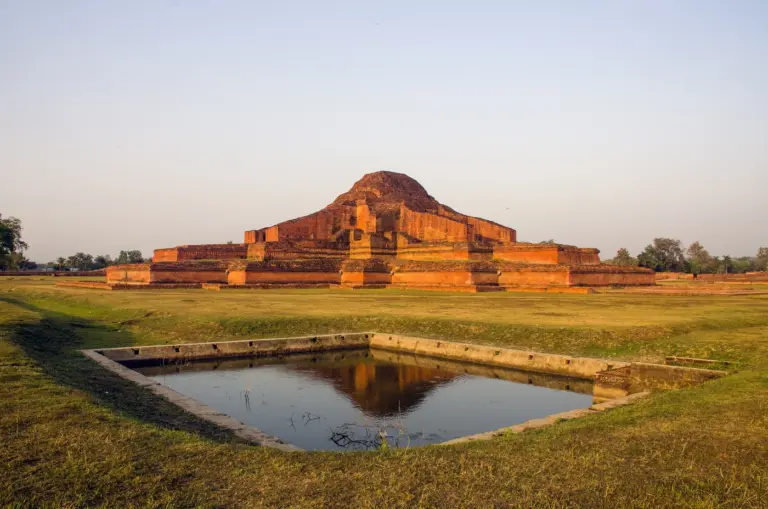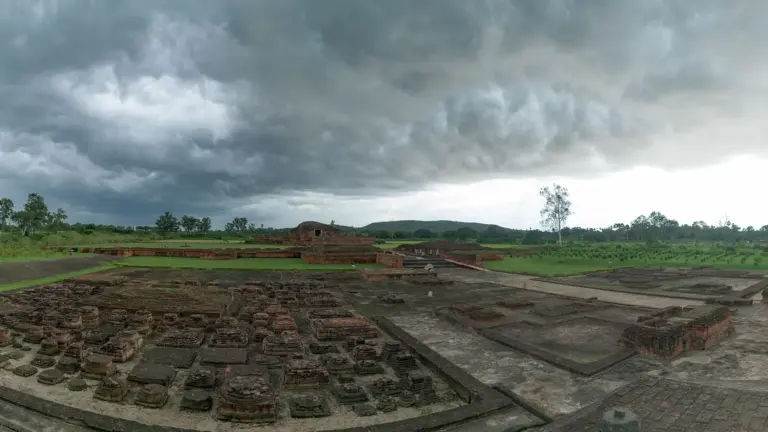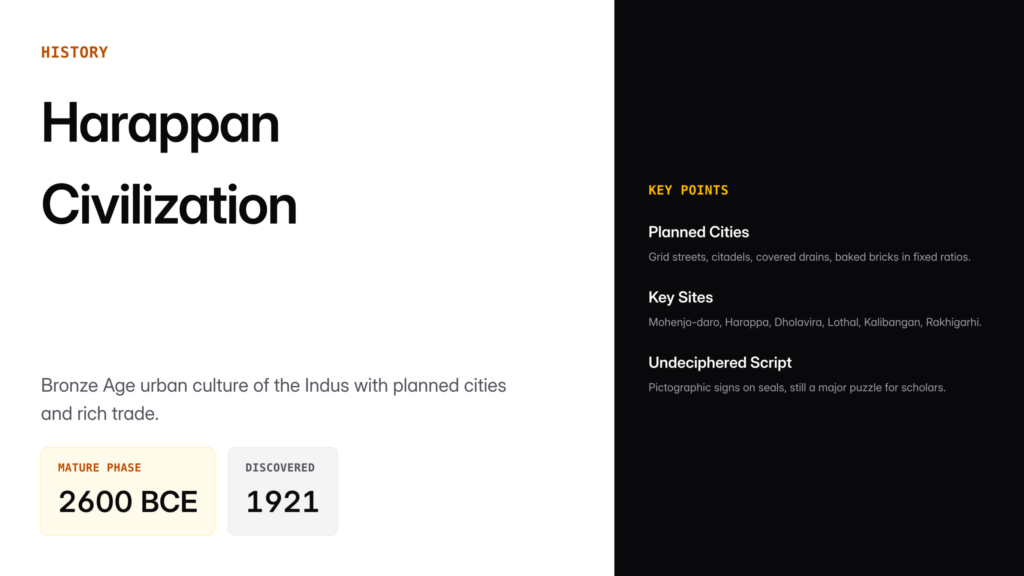
The Harappan civilization, also called the Indus Valley Civilization (IVC), was a Bronze Age urban culture that flourished across the north-western Indian subcontinent from about 3300 to 1300 BCE, with its mature urban phase between 2600 and 1900 BCE. Named after the site of Harappa in present-day Punjab, Pakistan, it was one of the four earliest river-valley civilizations along with Mesopotamia, Egypt, and China. Known for planned cities, sophisticated drainage, standardised weights, and a still-undeciphered script, the Harappan civilization is foundational for UPSC Ancient History. This guide covers chronology, sites, society, economy, religion, and its decline.
Discovery and Chronology
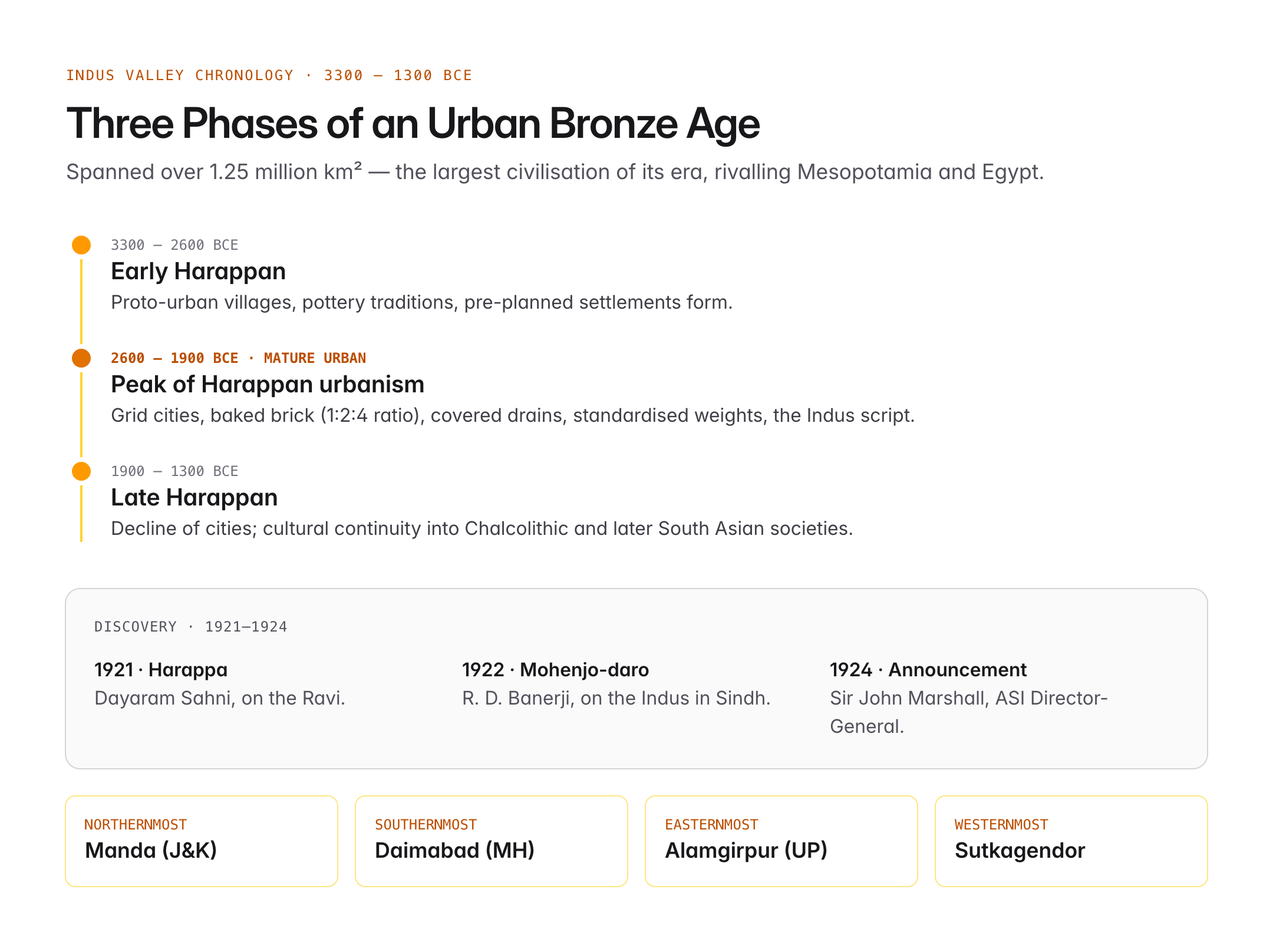
The existence of a pre-Aryan urban civilization was confirmed when the Archaeological Survey of India (ASI) announced discoveries in the 1920s.
- 1921: Dayaram Sahni excavated Harappa on the Ravi River (now in Pakistan).
- 1922: R. D. Banerji excavated Mohenjo-daro on the Indus in Sindh.
- The announcement was made by Sir John Marshall, ASI Director-General, in 1924.
Chronological phases (widely used):
| Phase | Approx. Dates |
|---|---|
| Early Harappan | 3300 – 2600 BCE |
| Mature Harappan (Urban) | 2600 – 1900 BCE |
| Late Harappan | 1900 – 1300 BCE |
Geographical Extent
The civilization covered over 1.25 million sq km, making it the largest of its era in the ancient world. Sites have been discovered across Pakistan and north-western India, along the Indus, Ghaggar-Hakra (Saraswati) and Sutlej systems.
- Northernmost site: Manda (Jammu) on the Chenab.
- Southernmost site: Daimabad (Maharashtra) on the Pravara.
- Easternmost site: Alamgirpur (UP) on the Hindon.
- Westernmost site: Sutkagendor (Balochistan) on the Dasht.
Major Sites and Key Finds
| Site | Location | Key Finds |
|---|---|---|
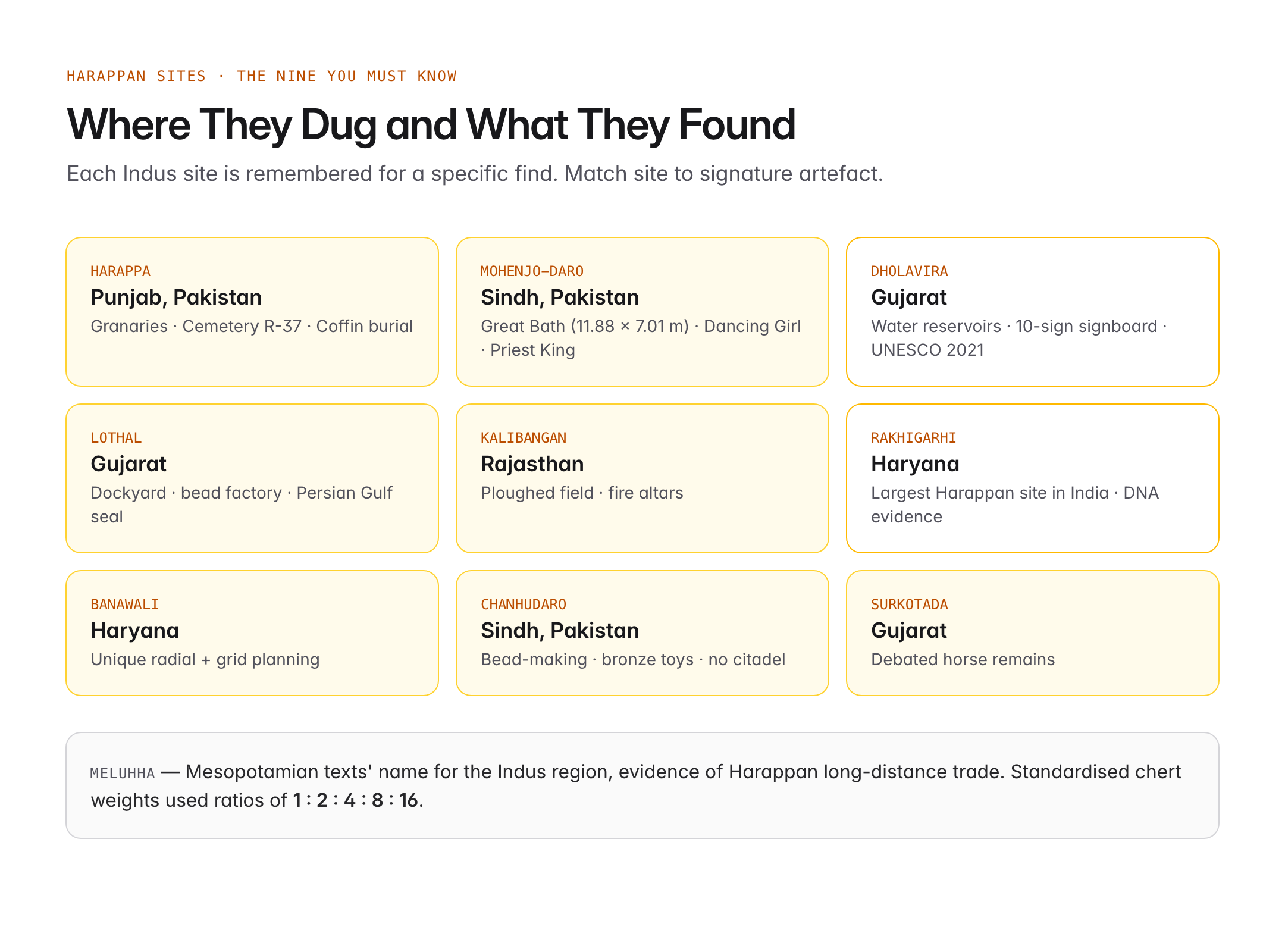
| Harappa | Punjab, Pakistan | Granaries, cemetery R-37, coffin burial |
| Mohenjo-daro | Sindh, Pakistan | Great Bath, Great Granary, Dancing Girl, Priest King |
| Dholavira | Gujarat, India | Water reservoirs, signboard, three-tier city |
| Lothal | Gujarat, India | Dockyard, bead factory, Persian Gulf seal |
| Kalibangan | Rajasthan, India | Ploughed field, fire altars |
| Rakhigarhi | Haryana, India | Largest IVC site in India |
| Banawali | Haryana, India | Unique planning combining radial and grid |
| Chanhudaro | Sindh, Pakistan | Bead-making, bronze toys; no citadel |
| Surkotada | Gujarat, India | Horse remains debated |
- Dholavira was inscribed as a UNESCO World Heritage Site in 2021, becoming India's 40th World Heritage Site.
- Rakhigarhi, often cited as the largest Harappan site in India, has yielded significant DNA evidence pointing to a Harappan genetic continuity with modern South Asians.
Town Planning
Harappan cities show remarkable uniformity, reflecting strong civic organisation.
- Grid pattern streets meeting at right angles.
- Cities divided into a fortified citadel (west) and a lower town (east).
- Baked brick constructions with standard ratio 1 : 2 : 4.
- Covered drains with manholes along streets — a hallmark of Harappan urbanism.
- Great Bath at Mohenjo-daro – 11.88 × 7.01 m, lined with bitumen for waterproofing.
- Granaries for storing surplus grain.
- Dholavira had three-part divisions – citadel, middle town, lower town – and sophisticated water conservation reservoirs.
Economy and Trade
- Agriculture: wheat, barley, rice (at Lothal and Rangpur), cotton (earliest known use), peas, mustard, sesame.
- Animal domestication: cattle, buffalo, sheep, goat, dog, cat; horse disputed.
- Craft production: beads (carnelian, agate, steatite), shell bangles, pottery, bronze metallurgy.
- Trade: internal and external. Harappan seals found in Mesopotamia; Mesopotamian texts refer to Meluhha, generally identified with the Indus region.
- Lothal's dockyard is evidence of maritime trade.
- Standardised weights in ratios of 1:2:4:8:16 made of chert.
Society, Religion, and Script
Society:
- No clear evidence of kingship or temples.
- Likely ruled by merchant oligarchies or priest-administrators.
- Egalitarian in comparison to contemporary Mesopotamia, though housing differences suggest social stratification.
Religion:
- Mother Goddess figurines widespread.
- Pashupati Seal from Mohenjo-daro shows a seated figure surrounded by animals, often interpreted as a proto-Shiva.
- Fire altars at Kalibangan and Lothal.
- Worship of trees (peepal), animals (bull), and phallic symbols (lingam).
- No large temples have been found.
Script:
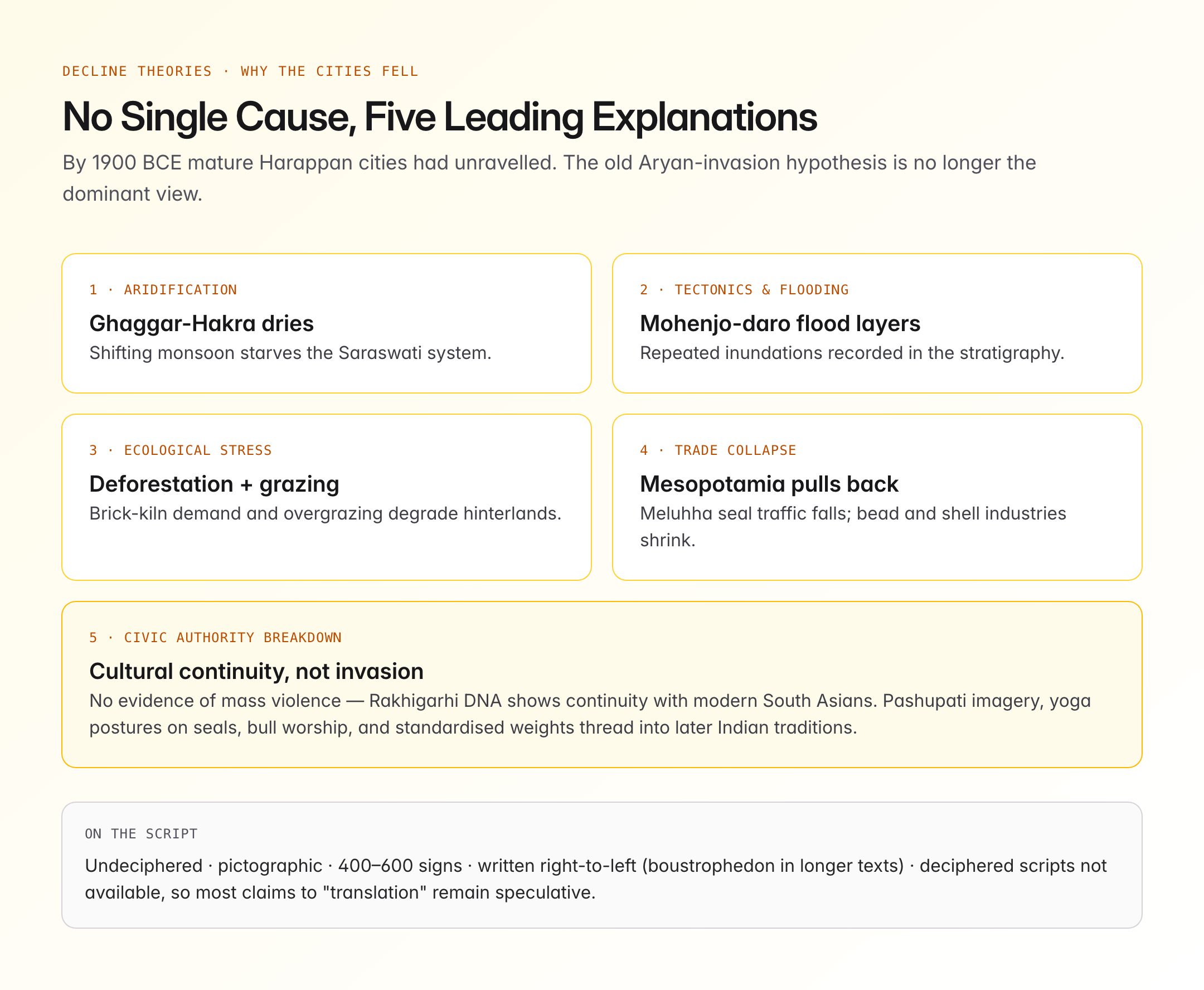
- Undeciphered pictographic script with about 400–600 signs.
- Written right to left (boustrophedon in longer texts).
- Found on seals, tablets, and pottery.
- The Dholavira signboard, a ten-sign inscription on wooden planks, is the largest Harappan inscription found.
Art and Artefacts
- Bronze Dancing Girl (Mohenjo-daro) – lost wax casting technique.
- Priest King stone figurine (Mohenjo-daro).
- Terracotta figurines, seals with unicorn motif, painted pottery (red ware with black motifs).
- Beadwork from Chanhudaro and Lothal.
- Toys and games – dice, carts, whistles – indicating a playful, materially rich culture.
Burial Practices
- Mostly extended burial with head north.
- Cemetery R-37 at Harappa is a major burial site.
- Coffin burials at Harappa are unique.
- Pot burials and twin burials at Lothal.
- Little elaborate tomb architecture — consistent with egalitarian features.
Decline of the Harappan Civilization
By 1900 BCE, mature Harappan cities began to decline. Multiple theories exist; no single one is universally accepted.
- Aridification and shifting monsoon drying up the Ghaggar-Hakra (Saraswati) river.
- Tectonic activity and floods (Mohenjo-daro shows flood deposits).
- Ecological degradation from overgrazing and deforestation.
- Trade collapse with Mesopotamia.
- Decline of civic authority rather than invasion – the Aryan invasion theory is no longer seen as the primary cause.
- Cultural continuity into Late Harappan and post-Harappan / Chalcolithic cultures, blending into later South Asian societies.
Significance and Legacy
- Among the first planned urban civilizations in the world.
- Pioneered urban sanitation unmatched for millennia.
- Demonstrated long-distance trade networks.
- Cultural continuity with later Indian traditions (yoga postures on seals, Pashupati imagery, weights).
- Shows that Indian civilizational roots predate Vedic Aryan culture, reshaping historical narratives.
UPSC Relevance
Prelims focus:
- Dates: Mature phase 2600–1900 BCE.
- Discovery: Harappa 1921 (Sahni), Mohenjo-daro 1922 (Banerji).
- Key sites and their specific finds (Lothal dockyard, Kalibangan fire altars, Dholavira water system).
- Dholavira – UNESCO World Heritage (2021).
- Pashupati seal, Dancing Girl, Great Bath.
- Script: undeciphered, pictographic, right-to-left.
Mains GS angle (GS Paper I – Ancient History; Art & Culture):
- Urban planning and civic organisation of the Harappan cities.
- Nature of Harappan religion and its continuity with later Hinduism.
- Causes of decline and lessons for contemporary sustainability.
- Comparison with contemporary Mesopotamian and Egyptian civilizations.
Sample PYQ angle: UPSC has asked about Harappan town planning, key artefacts, and chronology. Expect questions on specific sites (e.g., which site has a dockyard) and on aspects of Indus religion and economy.
Tell Google you want more of this.
Add Anantam IAS as a preferred sourceOne tap, and this site shows up more often in your own Top Stories, AI Overviews and AI Mode. Remove it any time.