Disclosure: this guide contains Amazon affiliate links. As an Amazon Associate, Anantam IAS earns from qualifying purchases — at no extra cost to you.
History Optional for UPSC: Preparation Strategy
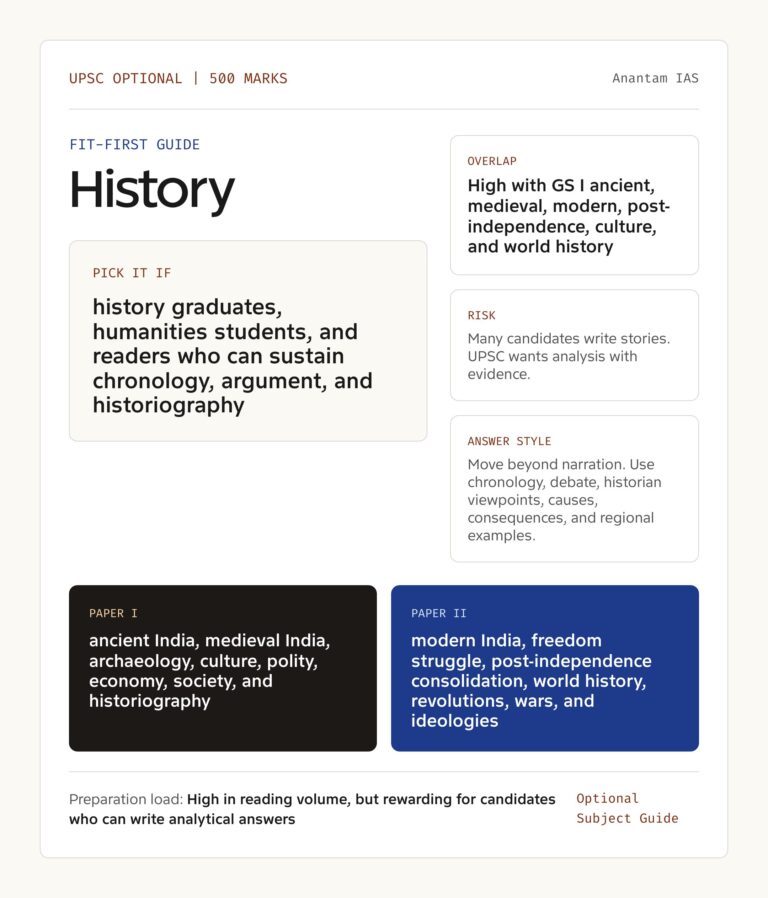
History optional covers the longest chronological span of any UPSC subject — from the Indus Valley Civilisation to the post-Cold War world order. Despite this breadth, it remains a consistently popular choice because of its strong overlap with GS Paper 1, rich source material, and the intellectual satisfaction of connecting past events to present governance. This guide breaks down the syllabus, recommended books, answer writing methods, and scoring strategies for both papers.
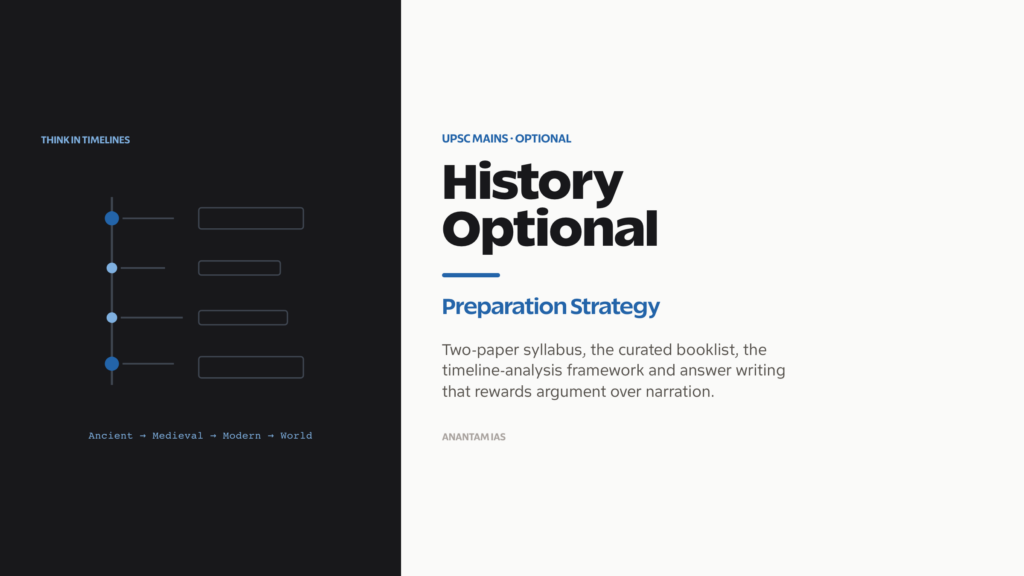
The subject rewards candidates who can think in timelines, draw connections across centuries, and present arguments with evidence. It demands more reading than compact optionals like Public Administration, but the payoff in GS preparation and interview performance is significant.
Why Choose History Optional
History optional isn’t the easiest choice — but for the right candidate, it’s one of the most rewarding.
Deep GS1 overlap. Modern Indian history, Indian culture, and world history topics in GS Paper 1 draw directly from the history optional syllabus. Preparing Paper 2 of history optional effectively covers 50–60% of the GS1 history-culture section.
Rich analytical scope. Unlike factual subjects, history rewards interpretation. UPSC questions increasingly ask candidates to analyse causes, evaluate consequences, and compare perspectives — skills that distinguish strong answers from average ones.
Stable, predictable syllabus. The events of history don’t change. New archaeological discoveries or historiographical debates add minor dimensions, but the core syllabus — Mauryas, Mughals, British colonialism, World Wars, Cold War — remains constant year after year.
Interview advantage. History optional candidates engage confidently with panel questions on India’s freedom struggle, constitutional evolution, and foreign policy roots. These topics surface frequently in UPSC interviews.
| Factor | History | Public Administration | Geography |
|---|---|---|---|
| GS overlap area | GS1 (very high) | GS2 (very high) | GS1, GS3 (high) |
| Syllabus volume | Large | Compact | Moderate |
| Books required | 6–8 core | 4–5 core | 5–6 core |
| Analytical depth | Very high | Moderate | Moderate |
| Map work need | Moderate | None | Very high |
| Avg. preparation time | 6–8 months | 3–4 months | 4–6 months |
Public Administration Optional: Strategy & Resources
Paper 1: Ancient and Medieval India
Paper 1 spans from prehistoric times to the 18th century. It divides into two unequal halves — ancient India (roughly 60% of questions) and medieval India (roughly 40%).
Ancient India: Key Topics
Prehistoric and Protohistoric periods — Paleolithic, Mesolithic, and Neolithic cultures. Indus Valley Civilisation (Harappa, Mohenjo-daro, Dholavira, Rakhigarhi) — urban planning, trade, decline theories.
Vedic period — Early Vedic (Rig Vedic) society vs Later Vedic transformation. Varna system origins. Political organisation — Sabha, Samiti, Jana, Rashtra.
Mahajanapadas and rise of heterodox sects — Sixteen Mahajanapadas. Gautama Buddha and Buddhism. Mahavira and Jainism. Causes of their rise — reaction against Brahmanical orthodoxy, support from trading classes (Vaishyas).
Mauryan Empire — Chandragupta Maurya, Kautilya‘s Arthashastra, Ashoka’s Dhamma policy, Mauryan administration (provincial system, espionage network), decline theories. Archaeological sources — Ashokan edicts, Sanchi, Sarnath.
Post-Mauryan developments — Sungas, Kanvas, Satavahanas. Indo-Greek, Saka, Kushana rule. Gandhara art (Greco-Buddhist synthesis). Trade with Roman Empire.
Gupta Empire — Samudragupta’s conquests (Allahabad Pillar inscription), Chandragupta II, classical age of Indian culture. Gupta administration, land grant system (agrahara), Nalanda University.
Post-Gupta and Regional Kingdoms — Harsha (Harshacharita by Banabhatta, Xuanzang’s account), Chalukyas, Pallavas, Rashtrakutas, Cholas (Rajendra Chola’s naval expeditions), temple architecture evolution.
Medieval India: Key Topics
Early Medieval Period — Rajput kingdoms, tripartite struggle (Pratiharas, Palas, Rashtrakutas), Arab conquest of Sindh (712 CE, Muhammad bin Qasim), Turkish invasions (Mahmud of Ghazni, Muhammad of Ghor).
Delhi Sultanate — Slave Dynasty (Qutbuddin Aibak, Iltutmish, Razia Sultan, Balban), Khalji Dynasty (Alauddin Khalji’s market reforms, military campaigns), Tughlaq Dynasty (Muhammad bin Tughlaq’s experiments, Firoz Shah Tughlaq), Sayyid and Lodi dynasties. Sultanate administration — Iqta system, Diwan-i-Arz, Diwan-i-Risalat.
Vijayanagara and Bahmani Kingdoms — Krishnadevaraya, Hampi, Deccan Sultanates. Cultural synthesis.
Mughal Empire — Babur (Battle of Panipat 1526), Humayun, Akbar (Mansabdari system, Din-i-Ilahi, Sulh-i-Kul, Todar Mal’s revenue reforms), Jahangir, Shah Jahan, Aurangzeb (Deccan policy, religious policy, Jizya reimposition). Mughal administration, art and architecture.
Maratha Confederacy — Shivaji’s administration (Ashtapradhan system), Peshwa era, Third Battle of Panipat 1761.
Bhakti and Sufi movements — Kabir, Guru Nanak, Chaitanya, Shankaradeva. Sufi orders — Chishti (Moinuddin Chishti, Nizamuddin Auliya), Suhrawardi, Naqshbandi.
Paper 2: Modern India and World History
Paper 2 is where history optional pays maximum dividends — modern India topics overlap heavily with GS1, and world history provides context for international relations questions.
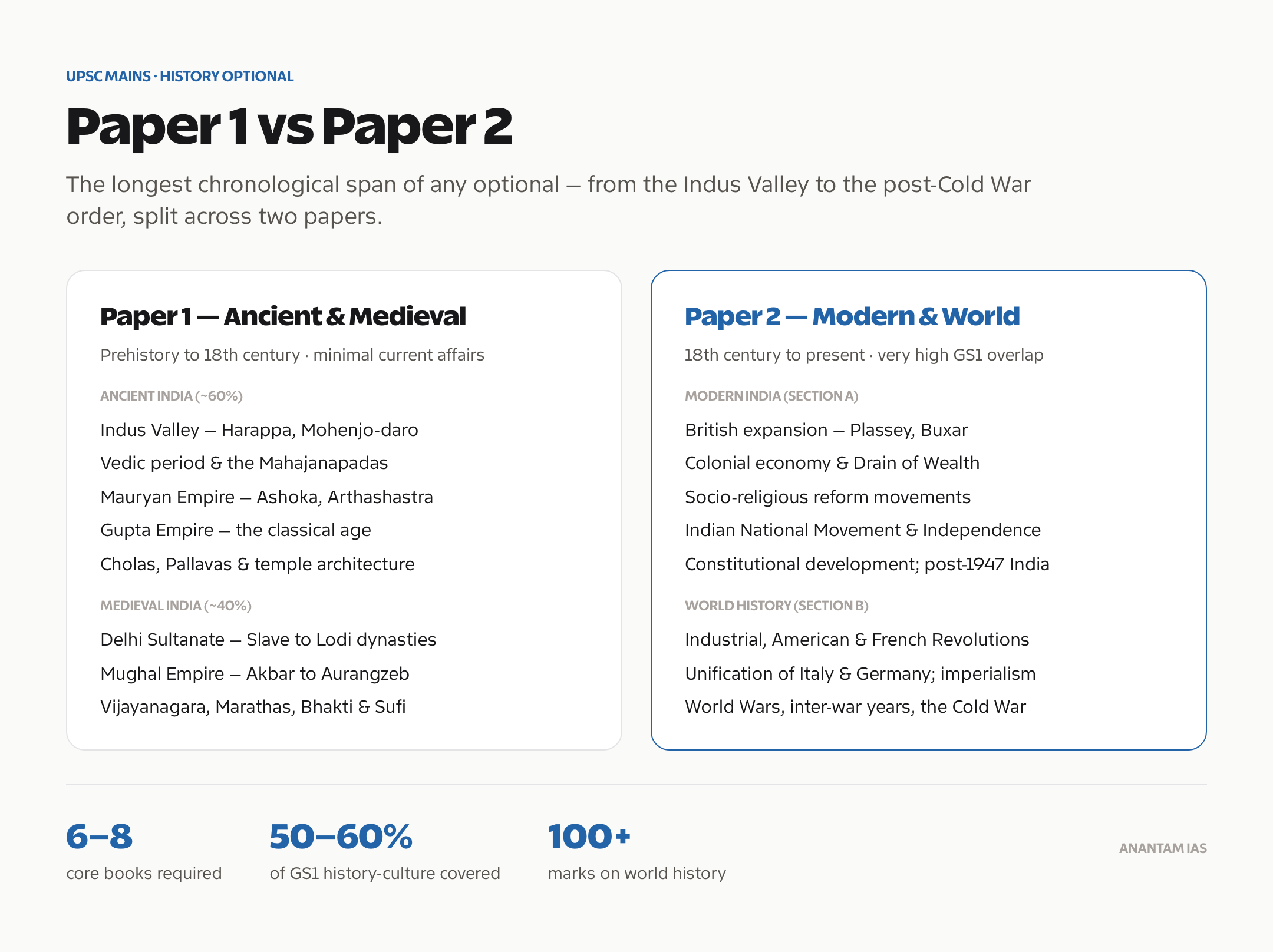
Modern India (Section A)
British expansion — Battle of Plassey 1757, Battle of Buxar 1764, Subsidiary Alliance (Lord Wellesley), Doctrine of Lapse (Lord Dalhousie). East India Company administration.
Colonial economy — Drain of Wealth theory (Dadabhai Naoroji), deindustrialisation, commercialisation of agriculture, famines, railway expansion, land revenue systems (Permanent Settlement, Ryotwari, Mahalwari).
Socio-religious reform movements — Raja Ram Mohan Roy and Brahmo Samaj, Ishwar Chandra Vidyasagar, Dayananda Saraswati and Arya Samaj, Jyotirao Phule, Pandita Ramabai, Sir Syed Ahmad Khan and Aligarh Movement.
Indian National Movement — Early Moderates (Dadabhai Naoroji, Gopal Krishna Gokhale), Extremists (Bal Gangadhar Tilak, Bipin Chandra Pal, Lala Lajpat Rai), Gandhian era (Non-Cooperation 1920, Civil Disobedience 1930, Quit India 1942), Subhas Chandra Bose and INA, Partition and Independence 1947.
Constitutional development — Indian Councils Act 1861 and 1892, Morley-Minto Reforms 1909, Montagu-Chelmsford Reforms 1919, Government of India Act 1935, Constituent Assembly, Constitution adoption 1950.
Post-independence India — Integration of princely states (Sardar Patel, VP Menon), Nehruvian era (Non-Alignment, Five-Year Plans, IITs), linguistic reorganisation of states 1956, Green Revolution, Emergency 1975, economic liberalisation 1991.
World History (Section B)
Industrial Revolution — origins in Britain, social consequences, urbanisation, labour movements.
American Revolution and French Revolution — causes, course, and global impact. Declaration of Rights of Man. US Constitution.
Nationalism and imperialism — unification of Italy (Mazzini, Garibaldi, Cavour) and Germany (Otto von Bismarck), Scramble for Africa, colonialism in Asia.
World War I — alliance systems, trench warfare, Treaty of Versailles 1919, League of Nations (Woodrow Wilson).
Inter-war period — Russian Revolution 1917, Great Depression 1929, rise of Fascism (Benito Mussolini) and Nazism (Adolf Hitler).
World War II — causes, major theatres, Holocaust, atomic bombings of Hiroshima and Nagasaki.
Cold War — NATO vs Warsaw Pact, Korean War, Cuban Missile Crisis, Vietnam War, détente, collapse of the Soviet Union 1991.
Decolonisation — Africa, Asia, Middle East. Non-Aligned Movement (Jawaharlal Nehru, Josip Broz Tito, Gamal Abdel Nasser). United Nations Organisation.
| Paper | Period Covered | GS Overlap | Current Affairs Need |
|---|---|---|---|
| Paper 1 (Ancient + Medieval) | Prehistory to 18th century | Moderate (GS1 culture) | Minimal |
| Paper 2 (Modern + World) | 18th century to present | Very high (GS1) | Moderate |
Fundamental Duties of India: Article 51A Explained
Best Books for History Optional
History optional demands more reading than most optionals. The booklist below is curated for efficiency — covering maximum syllabus with minimum redundancy.
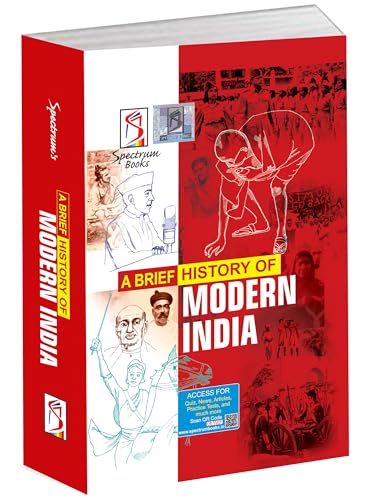
A Brief History of Modern India — Spectrum
- 1,000 pages covering 1707 to the present
- Chronological narrative with chapter summaries
- The most-used modern history book in the exam
Paper 1 Books
RS Sharma — India’s Ancient Past. The definitive text for ancient India. Covers Indus Valley to post-Gupta period with archaeological evidence and historiographical perspective. UPSC has drawn questions directly from this book for decades. Essential reading.
Satish Chandra — History of Medieval India. The standard reference for Sultanate and Mughal periods. Covers political history, administration, economy, and culture. The chapter on Mughal administration is particularly important.
Upinder Singh — A History of Ancient and Early Medieval India. More detailed than RS Sharma on certain archaeological topics. Use it to supplement, not replace, Sharma’s book. Particularly strong on art, architecture, and inscriptional evidence.
Paper 2 Books
Bipan Chandra — India’s Struggle for Independence. The go-to text for the national movement. Covers 1857 to 1947 with analytical depth. Every UPSC aspirant reads this book — for history optional, it needs chapter-level mastery, not surface familiarity.
Bipan Chandra — India Since Independence. Covers post-1947 India — Five-Year Plans, foreign policy, linguistic states, Emergency, liberalisation. Increasingly important as UPSC asks more post-independence questions.
Norman Lowe — Mastering Modern World History. The standard text for world history. Covers Industrial Revolution to the post-Cold War period. Written for British A-Level students, so the language is accessible and the structure is exam-friendly.
Supplementary Sources
NCERT History Textbooks (Class 6–12). The “Themes in Indian History” series (Class 12) is particularly useful — it introduces historiographical debates that UPSC values. Read all three parts.
Spectrum — A Brief History of Modern India (Rajiv Ahir). Good supplement for modern India, especially for quick revision. More concise than Bipan Chandra.
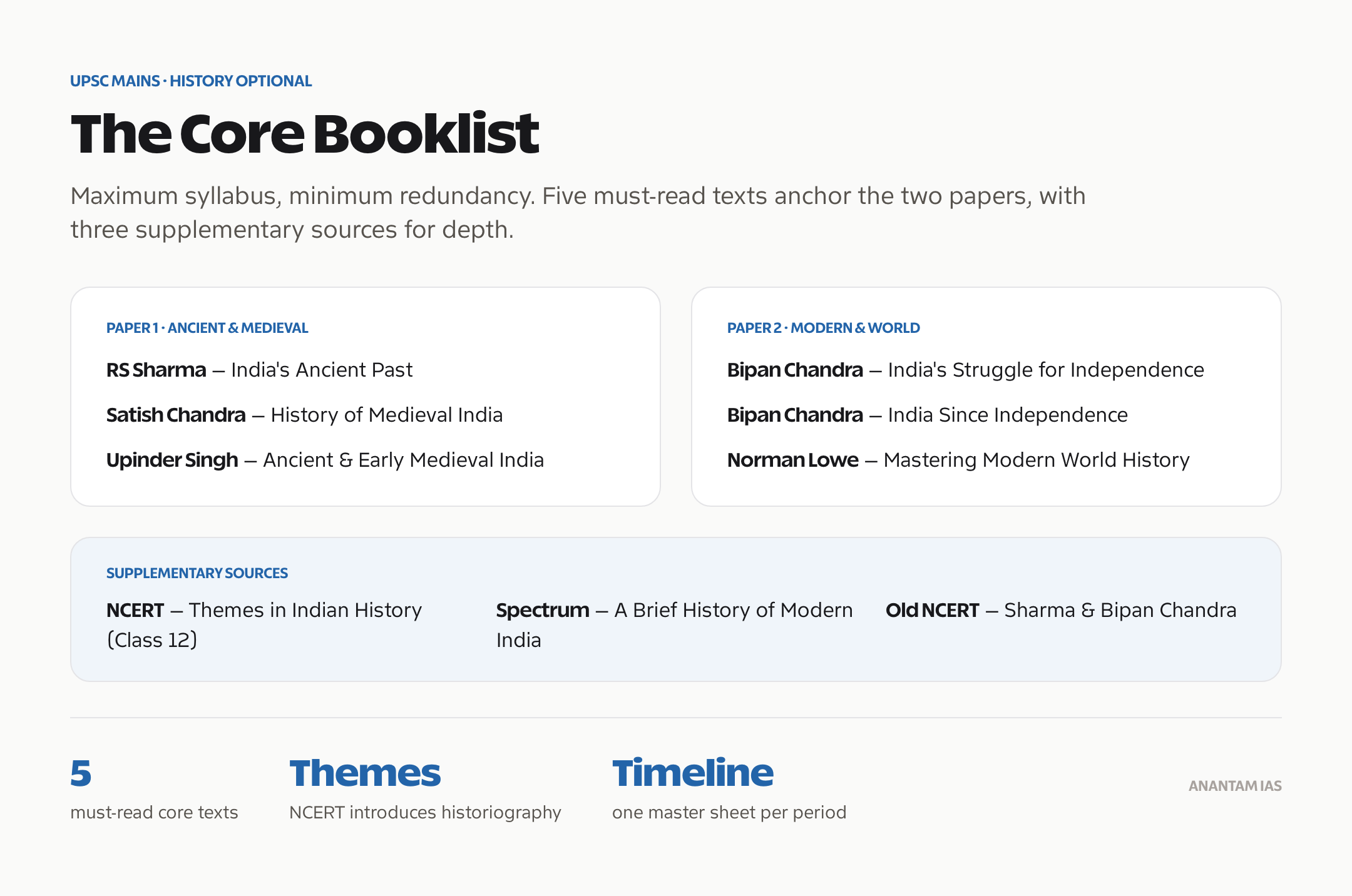
Old NCERT by RS Sharma and Bipan Chandra. Still preferred by many toppers for their straightforward narrative style. Available as reprints.
| Book | Period | Paper | Priority |
|---|---|---|---|
| RS Sharma — India’s Ancient Past | Ancient India | Paper 1 | Must read |
| Satish Chandra — Medieval India | Medieval India | Paper 1 | Must read |
| Bipan Chandra — Struggle for Independence | Modern India | Paper 2 | Must read |
| Bipan Chandra — India Since Independence | Post-1947 | Paper 2 | Must read |
| Norman Lowe — Modern World History | World History | Paper 2 | Must read |
| Upinder Singh | Ancient + Early Medieval | Paper 1 | Recommended |
| NCERT (Class 12 Themes) | All periods | Both | Must read |
| Spectrum Modern India | Modern India | Paper 2 | Recommended |
How to Become an IAS Officer: Step-by-Step Guide
Map Work for History Optional
Map work in history isn’t as intensive as geography, but it consistently appears in Paper 1. UPSC asks candidates to mark and describe historical sites, battle locations, trade routes, and cultural centres on outline maps.
What to Practise
Ancient India maps — Indus Valley sites (Harappa, Mohenjo-daro, Lothal, Dholavira, Kalibangan), Ashokan pillar and rock edict locations, Mahajanapada territories, Gupta empire extent, Nalanda, Vikramashila, major Buddhist and Jain sites.
Medieval India maps — Sultanate and Mughal territorial extent at different periods, major battle sites (Panipat, Talikota, Haldighati, Plassey, Buxar), trade routes (Silk Road, spice routes), important forts and monuments.
Modern India maps — Centres of 1857 revolt, major national movement events, Princely States, industrial centres of British India.
Map Strategy
- Spend 15–20 minutes weekly on map practice throughout preparation
- Use a historical atlas — not a political atlas
- Mark at least 5–6 sites when a map question appears; don’t leave it blank even if unsure about some locations
- Label clearly with brief descriptions (1–2 lines per site)
Answer Writing for History Optional
History answer writing rewards argument over narration. UPSC doesn’t want a retelling of events — it wants analysis of causes, consequences, and historical significance.
The Timeline-Analysis Framework
For every major event or period, structure answers around:
- Context — What preceded the event? What conditions made it possible? (2–3 sentences)
- Key developments — What actually happened? Name specific people, dates, and places. (3–5 sentences)
- Analysis — Why did it happen this way? What were the consequences? (3–4 sentences)
- Historiographical perspective — How do different historians interpret this? (1–2 sentences where relevant)
- Significance — Why does this matter for understanding the broader period? (1–2 sentences)
Tips for Different Question Types
“Critically examine” questions — Present multiple perspectives. For example, when examining Aurangzeb’s religious policy, discuss both the orthodox interpretation and revisionist scholarship. Take a position but acknowledge complexity.
“Assess the role of” questions — Focus on the individual or institution’s specific contributions. Use concrete examples. Avoid hagiography — UPSC rewards balanced assessment.
“Compare and contrast” questions — Use a structured format. State similarities first, then differences, then analytical conclusion. A comparison table within the answer scores well.
Map-based questions — Don’t just mark locations. Add 2–3 lines of historical context for each site. The description carries as many marks as the marking.
Common Mistakes
- Narrative without analysis. Writing “Akbar did X, then Y, then Z” without explaining why or what it meant is the most common error.
- Ignoring historiography. UPSC increasingly values awareness of historical debates — Marxist vs nationalist vs subaltern interpretations.
- Neglecting world history. Candidates often under-prepare Section B of Paper 2. World history questions carry 100+ marks and are often easier to score on because competition is lower.
- Date overload. Dates matter for major events but cramming every minor date is counterproductive. Focus on dates that mark turning points.
Scoring Trends and Preparation Timeline
Score Distribution (Recent Trends)
| Score Range | Candidate Outcome |
|---|---|
| Below 190 | Optional becomes a liability |
| 190–230 | Average; needs strong GS to compensate |
| 230–270 | Competitive range |
| 270–310 | Strong performance |
| 310+ | Exceptional — topper territory |
History optional scores tend to be slightly lower than geography or sociology averages, largely because of the syllabus volume. However, candidates who complete the full syllabus with answer writing practice consistently score 250+.
Recommended Preparation Timeline
| Phase | Duration | Focus | Key Activity |
|---|---|---|---|
| Foundation | Month 1–2 | NCERTs + RS Sharma | Read and make chronological notes |
| Core reading | Month 3–4 | Satish Chandra + Bipan Chandra | Medieval + Modern India in depth |
| World History | Month 5 | Norman Lowe | Cover all major topics |
| Answer writing | Month 6–7 | PYQ practice | 2 answers daily, timed |
| Revision | Month 8 | Full syllabus revision | Timeline sheets, map practice |
| Mock tests | Month 9–10 | Full-length tests | Weekly simulation under exam conditions |
The timeline approach works best for history. Create a master timeline for each period — a single sheet listing all major events, rulers, and developments in chronological order. This becomes the primary revision tool in the final months.
Geography Optional for UPSC: Strategy & Booklist
Frequently Asked Questions
Is history optional worth the extra reading compared to shorter optionals?
The additional reading investment pays off through GS1 overlap and interview preparation. Candidates preparing history optional typically save 4–6 weeks on GS1 modern India and culture sections. The total preparation time is longer than Pub Ad or sociology, but the net time spent across optional plus GS is comparable when overlap is factored in.
How should candidates handle historiographical debates in answers?
Mention the major schools of thought — nationalist, Marxist, subaltern, Cambridge — when relevant to the question. Don’t devote entire paragraphs to historiography unless the question specifically asks for it. A single sentence like u0022While nationalist historians emphasise Akbar’s syncretism, revisionist scholars point to pragmatic political motivationsu0022 demonstrates awareness without consuming word count.
Which paper should candidates prepare first — Paper 1 or Paper 2?
Start with Paper 1 (Ancient and Medieval India) because it builds the chronological foundation that Paper 2 extends. Understanding Mughal administration helps contextualise British colonial changes. Understanding pre-colonial economy helps analyse the impact of colonial economic policies. Paper 2 makes more sense after Paper 1 is complete.
Can history optional be prepared without coaching?
Self-study works well for history optional given the quality of available books. RS Sharma, Satish Chandra, and Bipan Chandra are self-explanatory texts written for undergraduate students. The main gap self-study creates is in answer writing feedback — joining a test series from a reputed institute fills this gap effectively without requiring full coaching enrollment.
How important is world history for scoring well in Paper 2?
World history (Section B of Paper 2) carries approximately 100 marks and is frequently under-prepared by candidates. This creates an opportunity — well-prepared world history answers face less competition and often receive generous marking. Norman Lowe’s single book covers the entire world history syllabus adequately. Skipping world history is a strategic mistake.
Tell Google you want more of this.
Add Anantam IAS as a preferred sourceOne tap, and this site shows up more often in your own Top Stories, AI Overviews and AI Mode. Remove it any time.