Disclosure: this guide contains Amazon affiliate links. As an Amazon Associate, Anantam IAS earns from qualifying purchases — at no extra cost to you.
Geography optional is chosen by roughly 25–30% of UPSC candidates each year, and for a specific reason: it is the one optional where a well-drawn diagram earns marks that a paragraph cannot. The subject rewards visual learners, overlaps heavily with General Studies, and delivers above-average scores when prepared methodically. This guide covers the geography optional syllabus for both papers, the booklist worth buying, map work strategy, answer structures by mark weight, and the scoring pattern you are actually competing against.
It suits science and arts backgrounds alike. Its quantitative edge — maps, diagrams, and models — is what separates it from purely essay-based optionals.
Geography Optional at a Glance
| Factor | What it means |
|---|---|
| Marks | 500 marks across Paper 1 and Paper 2 |
| Best fit | Visual learners, geography graduates, science-background aspirants, anyone comfortable with maps and spatial reasoning |
| GS overlap | Very high with GS 1 geography, GS 3 environment, agriculture, disasters, and resources |
| Preparation load | High in volume, but efficient because of the GS overlap |
| Answer style | Every good answer carries a map, diagram, model, or spatial example |
| Median score | 230–240; 280+ puts you ahead of the curve |
| Main risk | Collecting facts without practising diagrams, which leaves marks on the table |
Why Geography Optional Is Popular Among UPSC Aspirants
Geography’s popularity isn’t accidental. Several structural advantages make it a reliable scoring choice across cycles.
Overlap with General Studies. Physical geography topics like climatology, oceanography, and geomorphology feed directly into GS Paper 1. Human geography concepts — urbanisation, population, and resource distribution — overlap with GS Paper 2 and Paper 3. This dual benefit saves preparation time.
Static + dynamic balance. About 60% of the geography optional syllabus is static — geomorphology, climatology, biogeography. These topics don’t change year to year. The remaining 40% involves current affairs applications (environmental issues, regional planning, urban policy), keeping the subject engaging without becoming unpredictable.
Diagram-friendly answers. UPSC examiners reward well-labelled diagrams. Geography answers naturally accommodate maps, cross-sections, flowcharts, and models. A 150-word answer with a strong diagram often scores better than 250 words of plain text.
Consistent scoring trends. Geography optional scores have remained relatively stable compared to subjects like sociology or anthropology, which can swing 30–40 marks between years.
| Factor | Geography | Sociology | Political Science |
|---|---|---|---|
| GS overlap | High (GS1, GS3) | Moderate (GS1, GS2) | High (GS2) |
| Diagram scope | Very high | Low | Low |
| Static content ratio | ~60% | ~50% | ~55% |
| Average top-50 score | 290–320 | 280–310 | 275–305 |
| Book availability | Excellent | Good | Good |
Comparing shortlists? See Sociology Optional Notes for UPSC and Political Science Optional Notes for UPSC, or work through the full list at UPSC Optional Subjects.
Who Should Choose Geography Optional
Choose it if three conditions are true. Not two.
You can revise the subject’s basic language without going back to beginner material. Optional preparation becomes painful when every topic feels like a first reading. If you still need NCERTs open beside you in month six, the subject is fighting you.
You can write in the subject’s natural style. Every good geography answer carries a map, diagram, model, or spatial example. If that feels natural, you have a real advantage over candidates writing text-only answers. If it feels forced, test the subject for two weeks before committing 500 marks to it.
Your GS plan can survive the optional workload. The optional matters, but it cannot eat the whole year. A subject that gives you 20 extra optional marks and costs you 50 GS marks is not a win.
Skip geography optional if you dislike drawing and cannot see yourself revising a large but connected syllabus three times.
Paper 1 Syllabus: Physical Geography & Techniques
Paper 1 covers the scientific foundation of geography. Think of it as the “why” behind landforms, climates, and ecosystems. Read it paper-wise, not book-wise: a booklist gives you material, the syllabus tells you what UPSC can actually test.
Section A: Physical Geography
This section carries roughly 125 marks and spans five major topics:
Geomorphology — origin of the earth, interior structure, plate tectonics (Alfred Wegener’s Continental Drift, Harry Hess’s sea-floor spreading), weathering, erosion cycles (William Morris Davis’s cycle of erosion, Walther Penck’s model), landforms produced by fluvial, glacial, aeolian, and marine processes.
Climatology — atmospheric structure, insolation and heat budget, pressure belts and wind systems (Hadley Cell, Ferrel Cell, Polar Cell), monsoon mechanisms (Flohn’s model, jet stream theory), Koppen and Thornthwaite climate classifications, cyclones, and climate change.
Oceanography — ocean floor configuration, temperature and salinity distribution, ocean currents (Gulf Stream, Kuroshio Current, Humboldt Current), coral reefs, tides.
Biogeography — soil genesis and classification, major biomes, ecosystem concepts, biodiversity hotspots, deforestation, and conservation.
Environmental geography — environmental degradation, Sustainable Development Goals (SDGs), EIA frameworks, global environmental agreements (Paris Agreement, Montreal Protocol).
Section B: Human Geography
This section also carries roughly 125 marks:
- Population geography — demographic transition model (Frank Notestein), migration theories, population policies
- Economic geography — agriculture models (Von Thunen), industrial location (Alfred Weber), world trade patterns
- Settlement geography — central place theory (Walter Christaller), urban morphology, rural settlement patterns
- Regional planning — growth pole theory (Francois Perroux), regional imbalance, development indicators
- Geographical thought — dualisms, quantitative revolution, behavioural and radical geography
Treat Paper 1 as the conceptual base. The goal is not to collect facts. It is to build the vocabulary and structure an examiner expects from someone who has genuinely studied the subject.
Paper 2 Syllabus: Geography of India
Paper 2 applies geographical concepts to the Indian subcontinent. This paper demands current affairs awareness alongside textbook knowledge, and it is where candidates most often lose balance. Paper 2 feels more applied, but it still needs subject depth.
Section A: Physical Setting of India
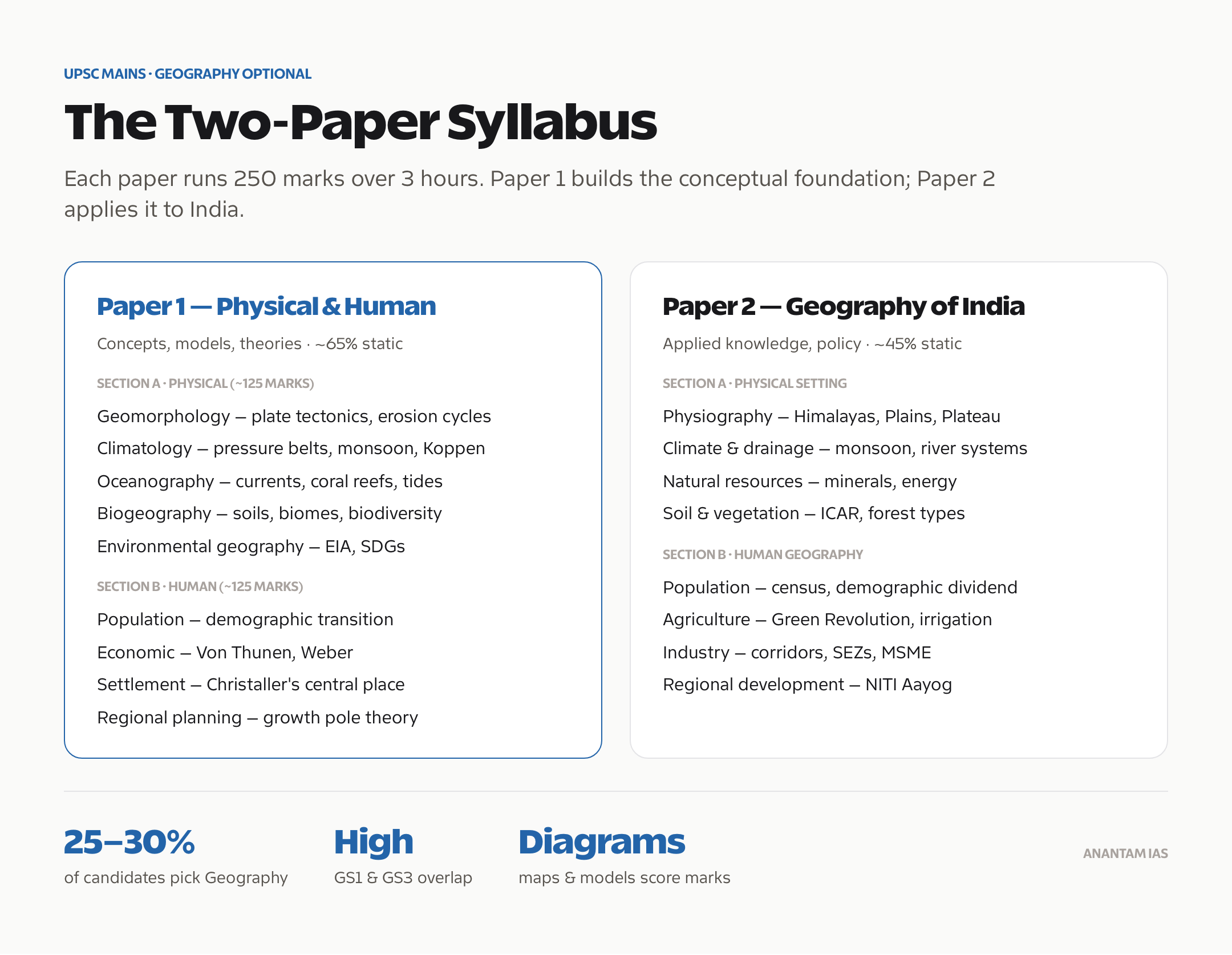
Physiography — Northern Mountains (Himalayas), Northern Plains (Indo-Gangetic system), Peninsular Plateau (Deccan Plateau, Western and Eastern Ghats), Coastal Plains, and Islands (Andaman & Nicobar, Lakshadweep).
Climate and drainage — Indian Monsoon mechanism (Indian Meteorological Department classifications), major river systems (Ganga, Brahmaputra, Godavari, Krishna, Narmada), inter-linking of rivers debate.
Natural resources — mineral and energy resources distribution, National Mineral Policy 2019, renewable energy targets.
Soil and vegetation — ICAR soil classification, forest types of India (Champion and Seth classification), wildlife conservation (Project Tiger, Project Elephant).
Section B: Human Geography of India
Population — Census of India 2011 data, demographic dividend, migration patterns, urbanisation trends (Smart Cities Mission, AMRUT).
Agriculture — Green Revolution legacy, crop distribution, irrigation systems (PMKSY), land reforms, food security (National Food Security Act 2013).
Industry — industrial corridors (DMIC, CBIC), Make in India, SEZs, MSME sector.
Regional development — NITI Aayog frameworks, backward region development, tribal area planning, border area programmes.
| Paper | Core Focus | Static vs Dynamic | Diagram Scope |
|---|---|---|---|
| Paper 1 (Physical + Human) | Concepts, models, theories | 65% static | Very high |
| Paper 2 (India Geography) | Applied knowledge, policy | 45% static | High (maps essential) |
Best Books for Geography Optional
Book selection matters enormously. Too many sources create confusion. Start limited and add only when a topic stays unclear after your first reading — for most aspirants, two good sources plus previous year papers beat seven half-read books.

Certificate Physical and Human Geography — G.C. Leong
- 200 pages, concept-led physical geography
- Diagrams that explain rather than decorate
- The base layer under every other geography book
Essential Reads (Non-Negotiable)
GC Leong — Certificate Physical and Human Geography. The foundation text. Covers geomorphology, climatology, oceanography, and human geography in accessible language. Read it twice — once for understanding, once for revision. Don’t skip the diagrams; replicate them in your notes.
Savindra Singh — Physical Geography. The deep-dive reference for Paper 1. Covers geomorphological theories (Davis, Penck, King) and climatological models in detail. Use it selectively — not every chapter needs equal attention. Focus on chapters that GC Leong covers lightly.
Majid Husain — Geography of India. The standard text for Paper 2. Covers physical setting, resource distribution, population, agriculture, and industry with India-specific data. UPSC has directly lifted questions from this book.
NCERT Geography Textbooks (Class 6–12). Non-negotiable foundation. The Class 11 and 12 textbooks — “Fundamentals of Physical Geography,” “India: Physical Environment,” “Human Geography,” and “India: People and Economy” — provide the base vocabulary UPSC expects. Read these before touching any reference book.
Supplementary Books
D.R. Khullar — India: A Comprehensive Geography. A useful alternative or supplement to Majid Husain for Indian geography, particularly strong on economic geography and on data tables that Majid Husain sometimes omits.
Oxford School Atlas / Orient Blackswan Atlas. Essential for map work. Practice locating every feature mentioned in your textbooks.
What to Skip
Avoid R.D. Dikshit’s “Geographical Thought” unless you are specifically targeting the thought-based questions in Paper 1. Most candidates over-invest here. Two or three questions on geographical thought don’t justify 200+ pages of dense reading.
| Book | Covers | Use For | Priority |
|---|---|---|---|
| GC Leong | Physical + Human Geography | Paper 1 foundation | Must read |
| Savindra Singh | Physical Geography (advanced) | Paper 1 depth | Must read |
| Majid Husain | Geography of India | Paper 2 core | Must read |
| NCERT (11th–12th) | All topics (basic) | Foundation | Must read |
| Khullar | India Geography | Paper 2 supplement | Recommended |
| Oxford Atlas | Map reference | Both papers | Must have |
Map Work Strategy: The Hidden Score Booster
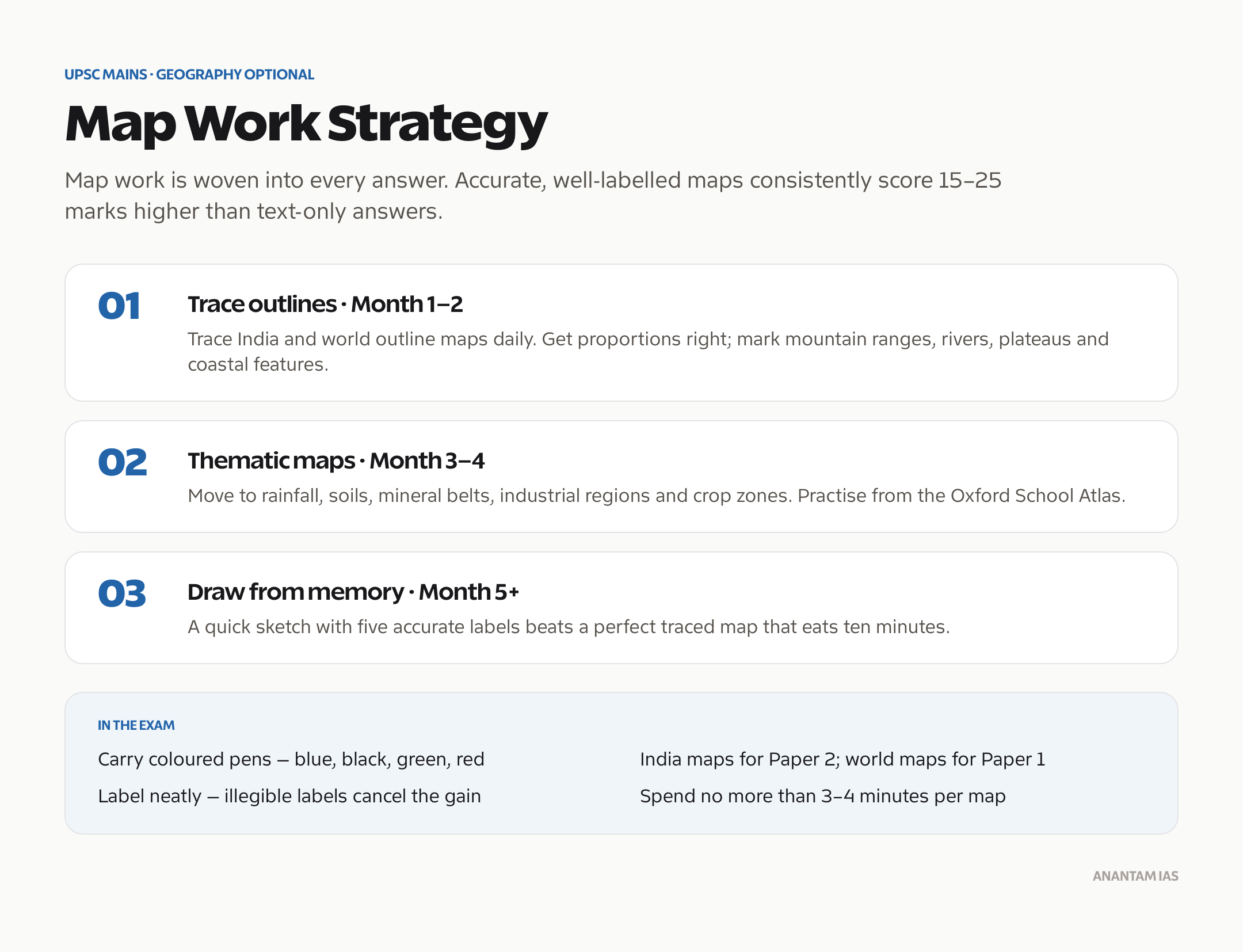
Map work isn’t a separate section — it’s woven into every geography answer. Candidates who draw accurate, well-labelled maps consistently score 15–25 marks higher than those who write text-only answers.
Daily Map Practice Routine
Phase 1 (Month 1–2): Trace outline maps of India and the world daily. Focus on getting proportions right. Mark major physical features — mountain ranges, rivers, plateaus, coastal features.
Phase 2 (Month 3–4): Move to thematic maps — rainfall distribution, soil types, mineral belts, industrial regions, crop zones. Practice from the Oxford School Atlas.
Phase 3 (Month 5 onwards): Draw maps from memory. In the exam, a quickly sketched map with five accurate labels is worth more than a perfect traced map that takes ten minutes.
Map Tips for the Exam
- Always carry coloured pens (blue, black, green, red minimum). Colour-coded maps score better.
- Use India outline maps for Paper 2 answers whenever location-based data is discussed.
- World maps work best for climatology, oceanography, and biogeography answers in Paper 1.
- Label neatly. Illegible labels cancel out the map’s advantage.
- Spend no more than 3–4 minutes per map. Speed matters.
Answer Writing Approach for Geography
Optional answers are not longer GS answers. They have to show subject command in the first few lines. The geography format is: concept → explanation → diagram or map → example → conclusion.
Structure for 10-Mark Questions (~150 words)
- Define the concept in one sentence
- Explain the mechanism or process (3–4 sentences)
- Include a diagram or map
- Give one or two real-world examples
- One-line conclusion or contemporary relevance
Structure for 15-Mark Questions (~250 words)
- Brief introduction with definition (2 sentences)
- Main body with subheadings (3–4 points)
- Diagram or map (labelled)
- Case study or data reference
- Conclusion linking to current relevance
Structure for 20-Mark Questions (~300–350 words)
- Introduction with context (3 sentences)
- Multiple subheadings covering different dimensions
- Two diagrams or maps if possible
- Comparative data or table
- Conclusion with a forward-looking statement
For general Mains practice outside the optional, use UPSC Mains Answer Writing. The mechanics of timing and structure carry over; the optional simply needs sharper subject vocabulary.
Common Mistakes to Avoid
- Writing without diagrams. This is the single biggest scoring mistake in geography optional. Every answer should have at least one visual element.
- Ignoring previous year questions until the syllabus is complete. PYQs are a reading guide, not a final revision tool. Keep them open from week one.
- Ignoring Paper 2 current affairs. Paper 2 questions increasingly reference recent government schemes, policy changes, and data. Read the Economic Survey and India Year Book.
- Overwriting. Geography rewards precision. A tight 150-word answer with a good diagram beats a rambling 300-word essay.
- Making notes too long to revise in the final 30 days. A good optional note holds a definition, the core argument, examples, a diagram or data point, and two PYQ angles. Nothing more.
- Skipping examples. Every theoretical concept needs grounding. Name specific rivers, mountains, cities, or regions.
Scoring Trends and Time Management
Recent Scoring Patterns
Geography optional scores have shown a clear pattern over the last five years:
| Score Range | Percentage of Candidates | Outcome |
|---|---|---|
| Below 200 | ~35% | Unlikely to clear |
| 200–250 | ~30% | Clears if GS is strong |
| 250–300 | ~25% | Comfortable zone |
| 300+ | ~10% | Topper zone |
The median score hovers around 230–240. Scoring 280+ puts a candidate well ahead of the curve. The difference between a 240 and a 300 almost always comes down to three things: diagrams, map work, and Paper 2 current affairs integration.
Time Management in the Exam
Each paper is 3 hours long with 250 marks. That’s roughly 1 minute per mark.
- 10-mark questions: 12–15 minutes each (including diagram)
- 15-mark questions: 18–22 minutes each
- 20-mark questions: 25–30 minutes each
Reserve the last 10 minutes for review. Check that every answer has at least one diagram or map. If you’ve written a text-only answer, add a quick sketch during review time.
Month-Wise Preparation Timeline
| Month | Focus Area | Key Activity |
|---|---|---|
| Month 1–2 | NCERTs + GC Leong | Foundation building, basic maps, syllabus mapping |
| Month 3–4 | Savindra Singh + Majid Husain | Deep reading, thematic maps |
| Month 5–6 | Answer writing practice | 2 answers daily, timed |
| Month 7–8 | Previous year papers | Full paper simulation |
| Month 9–10 | Revision + current affairs | India Year Book, Economic Survey |
| Month 11–12 | Mock tests + weak areas | Weekly full-length tests |
The last stretch should not be a reading marathon. It should be a retrieval marathon: recall, write, check, improve, repeat.
Geography Optional Resources
- Geography optional syllabus decoded clause by clause, with the marks each of the twenty units has actually carried since 2016.
- Geography optional question papers for every year from 2016 to 2026, both papers, with official UPSC PDFs and a topic-wise weightage table.
- Geography optional notes: what a usable note contains, unit priorities weighted by marks, and the nine-model sheet for Paper I.
- Geography optional booklist: the four books plus an atlas that cover both papers, and the two worth skipping.
Frequently Asked Questions
Is geography optional suitable for candidates without a geography background?
Geography optional doesn’t require a prior degree in the subject. NCERT textbooks from Class 11 and 12 provide sufficient foundation. Many UPSC toppers who scored 300+ in geography came from engineering, commerce, and medical backgrounds. The key requirement is comfort with maps and spatial reasoning rather than formal academic training.
How much does geography optional overlap with General Studies?
The overlap is substantial — roughly 30–35% of geography optional content directly feeds into GS Paper 1 (physical geography, Indian geography) and GS Paper 3 (environment, disaster management, resource distribution). This dual preparation benefit saves approximately 2–3 months of study time compared to optionals with minimal GS overlap. Use the overlap as a bonus, not as the only reason to choose the subject.
What score should candidates target in geography optional?
A realistic target for serious candidates is 280–300 marks across both papers. Scoring above 300 requires excellent diagram work, strong Paper 2 current affairs, and precise answer writing. The safe minimum to keep the optional from becoming a liability is 230–240. Below 200, geography optional actively hurts overall ranking.
How long does geography optional take to prepare?
Most candidates need 4 to 6 months for first coverage plus answer writing. If you are new to the subject, add extra time for foundation building with NCERTs. A 12-month runway is comfortable; anything under 3 months means cutting either Paper 2 depth or map practice, and both cost marks.
Which is harder, geography optional Paper 1 or Paper 2?
Paper 1 is conceptually harder because it demands models, theories, and named thinkers. Paper 2 is where more candidates actually lose marks, because it looks familiar and gets under-prepared. Treat Paper 2 as an applied paper that still needs Paper 1 depth, not as general knowledge about India.
How important are previous year question papers for geography optional?
Previous year papers from the last 15 years are indispensable. UPSC repeats themes and sometimes rephrases older questions directly. Analysing PYQs reveals which topics carry maximum weightage — geomorphology, climatology, Indian agriculture, and population consistently dominate. Solving them under timed conditions also builds exam temperament.
Should candidates join a coaching institute for geography optional?
Coaching helps but isn’t mandatory. Self-study with the right booklist, previous year papers, and answer writing practice produces comparable results. Coaching earns its cost when the syllabus feels scattered or when you cannot judge your own answer quality. The books listed in this guide cover the complete syllabus without coaching dependency.
What should I check before finalising geography optional?
Do three things before committing. Read the full syllabus for both papers. Outline five previous year questions. Read one standard chapter end to end. If all three feel manageable rather than exhausting, the subject deserves serious consideration — and that test tells you more than any ranking list.
Tell Google you want more of this.
Add Anantam IAS as a preferred sourceOne tap, and this site shows up more often in your own Top Stories, AI Overviews and AI Mode. Remove it any time.