India funds its investment mostly out of its own pocket, and that pocket is the household. The household sector contributes about 65 percent of gross domestic savings, which makes household savings the single most important determinant of how much domestic capital is available for investment. When that number falls, the growth rate follows, with a lag.
It fell hard. Net household financial savings dropped to roughly 5.3 percent of GDP in 2022-23, the lowest in about five decades.
The Structure of Household Savings
Household savings split into two broad forms.
- Financial assets, about 56 percent: currency, bank deposits, debt securities, mutual funds, pension funds, insurance and small savings schemes
- Physical assets, about 44 percent: real estate, gold and other tangible assets
Within the financial category, the distinction that matters is gross versus net.
Gross household financial savings is the total of the financial instruments above. Subtract financial liabilities, that is loans from banks, non-banking financial companies and housing finance companies, and what remains is net household financial savings. The net figure is the amount actually released to fund investment elsewhere in the economy.
That is why headlines about record mutual fund inflows can coexist with a savings crisis. Households can be buying more financial assets while borrowing even faster.
What Drove the Decline
- High inflation. Rising prices erode purchasing power, reducing the capacity to save after essential consumption is met.
- Surge in household borrowing. Increased borrowing for housing, vehicles and personal consumption raised financial liabilities, which are deducted from gross savings.
- Higher consumption expenditure. Post-pandemic recovery, pent-up demand and rising living costs left a smaller share of income to save.
- Shift towards physical assets. Relatively attractive returns from gold and real estate diverted savings away from financial instruments, which reduces measured financial savings even where total saving is unchanged.
The last point deserves care. A household buying gold is saving; it is simply saving in a form that does not intermediate into corporate investment. The problem is not that Indians stopped saving. It is that a growing share of what they save no longer reaches the financial system.
The Recovery, Read Honestly
Net household financial savings rose to about 7 percent of GDP in 2024-25. That looks like a resolution. It is not quite one.
The improvement came mainly from a sharp fall in household financial liabilities, not from a jump in gross savings. In other words, households borrowed less rather than saved substantially more. That is a healthier balance sheet, and it is welcome, but it is a different phenomenon from a revival in the savings rate.
Why It Matters Beyond the Number
Growth and capital formation. Lower domestic savings constrain investment, which is the mechanism through which the savings rate becomes the growth rate.
Dependence on foreign capital. As domestic savings shrink, securing foreign investment becomes harder in a period of geo-economic fragmentation, and more consequential when it succeeds.
Strategic exposure. Excessive reliance on external capital for defence, space, atomic energy and critical infrastructure raises questions that are not purely economic.
Financial sector vulnerability. Rising unsecured consumer lending concentrates risk in retail credit, which is a different and less collateralised exposure than the corporate lending cycle banks are built around.
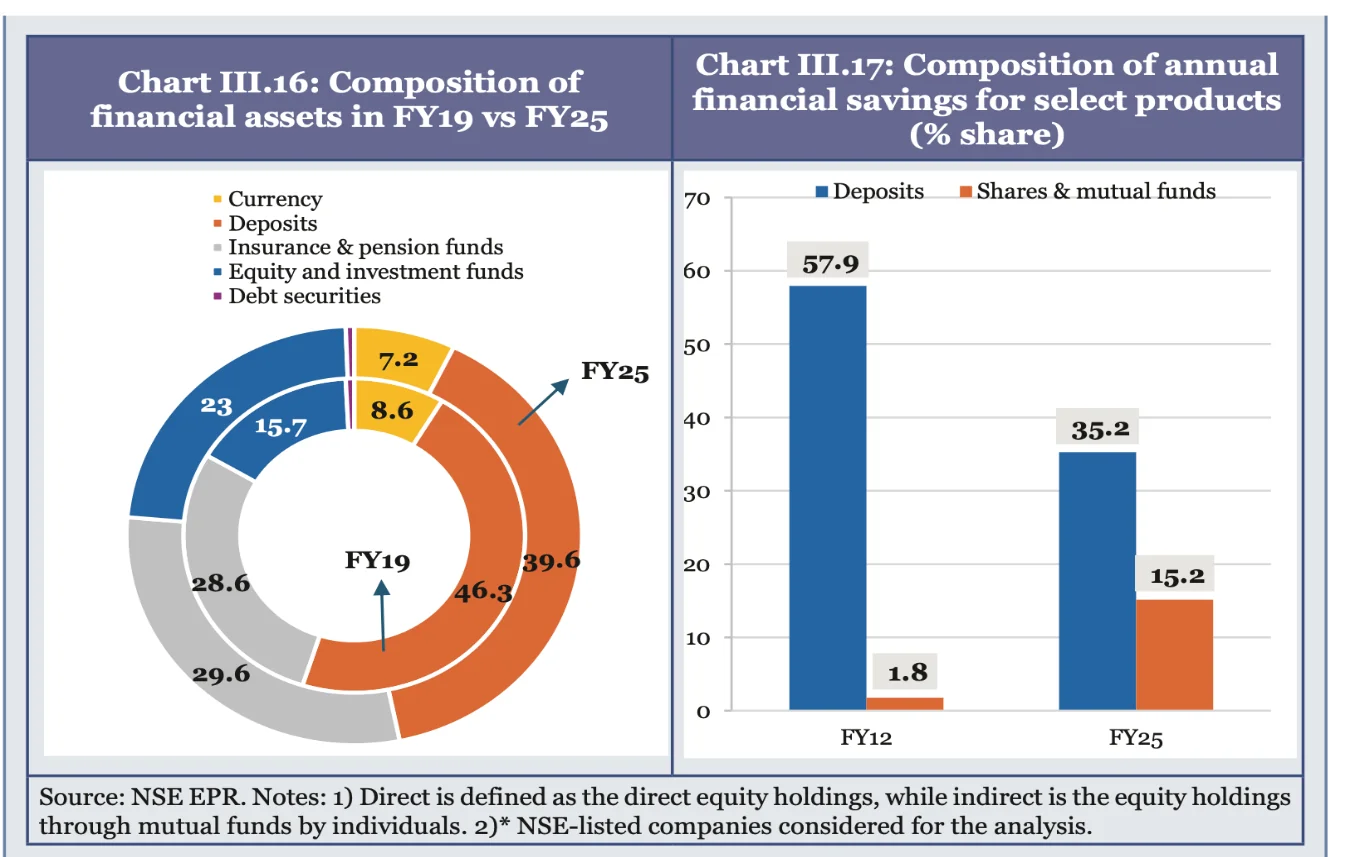
The Shift Within Financial Savings
Two trends run together, and only one of them is good.
Towards equities. Over the past five years domestic investors have become the dominant source of equity inflows, which has meaningfully reduced dependence on volatile foreign portfolio investment. That is a genuine structural improvement in market resilience.
Limited diversification. Household money has moved into equity while market-based debt instruments attract very little. The share of bank deposits has declined; pension and insurance shares are broadly unchanged. A savings pool concentrated in equity and property is more exposed to a single downturn than one spread across debt, equity and deposits.
The Way Forward
- Deepen financial inclusion. Expand access to formal financial services, digital banking and financial literacy so that saving has somewhere to go.
- Regulate retail credit prudentially. Higher risk weights on unsecured personal loans and credit card exposure moderate the borrowing that erodes net savings, a step the Reserve Bank has already taken.
- Keep real returns positive. Deposit rates that fail to beat inflation are an instruction to buy gold instead.
- Rationalise indirect taxation on essential consumption to raise disposable income at the margin where saving actually happens.
- Develop the retail debt market, so that households have a middle option between a deposit and an equity fund.
The savings rate is not a statistic that responds to appeals. It responds to real returns, to credit conditions and to inflation. Those are the levers.
Frequently Asked Questions
How important are household savings to the Indian economy?
The household sector is the primary source of financial resources in India, contributing about 65 percent of total gross domestic savings. Corporate and public sector savings make up the remainder, so household behaviour largely determines how much domestic capital is available for investment.
What is the difference between financial and physical household savings?
Financial savings are currency, bank deposits, debt securities, mutual funds, pension funds, insurance and small savings schemes. Physical savings are real estate, gold and other tangible assets. Financial assets account for roughly 56 percent of household savings and physical assets about 44 percent.
What is net household financial savings?
Gross household financial savings minus financial liabilities, which include loans from banks, non-banking financial companies and housing finance companies. The net figure is what is actually available to fund investment elsewhere in the economy, which is why it matters more than the gross number.
How far did net household financial savings fall?
To about 5.3 percent of GDP in 2022-23, the lowest level in roughly five decades. It subsequently recovered to about 7 percent in 2024-25, but that recovery was driven mainly by a sharp fall in household financial liabilities rather than by a jump in gross savings.
Why did household savings weaken?
Five reasons compounded: high inflation eroding the capacity to save after essential consumption, a surge in household borrowing for housing, vehicles and personal consumption, higher post-pandemic consumption expenditure, and a shift towards physical assets as gold and real estate offered relatively attractive returns.
What are the consequences of falling household savings?
Lower domestic capital formation and slower investment-led growth, greater dependence on foreign capital at a time of geo-economic fragmentation, potential sovereignty concerns if strategic sectors rely on external funding, and financial sector vulnerability as unsecured consumer lending expands.
How have savings patterns shifted within financial assets?
Towards equities. Over the past five years domestic investors have become the dominant source of equity inflows, reducing dependence on volatile foreign portfolio investment. But diversification remains limited: market-based debt instruments attract little household money, the share of bank deposits has fallen, and pension and insurance shares are broadly unchanged.
What measures can strengthen household financial savings?
Deepening financial inclusion through digital banking and financial literacy, prudential regulation of retail credit such as higher risk weights on unsecured personal loans and credit card exposure, ensuring real returns on deposits stay positive relative to inflation, and tax rationalisation that raises disposable income.
Practice Questions
Prelims MCQs
- The household sector contributes approximately what share of India's gross domestic savings?
(a) 25 percent
(b) 45 percent
(c) 65 percent
(d) 85 percent
Answer: (c) Households are the dominant contributor at about 65 percent, with corporate and public sector savings making up the rest. - Net household financial savings is defined as
(a) Gross financial savings plus physical savings
(b) Gross financial savings minus financial liabilities
(c) Bank deposits minus currency holdings
(d) Total savings minus tax paid
Answer: (b) Financial liabilities such as bank, NBFC and housing finance loans are deducted from gross financial savings. - Net household financial savings fell to about 5.3 percent of GDP in which year?
(a) 2018-19
(b) 2020-21
(c) 2022-23
(d) 2024-25
Answer: (c) The 2022-23 figure of roughly 5.3 percent was the lowest in about five decades. - The recovery in net household financial savings to about 7 percent of GDP was driven mainly by
(a) A sharp rise in gross savings
(b) A sharp fall in household financial liabilities
(c) Higher foreign portfolio inflows
(d) An increase in public sector savings
Answer: (b) The improvement came from reduced borrowing rather than from households saving substantially more. - Which of the following best describes the recent shift within household financial assets?
(a) Towards bank deposits and away from equity
(b) Towards equity, with limited use of market-based debt instruments
(c) Towards gold and real estate only
(d) Towards foreign currency holdings
Answer: (b) Domestic investors have moved into equity directly and through mutual funds, while household participation in corporate debt remains thin.
Mains Questions
- The decline in net household financial savings is a constraint on India's investment-led growth. Examine the causes and the policy response. (250 words)
- A recovery in net savings driven by falling liabilities is different from a recovery driven by higher gross savings. Discuss the significance of this distinction. (150 words)
- Rising household participation in equity markets reduces dependence on foreign portfolio investment but introduces new risks. Critically examine. (250 words)
- Discuss the relationship between household savings, dependence on foreign capital and economic sovereignty. (250 words)
- Evaluate prudential measures on unsecured retail credit as an instrument for protecting household savings. (150 words)
Tell Google you want more of this.
Add Anantam IAS as a preferred sourceOne tap, and this site shows up more often in your own Top Stories, AI Overviews and AI Mode. Remove it any time.