The Houthi movement, formally known as Ansar Allah (Supporters of God), is a Zaidi Shia political and armed group based in Yemen. What began as a regional insurgency in northern Yemen has grown into a force capable of disrupting global trade through attacks on commercial shipping in the Red Sea and Gulf of Aden. For UPSC aspirants, the Houthis intersect with topics spanning international relations, India’s energy security, maritime trade, and West Asian geopolitics.
Origins and Background
The movement takes its name from its founding leader, Hussein Badreddin al-Houthi, who launched an insurgency against the Yemeni government in 2004 in the northern province of Saada. The Houthis belong to the Zaidi Shia community, which constitutes roughly 35 per cent of Yemen's population and historically ruled North Yemen for nearly a thousand years through an imamate.
The Houthi grievances initially centred on the political and economic marginalisation of the Zaidi community in northern Yemen. The movement accused the central government in Sanaa of corruption, subservience to Saudi Arabia, and neglect of the north.
Rise to Power
After years of intermittent conflict (six wars between 2004 and 2010), the Houthis capitalised on the instability following the Arab Spring (2011). President Ali Abdullah Saleh was ousted, and his successor Abdrabbuh Mansur Hadi struggled to control the country. In September 2014, the Houthis captured Sanaa in alliance with forces loyal to the ousted Saleh. By early 2015, they controlled much of northern and western Yemen, including the capital and the strategic port of Hudaydah.
The Yemen Civil War
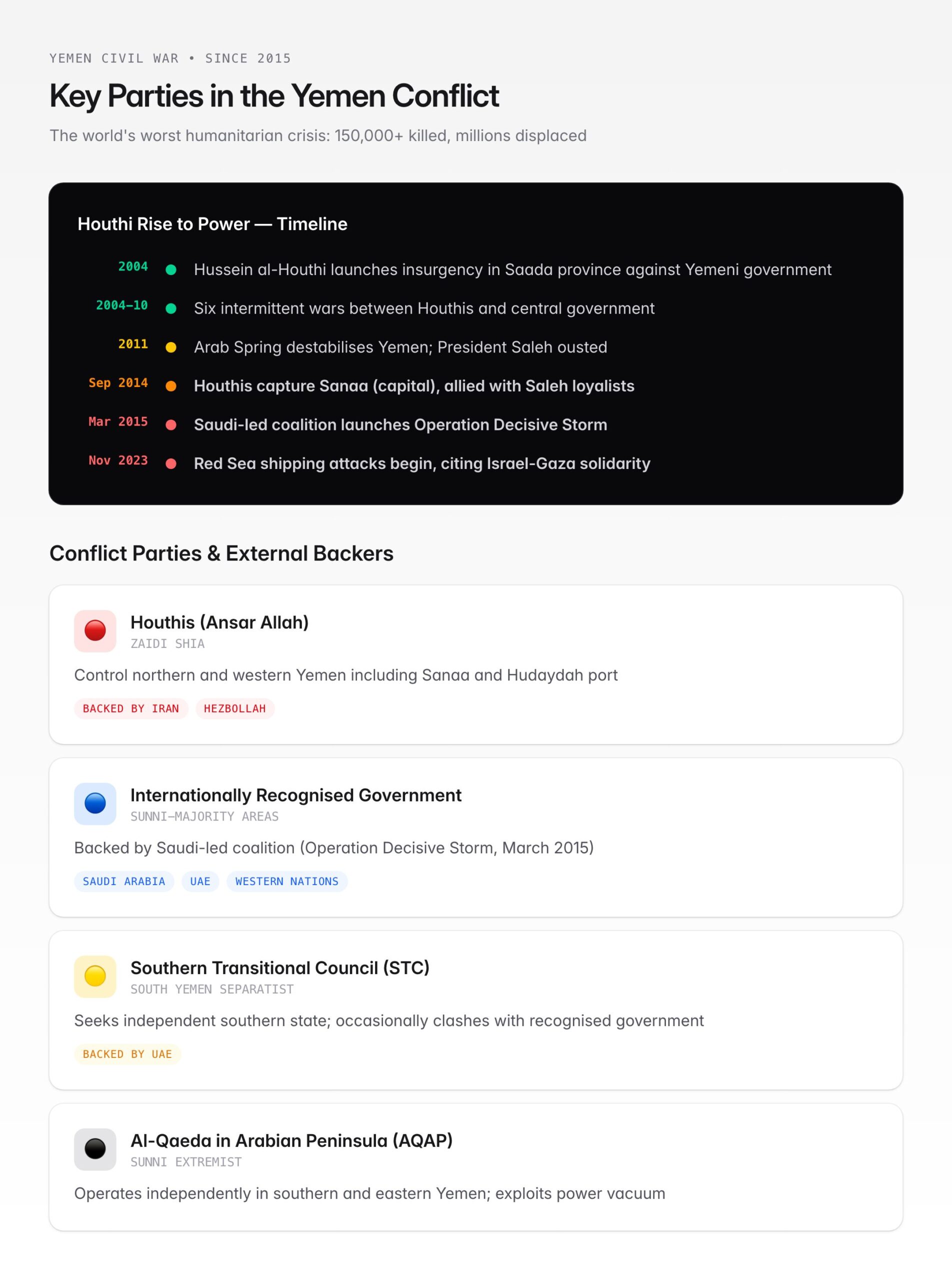
In March 2015, a Saudi Arabia-led coalition (including the UAE, Bahrain, Kuwait, and others) launched Operation Decisive Storm to restore the Hadi government. The conflict has since become one of the world's worst humanitarian crises.
Key Parties
| Party | Affiliation | External Support |
|---|---|---|
| Houthis (Ansar Allah) | Zaidi Shia | Iran, Hezbollah |
| Internationally recognised government | Sunni-majority areas | Saudi Arabia, UAE, Western nations |
| Southern Transitional Council (STC) | South Yemen separatist | UAE |
| Al-Qaeda in the Arabian Peninsula (AQAP) | Sunni extremist | Operates independently |
Iran's role: Iran provides the Houthis with weapons, training, and strategic guidance, though the Houthis maintain they are an independent movement. The flow of Iranian arms — including drones, missiles, and naval mines — has been documented by UN panels. The Houthi-Iran relationship is a key pillar of Iran's Axis of Resistance strategy against Saudi Arabia, Israel, and the United States in the region.
Humanitarian Impact
The UN has described the Yemen conflict as the world's worst humanitarian crisis. Over 150,000 people have been killed, millions have been displaced, and large parts of the population face famine and disease. A fragile UN-brokered truce was achieved in April 2022 and has broadly held, though a comprehensive peace agreement remains elusive.
The Red Sea Shipping Crisis
Beginning in November 2023, the Houthis escalated attacks on commercial vessels in the Red Sea, Bab el-Mandeb Strait, and the Gulf of Aden, claiming solidarity with Palestinians during the Israel-Gaza conflict. These attacks transformed the Houthis from a regional insurgency into a disruptor of global commerce.
Scale of Disruption
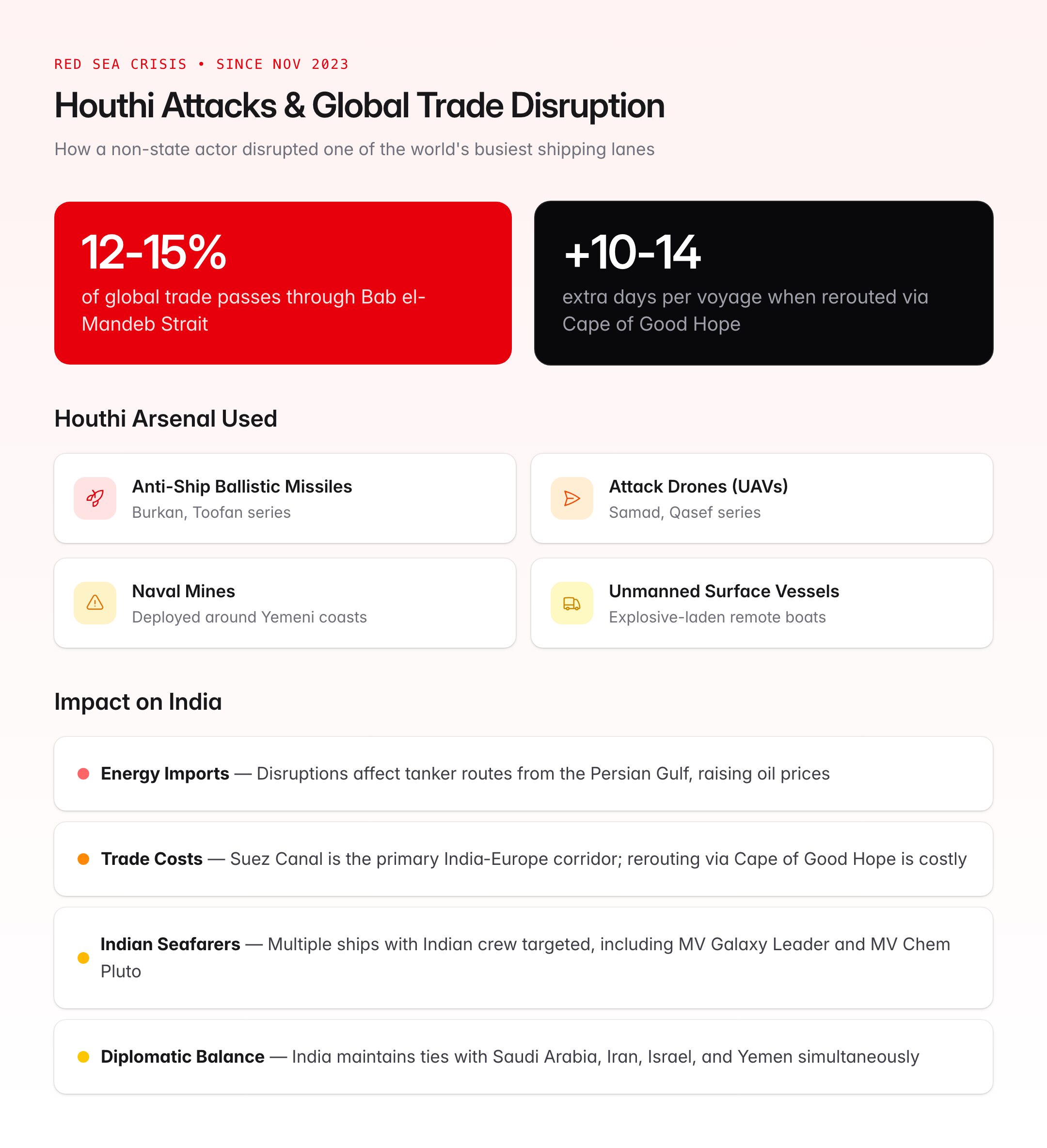
- The Bab el-Mandeb Strait is a chokepoint through which roughly 12-15 per cent of global trade passes, including a significant share of oil and LNG shipments.
- The Houthis used drones, anti-ship ballistic missiles, and unmanned surface vessels to target commercial ships, regardless of their connection to Israel.
- Major shipping companies including Maersk, MSC, and Hapag-Lloyd rerouted vessels around the Cape of Good Hope, adding 10-14 days and significant cost to Asia-Europe voyages.
- Insurance premiums for Red Sea transit surged, and freight rates spiked globally.
International Response
The United States formed Operation Prosperity Guardian, a multinational naval coalition, to protect shipping. The US and UK conducted direct strikes on Houthi positions in Yemen beginning January 2024. However, the strikes failed to eliminate the Houthi capability, and attacks continued into 2025.
The Suez Canal Authority reported a sharp decline in transit revenues, affecting Egypt's economy.
Impact on India
India has significant stakes in Red Sea stability:
- Energy imports: India imports a large share of its crude oil from the Persian Gulf. Disruptions in the Red Sea affect tanker routes and oil prices.
- Trade route: The Suez Canal route is the primary corridor for India-Europe trade. Rerouting via the Cape of Good Hope increases shipping costs and delivery times.
- Indian sailors: A large proportion of commercial seafarers globally are Indian nationals. Several ships with Indian crew were targeted or seized by the Houthis, including the MV Galaxy Leader and the MV Chem Pluto.
- Diaspora: India has a significant diaspora in Gulf countries, and regional instability raises evacuation and security concerns.
- Diplomatic balancing: India maintains relations with Saudi Arabia, Iran, Israel, and Yemen, requiring careful diplomatic navigation.
Houthi Military Capabilities
The Houthis have developed a surprisingly sophisticated arsenal, partly through Iranian technology transfer:
- Ballistic missiles: Including the Burkan and Toofan series, capable of reaching Saudi cities and maritime targets.
- Drones: Samad and Qasef series UAVs used for surveillance and attack.
- Anti-ship missiles: Adapted land-attack missiles for maritime targeting.
- Naval mines and unmanned boats: Used in the Red Sea and around Yemeni coasts.
This capability has made the Houthis one of the most potent non-state military actors in the world.
Geopolitical Significance
The Houthi movement is significant for several reasons:
- Proxy warfare: The Yemen conflict is a proxy battleground in the Saudi-Iran rivalry, which shapes the security architecture of West Asia.
- Maritime security: The Red Sea attacks demonstrated that a non-state actor can disrupt global trade routes, raising questions about the vulnerability of maritime chokepoints.
- Limits of military power: Despite extensive Saudi-led bombing and US/UK strikes, the Houthis have proven resilient, controlling territory and maintaining offensive capability.
- Multipolar disorder: The Houthi crisis is emblematic of a fragmented global order where traditional military alliances struggle to manage asymmetric threats.
UPSC Relevance
GS Paper II: International relations, India's foreign policy in West Asia, role of non-state actors, effect on India. GS Paper III: Energy security, maritime trade routes, security challenges.
Key Prelims facts:
- The Houthis are a Zaidi Shia group based in Yemen, formally called Ansar Allah.
- They captured Sanaa in 2014 and control much of northern and western Yemen.
- The Saudi-led coalition intervened in March 2015 (Operation Decisive Storm).
- Iran is the principal external backer of the Houthis.
- The Bab el-Mandeb Strait connects the Red Sea to the Gulf of Aden; about 12-15% of global trade passes through it.
- Red Sea attacks began in November 2023, linked to the Israel-Gaza conflict.
- The US-led naval coalition is called Operation Prosperity Guardian.
- Disruption affects India through oil imports, trade costs, and Indian seafarer safety.
Tell Google you want more of this.
Add Anantam IAS as a preferred sourceOne tap, and this site shows up more often in your own Top Stories, AI Overviews and AI Mode. Remove it any time.